
ROVSUN 9000 BTU Mini Split
4.4Editor score
9000 BTU cooling capacity
20 SEER2 efficiency rating
Heat pump heating support
Remote-controlled operation
Our Mini Split AC for Trailer guide compares ten ductless and 12-volt systems by capacity, power needs, efficiency, noise, smart controls, installation ease
A trailer mini split AC can transform a hot, enclosed camper into a comfortable living space without requiring a generator to power a conventional rooftop unit. The right system depends on trailer dimensions, available electrical service, battery capacity, desired heating performance, and how much exterior space you can devote to the condenser.
This guide compares ten mini split options designed for mobile spaces, small rooms, and compact living areas. We evaluated cooling capacity, heating capability, electrical requirements, efficiency, sound levels, operating modes, smart features, installation requirements, maintenance needs, and the amount of wall and outdoor space each system may need.
Each review explains where a particular unit is most practical and where it may be a poor fit. One standout is purpose-built for 12-volt vehicle power, while the others are residential ductless systems that may require an inverter, shore-power connection, or professional HVAC installation. Product listings and availability can change over time.
4.4Editor score

5.0Editor score

4.3Editor score
The comparison highlights the major differences among purpose-built 12-volt equipment and conventional 115-volt or 230-volt residential mini splits, including capacity, electrical requirements, heating performance, efficiency, and installation requirements.



The Tehanld 12000 BTU Mini Split is a conventional 115-volt ductless heat pump with a 4.4 rating and a stated coverage area of up to 750 square feet. Its strongest appeal for trailer owners is the combination of inverter-based cooling and heating in one wall-mounted system. It also includes an indoor unit, outdoor unit, remote, and a complete installation kit with a 9.8-foot copper piping line set.
We may earn a commission when you buy through this link, at no additional cost to you.
The operating menu is broad for a residential mini split. Cool, Heat, Auto, Fan, and Dry modes are supplemented by Sleep, Quiet, Turbo, and Eco settings. Four fan speeds, a 24-hour timer, and customizable sleep behavior make it possible to tailor the system to daytime travel, evening rest, and changing temperatures. Intelligent defrost is another useful feature for a year-round installation, while the outdoor unit is described as operating down to -4°F.
The central limitation is electrical infrastructure. A trailer equipped only with battery power, or with a modest shore-power circuit that cannot support the full load, would need modification before this system could be used. Installation is also not a casual wall-mounting project: the listing calls for installation by a licensed HVAC professional, and the two equipment packages may arrive separately. Those requirements reduce convenience even though the included line set can shorten the installer’s work.
This is a sensible option for a larger travel trailer, converted bus, or small detached structure that can support a conventional 115-volt HVAC circuit. It is less compelling for a small camper van or a trailer intended to operate independently on batteries. Buyers should confirm panel capacity, circuit requirements, line-set length, condensate drainage, and exterior mounting space before treating this as a trailer-ready solution.
The mix of cooling, heating, drying, fan, sleep, quiet, turbo, and eco modes gives this system more control options than a basic mobile cooler. The 24-hour timer also supports automatic scheduling around a travel routine.
Intelligent defrost and an advertised low-temperature operating capability make the heat pump more relevant to travel in cold climates. Actual heating performance still depends on trailer insulation, indoor temperature, and the installer’s refrigerant charge.
We may earn a commission when you buy through this link, at no additional cost to you.
The 12000 BTU 22 SEER2 Mini Split stands out as the most feature-rich residential option in this guide. It carries a 4.4 rating, provides 12,000 BTU of cooling and 12,300 BTU of heating, and is designed for spaces up to 750 square feet. A DC inverter compressor adjusts output rather than operating only through constant full-power starts and stops.
We may earn a commission when you buy through this link, at no additional cost to you.
Smart-control support is a major advantage. The system works with WiFi, Alexa, and Google Assistant, while its remote also provides access to seven modes, seven fan speeds, four-directional swing, Turbo, and Follow-Me. That flexibility is useful in a trailer because the indoor unit can be managed before arrival or adjusted without reaching across a compact living area. Sleep Mode dims the display and adjusts conditions for rest.
Sound and upkeep are also well addressed for a residential system. The indoor operation is listed as low as 23 dB, which is favorable for a small sleep area. A high-temperature self-cleaning function dries the indoor coil, while a washable filter captures dust and airborne particles. Heating is advertised down to 5°F, making cold-weather use more realistic than with systems that lack low-temperature assistance.
This is our Editor’s Choice because it combines strong efficiency, useful heat-pump capability, smart controls, quiet operation, and maintainability in one package. For a trailer, however, the 115-volt system is only suitable when the electrical system, circuit, grounding, and exterior installation area are ready. It is a strong fit for a well-equipped travel trailer or converted bus, not a minimalist van with no shore power.
The 22 SEER2 specification and inverter compressor are especially valuable when the system must cool a sun-exposed trailer for long periods. Efficient modulation can also make the heat pump more practical during shoulder-season travel.
WiFi scheduling and voice-assistant compatibility make this system more convenient than a basic remote-only model. The Follow-Me function also uses the remote’s temperature reading to personalize comfort around the seating area.
We may earn a commission when you buy through this link, at no additional cost to you.
The 12000 BTU 17 SEER2 Wall Unit offers 12,000 BTU of cooling in a 115-volt wall-mounted heat-pump configuration. Its 4.3 rating reflects a solid overall package, with inverter-based temperature control, a washable filter, sleep and mute modes, and both cooling and heating functions. The supplied information mentions 750 square feet in the title but references rooms up to 450 square feet in its description, so buyers should base sizing on the smaller figure unless the manufacturer confirms otherwise.
We may earn a commission when you buy through this link, at no additional cost to you.
Efficiency is handled through an AHRI-certified inverter system that adjusts compressor speed rather than relying exclusively on abrupt on-off cycling. A high-temperature self-cleaning cycle operates at temperatures above 135°F to dry the indoor unit and help inhibit mold. The outdoor condenser includes auto-defrost for heating operation, while the included filter can be washed and reused.
This is a straightforward choice for owners who want cooling, heating, quiet operation, and basic maintenance features without relying on WiFi. Sound levels are listed as low as 26 dB, and a remote provides convenient bed- or sofa-side control. That simplicity can be desirable in a travel trailer where network reliability is inconsistent and a physical controller is easier to operate.
Professional installation is recommended, and the product ships as two separate boxes that may arrive on different dates. The kit includes a 9.8-foot copper line set and accessories, but a trailer installation still requires checking electrical capacity, routing the line set, creating a protected exterior location, and providing a proper condensate drain. It is best suited to a medium or large trailer with a dedicated residential-style circuit.
Sleep and mute modes make the system practical overnight, while inverter modulation helps maintain a consistent indoor temperature. The remote-controlled format avoids dependence on an internet connection.
The washable filter catches dust, while the high-temperature self-cleaning feature helps dry the indoor coil. These features reduce maintenance demands, although periodic filter checks remain important in dusty travel environments.
We may earn a commission when you buy through this link, at no additional cost to you.
The 12V 9000 BTU Split AC is the only product here designed expressly around a vehicle’s 12-volt DC system. It has a 5.0 rating, 9000 BTU of cooling, and a slim wall-mounted evaporator intended for semi-trucks, Class B and C RVs, camper vans, cargo vans, pickup trucks, construction vehicles, and agricultural machinery. That mobile-specific design makes it the most relevant choice for many trailer applications.
We may earn a commission when you buy through this link, at no additional cost to you.
A scroll compressor is described as capable of reducing cabin temperature in as fast as eight minutes, while inverter control matches compressor output to cooling demand. The system can run with the vehicle engine off, avoiding the need to idle solely for air conditioning. Its indoor evaporator operates at approximately 35–40 dB, supporting comfortable rest during parked overnight stops or boondocking.
The electrical safeguards are particularly relevant to battery-powered trailers. Low-voltage cutoff, overvoltage, and overcurrent protection are included to help preserve battery condition and reduce the likelihood of a depleted starter battery. The ABS outdoor casing is described as UV stable, weather resistant, and able to withstand road vibration and prolonged sun exposure. Piping and installation hardware are included for a slimmer installation.
The chief trade-off is that this is a cooling-focused system, not a year-round heat pump. It also cannot create its own 120-volt power; trailer owners must account for battery capacity, inverter output, wiring, and charge cycling. Even so, for a van or trailer used primarily in hot conditions, this is the strongest mobile-specific recommendation in the guide. Verify mounting clearance, ventilation, and electrical requirements before installation.
Direct DC battery operation is the defining advantage over conventional mini splits. It can cool a parked trailer without running an engine or connecting to shore power, although a sufficiently large battery and sound charging strategy remain essential.
Low-voltage cutoff, overvoltage, and overcurrent protection help guard the trailer’s electrical system. The outdoor unit’s UV-stable ABS casing is also better suited to vibration and outdoor exposure than an unshielded residential condenser.
We may earn a commission when you buy through this link, at no additional cost to you.
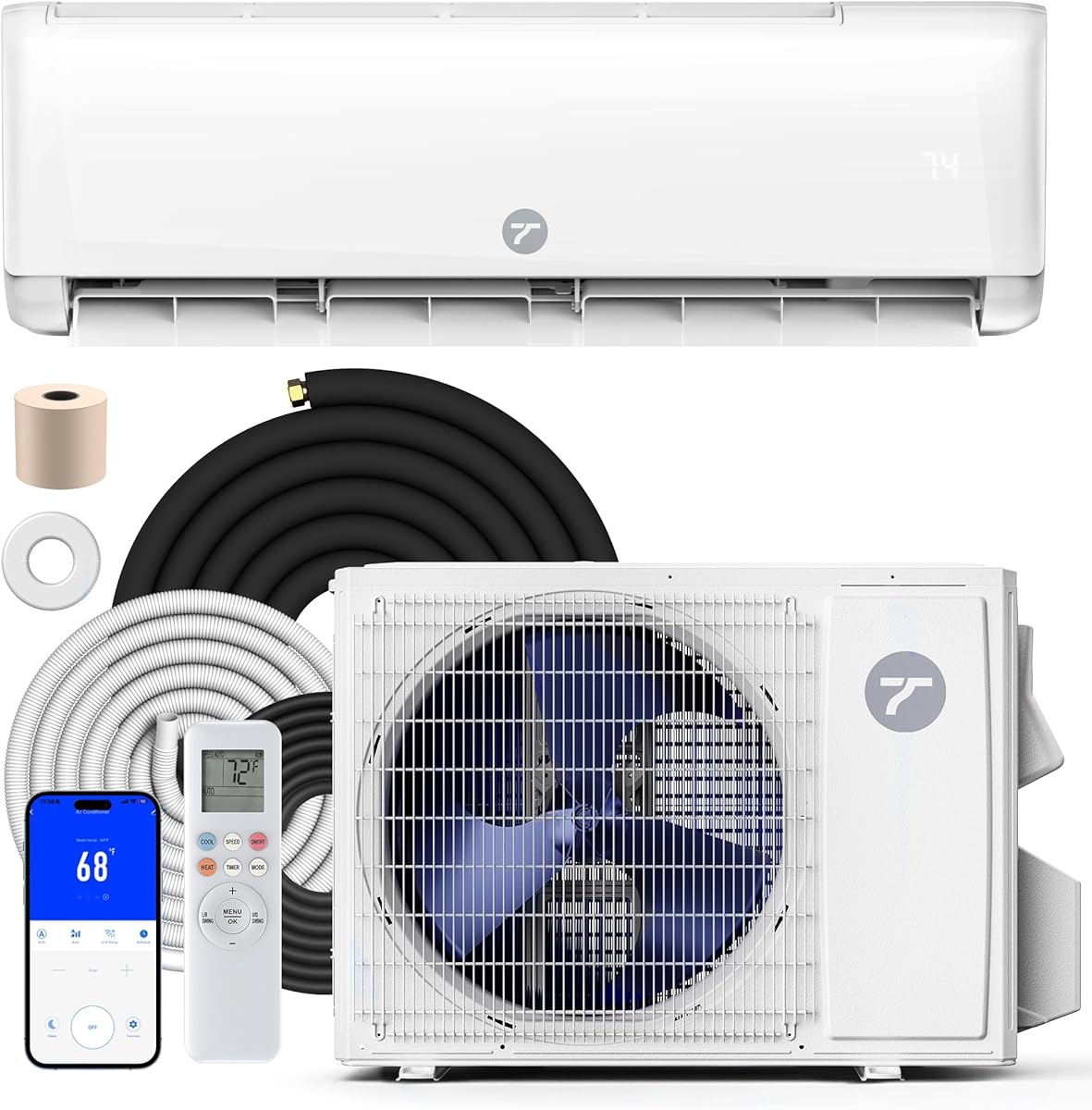
The ROVSUN 9000 BTU Mini Split combines 20 SEER2 efficiency with cooling and heat-pump operation in a 115-volt system. It has a 4.4 rating and a stated coverage area of up to 400 square feet, making it more closely matched to a compact travel trailer, small cabin, bedroom, office, or storage room than to a large mobile home. The pre-charged condenser and included kit simplify installer preparation.
We may earn a commission when you buy through this link, at no additional cost to you.
Remote operation is comprehensive, with fan-speed selection, Sleep Mode, a 24-hour timer, Eco Mode, Turbo Mode, and Mute Mode. The system has four-way swing to distribute air across the room, while sound levels are listed at 28–42 dBA. In a trailer, even relatively modest noise can become noticeable during quiet hours, so the mute setting and low operating output are meaningful benefits.
Its biggest practical limitation is electrical dependence. The system requires 115-volt, 60-hertz power, and the listing explicitly advises confirming voltage before purchase. A trailer with only a 12-volt battery circuit would need a suitably sized inverter, while a shore-power-equipped trailer still needs confirmation that its outlet and wiring can support the air conditioner and heat pump.
Professional installation is required, so the pre-charged condenser does not make the product completely installation-free. Nevertheless, it is a balanced option for owners seeking better efficiency and heating than a dedicated parking cooler without paying for a larger 12,000-BTU system. It is a particularly good fit for a compact trailer where heat gain has been reduced through insulation, reflective window covers, and limited occupancy.
A 20 SEER2 specification gives this system a strong efficiency foundation while 9000 BTU keeps it aligned with smaller rooms. It is a practical middle ground between portable evaporative coolers and larger residential heat pumps.
The remote combines basic temperature and fan control with timers, sleep, turbo, eco, and mute functions. Four-way swing helps avoid direct airflow against occupants in a compact living area.
We may earn a commission when you buy through this link, at no additional cost to you.
The Garvee 12000 BTU Heat Pump is a 4.5-rated 208–230-volt system designed for spaces up to 750 square feet. It delivers 12,000 BTU of cooling and heating with an 18.5 SEER2 efficiency specification. For a large travel trailer, converted bus, or small addition, its output and connected controls are compelling, but its voltage requirement is a major installation constraint.
We may earn a commission when you buy through this link, at no additional cost to you.
Built-in WiFi, a mobile app, and Alexa compatibility allow remote temperature, fan-speed, mode, and timer adjustments. The physical remote remains available for local use. A custom sleep mode is designed to adjust temperature and airflow through the night, while optimized noise-reduction technology supports work, study, and rest in smaller spaces.
Maintenance is streamlined by an automatic self-cleaning function intended to flush dust and residue from the internal unit. A reusable washable filter can be removed and cleaned to maintain airflow. The package includes the outdoor condenser, wall-mounted indoor handler, connection piping, drain hose, communication wire, remote, and manual, which gives an installer the core components needed for assembly preparation.
Safe, code-compliant professional installation is required, and the 208–230-volt requirement may rule out units designed around common residential 120-volt trailer receptacles. A trailer owner would need to verify available service, breaker capacity, grounding, and the outdoor location. For those who have the proper electrical infrastructure, the combination of heating, smart controls, and self-cleaning makes this a strong residential-style option.
WiFi scheduling, app control, and Alexa compatibility are useful when a trailer is occupied intermittently. Users can prepare the space remotely and retain a conventional remote for immediate changes.
The self-cleaning cycle is intended to reduce dust and grime buildup inside the indoor unit. It complements, rather than replaces, regular filter washing and airflow checks.
We may earn a commission when you buy through this link, at no additional cost to you.
The Tehanld 12000 BTU 19 SEER2 combines a 4.5 rating with 12,000 BTU of cooling, one-ton heat-pump capacity, and a stated 750-square-foot coverage area. It uses a 115-volt supply, making it a more approachable residential option for many travel trailers than 208–230-volt systems, provided the trailer’s electrical panel can handle the load.
We may earn a commission when you buy through this link, at no additional cost to you.
Its inverter design adjusts compressor speed to match demand, while R32 refrigerant is used to reduce global-warming potential relative to older refrigerants. Five primary modes—Cool, Heat, Auto, Fan, and Dry—cover normal seasonal needs. Four fan speeds, a 24-hour timer, Sleep Mode, Eco Mode, and a rapid cooling and heating function add useful control.
The product is designed for straightforward temperature management rather than extensive connected control. There is no indication of WiFi or voice-assistant compatibility in the supplied specifications, so buyers who value remote access should look elsewhere. On the other hand, the physical controls and operating modes are easier to understand and less dependent on a phone or network connection.
Professional installation is required, and the system ships in two packages that may arrive at different times. The air filter should be removed and cleaned regularly. Overall, it is a well-rounded option for a medium-to-large trailer that wants a heat pump, strong efficiency, and adjustable fan output without the added complexity of smart-home integration.
The 19 SEER2 specification and variable-speed compressor are designed to maintain comfort with less energy than constant cycling equipment. R32 refrigerant also provides a lower global-warming potential than many traditional alternatives.
Cooling, heating, drying, fan, and automatic operation cover the main trailer climate needs. The timer, sleep setting, eco mode, and rapid output function provide useful scheduling and comfort controls.
We may earn a commission when you buy through this link, at no additional cost to you.
The DELLA Motto Series 9100 BTU is a 4.3-rated, 115-volt mini split with a 20.5 SEER2 specification and a stated 400-square-foot cooling area. It supports both cooling and heating through a pre-charged, R-32-filled inverter heat pump. Its smart functions, including WiFi and Alexa compatibility, make it the most polished connected model in the group.
We may earn a commission when you buy through this link, at no additional cost to you.
Air distribution is handled by 4D airflow, allowing movement up, down, left, and right. Additional controls include I Feel mode, a 24-hour timer, Sleep Mode, Eco Mode, multiple fan speeds, Turbo, heating, cooling, dehumidifying, and dry modes. The remote’s temperature sensor is used during cooling, allowing the system to respond to conditions around the user rather than relying only on the wall unit.
The condenser includes an upgraded bottom heating element and is advertised as operating down to 5°F. Sound levels are listed as low as 27 dBa. A full 16-foot copper line set with 1/4-inch and 3/8-inch outer-diameter pipes is included, along with a 6.56-foot drain pipe. As with other conventional mini splits, line-set vacuuming is required during installation.
The 400-square-foot limit makes this a better match for a compact trailer than for a large motorhome. Its 115-volt requirement is also more trailer-friendly than 208–230-volt alternatives, but the circuit still must be properly sized. For an owner who values connected control, a refined remote interface, high efficiency, and cold-weather heating support, this premium system provides a particularly complete feature set.
The 4D swing system helps distribute conditioned air throughout a compact room. This is valuable in a trailer where one wall-mounted unit may otherwise leave opposite corners noticeably warmer.
WiFi, Alexa, and I Feel operation work together to make the system responsive to the occupied zone. A 24-hour timer and sleep mode add convenient automation for overnight travel.
We may earn a commission when you buy through this link, at no additional cost to you.
The DELLA Motto Series 18000 BTU is the highest-capacity conventional system in the comparison. It has a 4.3 rating, 18,000 BTU of cooling, 19 SEER2 efficiency, and a stated coverage area of up to 1,000 square feet. That makes it suitable for a large travel trailer, expansive converted bus, small house, or commercial addition with sufficient electrical service.
We may earn a commission when you buy through this link, at no additional cost to you.
The operating feature set matches the smaller DELLA model and includes 4D airflow, I Feel mode, a 24-hour timer, Sleep Mode, Eco Mode, multiple fan speeds, Turbo, heating, cooling, dehumidifying, and dry modes. WiFi and Alexa compatibility make remote scheduling possible, while the remote sensor allows the indoor system to respond to the temperature where the user is located.
R-32 refrigerant and an upgraded bottom heating element support the heating function, with cold-weather performance listed down to 5°F. Sound levels are advertised as low as 29 dBa. The installation kit contains a 16-foot copper line set with 1/4-inch and 1/2-inch outer-diameter pipes and a 6.56-foot drain pipe. Line-set vacuuming remains part of proper installation.
The 208–230-volt supply and 18,000-BTU capacity are substantial for a typical trailer. It could overwhelm a modest electrical system and consume space that a compact camper cannot spare. Choose this model only after an electrician confirms service capacity and an installer checks outdoor placement, drainage, and line routing. For the largest properly equipped spaces, however, it delivers considerable output and a full smart feature set.
The 18,000-BTU output and 1,000-square-foot coverage claim are intended for larger rooms with significant heat gain. This makes the system more suitable for expansive mobile interiors than for typical small campers.
WiFi, Alexa, and the remote-based I Feel function allow the system to be controlled and adjusted around the occupied area. These features are useful in a large trailer where the living zone may be distant from the indoor unit.
We may earn a commission when you buy through this link, at no additional cost to you.
The MRCOOL DIY Select 24000 BTU is the largest single-zone system listed, with cooling and heating capacity for rooms up to 1,050 square feet. It has a 4.0 rating, 230-volt electrical requirement, 16.5 SEER2 cooling efficiency, and 8.3 HSPF2 heating efficiency. In conventional homes, it serves large spaces; in a trailer, it is primarily relevant to unusually expansive mobile homes.
We may earn a commission when you buy through this link, at no additional cost to you.
Its clearest distinction is the pre-charged Quick Connect line set. The product information says that no vacuum pump, gauges, brazing, or refrigerant handling is required to begin installation. That streamlines setup, although wiring, mounting, drainage, electrical protection, and other site-specific work still need to be completed correctly. Owners should not interpret the DIY feature as a reason to skip local requirements or qualified electrical assistance.
Inverter-driven operation is designed to maintain steady comfort while limiting energy use, and the indoor unit can operate as quietly as 21.5 dBA in silent mode. The MRCOOL Comfort App and voice assistants provide remote management, while R-454B refrigerant is used for the system. Those features make it attractive for a large, well-equipped addition or commercial-style mobile space.
This model is probably too large and power-hungry for most trailers. It would require a robust 230-volt service, considerable outdoor condenser space, and a large interior wall area. Its strongest advantage is not trailer portability but installation convenience for someone building a larger space. Consider it only when the available area, electrical infrastructure, and heat load justify a 24,000-BTU system.
The quick-connect line set removes several steps traditionally associated with servicing refrigerant lines. It is the most installation-friendly feature among the large residential systems in this guide.
An operating level as low as 21.5 dBA in silent mode is useful for bedrooms and other occupied spaces. Actual noise varies with operating mode, airflow setting, and installation quality.
We may earn a commission when you buy through this link, at no additional cost to you.
The most important first step is matching the air conditioner to the trailer’s size, power, climate, and installation constraints. Capacity, electrical service, drainage, and exterior mounting requirements often matter more than extra smart features.
Choose output based on measured space and heat load, not square footage alone. For most small and medium trailers, the 9000- and 12,000-BTU groups offer the most useful range.
Match the system to the power already available, or budget for electrical upgrades before installation. A 12-volt system is the strongest choice for battery-centered mobile use.
Prioritize a heat pump when the trailer is used beyond hot weather. In severe cold, maintain a realistic backup plan because ductless capacity does not overcome poor insulation.
Efficient inverter modulation is valuable for extended use, but system sizing and trailer insulation still determine real-world comfort. Compare seasonal and electrical demands, not just SEER2.
Choose a system with quiet and sleep modes, especially when sleeping in the trailer. Consider normal-mode noise and vibration, not only the lowest published figure.
Check line-set length, drilling access, exterior clearance, and drain routing before buying. Included hardware reduces cost and effort but does not remove the need for sound installation.
Smart controls are useful when reliable connectivity is available, but prioritize a good remote, scheduling, and sleep mode for dependable daily use.
Choose a model with a washable filter and, ideally, a self-cleaning function. Schedule regular filter care and keep the indoor and outdoor airflow paths unobstructed.
Before operating a newly installed system, confirm that the indoor unit, outdoor condenser, line set, electrical service, and drain are securely installed. If the system was installed by a professional, ask about startup procedure, required maintenance, refrigerant service, warranty coverage, and the correct operating temperature range. For a mobile installation, check the condenser fasteners and insulated line routing after each long drive because road vibration and movement can loosen connections.
Set a comfortable temperature rather than repeatedly forcing maximum cooling or heating. Start with Auto or the mode that matches the season, select the lowest fan speed that circulates air effectively, and use Sleep, Quiet, or Eco settings at night. The I Feel function, where available, can follow the temperature at the remote. Avoid blocking the indoor airflow, and leave sufficient clearance around the outdoor unit to preserve heat transfer.
Clean the washable filter regularly according to the manufacturer’s instructions, especially during dusty travel. Inspect the drain opening and hose for blockages, keep the outdoor coil free of dirt and debris, and make sure the unit is not exposed to direct water intrusion. For a 12-volt system, monitor battery voltage and charge state so cooling does not leave the vehicle with an insufficient starting battery. If performance declines, electrical protection activates, or a leak is suspected, stop operating the system and obtain qualified service.
Yes, if the trailer has suitable electrical service, space for the indoor and outdoor units, a proper condensate drain, and an installation that complies with local requirements. Most 115-volt systems need a dedicated circuit, while 208–230-volt models require even more service capacity. A qualified HVAC installer should inspect the trailer before work begins.
The 12V 9000-BTU Split AC is the most directly compatible option because it runs from a vehicle’s 12-volt DC system. It can operate without idling the engine and includes electrical protection circuits. You still need adequate battery capacity, correct wiring, and a sensible charging plan.
A compact trailer will often fit within the 9000-BTU group, which covers approximately 400 square feet in the supplied listings. A 12,000-BTU system may be better for a medium or poorly insulated trailer with wide windows. Measure the interior and account for sunlight, occupancy, and ventilation rather than relying on floor area alone.
All products except the dedicated 12V 9000-BTU parking cooler list heating or heat-pump operation. Heating can be valuable in cool weather, although thin trailer walls and large windows can lose heat rapidly. Extreme cold may still require a supplemental heater, particularly in very small campers.
No. Every system has a physical remote, although selected models also add WiFi, app control, and voice-assistant support. Connected functions are convenient but can be unreliable where cellular or internet service is weak. A good remote, timer, sleep mode, and fan controls are the essential daily features.
A pre-charged condenser or line set can reduce installation steps and may eliminate some refrigerant-handling tasks for the included connection. It does not remove the need for safe electrical work, drilling, drainage, mounting, and leak checks. Local code and the manufacturer’s instructions should determine whether a qualified installer is required.
Inspect it regularly and wash it according to the manufacturer’s instructions, especially during dusty travel or frequent outdoor use. Some models also include a high-temperature self-cleaning cycle, but that feature does not eliminate filter cleaning. Restricted airflow can reduce cooling, increase energy use, and contribute to indoor moisture problems.
SEER2 describes seasonal cooling efficiency, so a higher number generally indicates more efficient cooling under standardized conditions. Noise ratings describe sound output, often at the quietest indoor setting. A high efficiency value cannot compensate for poor sizing, and a low minimum noise figure does not guarantee quiet operation at maximum fan speed.
The 12V 9000-BTU Split AC is the strongest match for a mobile trailer that needs cooling without engine idling, while the 22 SEER2 12000-BTU Mini Split offers the strongest residential combination of efficiency, heating, smart controls, and quiet operation. The ROVSUN 9000-BTU model provides a more economical 115-volt path, and the DELLA 9100-BTU system stands out as a polished connected option for smaller living spaces.
Prioritize electrical compatibility, correctly matched capacity, heat gain, drainage, and exterior mounting before focusing on convenience features. A larger unit is not automatically better, and a smart system cannot compensate for inadequate power or poor insulation. Measure the trailer, review the electrical system, and obtain a professional installation assessment whenever the product documentation requires one.
Finally, review current product listings, included components, certifications, warranty terms, and availability before purchasing. Trailers vary greatly in construction and electrical capacity, so the most important details are the ones specific to your floor plan, battery bank, climate, and travel pattern.