
RAINPOINT Water Timer for Garden Hose
4.3Editor score
Two programmable outlet zones
Low-battery safety shutdown
Water-resistant digital display
This Digital Hose Timer guide compares ten programmable models by zone capacity, scheduling, rain delay, durability, and smart-control features.
A digital hose timer turns an ordinary outdoor faucet into a dependable automated watering system. The most useful models combine clear programming, flexible schedules, dependable water resistance, and enough outlet capacity to manage separate lawn, garden, or drip-irrigation areas without constant supervision.
This guide compares ten digital hose timers across ten outlets, two outlets, and one outlet, as well as conventional, Bluetooth, and WiFi control. The evaluation focuses on supplied features such as programmable run times, watering frequency, rain delay, manual operation, display readability, weather resistance, battery requirements, and outlet configuration.
Each pick highlights the type of gardener it best suits, from a simple one-zone solution to sophisticated multi-zone or app-controlled irrigation. Ratings and specifications reflect the supplied product information, while product listings and market conditions can change. Review current details and availability before purchasing.
4.3Editor score

4.8Editor score
4.2Editor score
The comparison below covers the ten available digital hose timers, emphasizing outlet count, scheduling flexibility, weather protection, control style, and the practical features that distinguish one model from another.


The Orbit 62061 is a conventional programmable digital hose timer built around one core purpose: attaching to a faucet and controlling one irrigation area on a dependable schedule. Its supplied rating is 4.1, and its appeal comes from a clear LCD screen, adjustable watering duration, and a relatively uncomplicated design. It is suited to homeowners who want reliable automation without a phone app or multi-zone complexity.
We may earn a commission when you buy through this link, at no additional cost to you.
The strongest qualities are practical outdoor features. This battery-powered timer uses a water-resistant construction designed for regular faucet use, while its built-in rain delay can suspend the program when rainfall makes additional watering unnecessary. Adjustable duration helps users match watering intervals to different plants, and the readable display allows schedules and current timer information to be checked without navigating a complex menu.
Its main limitation is outlet capacity. One outlet means the timer can manage only one hose-connected zone at a time, so gardeners with separate lawn, flower-bed, or vegetable-garden irrigation lines will need additional equipment or a more capable multi-zone controller. App-based remote access is not documented in the supplied information, which may be another drawback for users who want control from away from home.
This Orbit model is a sensible recommendation for a patio planter, small flower bed, single drip line, or uncomplicated lawn that needs only one timed outlet. Buyers who value straightforward scheduling, an LCD interface, rain delay, and a six-year limited warranty will find it more compelling than users seeking wireless control or simultaneous watering of multiple zones.
The LCD screen and adjustable duration make this timer approachable for everyday use. A homeowner can establish a repeatable watering interval without depending on a phone, network, or cloud account, while the single outlet keeps the physical setup relatively uncomplicated.
The built-in rain delay and water-resistant construction address two common outdoor concerns. The timer can pause scheduled watering during selected wet conditions, reducing the likelihood of unnecessary irrigation while remaining designed for exposure near an outdoor faucet.
We may earn a commission when you buy through this link, at no additional cost to you.
The RAINPOINT Sprinkler Timer combines a 4.4 rating with a broad set of scheduling options in a single-outlet design. It supports start-time, watering-duration, and watering-frequency settings, with a duration of one minute to three hours and fifty-nine minutes. That range makes it a flexible fit for short drip cycles as well as longer soaker-hose or lawn-watering sessions.
We may earn a commission when you buy through this link, at no additional cost to you.
The automatic, manual, and rain-delay modes are its most useful features. Manual mode can run water for one minute to eight hours without interrupting the stored schedule. Rain delay pauses the programmed routine for 24, 48, or 72 hours before automatic resumption. The large LCD screen displays details such as watering time, frequency, and power status, making the unit easier to configure and monitor.
The main compromises are practical rather than fundamental. Batteries are not included, so buyers must supply two AA alkaline batteries, and the timer controls only one outlet. As a result, it is less convenient for users who already have a complex multi-zone layout. The manual run duration also differs from the maximum programmed duration, which is worth understanding before relying on extended manual watering.
This RAINPOINT is a strong option for a garden, lawn, or outdoor soaker hose that needs frequent adjustments but still requires a single automated outlet. It combines readable controls, flexible frequency settings, and useful operating modes, making it especially attractive for users who want more scheduling freedom than a basic mechanical timer can provide.
Programmable start times, frequency selections, and run durations make the timer adaptable to several watering styles. Users can choose shorter cycles for targeted irrigation or longer periods for a soaker hose, provided the selected outlet and system can handle the intended use.
Manual mode provides immediate access to the faucet while leaving the programmed plan intact. The ability to choose a one-minute-to-eight-hour manual period makes this useful for occasional watering in addition to routine automated irrigation.
We may earn a commission when you buy through this link, at no additional cost to you.
The Orbit 62067 two-pack earns its place by providing two programmable single-outlet timers in one package. Each has a 4.4 product rating, and the pair gives users more scheduling flexibility than a one-outlet model without requiring the complexity of an integrated multi-zone controller. It works particularly well when separate faucets already serve different parts of a property.
We may earn a commission when you buy through this link, at no additional cost to you.
A large, easy-to-read LCD display supports straightforward setup, and each timer lets the user establish a start time, duration, and frequency. Program retention during battery replacement is especially useful because it reduces the need to reconstruct a routine after routine maintenance. The built-in rain delay can pause the schedule for 24, 48, or 72 hours, supporting efficient watering during unsettled weather.
The trade-off is that these are two independent one-outlet units rather than a single dual-valve controller. They need compatible faucet connections and may not deliver simultaneous watering to both areas. The supplied information also does not identify app or smart-home control, so buyers seeking phone-based scheduling should consider another category of timer.
The two-pack is a strong recommendation for homeowners with two outdoor faucets, separate lawn and garden hoses, or an irrigation layout that benefits from independent timing. It combines Orbit's familiar digital programming and rain-delay features with a convenient way to manage two areas using individual schedules.
Using two independently programmable timers allows a lawn and a flower bed to follow different watering patterns. This arrangement is especially practical when each zone needs a distinct duration or frequency and separate faucets are readily available.
Retaining programmed settings through a battery change reduces setup disruption. Users can replace batteries with less concern about losing an established schedule, although routine display and operation checks remain sensible.
We may earn a commission when you buy through this link, at no additional cost to you.
The Underhill AquaZone Digital Hose Timer stands out with a supplied rating of 4.8, the highest among the ten products, and a feature set aimed at users who want more control than a basic one-program timer provides. Its AquaVision programming supports customized days, times, and multiple programs per zone, making it a compelling option for lawns, flower beds, vegetable gardens, and drip systems.
We may earn a commission when you buy through this link, at no additional cost to you.
The large digital display keeps programming information visible, which helps when creating multiple schedules across different days or zones. Additional controls include multiple start times, rain delay, a child-proof lock, automatic valve cleaning, and independent day control. These features go beyond the basic start-time-and-duration formula and offer finer management of mixed irrigation needs.
Durability is another central strength. The construction is engineered for sun, heat, and regular outdoor use, and the fittings are described as brass. The included child lock is also useful in households where children or pets might interact with the device. These advantages come with a more complex interface, however, and the supplied information does not document app connectivity or remote access.
The AquaZone is the strongest all-around recommendation for someone who wants detailed scheduling, multiple irrigation programs, and a high feature density in an outdoor controller. It is less compelling for a single uncomplicated watering line, but for a varied yard or garden, its independent controls and durable construction offer a notably capable solution.
Multiple programs, start times, and independent day controls allow watering plans to reflect the different requirements of turf, flowers, vegetables, and drip lines. This granularity is valuable when a single repeating schedule would be inefficient for every zone.
Rugged construction and brass fittings are intended to withstand sun, heat, and routine outdoor use. Those characteristics make the timer a practical fit for installations where the device will remain connected to an exterior faucet throughout the watering season.
We may earn a commission when you buy through this link, at no additional cost to you.
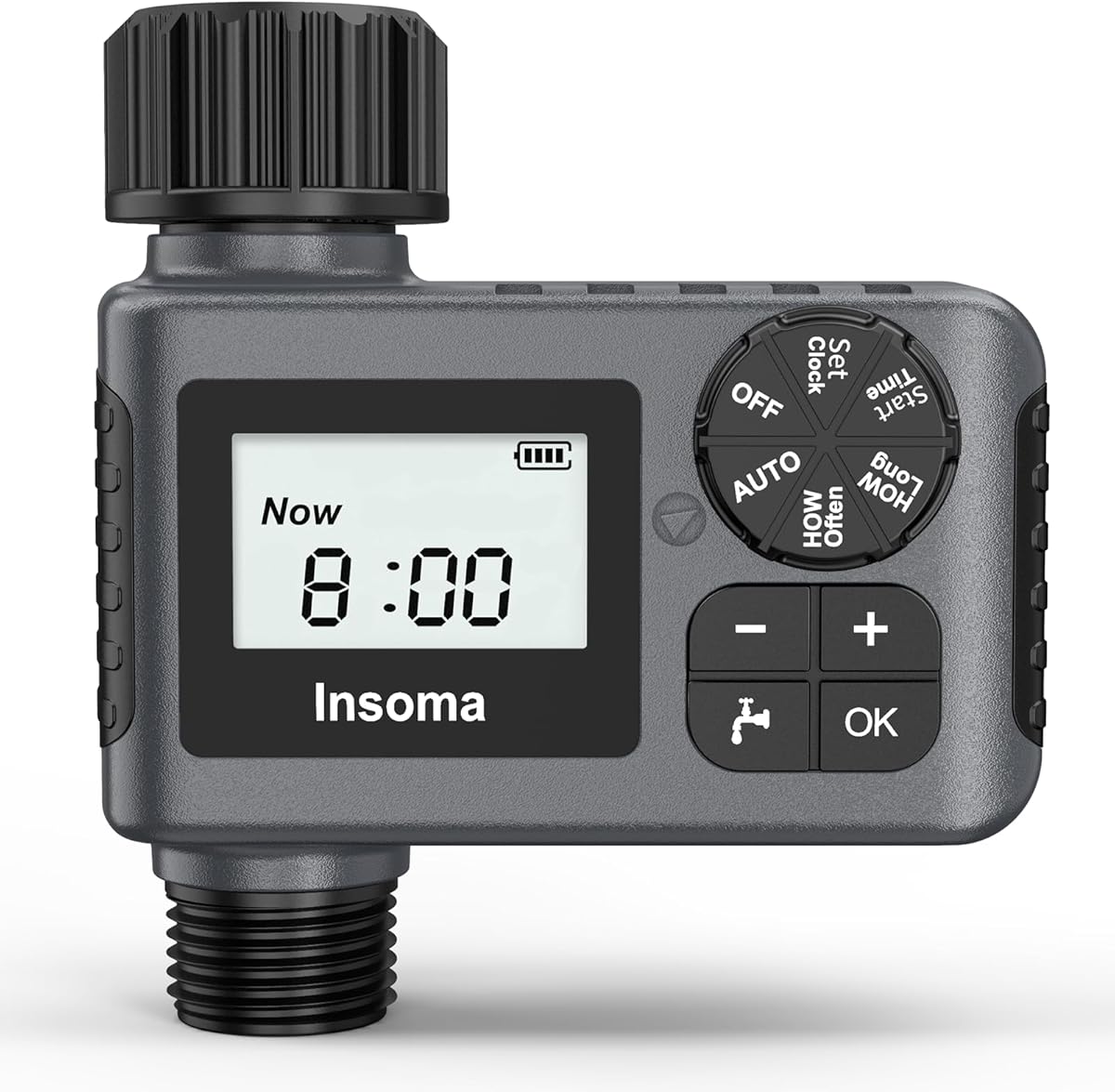
The Insoma Outdoor Garden Hose Faucet Timer is a capable budget-oriented option with a 4.2 rating and a broad operating range. Despite the single outlet, it supports automatic, manual, and rain-delay modes, while its start-time, frequency, and duration settings make it more versatile than a simple mechanical timer.
We may earn a commission when you buy through this link, at no additional cost to you.
The maximum programmed duration reaches 23 hours and 59 minutes, and frequency can be set from one minute to 23 hours and 59 minutes or from one to seven days. Manual watering follows the same broad duration range without interrupting the stored schedule. Rain delay can pause a program for one to seven days and then resume it automatically, offering a notably broad weather-related range.
Outdoor durability is a major selling point. The product uses IP55 water-resistant material, a sealed battery cover, and a connector designed for a stated pressure range of 7.25 to 116 psi. A child lock reduces accidental changes, while the supplied reducing hex bushing and thread-seal tape broaden faucet and hose compatibility. Batteries are not included and the timer requires two AA cells.
This model is a strong recommendation for cost-conscious buyers who want multiple modes, detailed programming, and a long rain-delay option without moving to a connected device. It is especially useful for gravity drip irrigation, lawns, greenhouse misting, pools, and ordinary garden hoses, as long as the installation stays within the documented pressure and connection requirements.
Automatic, manual, and rain-delay modes let the timer respond to both planned and immediate watering needs. Manual operation can last as long as 23 hours and 59 minutes while preserving the programmed schedule for later use.
The included reducing hex bushing and thread-seal tape make it easier to adapt the timer to different hose or faucet sizes. Buyers should still verify their connection dimensions and faucet condition before installation to help minimize leaks.
We may earn a commission when you buy through this link, at no additional cost to you.
The RAINPOINT two-zone timer is designed for gardeners who want to water two areas on separate schedules from one controller. It carries a 4.3 rating, and its two programmable valves allow distinct start times and watering durations for each zone. A zone button also makes it possible to choose Zone 1, Zone 2, or both during a manual watering session.
We may earn a commission when you buy through this link, at no additional cost to you.
The product emphasizes durability and user accessibility. Upgraded valves are described as reducing flow resistance by 40%, the screen structure has an IP65 waterproof rating, and the unit is reported to have passed 20,000-cycle laboratory testing. A 2.5-inch LED display presents watering time, the next irrigation plan, and power information, while a low-battery notice helps users respond before the valve loses power.
Its most important operational safeguard is automatic valve closure if the battery becomes low. This reduces the risk of an unattended watering session continuing after power failure. The other trade-offs include a required 3/4-inch interface and the warning that rust on an existing pipe or faucet can cause a loose connection. Two AA batteries are also required, and the supplied information indicates they are not included.
This RAINPOINT is a strong premium pick for a two-part landscape that benefits from separate schedules but does not need smartphone control. Its flexible timing, water-resistant interface, accessible display, and low-battery shutdown make it especially appropriate for users who value reliability and clear status information.
Separate zone settings allow a lawn and a flower bed, for example, to receive different run times. The controller therefore offers more practical flexibility than a single outlet without requiring a second independent timer body.
The low-battery notice and automatic valve closure help protect an irrigation schedule from an unexpected power loss. This is particularly valuable when the timer operates while nobody is present to intervene.
We may earn a commission when you buy through this link, at no additional cost to you.
The Orbit B-hyve XD is the most explicitly smart and connected model in this group, with a 3.9 rating and a dual-outlet design. It uses Bluetooth and an app to let users program and control watering remotely, while its two outlets expand irrigation capacity beyond a standard single-zone hose timer.
We may earn a commission when you buy through this link, at no additional cost to you.
Its most notable feature is weather-responsive scheduling. According to the supplied information, the controller automatically adjusts watering schedules using local weather data and can adapt to drought conditions. Smart weathersense technology is intended to support plant health and water conservation. A weather-resistant body and weatherproof battery housing are designed for year-round outdoor positioning near a faucet.
The main drawback is the lowest supplied rating in the comparison, which suggests that prospective buyers should assess the app experience and overall product satisfaction carefully. This is also not a universal WiFi timer: control is described as app based through Bluetooth, so users who require internet-based remote access may need a different product. The two-year limited warranty is shorter than the warranty periods listed for several conventional picks.
The B-hyve XD is best for users who actively want app-based watering management and have two areas to control. It may suit a lawn and a garden hose, or two separately irrigated beds, while adding automatic weather-based adjustments. Buyers should confirm that the Orbit app and their phone are a comfortable fit before choosing it over a simpler standalone model.
Using local weather data can reduce unnecessary irrigation and help schedules respond to changing conditions. The drought-adjustment feature gives this model a practical advantage for users who want automation to account for more than a fixed timer.
Bluetooth app control moves programming and adjustments onto a smartphone, which is convenient for monitoring a schedule from elsewhere. The trade-off is dependence on the app experience rather than a fully standalone control panel.
We may earn a commission when you buy through this link, at no additional cost to you.
The Melnor 65139AMZ AquaTimer combines two independently programmable valves with a 4.2 rating and a quick-connect bundle. It is designed for yards where separate lawn and garden areas need distinct schedules, and its two-valve arrangement offers useful capacity without adding a second controller.
We may earn a commission when you buy through this link, at no additional cost to you.
Scheduling flexibility is one of its primary advantages. Each valve can operate as often as every hour, with up to 24 starts per day, or as little as once per week. The built-in rain delay pauses the watering schedule for up to seven days, which is among the longest weather delays in the group and can prevent unnecessary watering during extended wet conditions.
The product requires two AA batteries, which are not included. It also does not document rain-sensing, WiFi, Bluetooth, or app control, so its appeal rests on programmable scheduling rather than connected intelligence. A quick-connect bundle simplifies the physical setup, though users should confirm that the connection method suits their faucet and existing hose arrangement.
The Melnor is a good recommendation for households seeking two independently scheduled outlets, frequent watering intervals, and substantial warranty coverage. It is particularly appealing to buyers who want the longest stated rain-delay option and who do not need remote app control.
Two valves let users tailor watering to separate areas, such as a high-traffic lawn and a more delicate flower bed. Independent programming is more useful than forcing both areas onto one shared schedule.
A delay of up to seven days gives users a longer pause than many competing models. It can be useful during prolonged rainfall, although schedules should still be checked after the pause ends.
We may earn a commission when you buy through this link, at no additional cost to you.
The Melnor 65138AMZ is a straightforward one-zone digital timer with a 4.1 rating. It focuses on flexible frequency, a broad run-time range, and quick access to manual watering rather than multi-zone management or connected control. The supplied quick-connect bundle helps create a convenient hose-to-faucet installation.
We may earn a commission when you buy through this link, at no additional cost to you.
The timer can water as often as every hour, support up to 24 cycles in a day, or run as infrequently as once a week. Its automatic run time ranges from one minute to six hours, making it appropriate for both brief misting-style cycles and longer irrigation periods. A manual option lets the user access the faucet immediately without complicating the basic control concept.
The most notable omission in the supplied information is rain delay. Unlike many timers in this comparison, the product details do not document a built-in weather pause, so users who need automatic rain avoidance should verify that feature before purchasing. Two AA batteries are required and are not included. It also cannot manage a second zone at the same time.
This Melnor model is a solid recommendation for a single hose-connected garden, planter, or modest lawn that benefits from digital scheduling and simple manual access. Its seven-year limited warranty adds reassurance, while its one-zone format and lack of documented rain delay make it more appropriate for straightforward installations than advanced irrigation management.
A one-minute minimum is useful for short, targeted cycles, while the six-hour maximum supports longer watering periods. Combined with hourly to weekly frequency choices, the timer covers a broad range of single-zone routines.
The manual option provides immediate faucet access when a short, unplanned watering session is needed. That convenience makes the timer practical for users who still want hands-on control between scheduled runs.
We may earn a commission when you buy through this link, at no additional cost to you.
The Insoma WiFi Water Timer is built for users who want remote and voice-assisted irrigation control. It has a 4.2 rating and connects directly to a 2.4GHz WiFi network through the Smart Life app without requiring a separate gateway. That setup simplifies the connection process and distinguishes it from controllers that require an intermediate hub.
We may earn a commission when you buy through this link, at no additional cost to you.
The app allows users to manage programs, inspect watering history, and share access with family members. Voice control is compatible with Alexa and Google Assistant, permitting hands-free activation. The timer can store up to 20 schedules, including ten normal and ten cycle or soak schedules, which provides substantial flexibility for lawns, gardens, greenhouses, pools, and vegetable or fruit irrigation.
Manual mode supports customized runs from one minute to 24 hours without disrupting the preset program. Weather delay can pause schedules for 24, 48, or 72 hours and then resume automatically. The brass inlet and outlet, IP55 waterproof anti-UV coating, anti-rust ABS body, and sealed battery compartment are designed for outdoor durability. Four AA batteries are required and are not included.
This is a strong recommendation for a connected single-zone setup, especially when remote monitoring, shared family access, or voice control matters. The trade-off is dependence on a compatible 2.4GHz network and the Smart Life ecosystem. It also controls only one outlet, so larger irrigation systems may require a different capacity level.
Direct WiFi connectivity allows schedules to be managed from the app without a separate gateway. Support for Alexa and Google Assistant adds a hands-free way to start or stop watering, which can be convenient for busy households.
Twenty available schedules, including cycle and soak options, offer room for sophisticated irrigation patterns. The app also provides access to watering history, helping users review past activity rather than relying only on assumptions about what ran and when.
We may earn a commission when you buy through this link, at no additional cost to you.
The right digital hose timer depends on irrigation layout, scheduling complexity, local conditions, and the amount of control you want away from the faucet. Compare outlet count, programmable ranges, weather handling, connectivity, and physical connection requirements before choosing.
A one-outlet timer is sufficient when a single hose, drip line, or sprinkler covers the area being irrigated. It is also simpler to configure and usually adequate for a planter, small garden, or compact lawn. A two-zone controller is more useful when the property has two areas with different water requirements, such as a lawn and a flower bed. Some options also provide independent programs or multiple start times within a zone, which adds flexibility without necessarily adding another outlet.
Examine the available start times, run-time minimum and maximum, and watering-frequency options. Short minimum durations are useful for drip lines and delicate plants, while longer maximum durations accommodate soaker hoses or lawn sprinklers. Frequent hourly starts may benefit from thirsty vegetation during hot periods, whereas weekly scheduling is useful for slow-growing or seasonally stable plants. Multiple programs and independent day controls offer the most control but can take more time to configure.
Rain delay pauses a programmed schedule and then resumes it automatically, helping prevent unnecessary watering during wet weather. Available pauses differ significantly, ranging from one day to as long as seven days, and they are usually a fixed selection rather than a continuous moisture sensor. Manual mode allows immediate watering without disturbing the stored routine. Verify that manual activation and the main schedule can coexist, since this behavior varies among models.
Bluetooth control can provide app-based programming and monitoring without requiring a separate hub, while direct WiFi connectivity can support remote access and voice assistants. Connected timers are useful when you want to adjust irrigation while away, but they also depend on a compatible phone, network, and app. A conventional standalone timer remains dependable for users who value fewer setup variables and do not need remote changes.
Hose timers live outdoors and must tolerate moisture, sunlight, and temperature changes. Look for a stated water-resistance or waterproof rating, weather-resistant housing, sealed battery compartments, and corrosion-resistant fittings. Brass connections may offer advantages over plastic threads, while anti-UV and anti-rust materials help protect frequently exposed components. Ratings are not directly interchangeable, so the overall construction and included seals deserve attention as well.
A large LCD or LED display makes it easier to confirm the current time, next watering period, selected frequency, and battery status. Digital programming is more precise than a mechanical dial, but a cluttered interface can still slow setup. Look for clear controls, straightforward automatic and manual modes, and status alerts that warn about low batteries. A child lock is useful where accidental button presses are likely.
Most models use AA batteries, commonly two, while the Insoma WiFi model uses four. Batteries are generally not included, so include that need when comparing complete ownership costs. Also verify the connection size and method. A standard 3/4-inch connection may not match every faucet, and rusted or poorly threaded fixtures can leak even when the timer itself is compatible.
Warranty length can provide useful insight into the manufacturer's confidence, although it should not replace evaluating features and construction. The listed products include limited warranties ranging from two to seven years, with the Melnor models and several Orbit products among the longer-term options. Registration requirements and consumer-law rights can vary by location, so the supplied warranty terms should be reviewed for the intended use.
Begin by confirming that the faucet's connection matches the timer and that the hose or irrigation equipment is in good condition. Clean the faucet threads, attach the timer as directed, and use thread-seal tape or a suitable washer when required. Install the required alkaline batteries, set the correct current time, and confirm that the display and buttons respond before attaching the hose.
Program the start time, watering duration, and frequency for each outlet or zone. Choose automatic mode for normal operation, use manual mode for immediate watering, and configure rain delay if the model includes it. For multi-zone controllers, assign each area its own schedule and verify that the selected zone matches the intended hose or sprinkler. Leaving all setup instructions nearby is helpful when changing a program.
Check the display periodically, especially after rain, a power outage, or battery replacement. Keep the housing and battery cover sealed, clear debris from around the connection, and inspect washers and threads for leaks. Remove the batteries if the timer will be stored for an extended period, and confirm the schedule after each maintenance task so an automated system continues operating as intended.
A one-zone timer controls a single hose, sprinkler, or drip-irrigation line. A two-zone timer controls two areas independently, allowing different start times or durations for each. The latter is useful when a lawn and garden bed have different watering needs. More zones add convenience but can also make programming and installation more complicated.
A digital hose timer can automate a hose-connected sprinkler, soaker hose, or drip system, but it may not provide the same zone control as a conventional irrigation controller. The right choice depends on the number of outlets, required schedules, and whether you need app control. The products here vary from one-outlet models to dual-zone units and connected smart timers.
Yes, many models are suitable for drip systems, especially when the watering duration and operating pressure suit the tubing. The Insoma models explicitly list drip irrigation among their uses, and the Underhill AquaZone supports drip systems. Confirm pressure compatibility, connection size, and the timer's ability to handle the flow before installation.
Behavior varies by model. The RAINPOINT two-zone timer includes a low-battery notice and automatically closes its valve when power is low. The Orbit 62067 retains its programmed settings during a battery change, which simplifies restoring the schedule. On other models, replacing batteries promptly and checking the display afterward is still advisable.
No. The Orbit B-hyve XD uses Bluetooth and an app, while the Insoma WiFi model connects directly to a 2.4GHz WiFi network. The Insoma model also supports Alexa and Google Assistant, whereas the Orbit emphasizes weather-based adjustments. A standard digital model requires no phone or network, making it suitable for simpler installations.
Battery life depends on the model, schedule, valve activity, and operating environment. The Insoma programmable model states that two AA alkaline batteries can run for over six months, while the Insoma WiFi model states support for up to one year with four AA alkaline batteries. Actual results can vary, so regular battery checks remain important.
A leak may result from an incompatible thread size, worn faucet threads, a missing washer, or insufficient thread-seal tape. Some products include adapters and seal tape, while others specifically warn that rusted pipes or faucets can cause loose connections. Remove the timer, inspect the fittings, clean or replace the damaged component, and reinstall according to the instructions.
Most digital timers are designed for programming after installation. The two Orbit two-pack models retain their programs during battery changes, while the RAINPOINT manual mode allows watering without interrupting the schedule. For any model, consult its instructions and confirm the new program on the display before leaving the area unattended.
The Underhill AquaZone is the standout choice for detailed irrigation control, multiple programs, independent day settings, and a high supplied rating. The RAINPOINT two-zone model is the strongest premium option for independent zones, water-resistant construction, and automatic low-battery closure, while the Insoma programmable timer delivers a broad feature set and flexible modes at the budget end of the comparison.
Prioritize the number of independent zones first, followed by the watering-duration and frequency ranges required by your plants. Rain delay, manual mode, battery behavior, outlet construction, and connectivity should then determine which model fits your routine. A simple standalone timer may be more dependable for one basic line, while a connected model adds convenience when remote management and voice control justify the extra setup.
Before buying, verify the faucet size, hose arrangement, operating pressure, and battery requirements. Product listings, ratings, features, and market conditions can change, so check the current listing and manufacturer information before making a final selection.