
Ubiquiti UniFi G5 Ultra
4.5Editor score
4K image resolution
PoE wired connectivity
Indoor and outdoor use
Motion detection
Integrated night vision
POE Network Cameras guide compares ten wired options on image quality, night vision, PoE setup, detection, weather resistance, and system and device compatibili
POE network cameras provide a dependable way to monitor homes, offices, driveways, and other properties while consolidating power and data onto a single Ethernet connection. The best models balance useful image detail, dependable night performance, intelligent detection, flexible recording options, and compatibility with the equipment already in your security system.
The products in this guide were compared using the information available for resolution, lens coverage, low-light and infrared performance, weather resistance, PoE connections, recording support, detection features, and third-party platform compatibility. The list includes eight standalone cameras and two PoE network video recorders that can serve as practical foundations for a broader camera system.
Each review explains the strongest reasons to consider a product alongside its limitations and ideal installation environment. Ratings reflect the published customer feedback supplied with each listing, while technical details can vary by firmware and compatible hardware. Prices and promotions change frequently, so confirm the latest listing information before making a purchase.
4.5Editor score

4.3Editor score

4.0Editor score
The table below compares the ten featured options by resolution, low-light capability, physical design, weather protection, and their most important installation or compatibility considerations.

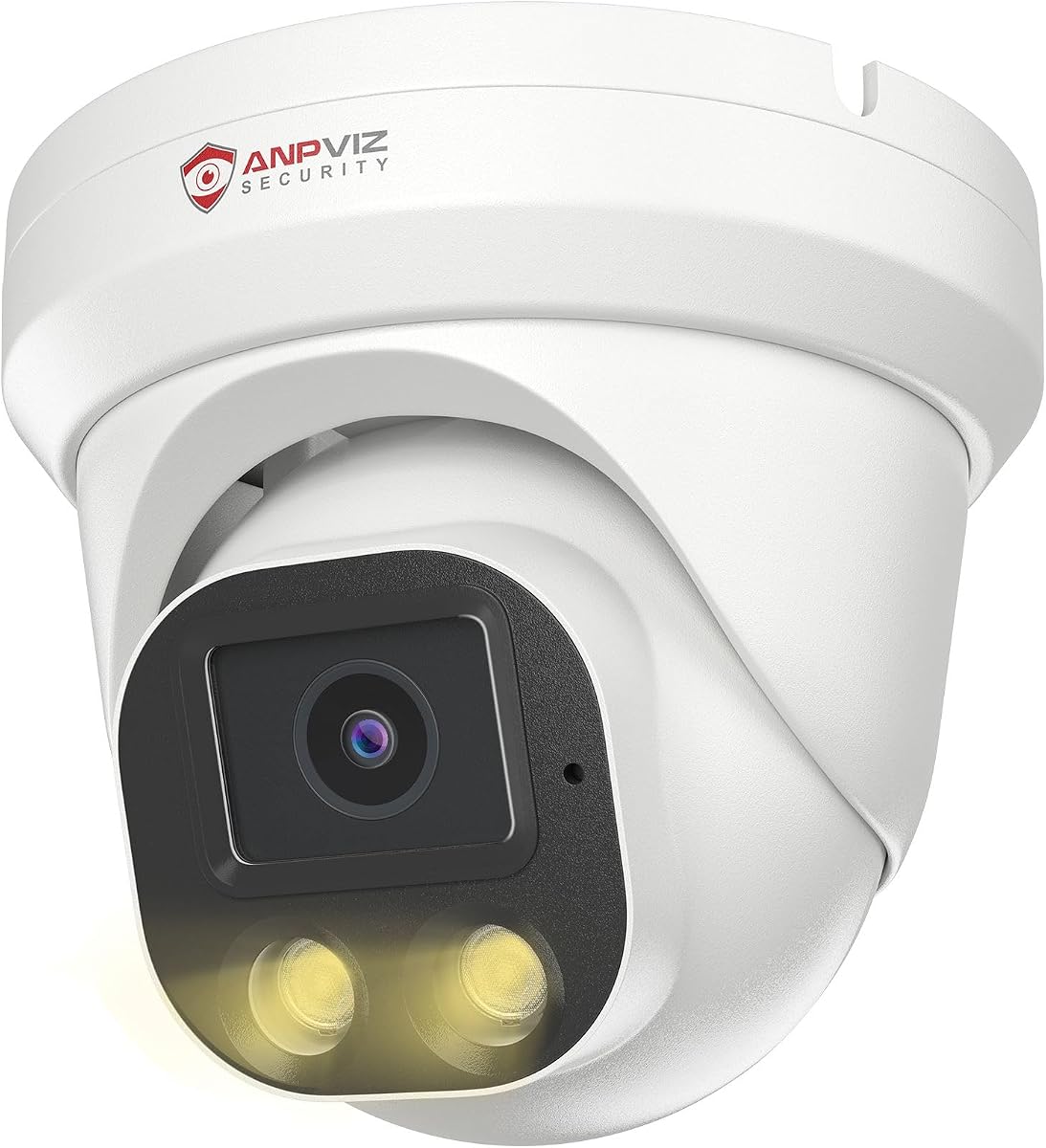


The Anpviz 5MP PoE Camera stands out as the most complete general-purpose option in this guide. It combines a 2880×1620 sensor with a fixed 2.8mm F1.6 lens, producing a stated 110-degree field of view suited to yards, porches, driveways, and other broad outdoor spaces. Its turret housing, IP66 rating, full metal construction, and 4000V lightning protection make it a credible choice for exposed installations.
We may earn a commission when you buy through this link, at no additional cost to you.
Smart dual-light illumination is one of its most useful features. Infrared LEDs provide black-and-white monitoring as far as 98 feet in darkness, while integrated warm lights can produce color footage in low-light conditions. AI-based human detection is intended to distinguish people from animals, foliage, and other irrelevant movement. The camera also supports both H.265 and H.264 compression, with H.265 reducing the storage burden on compatible recorders.
The most important limitation is system dependence. This camera has no app support and is designed to work with Anpviz or compatible third-party ONVIF PoE NVRs. It can also work with iSpy, Blue Iris, Milestone, Synology NAS through NFS, and QNAS. Buyers who want a simple phone-only experience should verify the required ecosystem carefully, while those with an established network or NVR may find that flexibility advantageous.
This is the strongest all-around recommendation for buyers who already operate compatible ONVIF infrastructure or are prepared to build a wired system around an NVR. It offers more than the basic 4MP models in the group, particularly in night illumination and image resolution, without requiring the specialized compatibility associated with a branded ecosystem. The right buyer values dependable wired monitoring, useful wide coverage, and smart detection more than a streamlined standalone app.
The combination of infrared and warm-white illumination gives the camera useful options for nighttime coverage. Infrared supports conventional surveillance footage, while the warm light enables color video when ambient conditions are low.
Compatibility with several NVRs, desktop platforms, and NAS workflows makes this a practical option for installers who prefer open, network-based systems. The lack of native app support still makes ecosystem planning essential.
We may earn a commission when you buy through this link, at no additional cost to you.
The Ubiquiti UniFi G5 Ultra is the premium camera in this collection and the only one described with a native 4K resolution of 3840×2160 pixels. It is intended for both indoor and outdoor use, with PoE, motion detection, and night vision included. A dual-core Arm Cortex-A7 processor provides the core processing platform for the camera's connected surveillance functions.
We may earn a commission when you buy through this link, at no additional cost to you.
Its primary advantage is a combination of high resolution, a modern wired power model, and flexibility in placement. PoE sends both network data and power through a LAN connection, reducing the need for a separate power cable at the camera location. This is particularly helpful for a new installation or for an existing property where Ethernet infrastructure is already available.
The supplied specification is more concise than that of the Anpviz models, so buyers should not assume detailed third-party platform support, specific infrared distances, or particular detection categories without checking the current product and ecosystem documentation. The camera also requires a LAN-based setup rather than offering Wi-Fi as its primary connection method. Those constraints are reasonable for a premium wired camera but can make it less convenient for a small or temporary installation.
Choose the UniFi G5 Ultra when image density and a professional wired architecture matter more than standalone convenience. It is a strong fit for buyers who understand the surrounding network and want a 4K-capable camera designed for flexible indoor and outdoor deployment. The available customer feedback is encouraging, although actual image results, storage workflows, and remote access depend on the associated system configuration.
A 3840×2160 image provides substantially more pixel density than the 4MP options in this guide. That can be valuable on wide scenes where a small subject occupies only a limited portion of the frame.
PoE combines network connectivity and electrical power over LAN cabling. This can simplify installation and make expansion more orderly than maintaining separate data and low-voltage power runs.
We may earn a commission when you buy through this link, at no additional cost to you.
The Anpviz 4MP PoE IP Camera is a well-equipped turret option for users who want more than standard infrared monitoring. It records at 2560×1440 and 25 frames per second through a 2.8mm lens with a stated 108-degree field of view. Smart color night vision and a spotlight can illuminate an area in color, while human and motion detection can reduce irrelevant alerts caused by environmental movement.
We may earn a commission when you buy through this link, at no additional cost to you.
The camera's connectivity is designed around compatible ONVIF NVRs and third-party software, including Blue Iris, iSpy, and Milestone. It also works with Anpviz NVRs, Synology NAS through NFS, QNAS, and browsers such as Edge, Firefox, and Chrome. Email alerts, app push notifications, built-in microphone support, 24/7 recording, and both H.265 and H.264 compression make it versatile once installed within a compatible system.
The product's limitations concern accessories and browser coverage. A power adapter is not included, and the listing specifically notes incompatibility with Mac Safari. It also lacks a speaker, so the built-in microphone should not be interpreted as two-way audio. Because it is an ONVIF PoE camera rather than a self-contained consumer camera, buyers need a suitable recorder, PoE switch, injector, or another compatible source of power.
This Anpviz turret is a strong selection for a driveway, side entrance, patio, or indoor room where color illumination can add useful evidence. Its combination of spotlighting, intelligent detection, wide coverage, and open-platform support exceeds that of many basic alternatives. It is especially attractive to users already invested in ONVIF-compatible recording software or NAS-based surveillance.
The integrated spotlight can activate after an intrusion is detected and may also be controlled manually. This gives the camera a visible deterrent function in addition to recording activity.
Human and motion detection are designed to filter out changing light, leaves, rain, and similar movement. This can make recorded events easier to review, although vehicle detection is not supported.
We may earn a commission when you buy through this link, at no additional cost to you.
The 4MP PoE IP Turret Bullet Camera provides a straightforward way to add wired surveillance to an ONVIF-compatible setup. It captures 2560×1440 footage at 25 frames per second and uses a 1T NPU with an AI algorithm model. Its fixed 2.8mm lens covers a stated 110-degree field of view, making it useful for front yards, backyards, and other broad coverage areas.
We may earn a commission when you buy through this link, at no additional cost to you.
The camera supports both H.265+ and H.264 compression, with H.265+ intended to reduce file sizes and hard-drive consumption. It also offers flexible power arrangements: it can connect to a compatible NVR, use a 48–54V PoE switch or injector, or operate through a 12V adapter when a PoE network is unavailable. Remote live viewing and playback are available through the HIEASY app or LMS on a computer, with support for multiple simultaneous viewers.
Night coverage is limited to a stated 65-foot infrared range, which is shorter than several competing models. The power adapter is not included, and the camera still needs a suitable PoE source or the alternative power arrangement. Its plug-and-play language applies most directly to compatible NVRs, and adding cameras from other brands depends on ONVIF support.
This camera is a practical value choice when the priority is wide daytime coverage, flexible PoE connections, efficient compression, and remote access without moving to a premium ecosystem. It is less compelling for very large outdoor areas that require long-distance illumination or for buyers expecting a fully self-contained camera with its own standalone app experience.
Three connection methods make the camera adaptable to different network arrangements. A compatible NVR, a suitably powered PoE switch or injector, or a separate 12V supply can provide the appropriate operating connection.
H.265+ can materially reduce the storage required compared with older compression approaches. This is particularly useful for systems intended to record continuously around the clock.
We may earn a commission when you buy through this link, at no additional cost to you.
The Marquis 4MP PoE Turret Dome Camera is built around a 2.8mm lens and a stated 103-degree field of view. Its key distinguishing feature is a built-in microphone, allowing the camera to capture audio alongside its video when used with a compatible recording and playback system. The product is designed for outdoor applications and carries an IP66 weather rating.
We may earn a commission when you buy through this link, at no additional cost to you.
PoE provides both power and data over an existing LAN connection, which can simplify the physical installation. Dual H.265 and H.264 compression helps reduce storage requirements, while support for multiple NVR brands and third-party software adds flexibility. The camera can be added to compatible PoE NVRs and is listed as working with iSpy, Blue Iris, Milestone, and similar platforms.
This camera does not function as a standalone product. It needs an NVR or another suitable configuration to provide power, network addressing, recording, and viewing. Its night imaging uses regular infrared rather than the warm-color illumination found in some competing models. Buyers who require a microphone, broad ONVIF-style compatibility, and a compact wide-angle design will find those priorities clearly represented.
The Marquis dome is a good match for porches, entrances, warehouses, and outdoor commercial areas where audio adds context to a recorded event. Its two-year warranty also provides some reassurance, although the need to source a compatible recorder should be considered from the outset. This is not a casual plug-and-play camera, but it is a flexible option for a properly configured wired system.
A built-in microphone can capture nearby sound, potentially revealing details that silent video misses. It is especially useful near entrances, loading areas, reception points, and other active spaces.
The 103-degree view lets one camera cover a substantial area without the bulk associated with some bullet-style models. The dome format can also blend more discreetly into ceilings and sheltered exterior areas.
We may earn a commission when you buy through this link, at no additional cost to you.
The Anpviz 4MP PoE IP Dome Camera is a feature-rich wired model with a stated infrared range of 65 to 98 feet. Its 2560×1440 resolution, 108-degree field of view, and built-in microphone make it suitable for monitoring areas where both visual detail and nearby audio would be useful. A metal housing and IP66 rating support indoor and outdoor use.
We may earn a commission when you buy through this link, at no additional cost to you.
This model is compatible with Anpviz PoE NVRs and other ONVIF NVRs, as well as iSpy, Blue Iris, Milestone, and NAS devices using NFS. It offers three connection routes: a compatible ONVIF NVR, a 48–54V PoE switch or injector, or a separate 12V power supply. The power adapter is not included. Remote access is available through the VideoLink app, and a browser interface supports Edge, Firefox, and Chrome.
Human and vehicle detection alerts are listed among its features, giving it broader event categories than several Anpviz models. It also offers 24/7 recording, H.265 and H.264 compression, and an IK10 vandal-resistance rating. However, it is not a PTZ camera, has no SD card slot, and lacks a speaker. Mac Safari is also specifically listed as unsupported.
Choose this dome when long-range infrared coverage and a broader mix of detection alerts are priorities. It is well suited to driveways, yards, corridors, and commercial approaches where a fixed 108-degree view is enough. The need for compatible recording equipment remains, but the supported NVR, software, and NAS options provide a clear path for a wired installation.
An infrared range reaching 98 feet can help maintain useful detail across larger yards, driveways, and approaches. The exact result depends on scene conditions, placement, and how the camera is configured.
Support for both human and vehicle detection makes this model more versatile than cameras limited to person-focused alerts. Reviewers can narrow their attention to relevant moving subjects.
We may earn a commission when you buy through this link, at no additional cost to you.
The Anpviz 4MP PoE IP Turret Security Wired Camera is centered on wide-area monitoring. It captures 2560×1440 footage at 25 frames per second, and its 2.8mm lens supplies a stated 110-degree field of view. A full metal enclosure and IP66 rating allow the camera to be used indoors or outdoors where weather and dust require additional protection.
We may earn a commission when you buy through this link, at no additional cost to you.
Remote access and event alerts are particularly useful. The VideoLink app on a phone and LMS on a computer support live viewing, remote playback, and simultaneous viewing by multiple users. Users can designate a target and customize a detection zone, then receive email and push notifications when the target's position changes. The camera also works with ONVIF NVRs, third-party software such as Blue Iris, iSpy, and Milestone, and NAS devices.
H.265 and H.264 compression provide flexibility for storage planning, while PoE eliminates the need for a separate power cable. As with other cameras in this category, the implementation depends on the selected NVR or software. The product listing emphasizes audio but does not describe a full two-way communication package, so buyers should verify speaker and microphone behavior within their intended system.
This turret is a practical choice for broad residential or light commercial scenes that need active notifications and a wide field of view. It can reduce the number of cameras needed around a yard or open interior space. Those who require a native standalone application, color night illumination, or a modern 5MP or 4K sensor may find a different model better aligned with those priorities.
Customizable detection zones help direct attention toward meaningful areas rather than every point in the frame. This can be especially useful for doorways, paths, parking approaches, and other fixed points of interest.
A 110-degree field of view can cover a large area from a single mounting point. That makes the camera useful when the goal is efficient coverage rather than a narrow, highly zoomed scene.
We may earn a commission when you buy through this link, at no additional cost to you.
The Marquis HD 4K 8MP IP Camera is the strongest option here for low-light color detail. Its 3840×2160 resolution reaches 4K, while ColorVu technology is designed to maintain full-color imagery in dim conditions rather than switching immediately to monochrome infrared. The stated low-light sensitivity of 0.1 lux is a notable specification for porches, driveways, and exterior areas that receive minimal illumination.
We may earn a commission when you buy through this link, at no additional cost to you.
Image processing features include digital wide dynamic range, 3D digital noise reduction, and auto white balance. Together, these features can help balance bright and dark areas, reduce visible noise, and maintain more natural color as lighting changes. The 2.8mm wide-angle lens and turret design offer flexible positioning, while the built-in microphone can add audio context to recordings.
The product is described as suitable for indoor and outdoor use, and the supplied feature details give it an IP66 weather rating. It is a PoE camera, so a suitable wired power and data connection remains necessary. Full-color performance also depends on the available light; the technology can extend useful color capture, but it does not create illumination in a completely dark scene.
This camera is ideal for users who prioritize color recognition and fine detail at night. It can outperform standard infrared models in driveways, hallways, and outdoor approaches where even modest ambient light is present. The 4K resolution also helps when a wide field of view places people or objects relatively small within the frame.
ColorVu is intended to preserve color information in low-light scenes. That can make clothing, vehicles, and other details easier to distinguish when reviewing nighttime footage.
The 8MP sensor produces a 3840×2160 image, providing useful pixel density for large properties. The wide lens and high resolution work together when a subject occupies a small part of the scene.
We may earn a commission when you buy through this link, at no additional cost to you.
Although it is a network video recorder rather than a standalone camera, the Hiseeu 4K PoE NVR is relevant to anyone building a POE network camera system. It includes eight PoE ports and can power and connect eight cameras simultaneously over Ethernet. Expansion to 16 channels is possible through a PoE switch, with support for as many as 16 4K 8MP cameras.
We may earn a commission when you buy through this link, at no additional cost to you.
The recorder supports advanced H.265+ compression, which the listing says can save up to 50% of hard-drive storage compared with less efficient approaches. Remote viewing is available through the free Guard Live mobile application and Guard Station software for computers, Macs, and tablets. There is no stated monthly remote-access charge, which can simplify long-term system planning.
Compatibility requires attention. Third-party cameras are not fully plug-and-play: the NVR's Virtual Host setting must be enabled and the camera IP addresses must be changed to a similar 172.16.0.x pattern. The unit also does not include a hard drive, and it cannot record or play back video until compatible storage is installed. It supports hard drives up to 12TB.
This NVR is best suited to buyers planning an eight-camera installation or anticipating later expansion through a PoE switch. Its combination of integrated camera ports, 4K support, and free remote applications creates a practical recording center. Buyers using mixed camera brands should verify compatibility before installation, while those committing to one compatible ecosystem should have a smoother setup experience.
Eight integrated PoE ports provide a straightforward base for a wired installation. Each connected camera can receive both power and network data through the recorder's Ethernet connections.
A PoE switch can extend the system to 16 channels, allowing additional cameras to be added as coverage needs grow. The additional switch and any compatible storage must be sourced separately.
We may earn a commission when you buy through this link, at no additional cost to you.
The ANNKE 12MP 8CH PoE Network Video Recorder is designed as the central hub for a compatible ANNKE camera system. It handles ANNKE IP cameras at 12MP, 8MP, 4K, 5MP, 4MP, and 3MP levels, and works particularly well with the C500, C800, and C1200 camera families. It also includes eight PoE camera channels for a consolidated wired installation.
We may earn a commission when you buy through this link, at no additional cost to you.
ANNKE AI cameras add human and vehicle detection, line crossing, and region intrusion capabilities. The recorder itself does not contain built-in AI functions, so these features depend on the cameras connected to it. H.265+ compression can save up to 75% in storage compared with H.264, supporting efficient 24/7 recording and reduced bandwidth use while retaining image quality.
Remote access is provided through the free ANNKE Vision app for iOS, Android, Windows, and Mac without a stated monthly fee. The NVR supports 2.5-inch and 3.5-inch hard drives, giving buyers some flexibility in storage selection. No hard drive is included, however, and a drive is necessary for continuous recording and playback.
This is the strongest NVR choice for an ANNKE-centered project, particularly when AI detection and high-resolution camera support are priorities. Third-party camera users should consult ANNKE support before installation because compatibility is not guaranteed. For buyers willing to build around the supported ecosystem, the result is a capable eight-channel system with efficient compression and flexible remote viewing.
The NVR can process relevant capabilities from supported ANNKE AI cameras, including human and vehicle detection, line crossing, and region intrusion. The intelligence originates in the cameras rather than the recorder itself.
Compatibility with cameras up to 12MP gives the system room for high-detail monitoring. Matching the recorder to the intended camera resolution also helps avoid purchasing equipment that cannot use its full recording capability.
We may earn a commission when you buy through this link, at no additional cost to you.
A useful POE camera purchase depends on more than headline resolution. The most important choices involve the recording platform, low-light performance, field of view, installation environment, storage, and the specific detection features that will make the footage useful after an event.
Resolution determines how much pixel detail a camera can preserve, but it does not automatically produce a useful image. A 4MP model can be effective for monitoring doors, hallways, driveways, and moderate outdoor areas, while an 8MP or 4K model offers more flexibility when a subject is distant or the camera covers a broad space. Lens choice is equally important: the 2.8mm lenses used across many featured models produce wide fields of view near 103 to 110 degrees, which can reduce the need for multiple units but may make people and vehicles smaller in the frame.
Choose a resolution and lens combination based on the size and distance of the area you need to monitor. Do not equate a wider field of view with greater detail in every part of the scene.
Standard infrared cameras use invisible or low-visible infrared illumination to create black-and-white night footage. The listed infrared ranges range from 65 feet to 98 feet, but actual visibility depends on reflectivity, angle, weather, scene layout, and camera placement. Dual-light and ColorVu models offer another approach: infrared remains available while warm or full-color imaging is used where there is enough ambient light. The Marquis 8MP model is particularly notable for color capture down to a stated 0.1 lux.
If identifying colors at night matters, favor a camera with warm-light or low-light color capabilities. If reliable monochrome coverage over a larger distance is more important, compare the stated infrared range and place the camera where reflected infrared light will not be blocked.
Most of the standalone cameras in this guide are not positioned as simple phone-only devices. Many rely on an Anpviz or compatible ONVIF NVR, while others support platforms such as iSpy, Blue Iris, Milestone, Synology NAS through NFS, or QNAS. The Hiseeu and ANNKE recorders take a different approach, with Hiseeu requiring specific network-address preparation for third-party cameras and ANNKE being primarily optimized for its own camera range.
Make a list of the recorder, NAS, mobile application, and computer software you intend to use before buying. Verify every planned camera against the relevant compatibility documentation rather than assuming that all ONVIF devices offer identical features.
Power over Ethernet combines network data and electrical power in a single Ethernet run. This is one of the main attractions of POE cameras because it can reduce the number of cables and eliminate the need for a nearby outlet. Some products can connect directly to a PoE-enabled NVR, while others support a PoE switch or injector. Several also offer a 12V DC alternative when a PoE network is not available, although the corresponding power adapter may not be included.
Plan the cable route before purchasing, and check distance, environmental exposure, and whether your switch or recorder supplies sufficient PoE power. A planned Ethernet path is generally cleaner and more scalable than improvised power extensions.
The usable recording window depends on camera resolution, compression, scene activity, storage capacity, and the recorder's retention settings. H.265 and H.265+ are valuable because they can reduce file sizes and preserve more footage in the same amount of storage. The Hiseeu NVR supports drives up to 12TB, while the ANNKE model accepts 2.5-inch and 3.5-inch hard drives. Neither includes a hard drive, and the Hiseeu unit cannot record or play back without one.
Estimate storage needs around continuous recording, not just the number of cameras. A high-resolution camera with a busy scene may consume more space than a quieter location, so review recording schedules and available capacity regularly.
Basic motion detection may generate alerts whenever leaves, shadows, rain, or other environmental movement change. Human detection, vehicle detection, customizable zones, and targeted alert rules can make notifications more useful. The Anpviz 5MP model offers human detection, the 4MP Anpviz dome supports human and vehicle alerts, and several cameras include spotlights intended to warn off intruders. Audio support varies: some models include microphones, but a microphone does not automatically mean two-way communication.
Choose detection categories based on the property. If vehicles frequently pass through the monitored area, human-only detection may create gaps. Confirm that audio is supported by the recorder and accessible through the playback application.
A camera intended for outdoor use should have a clearly stated weather-resistance rating, suitable housing material, and a mounting position that protects it from unnecessary impact and direct exposure. Most of the turret and dome options in this guide carry an IP66 rating and use metal housings. The Anpviz 5MP model adds 4000V lightning protection, while the Anpviz 4MP dome includes an IK10 vandal-resistance rating. These are useful distinctions, but the rating does not remove the need for sensible placement.
Match the housing to the environment rather than assuming every model belongs in every location. For exposed entrances, consider both weather resistance and resistance to accidental or deliberate impact.
Turret and dome cameras offer a compact appearance and can work well on ceilings, soffits, walls, and sheltered outdoor areas. Bullet-style housings can be easier to aim over a wide area, although the featured turret bullet uses a wide fixed lens rather than a mechanical zoom. The Anpviz 4MP dome is explicitly not a PTZ camera, and several other models also use fixed lenses. Buyers seeking motorized pan, tilt, and zoom should not infer PTZ capability from the dome shape.
Check the mounting pattern, field of view, and target distance before ordering. Fixed wide-angle cameras are efficient for broad scenes, while more directional deployments may require a different lens or camera type.
Begin by mapping the property and identifying what each camera needs to cover. Decide whether the footage will be recorded on an NVR, viewed through NAS or desktop software, or accessed with a supported mobile application. Confirm the camera's power requirements, network compatibility, mounting hardware, and field of view before pulling Ethernet cable or drilling into a wall.
Mount each camera high enough to discourage tampering but low enough to preserve a useful view. Use the stated weather rating as a guide rather than as permission to expose any camera to every weather condition. Keep lenses clean, maintain unobstructed sight lines, and avoid pointing strong direct light into the image sensor whenever possible. Periodically check that seals, connectors, brackets, and cable entry points remain secure.
After installation, review detection zones, sensitivity, notification schedules, and recording retention. Test day and night footage from the actual viewing platform, confirm that audio behaves as expected, and verify that every camera can be reached by the people who need access. Keep firmware, recorder software, and applications updated according to their respective providers, and back up important footage according to the recording system's retention and storage design.
Some can operate with a PoE switch or injector and compatible viewing software, but many of the models featured here require an NVR or another properly configured system. The Anpviz 5MP camera has no app support and is intended for compatible NVRs or third-party ONVIF software. Check the camera's power and viewing requirements before installation.
A PoE camera receives electrical power and network data through one Ethernet connection. An ordinary wired IP camera may require a separate power supply while using Ethernet only for data. PoE can simplify cabling, but the recorder, switch, or injector must provide compatible PoE power.
Neither resolution alone guarantees better outdoor security. Consider lens coverage, night illumination, weather resistance, recording storage, and the distance from the camera to the subject. A 4MP wide-angle model may cover a yard efficiently, while an 8MP or 4K model can preserve more detail in a broad scene under suitable conditions.
Yes, when connected to a compatible recorder with adequate storage and configured for continuous recording. The Hiseeu and ANNKE NVRs are designed for 24/7 recording, but neither includes a hard drive. Recording duration also depends on resolution, compression, scene activity, drive capacity, and retention settings.
These filters can reduce irrelevant alerts caused by moving leaves, shadows, rain, or other background activity. Human detection is useful around entrances, while vehicle detection can help identify activity in driveways or parking areas. Not every featured camera supports both categories, so confirm the exact detection functions for the model you choose.
Several of the Anpviz and Marquis cameras explicitly support ONVIF-compatible NVRs and third-party software. The Hiseeu NVR requires network-address changes and a Virtual Host setting for third-party cameras, while the ANNKE NVR is optimized for ANNKE cameras. Compatibility should be verified for the exact camera, firmware, recorder, and viewing application.
A PoE-enabled NVR, switch, or injector can supply both power and data over Ethernet. Some featured cameras also support a separate 12V DC input, but their power adapters are generally not included. This alternative can be useful where a PoE network is not yet available.
Storage needs vary with camera resolution, frame rate, compression, motion, and recording schedule. H.265 or H.265+ can reduce the space required, while continuous recording of a busy 4K scene will consume more than a quiet lower-resolution view. It is better to estimate the highest expected demand and add retention margin than to rely only on the camera count.
The Anpviz 5MP PoE Camera is the strongest all-around recommendation because it combines 5MP detail, a wide lens, human detection, IP66 protection, and flexible dual-light night imaging. The Ubiquiti UniFi G5 Ultra is the premium choice for buyers who want 4K resolution and a professional PoE architecture, while the 4MP PoE IP Turret Bullet Camera provides a practical value-focused route to wide coverage and efficient H.265+ recording.
Prioritize compatibility before features. Confirm which NVR, NAS, application, or computer platform you will use, verify whether the camera can function without an app, and check the required power arrangement. Then select the night-vision method, detection categories, resolution, and field of view that best match the actual property. A technically capable camera is more valuable when it integrates cleanly into a system you can operate and maintain.
Finally, review the current listing before ordering, because hardware revisions, included accessories, firmware behavior, compatibility details, and promotions can change. Confirm the model's exact specifications, weather rating, power requirements, and supported platforms. Those checks help ensure that your chosen POE network camera or NVR foundation delivers useful footage rather than creating avoidable installation and compatibility problems.