
NOYAFA Network Cable Tester with Optical Power Meter & VFL
4.9Editor score
Seven-wavelength optical meter
Integrated visual fault locator
Color display and flashlight
Our Network Cable Tester guide compares ten models for wire mapping, fault detection, cable tracing, PoE checks, length measurement, portability, and ease of
A network cable tester helps reveal wiring faults that can otherwise be difficult to isolate in Ethernet installations. The right model should identify opens, shorts, miswires, split pairs, and other continuity issues while remaining simple enough for everyday troubleshooting, whether you are working in a home, office, server room, or structured cabling environment.
We compared the ten models in this guide using the capabilities listed in their product information. The comparison covers wire mapping, fault detection, cable tracing, length measurement, PoE-related functions, supported connectors, displays, power options, and portability, while giving particular attention to what each tool can realistically handle during installation and maintenance work.
Each review explains the standout features, practical limitations, and most suitable user for every tester. The top three selections represent the strongest options for general use, portable budgeting, and advanced professional work, although product availability and prices change over time, so readers should verify current listings before purchasing.
4.9Editor score

4.8Editor score
4.6Editor score
The table below places each network cable tester side by side, emphasizing connector support, diagnostic capabilities, measurement features, and physical design to help narrow the field before reading the detailed reviews.




The Klein Tools VDV526-200 LAN Scout Jr is a focused cable diagnostics tool for RJ45-terminated data cables and patch cords. It carries a 4.8 rating and stands out for its large backlit LCD, which presents pin-to-pin wiremap results clearly even in dim work areas. Its interface is designed to make routine fault identification direct rather than requiring users to interpret complicated test sequences.
We may earn a commission when you buy through this link, at no additional cost to you.
Its fault coverage is the main attraction. The tester checks for opens, shorts, miswires, split pairs, cross-overs, and shield problems. It also provides several tone-generator styles for a single wire, a wire pair, or all eight conductors, giving technicians more than a simple pass-or-fail continuity check. The three-button layout and clearly identified responses should make the unit approachable for occasional users as well as experienced installers.
The principal trade-off is specialization. This model concentrates on RJ45 data cables rather than combining telephone and coax testing, and tracing a tone through a bundle requires the separate VDV500-123 analog probe. Its automatic power-off is also helpful, although a unit that remains active indefinitely might be preferable during a long uninterrupted session. Neither point undermines its effectiveness as a dedicated Ethernet wiremap and fault detector.
This is the strongest general recommendation for users who want an approachable tester with a professional backlit display and thorough RJ45 diagnostics. Installers can quickly check finished patch cords, identify a bad termination, and narrow down intermittent cabling issues. It is especially suitable for home-network maintenance, small-office support, and structured-cabling work where a detailed wiremap matters more than maximum port-lighting or optical functions.
The large backlit screen puts pin-to-pin results in the center of the workflow. This is especially helpful when a cable looks physically intact but a connection fails because one conductor is miswired or a pair is split.
Open, short, miswire, split-pair, cross-over, and shield checks are combined in a compact body. The result is a focused tool that can travel easily between patch panels, wall outlets, and equipment racks without becoming a full cable analyzer.
We may earn a commission when you buy through this link, at no additional cost to you.
The FNIRSI LPM-10A combines a network cable tester, cable tracer, port finder, and several electrical checks in one kit. Its 4.2 rating reflects a broad feature set, while the ability to locate Ethernet cables and identify active ports distinguishes it from basic remote-style continuity testers. The receiver and transmitter are rechargeable, making the kit suitable for extended installation or troubleshooting work.
We may earn a commission when you buy through this link, at no additional cost to you.
Continuity and crimp testing cover RJ45 cables, couplers, and patch cords, with diagnostics for opens, shorts, miswires, and other faults. The product information also describes PoE testing, network-speed verification, and auto-detection of standard and non-standard PoE. A non-contact voltage function alerts users to live AC wiring, while adjustable tracing sensitivity helps the tool perform in noisy or bundled environments.
Its main limitation is that the listed specifications provide fewer concrete details than those of the more technical NOYAFA models. Buyers seeking exact wavelength support, detailed port information, or documented numerical measurement ranges may need to consult the current manual and listing carefully. Tracing performance in heavily bundled cables also depends on setting the sensitivity appropriately, so the tool is not entirely immune to difficult environments.
Despite that caveat, the LPM-10A is a compelling choice for installers who often need to identify the correct switch port or locate a particular run in a crowded bundle. It is also useful for mixed RJ11 and RJ45 work and adds valuable power and voltage checks. For active-port discovery, rechargeable field equipment, and broad troubleshooting, it offers a practical balance of functions.
Port identification turns this from a passive wire checker into a more active troubleshooting tool. Technicians can use it when several similar connections lead into a wall or patch panel and labels are missing or unreliable.
The rechargeable transmitter and receiver reduce the need to carry spare batteries during long shifts. A low-battery alert and integrated flashlight add further convenience in server closets, crawl spaces, and other poorly lit locations.
We may earn a commission when you buy through this link, at no additional cost to you.
The Klein Tools VDV501-851 Scout Pro 3 Starter Set is the most versatile traditional Klein option in this group. It supports voice cables with RJ11 or RJ12 connectors, data cables with RJ45 connectors, and coax terminated with an F-connector. Its 4.7 rating reflects a balanced feature set, while the backlit display provides cable length, wiremap, cable identification, and test results.
We may earn a commission when you buy through this link, at no additional cost to you.
Cable length measurement extends to 2,000 feet, a substantial stated range for installers working across large buildings or exterior runs. Fault detection includes opens, shorts, miswires, and split pairs. The tester can also trace cables, pairs, and individual conductors through a multiple-style tone generator, although an analog VDV500-123 probe must be purchased separately for that use.
The important limitation is that this model is explicitly not designed to test PoE. Users handling powered network equipment should therefore treat it as a cabling diagnostic tool for unenergized Ethernet rather than a complete live-network analyzer. The separate tracing probe also makes the starter set less self-contained for users whose main priority is following cables through walls or bundles.
Even with those boundaries, the Scout Pro 3 is a strong choice for technicians who support mixed voice, data, and coax environments. It also suits installers who need to confirm long cable runs rather than merely test a short patch cord. For broad connector coverage and a large stated measurement range, it is one of the most capable conventional testers here.
RJ11, RJ12, RJ45, and coax support makes this useful for technicians who still encounter telephone, data, and video infrastructure. That breadth can eliminate the need to carry separate baseline testers for each medium.
The backlit screen brings together length, wiremap, identification, and diagnostic results. This helps users move from simply declaring a cable bad to understanding the nature and location of a suspected problem.
We may earn a commission when you buy through this link, at no additional cost to you.
The NOYAFA NF-8209 combines continuity testing, tracing, length measurement, PoE detection, port flash, link testing, and non-contact voltage detection in a substantial kit. It supports CAT5 and CAT6 cabling and handles RJ45 plus RJ11 connections, making it useful for both network installation and residential telephone-line troubleshooting.
We may earn a commission when you buy through this link, at no additional cost to you.
Digital decoding and Normal, Anti-Interference, and PoE tracing modes are designed to improve accuracy and reduce false signals. The remote adapter supports one-to-one testing of shielded and unshielded cables, including eight-pin network and nine-pin shielded configurations. Fault diagnostics cover shorts, opens, and miswiring, while pair length readings appear in meters, feet, or yards within the stated 2.5-to-200-meter range.
PoE is one of the most useful additions. The tester checks standard and non-standard power, identifies IEEE 802.3af and 802.3at, and displays power method, voltage, and polarity. Port flash and Link testing help identify connected or active network ports. The trade-off is a more complex kit with a receiver that uses a 9V battery, while the transmitter is rechargeable, and some features rely on the included adapters.
This is an attractive option for a broad range of field troubleshooting, particularly when PoE and non-contact voltage checks are as important as ordinary wire mapping. The rechargeable transmitter, tool bag, cable accessories, and LED light make it practical for mobile technicians. It may feel more elaborate than necessary for someone checking only a few basic Ethernet patch cords, but its diagnostic range justifies the complexity for regular users.
Showing voltage, polarity, power method, and whether power appears standard or non-standard gives technicians more context than a simple pass-or-fail result. That information is useful when diagnosing camera or access-point power faults.
Normal, Anti-Interference, and PoE modes let users adapt the tracer to different wiring conditions. Digital decoding is intended to limit false alerts when cables are bundled or electrical noise is present.
We may earn a commission when you buy through this link, at no additional cost to you.
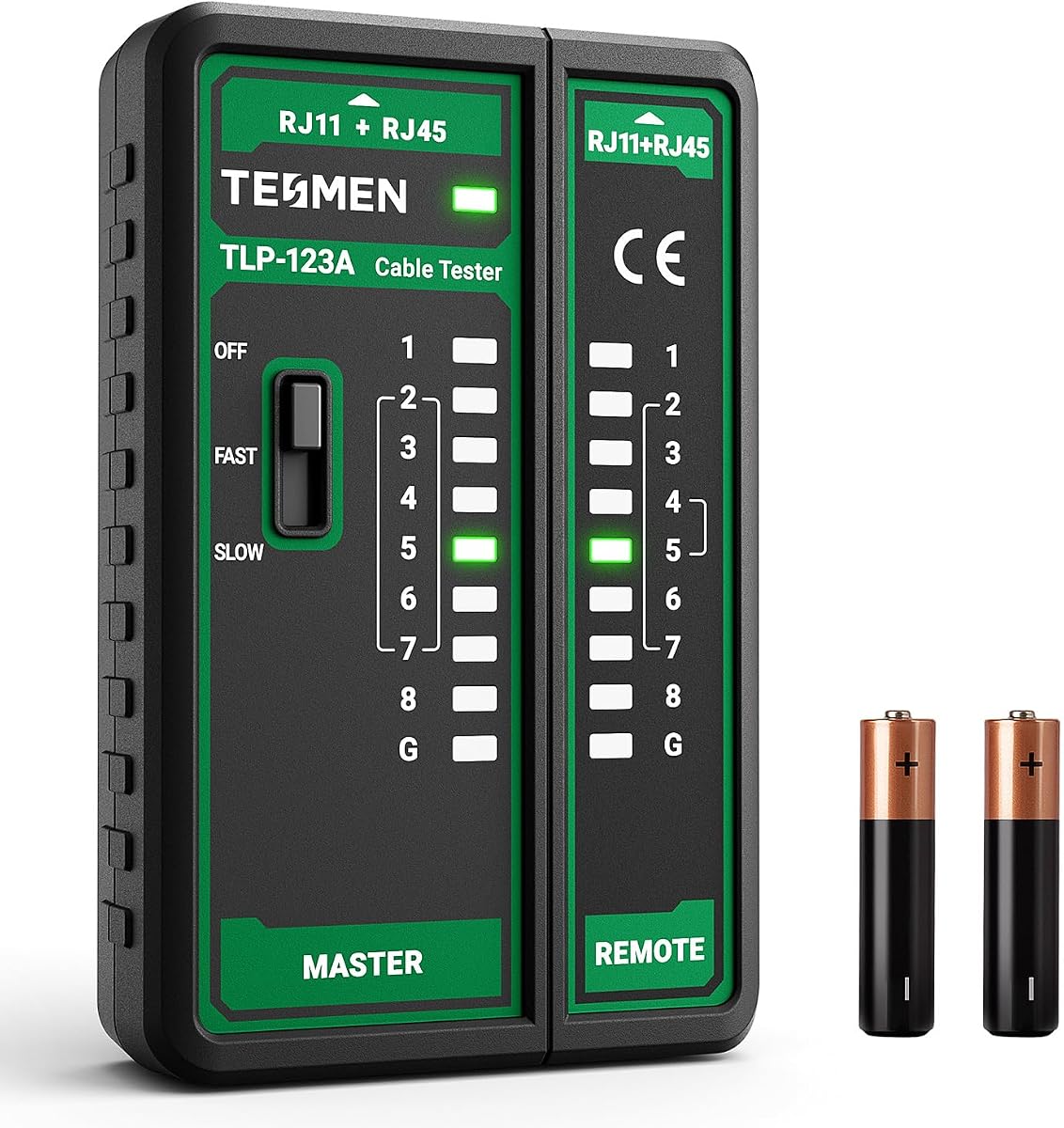
The TESMEN TLP-123A is a straightforward, inexpensive choice for basic continuity and fault checking. It supports RJ45 and RJ11 cables and is listed for CAT5, CAT5e, CAT6, CAT6A, and CAT7 installations, including both UTP and STP wiring. Its 4.6 rating is especially notable for a budget-oriented model, and the detachable main and remote units make it easy to test both ends of longer runs.
We may earn a commission when you buy through this link, at no additional cost to you.
One-button operation and a test-speed adjustment keep the interface approachable. LEDs communicate connectivity, short circuits, open circuits, miswiring, and shielding status without requiring complex menus. The compact housing is made from plastic, and the package includes two AAA batteries, a user manual, and the tester itself. These qualities suit home users, LAN hobbyists, and technicians who need a dependable basic checker.
The limitations are significant for advanced diagnostics. There is no listed numerical length measurement, and the LED interface does not provide the same pin-by-pin wiremap visibility as an LCD model. It also lacks the tracing, PoE, port-flash, and optical functions found in higher-end choices. For long structured-cabling jobs, that means the tool answers whether a cable passes or fails but offers less insight into complex installation errors.
Even so, the TLP-123A fulfills its core purpose very well. Its broad supported-cable list, straightforward indicators, and detachable design make it an excellent affordable companion for checking patch cords, wall runs, and telephone lines. It is the top budget selection for readers who want dependable basic testing without paying for advanced network diagnostics.
The one-button workflow and clear LEDs make results easy to interpret. A homeowner can identify a failed cable without learning a detailed wiremap, while a technician can move quickly through multiple patch cords.
Separating the remote from the main unit allows one person to test a long run ending at a wall outlet or distant jack. Independent operation also makes the tester easier to position around furniture, equipment, and fixed panels.
We may earn a commission when you buy through this link, at no additional cost to you.
The Network LAN Cable Tester with Remote is a compact basic tester designed for technicians and advanced home users who want rapid results without a large display or complex controls. It supports RJ11, RJ12, and RJ45 terminated voice and data cables, as well as CAT3, CAT5e, CAT6, and CAT6A wiring. Its 4.7 rating indicates strong satisfaction for its straightforward purpose.
We may earn a commission when you buy through this link, at no additional cost to you.
A single button starts testing, and fast LED responses classify the outcome as Pass, Miswire, Open-Fault, Short-Fault, or Shield. This gives users more useful fault categories than a simple binary indicator. The remote fits securely inside the tester body, and the whole unit is small enough to carry in a pocket without adding bulk to a tool pouch.
Power management is handled by a 9V battery and an automatic power-off feature, with a low-battery indicator to prevent confusing incomplete results with a genuine wiring failure. As with the TESMEN TLP-123A, there is no listed length measurement, PoE testing, port flashing, or cable tracing. It is therefore a checker rather than a comprehensive analyzer.
This model makes the most sense for routine patch-cord validation, quick checks of installed Ethernet, and basic voice-line troubleshooting. Its compactness is a genuine advantage for mobile use, while the fold-away remote keeps the kit organized. Buyers who need detailed wiremaps or advanced network diagnostics should move up to one of the display-equipped models in this guide.
The pocket-sized body and internally stored remote make this one of the easiest testers to carry. It is well suited to quick checks away from a workbench or during service calls where every piece of equipment matters.
Separate LEDs for pass, miswire, open, short, and shield conditions speed up basic triage. While not as detailed as an LCD wiremap, the categories are more informative than an undifferentiated failure light.
We may earn a commission when you buy through this link, at no additional cost to you.
The NOYAFA Network Cable Tester with Optical Power Meter and VFL is the most all-encompassing device in this guide. It combines digital continuity and scan testing, cable length measurement, PoE checks, port flashing, visual fault location, connector quality testing, optical power measurement, non-contact voltage detection, and automatic shutdown. Its 4.9 rating reflects an exceptionally broad set of capabilities.
We may earn a commission when you buy through this link, at no additional cost to you.
The optical meter supports seven standard wavelengths: 850, 1300, 1310, 1490, 1550, 1625, and 1650 nanometers. Its stated detection range extends from -70 to +10 dBm and accommodates FC, SC, and ST connectors. A 650-nanometer visual fault locator helps identify fiber breakpoints, poor connections, bending, or cracking, allowing copper and fiber troubleshooting to be handled with one kit.
Copper-network functions include wire mapping, short and open testing, PoE mapping and voltage checks, port flash, and cable length measurement to 350 meters. The product is protected against 60 volts DC during PoE testing. A color screen, LED flashlight, 1,500mAh rechargeable battery, Type-C charging, and an included carrying case make it suited to professional field work, although users who only need simple continuity checks may find the setup excessive.
This is the best premium recommendation for network engineers, fiber technicians, and installers who want fewer separate tools. It is particularly valuable when both structured copper cabling and fiber links must be inspected. The combination of color-screen guidance, optical readings, VFL output, PoE handling, and rechargeable hardware justifies its position as a premium multi-function kit rather than a basic cable checker.
Optical power measurement and visual fault location give the kit relevance beyond conventional Ethernet wiring. Technicians can assess fiber signal strength, identify visible breaks, and inspect copper links without carrying a separate optical meter and VFL.
The color display, integrated flashlight, rechargeable battery, Type-C charging, and zippered carrying case support demanding site work. These quality-of-life details can matter as much as the measurement list when a tool is used throughout a long service day.
We may earn a commission when you buy through this link, at no additional cost to you.
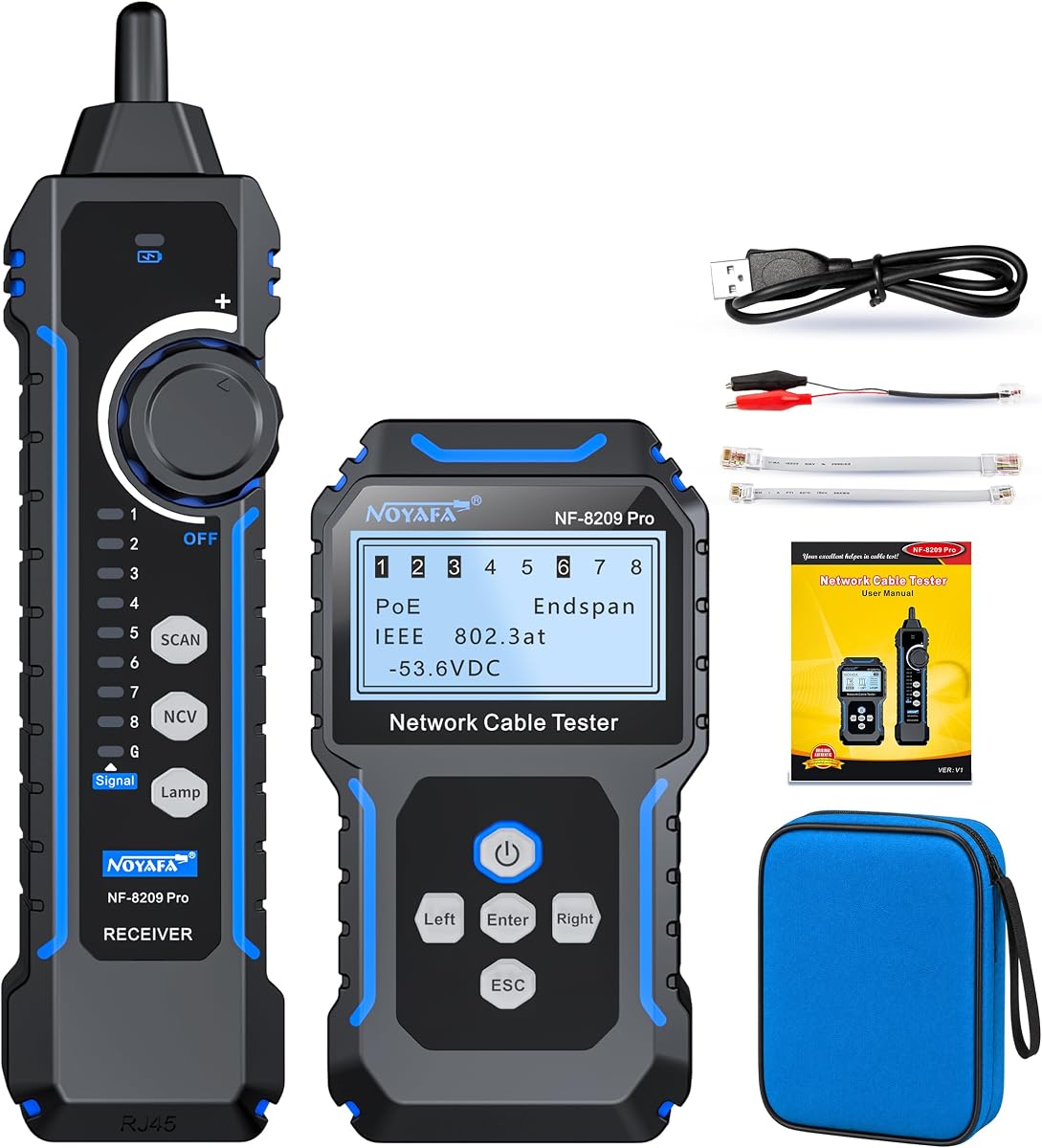
The NOYAFA NF-8209PRO is a professional-style copper cable diagnostic kit with seven principal functions: wire tracking, cable mapping, length testing, PoE detection, port flashing, crimp testing, and non-contact voltage detection. Its 4.8 rating and extensive specification list place it among the strongest all-round choices for network installation and maintenance.
We may earn a commission when you buy through this link, at no additional cost to you.
Digital signal technology is used to minimize false alarms while testing open, short, and cross-connected RJ45 and RJ11 cables, including CAT5 and CAT6 shielded or unshielded wiring. PoE identification covers standard and non-standard power, voltage, and active wire pairs. The stated length range reaches 350 meters, while port flashing assists with matching a cable to a switch port.
An especially practical addition is eight-core RJ45 connector crimp quality verification, which can reveal workmanship problems before a cable is installed. The rechargeable lithium-ion battery, Type-C port, automatic shutdown, low-battery reminder, and flashlight reinforce its field orientation. Its limitation relative to the other premium NOYAFA model is the absence of optical power measurement and an integrated visual fault locator for fiber work.
This tester is best suited to network technicians who need one device for both installation checks and live troubleshooting. It offers a strong balance between copper-focused capability and physical convenience. The broad set of functions will exceed the needs of a casual homeowner, but for a working installer it can consolidate several everyday diagnostic tasks into a single organized package.
Testing the quality of an eight-core RJ45 termination identifies connector workmanship that might otherwise go unnoticed. That makes the NF-8209PRO useful during both cable fabrication and final installation inspection.
Detailed PoE detection works alongside switch-port flashing. This combination helps technicians separate power-delivery problems from ordinary link or cabling issues and identify which port a particular cable activates.
We may earn a commission when you buy through this link, at no additional cost to you.
The NOYAFA NF-8508 is a multifunction network and fiber maintenance tool with nine listed capabilities: continuity testing, cable scanning, port flashing, length measurement, PoE testing, connector quality testing, optical power measurement, visual fault location, and non-contact voltage detection. Its 4.2 rating is supported by a feature set that spans copper cabling and fiber-optic links.
We may earn a commission when you buy through this link, at no additional cost to you.
The optical meter measures the same seven standard wavelengths as the premium NOYAFA combination model and covers the stated -70 to +10 dBm range with FC, SC, and ST connector support. Its 650-nanometer visual fault locator includes fast-flash, slow-flash, and high-precision modes. Built-in self-calibration is intended to maintain stable long-term measurement performance.
For copper networks, the unit can check PoE mapping and voltage, withstand 60 volts DC, trace cables, identify shorts and interruptions, and measure cable length up to 200 meters. Port flashing can reveal operating speed, duplex mode, and negotiation settings on the display. The trade-off is a more complex device, and the 200-meter range is shorter than the 350-meter reach offered by the NF-8209PRO and premium combination tester.
The NF-8508 is a strong fit for technicians who maintain both fiber and conventional network infrastructure and want port-level information in addition to continuity testing. Its rechargeable 1,500mAh lithium battery, Type-C charging, adjustable backlight, and automatic shutdown suit daily use. It is less rational for a homeowner who only needs to identify a failed Ethernet patch cord, but valuable for a mixed-network professional.
Seven-wavelength optical measurement and a dedicated visual fault locator provide more than simple continuity. They help evaluate signal strength and locate visible damage, which is important when fiber problems are not visible at a connector.
Besides making the relevant switch light flash, the tester can display operating speed, duplex mode, and negotiation settings. This adds context that a basic pass-and-fail cable tester cannot provide.
We may earn a commission when you buy through this link, at no additional cost to you.
The TESMEN TLP-528A is a compact, budget-conscious tester that expands on basic continuity checking with connector crimp quality control. It supports RJ45 network cables and RJ11 telephone lines, with listed compatibility for CAT5, CAT6, and CAT7 wiring. Its 4.9 rating is the joint-highest in the guide and reflects strong reception for this combination of simplicity and capability.
We may earn a commission when you buy through this link, at no additional cost to you.
The tester quickly identifies continuity and shielding status and can perform QC checks on crimped connectors. Users can switch between fast and slow test modes using clear LED indicators, allowing a quick screening pass or a more deliberate test process. Its high-quality plastic shell and non-slip silicone provide a durable, secure grip, and the included storage box protects the tool during transport.
The detachable main and remote units can operate independently, making it practical for testing long runs and cables that terminate at a wall-mounted port. The trade-off is the absence of a screen, length measurement, port flashing, PoE detection, and advanced wire tracing. As with other LED-only models, the result is an excellent go-or-no-go and fault-category tool rather than a detailed network analyzer.
This is a strong choice for home users, IT installers, and maintenance teams who want a simple tester with a valuable crimp QC feature. It is particularly helpful when routine work involves making connectors and quickly checking their workmanship. Buyers needing advanced diagnostics can choose from the display-equipped alternatives, while those who value affordability, compactness, and fast LEDs will find this model especially convenient.
The crimp quality check adds a useful layer beyond testing an already assembled cable. It can help reveal whether a connector was terminated properly, reducing the chance that a faulty plug is installed into a patch panel.
Fast and slow modes support both rapid sorting of multiple leads and more methodical individual testing. The simple LED interface avoids unnecessary complexity for common cable-maintenance tasks.
We may earn a commission when you buy through this link, at no additional cost to you.
The best network cable tester depends on the cable types you work with, the faults you need to identify, and whether portability, detailed displays, PoE checks, or fiber testing matter most. Use the following factors to narrow the field before comparing individual models.
Choose broad compatibility when your work crosses service boundaries. Select a focused RJ45 model when your tasks are limited to standard Ethernet and simpler operation is the priority.
Prioritize pin-to-pin wiremaps for installation work. Choose clear pass, open, short, and miswire indicators for routine, high-volume cable checks.
Look for tracing and port flashing if you work through structured cabling. Confirm whether the required probe or accessories are included before buying.
Choose detailed PoE testing for cameras, access points, and VoIP equipment. Confirm voltage limits and live-testing compatibility before connecting to energized systems.
Match the measurement range to your longest run. Higher figures are useful in buildings and structured cabling, while short patch leads need little more than basic continuity testing.
Use LEDs for quick, repetitive testing. Choose a screen when detailed results and easier interpretation are worth the added complexity.
Consider battery format, recharge time, included cables, storage, and required probes together. The most complete kit is not always the most convenient one for daily carry.
Begin by identifying the cable, connector, and test required. Disconnect the cable from active network equipment unless the manual explicitly states that the tester is designed for live PoE, port-flash, or electrical checks. Connect the main and remote units to the two ends, select the appropriate test mode, and allow the display or indicators to stabilize before interpreting the result.
For a wiremap or continuity test, compare every conductor position and fault category with a known-good cable or the expected pinout. If the result indicates a short, open, miswire, or split pair, inspect the connectors, patch cord, and termination rather than assuming the installed cable is the only possible cause. For tracing and port identification, keep the receiver moving slowly near the cable bundle and adjust sensitivity when necessary.
Care for the tester by protecting its display, connectors, probe tips, and battery contacts from impact, moisture, and debris. Use the specified battery or charging cable, and replace or recharge batteries according to the manufacturer's instructions. Store probes and adapters in the supplied case, remove batteries from long-term storage if the manual recommends doing so, and recalibrate optical equipment only in accordance with its guidance.
A network cable tester checks whether conductors connect correctly between the ends of a terminated cable. Basic models identify pass, open, short, and miswire conditions, while advanced models may also detect split pairs, shield faults, cable length, broken pairs, PoE, and active ports. The exact functions depend on the model, so check the supported cable types and test modes before purchasing.
Some advanced testers can verify supported network speeds or make connected switch ports flash, but most basic continuity testers cannot measure live Ethernet performance. The FNIRSI LPM-10A lists 10, 100, and 1000 Mbps verification, while the NOYAFA NF-8508 can display port operating speed and duplex information. These functions should not be confused with a full bandwidth or certification test.
Yes, because a split pair can allow a cable to pass basic continuity checks while producing unreliable network performance. The Klein Tools VDV526-200 and VDV501-851 both specifically identify split-pair faults. Detailed wiremap models are particularly useful when a link is unstable, intermittent, or fails despite appearing electrically continuous.
PoE detection is valuable if you work with powered Ethernet devices such as cameras, VoIP phones, or wireless access points. It can reveal whether power is present and, in advanced models, show voltage, polarity, and active pairs. The Klein Tools VDV501-851 is explicitly not designed to test PoE, so it is better suited to unenergized cable diagnostics.
Only if it includes an optical power meter and visual fault locator. The NOYAFA Network Cable Tester with Optical Power Meter and VFL and the NOYAFA NF-8508 measure multiple optical wavelengths and provide a 650-nanometer visual fault locator. Most copper-focused testers in this guide cannot inspect fiber signal strength or locate visible fiber breaks.
It depends on the model and how the kit is supplied. The Klein Tools VDV526-200 and VDV501-851 use multiple-style tone generation but list the VDV500-123 analog probe as a separate accessory. Other kits, such as the FNIRSI LPM-10A and several NOYAFA combinations, include transmitter and receiver units for digital cable tracing.
Continuity testing checks whether conductors and connections form the expected paths. Length testing estimates the length of a cable or individual pair, which can help identify a break or confirm that a run matches its expected distance. A tester with both functions can both validate the termination and estimate whether the physical cable run is intact.
An LED tester is usually faster and simpler for routine sorting of patch cords, while a display is better for detailed wiremaps, length readings, PoE data, and port information. If you diagnose difficult installation faults, a display offers more context. If your work mainly consists of quick pass-or-fail checks, the TESMEN and compact LED models can be sufficient.
The Klein Tools VDV526-200 is the strongest all-around selection because it combines a readable backlit wiremap with thorough RJ45 fault detection, useful tone options, and automatic shutdown. The NOYAFA optical combination model is the premium choice for technicians who also maintain fiber, while the TESMEN TLP-123A provides the best budget balance of supported cable types, detachable design, and simple indicators.
Prioritize the functions your actual work requires. A basic LED checker is enough for frequent patch-cord sorting, a display and detailed fault categories benefit installation work, and PoE, tracing, port flashing, or optical measurement become essential around active networks and mixed infrastructure. Accessories matter too, so verify whether tracing probes, remote adapters, charging cables, batteries, and cases are included.
Product specifications, ratings, availability, and prices can change, so check the current listing and manufacturer guidance before making a final purchase. Also review the supported connectors, maximum measurement range, live-testing limits, and required accessories for the model you select. With those checks completed, the right network cable tester can turn a confusing connectivity problem into a much shorter troubleshooting process.
