
ZIBOO FT-1000W
4.5Editor score
Measures up to 1000 watts
Tracks 80 volts, 35 amps
Backlit hold-function display
Our Multimeter for Solar Panels guide compares 10 PV testers and multimeters across power range, voltage, current, safety, accuracy, portability, and outdoor
A multimeter for solar panels must do more than display voltage and resistance. A useful photovoltaic tester should measure operating power, open-circuit voltage, short-circuit current, and the electrical behavior of a panel without placing the module or technician at unnecessary risk. The right model depends on array size, measurement range, and field conditions.
We compared ten purpose-built solar panel testers and general-purpose multimeters using their published specifications, measurement ranges, safety features, display design, accessories, and stated applications. The list includes self-powered PV meters, MPPT-capable instruments, and rugged multimeters that can be adapted for panel testing with appropriate leads.
Each review explains the strongest use case, notable limitations, and the kinds of technician or homeowner for whom the product makes sense. Ratings and specifications reflect the supplied product information, while availability and configurations can change, so readers should confirm current listing details and compatibility before purchasing.
4.5Editor score

4.6Editor score

4.8Editor score
The table below compares all ten instruments by measurement capacity, photovoltaic specialization, safety features, and field practicality. Purpose-built meters provide more direct panel diagnostics, while general-purpose Fluke and Klein Tools models offer broader electrical testing functions for technicians who need one instrument for several jobs.


The ZIBOO FT-1000W is a purpose-built solar panel tester with a 4.5 rating and a stated maximum power measurement of 1,000 watts. It combines maximum-power, open-circuit voltage, short-circuit current, and MPPT-related measurements in one instrument, giving installers a focused tool for evaluating individual photovoltaic modules.
We may earn a commission when you buy through this link, at no additional cost to you.
Its 80-volt voltage ceiling and 35-amp current capacity make it appropriate for many residential and smaller commercial modules. The stated accuracy of plus or minus 0.8 percent is particularly useful when comparing measured performance with a panel's expected output. Auto-ranging simplifies operation, while a backlit LCD and data hold improve readability on rooftops and in other dim locations.
Safety is another strength. The meter carries CAT III 1000-volt and CAT IV 600-volt ratings, uses double-insulated probes, and is described as meeting IEC/EN 61010 standards. IP54 dust and water resistance adds useful protection for outdoor service work, although users still need to apply appropriate electrical precautions and remain within the instrument's measurement limits.
This is a compelling choice for installers who need the core functions of a solar panel tester without moving to a higher-capacity model. It is less suitable for larger strings, higher-voltage systems, or users who also need a general-purpose multimeter with resistance, capacitance, and temperature functions. For compatible modules, it offers a practical balance of capability, portability, and value.
Instead of forcing users to calculate output from separate voltage and current measurements, the FT-1000W presents dedicated photovoltaic test functions. Maximum power, Voc, Isc, Vmp, and current tracking can help reveal degradation, mismatched panels, or shading-related performance problems.
The combination of a backlit display, data hold, auto-ranging operation, and IP54 enclosure supports practical field use. Low-power auto-off also reduces the chance of draining the meter during intermittent troubleshooting sessions.
We may earn a commission when you buy through this link, at no additional cost to you.
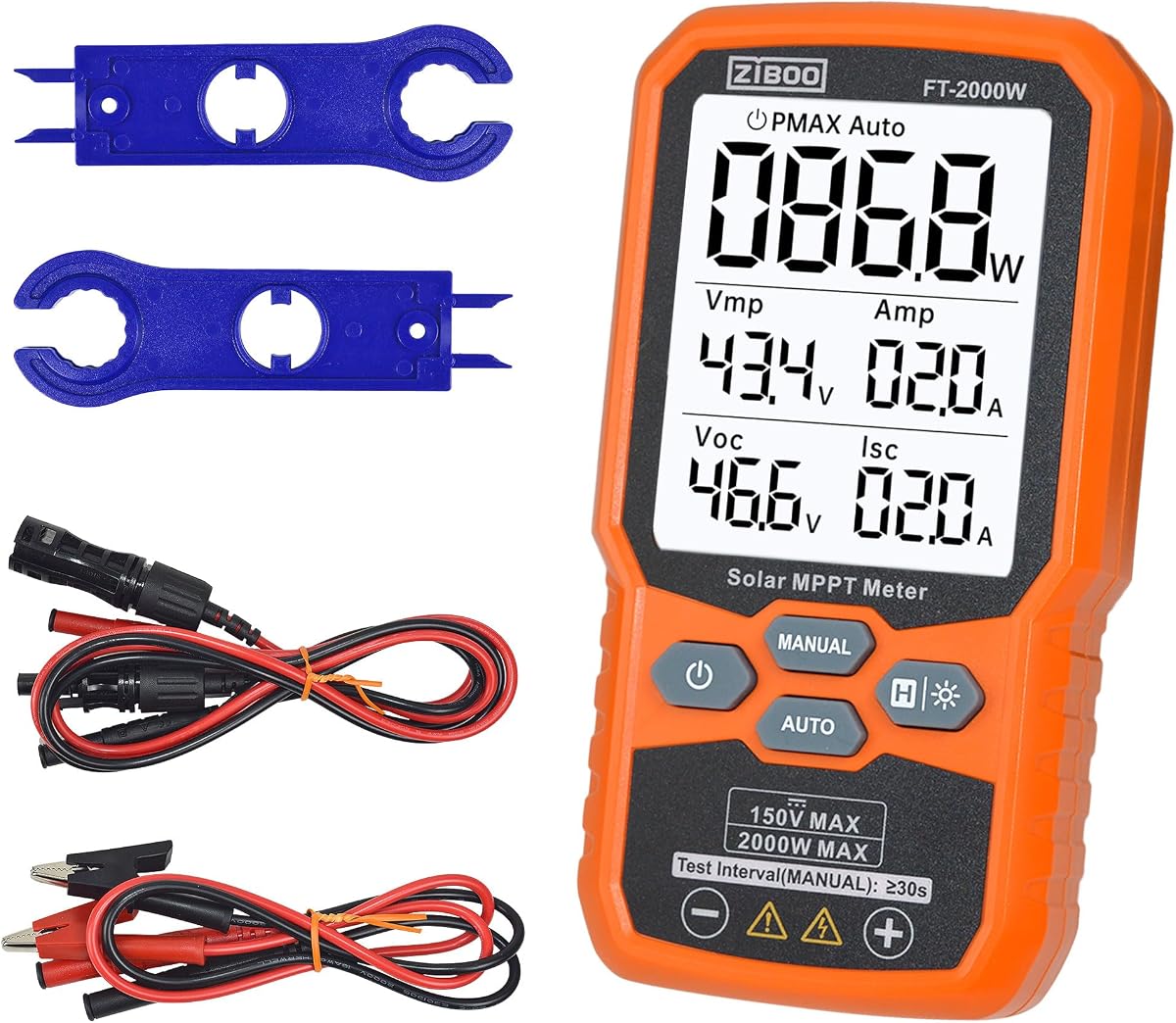
The ZIBOO FT-2000W carries a 4.4 rating and raises the maximum power measurement to 2,000 watts. It is the larger-capacity sibling of the FT-1000W, adding a 150-volt measurement ceiling while retaining a 35-amp short-circuit-current limit and the same stated plus or minus 0.8 percent accuracy.
We may earn a commission when you buy through this link, at no additional cost to you.
The expanded voltage range makes this model more relevant to larger modules, portable solar kits, and photovoltaic equipment that would exceed an 80-volt instrument's limits. It tracks Vmp and current in real time for MPPT-oriented analysis, helping users investigate underperformance, degradation, or shading before undertaking more involved system diagnostics.
Its safety credentials are similar to those of the smaller model: CAT III 1000-volt and CAT IV 600-volt ratings, double-insulated probes, and IEC/EN 61010 compliance. The backlit display, data hold, auto-ranging, IP54 enclosure, and auto-off function all contribute to convenience in outdoor installations and maintenance environments.
Buyers should choose the FT-2000W when their equipment may exceed the FT-1000W's power or voltage limits. A homeowner checking one compact panel may find its extra capacity unnecessary, while an installer working across larger residential or commercial modules can benefit from the additional headroom. It remains focused on photovoltaic assessment rather than broad electrical work.
The 2,000-watt and 150-volt limits provide additional room for testing larger panels without approaching the boundaries of a smaller meter. This makes the FT-2000W more flexible for installers who service varied arrays and portable photovoltaic products.
Real-time tracking of operating voltage and current helps technicians compare a panel's output with its expected behavior. The result is a more informative field tool for locating performance deviations before components or mounting positions are changed.
We may earn a commission when you buy through this link, at no additional cost to you.
The 1800W Solar Panel Tester MPPT Photovoltaic Multimeter is a portable meter designed to measure output power, maximum power point performance, open-circuit voltage, and short-circuit current. It holds a 4.0 rating, placing it among the less highly rated products in this guide, but its published feature set covers the central measurements needed for basic panel assessment.
We may earn a commission when you buy through this link, at no additional cost to you.
A 120-volt maximum voltage and 60-amp maximum current give it useful capacity for a broad selection of modules. The clear LCD allows voltage, current, and power output to be monitored without navigating a complicated interface. No batteries are required, so the instrument draws power from the connected solar panel, reducing preparation time in the field.
The included EVA tool kit, MC4 connectors, and alligator clips make the package practical for portable diagnostics. A user can connect to a module and begin taking readings without a separate supply. The product is described as suitable for comparing multiple panels and assessing output against expected specifications.
This tester appeals to installers, hobbyists, and maintenance users who value straightforward operation and a complete accessory set. Its lower customer rating and limited published detail on accuracy and formal safety categories deserve attention. Buyers who need certification markings, detailed protection specifications, or highly precise comparative measurements may prefer one of the better-documented UNI-T, Fluke, or ZIBOO models.
Because the meter is powered by the connected panel, technicians can carry it to a roof or remote location without managing meter batteries. The included connection options reduce the number of adapters required for routine testing.
The interface emphasizes the values most users need when checking a module: power, voltage, current, Voc, and Isc. This makes it useful for a straightforward comparison between panels or for evaluating output under different placement conditions.
We may earn a commission when you buy through this link, at no additional cost to you.
The FROGBRO 1600W MPPT Solar Panel Tester is a compact photovoltaic meter with a 4.4 rating. It is designed to measure voltage, current, and power, and it can help assess whether a panel is working as expected, compare the quality of different photovoltaic products, and identify a favorable installation angle or location.
We may earn a commission when you buy through this link, at no additional cost to you.
Its defining limitation is array topology. The product cannot measure multiple panels connected in series, although it can test panels connected in parallel. This makes the tester more useful for portable solar, foldable panels, vehicle or marine kits, and roof modules that operate within its 1,600-watt and 60-volt boundaries.
The large LCD is designed for readability in direct sunlight, a meaningful advantage during rooftop work. Two types of connecting cable, including MC4 leads and alligator clips, support different connection needs. The unit is self-powered, while over-voltage, over-temperature, over-current, and over-power protections add layers of operational safeguards.
This is a strong fit for users who routinely work with parallel-connected modules and value portability. It is a poor match for series-string testing or higher-voltage systems. The brand also highlights a 12-month replacement service, which may provide added confidence, but buyers should still follow safe isolation procedures and avoid exceeding the stated panel-power limit.
The ability to test several panels in parallel differentiates this model from meters intended only for isolated modules. That makes it useful for assessing common-output portable and residential panel groups when the combined configuration remains within the meter's limits.
A large display with sunlight-readable output improves usability when technicians work on rooftops or in open areas. The self-powered design and included cable assortment further reduce setup time and dependence on field accessories.
We may earn a commission when you buy through this link, at no additional cost to you.
The Fluke 87V Max is a premium True-RMS digital multimeter paired with solar test leads, and it carries the highest customer rating in this selection at 4.8. Unlike dedicated PV meters that focus on maximum power, Voc, and Isc, it is a broad electrical instrument that also serves professional troubleshooting beyond solar installations.
We may earn a commission when you buy through this link, at no additional cost to you.
Its main solar advantage is the included MC4 lead set, which is designed for meters accepting four-millimeter banana plugs. The leads are rated CAT III 1000 volts and CAT IV 600 volts, matching the meter, while the product information specifically notes that they can measure PV-array voltage safely and accurately.
Physical construction is a major strength. The IP67 case provides dust and water protection, and the unit withstands drops of up to four meters. These qualities suit demanding jobsites, rooftop environments, and service work where a lesser enclosure could be vulnerable to dust, moisture, or accidental falls.
The trade-off is that the 87V Max does not automatically replace a dedicated MPPT or maximum-power analyzer. It is most compelling for electricians, solar technicians, and facilities professionals who want a rugged, trusted multimeter plus appropriate PV access. Buyers focused strictly on module output analysis may prefer a purpose-built solar meter, while those handling broader electrical faults will find this package more versatile.
The included MC4 leads remove much of the guesswork involved in connecting the meter to photovoltaic equipment. Their stated CAT III 1000-volt and CAT IV 600-volt ratings align with the instrument and support safe, accurate PV-array voltage measurements when used correctly.
An IP67 enclosure and four-meter drop resistance make the meter suitable for harsh service environments. The included holster adds another layer of protection and makes the instrument easier to carry between installations.
We may earn a commission when you buy through this link, at no additional cost to you.
The 1600W Solar Panel Tester MPPT Photovoltaic Multimeter offers real-time measurement of maximum power, Voc, Isc, voltage, current, and output performance. Its 3.9 rating is the lowest among the ten products, so buyers should weigh its simple feature set against the stronger ratings and more extensive specifications of the alternatives.
We may earn a commission when you buy through this link, at no additional cost to you.
Maximum current is listed at 60 amps, while maximum voltage is limited to 60 volts. The 1,600-watt power designation and 60-amp current ceiling provide a useful combination for portable panels, automotive applications, and other modules operating within those limits. Its interface is designed to keep voltage, current, and power information immediately visible.
No batteries are required because the meter operates from the connected panel. MC4 connectors and alligator clips are included, and the supplied EVA kit makes the device easier to transport. The stated applications include comparing actual output with panel specifications, checking several panels, and diagnosing performance issues across different conditions.
The product may suit users who want a portable watt meter with straightforward connections and a generous current limit. However, the lack of a stated accuracy figure, combined with the lowest rating in the guide, makes it harder to recommend over the UNI-T UT673PV or the Fluke bundle. Buyers should confirm that the voltage, current, and power limits match their intended panel before ordering.
The stated 60-amp maximum current gives this model more current-measurement headroom than several higher-voltage competitors. That can be useful for diagnosing portable and vehicle-oriented solar modules, provided the connected panel remains within the stated limits.
Drawing power from the panel simplifies preparation and avoids concerns about maintaining spare batteries. The EVA organizer and supplied connection leads make the package convenient to carry to different field locations.
We may earn a commission when you buy through this link, at no additional cost to you.
The UNI-T Solar Panel Tester is a 2,000-watt solar power meter with a 4.6 rating, making it a strong all-around choice for installers, manufacturers, and advanced solar hobbyists. It measures and captures maximum power point data, voltage, and current across a broad operating range.
We may earn a commission when you buy through this link, at no additional cost to you.
The power range extends from 60 to 2,000 watts, Voc from 12 to 150 volts, and Isc from 5 to 45 amps, with stated accuracy of plus or minus 1 to 1.5 percent. Pmax, Vmp, Imp, Voc, and Isc appear together on one screen, allowing a technician to evaluate several aspects of panel performance at once without cycling through menus.
Protection against reverse polarity, over-temperature, and drops helps support reliable field operation. The extra-large LCD, data hold, and auto power-off function make the meter practical for extended diagnostic sessions. A standard MC4 lead, alligator-clip lead, PV-specific wrench, carrying strap, and three AAA batteries provide a more complete kit than many competing packages.
This meter is best for users who need to test varied modules and want a clear comparison of operating and open- or short-circuit values. It is less convenient than self-powered models because it uses batteries, and its stated accuracy is not as precise as the ZIBOO models' advertised plus or minus 0.8 percent figure. Even so, its broad range, simultaneous display, and complete accessory set make it the most balanced dedicated option here.
Displaying Pmax, Vmp, Imp, Voc, and Isc simultaneously gives users a fuller view of module behavior than a single-value meter. It also makes side-by-side troubleshooting faster because the relevant electrical values remain visible together.
The included MC4 cord, alligator-clip lead, PV wrench, strap, and batteries cover the basic tasks of connecting, assembling, and carrying the meter. Reverse-polarity and thermal protection add confidence during demanding diagnostic work.
We may earn a commission when you buy through this link, at no additional cost to you.
The UNI-T UT673PV is a self-powered solar MPPT meter intended for installers, photovoltaic manufacturers, and end users. It has a 4.2 rating and tests maximum power, peak power voltage and current, open-circuit voltage, and short-circuit current, covering the core measurements required for panel health and fault assessment.
We may earn a commission when you buy through this link, at no additional cost to you.
Its maximum measurement range is 800 watts, with Vmp and Voc spanning 12 to 60 volts and both Imp and Isc reaching 35 amps. That makes it appropriate for many residential and portable panels, although it offers less headroom than the 1,600-, 1,800-, and 2,000-watt models in the guide.
A spacious screen displays measurement results simultaneously, and the interface supports English, French, German, Italian, Spanish, Swedish, Polish, and Czech. Manual and automatic MPPT test modes offer flexibility for different diagnostic situations, while data hold helps retain values. The meter is powered by the connected panel, so batteries are unnecessary.
The package includes a paper manual, cloth bag, MC4 wrench, and an MC4 lead with a Safety Class CAT 0 60-volt rating. Reverse-polarity, over-voltage, over-current, over-temperature, and over-power protection broaden the safety framework. This model is especially attractive to international teams or technicians who want a portable meter without managing batteries.
Broad language support is unusual in the category and helps technicians working across different regions or service teams. It reduces the need to memorize symbols and makes on-site communication easier when the instrument changes hands.
Automatic and manual modes serve different diagnostic needs. Automatic operation simplifies routine checks, while manual control can help an experienced technician observe or compare readings under specific conditions.
We may earn a commission when you buy through this link, at no additional cost to you.
The Klein Tools MM325 is a manual-ranging digital multimeter with a 4.7 rating. It is not a dedicated photovoltaic meter, but its 600-volt AC and DC voltage capability, 10-amp DC current range, and two-megohm resistance range make it a useful general instrument for basic solar troubleshooting.
We may earn a commission when you buy through this link, at no additional cost to you.
Additional functions include continuity, diode, and battery testing. A backlit LCD helps users read the display in low-light conditions, while lead-alert LEDs illuminate to indicate whether the test leads are placed in the correct terminals. That feature can reduce avoidable mistakes when working with unfamiliar lead configurations.
Physical usability is another strength. Test-lead holders on the back keep accessories organized, and a kickstand supports hands-free reading. An optional magnetic hanger is also referenced for users who want another mounting method, although it is not necessarily part of the standard package.
The MM325 is best for a homeowner or general electrician who already understands safe photovoltaic measurement and needs continuity, resistance, and voltage functions in the same tool. It does not provide MPPT analysis, maximum-power tracking, or dedicated PV safety markings in the supplied information. For direct module performance testing, a purpose-built solar meter is the more coherent choice.
Continuity, diode, resistance, and battery functions broaden the MM325's usefulness beyond basic solar voltage checks. This makes it attractive for technicians who also service wiring, fuses, controllers, or other electrical accessories.
The lead-alert LEDs give immediate feedback about terminal placement. In a busy field environment, that visual cue can improve workflow and reduce the likelihood of selecting the wrong connection for a measurement.
We may earn a commission when you buy through this link, at no additional cost to you.
The Klein Tools MM420 is an auto-ranging True-RMS digital multimeter with a 4.7 rating. Like the MM325, it is a general-purpose instrument rather than an MPPT solar meter, but its 600-volt AC and DC range and 10-amp AC and DC current capacity make it suitable for supporting broader electrical diagnostics around a solar installation.
We may earn a commission when you buy through this link, at no additional cost to you.
Its measurement set includes resistance up to 50 megohms, continuity, temperature, capacitance, frequency, duty cycle, and diode testing. Auto-ranging removes the need to select measurement ranges manually, while True-RMS technology supports more accurate readings on AC signals with waveforms that can challenge an average-response meter.
The backlit display improves visibility in low light. Lead-alert LEDs provide feedback on test-lead placement, and holders on the back, a kickstand, and an optional magnetic hanger make the meter easier to use on extended jobs. The stated 6.6-foot drop resistance is appropriate for residential, business, HVAC, and light-industrial environments.
The package includes test leads with CAT III and CAT IV safety caps, a thermocouple, instructions, and two AAA batteries. The MM420 is a compelling secondary meter for professionals who need broad electrical functions and convenient auto-ranging, but it lacks the dedicated maximum-power, Voc, and Isc analysis offered by purpose-built solar testers. Solar-specific leads and proper PV procedures remain essential.
Auto-ranging makes the MM420 quicker for routine work because the meter selects the appropriate range automatically. True-RMS measurement is particularly useful for electrical diagnostics involving AC signals beyond simple DC continuity checks.
Temperature, capacitance, frequency, duty-cycle, diode, and resistance functions create a versatile tool for solar technicians who also service inverters, batteries, controls, and wiring. The included thermocouple and safety-capped leads expand its immediate usefulness.
We may earn a commission when you buy through this link, at no additional cost to you.
Choosing the right solar panel multimeter starts with the equipment being tested and the measurements required to diagnose it. Capacity, photovoltaic safety, connection methods, display quality, and general electrical functions should all be considered before making a selection.
Begin by comparing every intended panel or array with the meter's maximum power, voltage, and current ratings. A model with adequate power capacity may still be unsuitable if its voltage ceiling is too low, while a high current rating is of little value when the panel cannot produce enough current. The 800-watt UNI-T UT673PV and 1,000-watt ZIBOO FT-1000W suit more compact systems, while the 1,600-, 1,800-, and 2,000-watt options support progressively larger testing demands.
Choose a meter with comfortable headroom above your expected output, but do not confuse a headline wattage with a complete compatibility check.
A useful photovoltaic meter should offer maximum power, open-circuit voltage, short-circuit current, and operating voltage and current measurements. MPPT-oriented meters can track the panel at its maximum power point, making it easier to compare actual output with expected performance and investigate shading or degradation. A conventional multimeter can handle basic voltage checks but generally cannot substitute for a dedicated maximum-power analyzer.
Prioritize the specific values needed for your diagnostic workflow rather than assuming every displayed measurement has the same purpose.
For work around photovoltaic arrays, inspect the meter and its leads for suitable CAT ratings and confirm that the accessory being used carries equivalent protection. The ZIBOO models and Fluke bundle list CAT III 1000-volt or CAT IV 600-volt classifications, while the UNI-T UT673PV includes a 60-volt CAT 0 lead. Protection markings do not eliminate the need to isolate circuits, follow manufacturer procedures, and use appropriate personal protective equipment.
Safety compatibility matters as much as the measurement range, especially when the meter and leads are used in different combinations.
MC4 connectors are standard on many modern photovoltaic modules, so an included MC4 lead can greatly simplify testing. Alligator clips are also useful for alternative connections and troubleshooting. Check whether the panel is already fitted with compatible plugs, whether extension leads are needed, and whether the supplied cable length suits the test location. A tester with the wrong connector arrangement can be inconvenient even if its measurement specifications are excellent.
Prefer a kit that includes both the appropriate permanent connector and a flexible clip lead when working across different equipment.
Several solar meters draw power from the connected panel, eliminating the need to carry or replace batteries. This is especially convenient on rooftops, in remote installations, and during quick diagnostic visits. Models powered by removable cells, such as the UNI-T 2000W meter, offer different trade-offs because they are easier to use in low-light or disconnected conditions but require battery management. Consider how and where the instrument will actually be used.
Self-powered operation is a convenience, not a substitute for confirming that the meter's limits match the panel.
Roof and outdoor work can expose a display to glare, while shaded equipment compartments may be too dark for a basic screen. A large LCD, sunlight-readable characters, backlighting, and simultaneous result display all improve usability. Data hold is also useful when values need to remain visible while the probes are moved. The UNI-T 2000W model is especially notable for showing five photovoltaic values together, while the FROGBRO tester emphasizes a large sunlight-readable display.
Choose a screen that remains clear under the lighting conditions you expect, not just one with a large physical display.
A dedicated solar meter concentrates on Pmax, Vmp, Imp, Voc, Isc, and panel health, making it the more direct choice for module evaluation. A general multimeter adds continuity, resistance, diode, capacitance, temperature, and other functions useful for investigating controllers, batteries, wiring, and inverters. The Fluke 87V Max bundle bridges these categories by adding MC4 solar leads to a professional general-purpose meter, while the Klein Tools models are best viewed as versatile supporting instruments.
Owning one of each type can serve different stages of a service workflow, but a single buyer should select the category that matches most of the required tasks.
Field instruments should be easy to carry, protected from dust and moisture, and capable of surviving the inevitable drop. The ZIBOO meters offer IP54 protection, the Fluke 87V Max has an IP67 case and four-meter drop resistance, and the Klein Tools MM420 is stated to withstand a 6.6-foot drop. Self-powered designs, compact cases, lead storage, kickstands, and wrist straps can make a meaningful difference when moving between panels or working on a roof.
Prioritize the level of protection your normal work environment actually demands, then verify that the accessories can withstand the same conditions.
Before testing, review the meter and lead instructions, identify the panel's rated voltage and current, and confirm that your planned measurement falls within both limits. Disconnect the photovoltaic module from other equipment or loads when the instrument or manufacturer requires isolation. Inspect connectors for dirt, damaged pins, loose fittings, and signs of arcing, then connect the leads with the equipment powered only as directed by the user manual.
Select the photovoltaic or MPPT function that matches the intended measurement and allow the display to stabilize. Record the relevant voltage, current, and power values along with weather, shading, orientation, and panel temperature. For troubleshooting, compare the results with the module's expected specifications and repeat the reading under similar conditions before concluding that the panel is faulty.
Afterward, switch off the meter, disconnect leads carefully, and reinstall any protective caps or weather covers. Store the instrument in a dry location away from direct prolonged heat, impact, and corrosive material. Clean the exterior with a dry or lightly damp cloth, avoid flooding openings, and check leads and connectors periodically for wear. Use the specified battery type when applicable and replace cells promptly to prevent leakage.
A regular multimeter can usually measure a panel's voltage and, with the correct current input and connection method, current. It normally will not track the maximum power point or calculate meaningful Pmax output without a dedicated photovoltaic feature. For full performance checks, a solar panel tester is more suitable.
MPPT refers to Maximum Power Point Tracking. A meter with this capability operates the connected panel near its maximum power point and displays related values such as Pmax, Vmp, and Imp. This helps technicians identify underperformance, shading problems, degradation, or mismatched panel behavior.
Only if the meter's voltage and power ratings cover the complete series string. Some meters explicitly support only single-panel or parallel-panel testing, so their instructions and measurement limits should be checked before connection. Never exceed the voltage, current, or power rating of the meter or its leads.
A self-powered meter is convenient for field work because it draws power from the connected panel and requires no battery preparation. Battery-powered models can be more practical when the meter must be powered before connection or used in low light. The choice depends on the intended workflow and the included accessories.
Choose a meter with a voltage ceiling comfortably above the expected panel or string voltage. Residential and portable systems may fit lower ranges, while larger modules and series strings demand more headroom. Also consider the CAT rating of the meter and leads, not just the maximum numeric voltage.
Compatible MC4 leads are the most useful accessory for modern photovoltaic modules, while alligator clips provide flexibility for other connections or troubleshooting setups. A stable connection, protective equipment, and the correct adapters are important. Confirm the connector type, cable condition, and meter compatibility before traveling to the site.
Yes. Irradiance, temperature, panel orientation, and partial shading can change the readings obtained from a photovoltaic module. A meter cannot create operating power that the panel does not receive. Comparisons are most meaningful when panels are tested under similar conditions or when results are interpreted alongside environmental information.
Many manufacturers and product instructions require the panel to be disconnected from other equipment or loads before testing. Doing so prevents the controller from influencing the result and reduces ambiguity. Follow the panel, controller, and meter instructions, and isolate the circuit using appropriate safe procedures.
The ZIBOO FT-1000W stands out as a focused budget option, combining MPPT-oriented measurements, an 80-volt ceiling, a 35-amp limit, and outdoor-oriented protection. The UNI-T 2000W Solar Power Meter is the most balanced dedicated instrument in the guide, offering broad ranges, five simultaneous readings, extensive safeguards, and a complete accessory package.
For professionals who need one dependable meter for solar and broader electrical work, the Fluke 87V Max with MC4 leads is the premium choice. Dedicated PV meters are better for maximum-power analysis, while the Klein Tools models make sense as general-purpose additions for wiring, continuity, resistance, and other electrical diagnostics.
Before buying, verify the meter's voltage, current, and power limits against the exact panels you intend to test. Check lead ratings, connection types, supported array configurations, and available self-powered or battery-powered operation. Current listing details may change, so confirm the final package and specifications at the point of purchase.