
Lenovo ThinkCentre M75Q G2
5.0Editor score
Ryzen 5 PRO 5650GE
16GB DDR4 memory
256GB NVMe storage
Windows 11 Pro
Explore the best Mini PC for Data Analysis options, comparing processors, memory, storage, displays, connectivity, expandability, and portability.
A Mini PC for data analysis should deliver enough processor power, memory, and storage to handle spreadsheets, databases, notebooks, and visualization tools without occupying a large portion of your desk. The best compact systems pair capable hardware with useful monitor support, fast networking, and enough flexibility to grow as your datasets and workflows become more demanding.
We compared ten mini PCs using their stated processor configurations, memory, storage, display capabilities, ports, networking, upgrade options, warranty information, and customer ratings. The list covers business desktops, renewed systems, AI-focused models, and compact Ryzen alternatives, giving both practical office users and demanding analysts a range of configurations to consider.
Each review explains where a particular mini PC fits best, from economical everyday analysis to larger local AI and virtual-machine workloads. Ratings and product configurations can change over time, and current availability may vary, so check the latest listing details and confirm software compatibility before purchasing.
5.0Editor score

4.8Editor score

4.3Editor score
The table below highlights the core processor, memory, storage, and display characteristics of all ten mini PCs, making it easier to compare everyday business systems with high-memory and expandable workstation-style models.
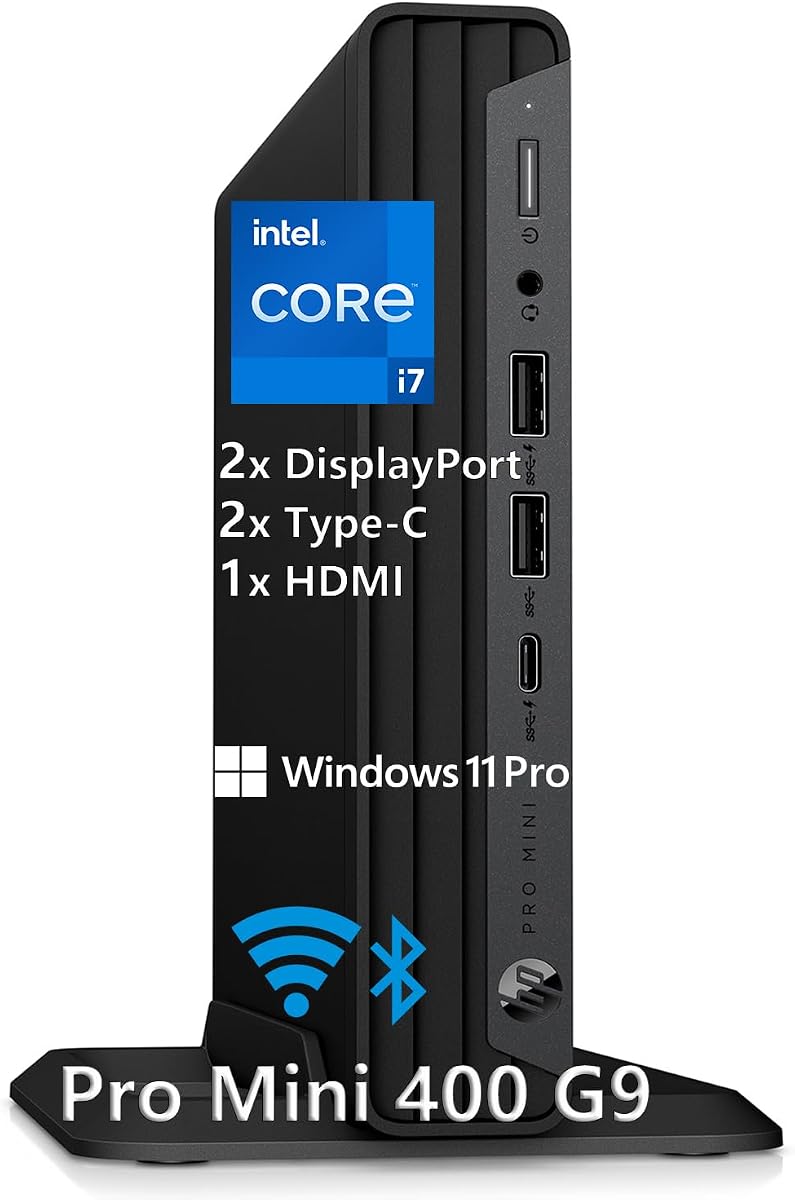


This HP Mini Desktop PC combines a 12th-generation Intel Core i7-12700T with 16GB of DDR4 memory and a 512GB NVMe SSD, making it a strong all-around option for data analysis. Its 4.7 rating reflects a favorable customer impression, while the three-monitor capability is especially useful when separating raw data, reports, dashboards, and documentation.
We may earn a commission when you buy through this link, at no additional cost to you.
The 12-core processor provides a useful foundation for spreadsheet analysis, database queries, browser-based analytics, programming environments, and simultaneous communication applications. DDR4 memory supports heavy multitasking, while the NVMe drive supports rapid application loading and quick access to active project files. Two DisplayPort 1.4 connections and HDMI 2.1 allow three 4K displays at 60Hz.
Connectivity is another strength. The system lists seven high-speed USB ports, including two USB-C ports with 20Gbps throughput, along with Gigabit Ethernet, Wi-Fi 5, and Bluetooth. Windows 11 Pro, a wired keyboard, a wired mouse, a 90W adapter, and a stand are included, reducing the number of extra items required for a basic setup.
The main limitation is that 16GB of memory and 512GB of storage may feel limited for very large datasets, local AI models, or numerous virtual machines. Even so, the processor, monitor flexibility, Pro operating system, and generous port selection make this a compelling recommendation for analysts who want one compact system to cover office, technical, and visualization work.
Three 4K outputs can reduce the need to switch among overlapping windows. An analyst could keep a raw dataset in one display, a visualization dashboard in another, and documentation or messaging on the third.
Windows 11 Pro and the included keyboard, mouse, adapter, and stand reduce setup friction. The range of USB connections also makes it easier to attach storage, adapters, and specialized analysis peripherals.
We may earn a commission when you buy through this link, at no additional cost to you.
The HP Elitedesk 800 is a particularly balanced data-analysis mini PC because it pairs a six-core, 12-thread Intel Core i5 with 32GB of DDR4 memory and a 1TB PCIe NVMe SSD. Its 4.8 rating is the highest among the non-renewed configurations in this guide, indicating strong customer reception across its feature set.
We may earn a commission when you buy through this link, at no additional cost to you.
The 32GB memory capacity is the standout specification for analysts. It provides room for large spreadsheets, multiple browser sessions, database clients, statistical software, and background services compared with a typical 16GB mini PC. The 1TB NVMe drive also offers more room for local datasets, project files, models, and application installations.
Display support includes two DisplayPort 1.4 outputs with Intel UHD Graphics 630, while a rear USB-C port supports DisplayPort Alternate Mode as a third-display option. Connectivity includes front USB-C, several USB-A ports, a 100W USB-C connection with DisplayPort, Gigabit Ethernet, Wi-Fi 6, and Bluetooth. A wired keyboard and mouse are included.
One detail to note is that the listing does not name the specific Intel Core i5 model, although it states a 6-core, 12-thread configuration with up to 4.5GHz turbo and a 12MB cache. Buyers who need a particular processor generation should verify the current listing. Otherwise, the balance of memory, storage, networking, and compactness makes this an excellent general-purpose analysis workstation.
With 32GB of DDR4 memory, this system is better suited than most compact alternatives to simultaneous analysis applications, large data windows, and several productivity tools without relying on a large desktop tower.
The 1TB PCIe NVMe SSD provides useful capacity and fast file access, while Wi-Fi 6, Bluetooth, Gigabit Ethernet, and numerous USB ports make the mini PC adaptable to both fixed workstations and more mobile professional setups.
We may earn a commission when you buy through this link, at no additional cost to you.
The Reatan X8 is the premium option in this guide, combining an AMD Ryzen AI 9 HX 470 with 48GB of Crucial DDR5 memory and a 1TB Crucial PCIe 4.0 NVMe SSD. Its 4.3 rating is lower than those of the two leading business picks, but its specifications target especially demanding analysis, local AI, and development workloads.
We may earn a commission when you buy through this link, at no additional cost to you.
The processor provides 12 cores and 24 threads with speeds up to 5.2GHz, along with Radeon 890M integrated graphics and an NPU advertised at up to 86 TOPS of AI performance. Memory and storage are particularly attractive for advanced workflows because the two DDR5 SODIMM slots support up to 96GB of RAM, while dual M.2 slots can accommodate up to 8TB.
OCuLink gives the X8 a path to dedicated graphics expansion, which is valuable for visual computing, accelerated software, and other GPU-dependent tasks. The system also supports up to four displays through HDMI 2.1, DisplayPort 2.0, and dual USB4 connections, with 8K at 60Hz stated for supported configurations. Wi-Fi 7 and 2.5Gbps Ethernet provide high-speed networking options.
The trade-offs are its higher acquisition cost and greater complexity. It makes most sense for an analyst who can use the 48GB memory, upgrade potential, local AI capability, or OCuLink expansion. For standard spreadsheet and database work, a less advanced system may offer better value without sacrificing the essentials.
The 48GB starting configuration and support for up to 96GB allow analysts to accommodate large working sets and multiple demanding services. Removable Crucial memory also makes future capacity increases more straightforward than with fully soldered configurations.
OCuLink provides a high-bandwidth route for an external desktop graphics card, while 2.5Gbps Ethernet, Wi-Fi 7, and USB4 improve the system’s usefulness for data transfer, remote access, and advanced professional workflows.
We may earn a commission when you buy through this link, at no additional cost to you.
The Glorlin Mini PC pairs an AMD Ryzen 7 8845HS with 16GB of DDR5 memory and a 500GB NVMe SSD. Its 4.7 rating makes it one of the better-reviewed systems here, and the combination of processor power, four-display support, and extensive connectivity is attractive for analysts who want a flexible desk setup.
We may earn a commission when you buy through this link, at no additional cost to you.
The Ryzen 7 8845HS has eight cores, 16 threads, and boost speeds up to 5.1GHz. Its integrated AI NPU is stated at up to 38 TOPS, while Radeon 780M graphics support smooth 4K playback and light graphics work. Four 4K displays can be connected through HDMI, DisplayPort, and dual USB-C connections.
Expansion is another advantage. Memory can be increased to 256GB, and dual M.2 slots support up to 4TB of storage. USB4, USB 3.2, dual 2.5Gb Ethernet, Wi-Fi 6, and Bluetooth 5.3 make this a well-connected system for data transfer, external storage, remote work, and multi-device offices.
The 16GB memory and 500GB storage are the obvious constraints for heavy analysis. A buyer handling large local datasets should budget for additional memory and storage. Even without immediate expansion, however, the CPU, four-monitor capability, dual wired networking, and strong 4.7 rating give this model broad analytical utility.
Four 4K outputs can accommodate several layers of data and communication windows, while dual 2.5Gb Ethernet offers more network options than a conventional office mini PC for shared storage, lab, or server-adjacent setups.
The system supports substantially more memory and dual NVMe storage, giving buyers a way to overcome the limits of the included 16GB and 500GB components as project requirements grow.
We may earn a commission when you buy through this link, at no additional cost to you.
The ACEMAGICIAN S3A combines a Ryzen 7 H 255 processor, Radeon 780M graphics, 16GB of LPDDR5 memory, and a 512GB PCIe 4.0 NVMe SSD. Its 4.6 rating and adjustable performance modes make it an appealing option for analysts who alternate between quieter spreadsheet work and heavier development, editing, or visualization tasks.
We may earn a commission when you buy through this link, at no additional cost to you.
The processor supplies eight cores and 16 threads with speeds up to 4.9GHz, which is suitable for multithreaded analysis, programming, and multiple simultaneous applications. Three performance modes let users select Silent, Auto, or Performance power levels. The listing states that Silent Mode can reduce fan noise to as low as 35dB, making the unit relevant to quiet shared offices.
Triple 4K display support through HDMI 2.0, DisplayPort 2.0, and USB4 Type-C is useful for keeping datasets, code, dashboards, and calls visible at once. Storage can expand to 4TB through a tool-free removable design. Connectivity includes full-function USB-C, USB 3.2, LAN, and display outputs.
Unlike many compact PCs, the 16GB LPDDR5 memory is not presented as user-expandable. That reduces flexibility for unusually large datasets or many virtual machines. Still, the capable CPU, three-monitor support, quiet operating option, and expandable storage make the S3A a well-rounded choice for mixed technical and office analysis.
Silent mode is useful when working quietly, while Performance mode provides more processing power for compute-heavy tasks. Auto mode offers a middle ground for users who do not want to manage power settings manually.
The same display and processor capabilities that support data work can also accommodate programming, photo and video editing, streaming, and light gaming, making the S3A useful outside a dedicated analytics role.
We may earn a commission when you buy through this link, at no additional cost to you.
The Lenovo ThinkCentre M75Q G2 is a budget-oriented business micro PC built around the AMD Ryzen 5 PRO 5650GE, 16GB of DDR4 memory, and a 256GB NVMe SSD. It carries a 5.0 customer rating, and its renewed status, Windows 11 Pro installation, and support arrangement make it an intriguing entry point for everyday analysis.
We may earn a commission when you buy through this link, at no additional cost to you.
The Ryzen 5 PRO 5650GE is positioned for multitasking and business applications, including databases, productivity suites, and data analysis tools. The NVMe drive supports quick access to files and applications, while 16GB of RAM is sufficient for a typical working set containing a browser, spreadsheet software, a visualization tool, and communication applications.
As a renewed product, it is aimed at buyers seeking lower acquisition cost and sustainable reuse. The listing states that it was renewed by the world’s largest Microsoft Authorized Refurbisher and includes free U.S.-based technical support. It also explicitly identifies data analysis and productivity applications as suitable workloads.
The 256GB SSD is the main limitation and may fill quickly with large datasets, software environments, and project files. Renewed condition also deserves attention when comparing warranty and cosmetic details. Within those constraints, the strong processor, 5.0 rating, Pro operating system, and compact business format create a solid budget choice.
The Ryzen 5 PRO 5650GE and 16GB of memory are appropriate for standard business analysis, database exploration, reporting, and simultaneous office applications without moving to a full-size tower.
A renewed system can reduce the cost of acquiring a capable business PC, but buyers should review the condition description, included accessories, warranty terms, and return policy before ordering.
We may earn a commission when you buy through this link, at no additional cost to you.
The Dell OptiPlex 3080 is a renewed micro PC featuring a 10th-generation Intel Core i5-10500T, 16GB of RAM, a 512GB SSD, and Windows 11 Pro. Its 3.7 rating is the lowest among the ten products, so it should be considered with a more measured expectation than the higher-rated alternatives.
We may earn a commission when you buy through this link, at no additional cost to you.
The six-core processor is designed for multitasked office work, and the 16GB memory is adequate for spreadsheets, browser-based reporting, database clients, and common business applications. The 512GB SSD offers twice the capacity of the Lenovo ThinkCentre M75Q G2 while providing fast access to active files and installed software.
Wireless convenience is built in through Wi-Fi and Bluetooth, which is useful for flexible workspaces where a permanent Ethernet connection is unavailable. The listing also notes that the system was renewed by the world’s largest Microsoft Authorized Refurbisher and includes free U.S.-based technical support.
The older processor generation and lower rating are the central trade-offs. It is most appropriate for established business workflows that do not require the newest AI features, very high core counts, or intensive local model workloads. The storage, memory, and Pro operating system still make it a practical way to build a compact analysis station.
A 512GB SSD gives this renewed system more room for applications, working files, and active datasets than many entry-level mini PCs, although serious archive storage may still require an external drive.
Windows 11 Pro, a six-core processor, and included wireless connectivity create a straightforward platform for standard analytics, reporting, database work, and general office productivity.
We may earn a commission when you buy through this link, at no additional cost to you.
The BOSGAME P6 combines an AMD Ryzen 9 6900HX with 24GB of LPDDR5X memory and a 1TB M.2 PCIe 4.0 NVMe SSD. Its 4.6 rating and generous specification mix position it as a capable compact system for analysis, development, content creation, and light gaming.
We may earn a commission when you buy through this link, at no additional cost to you.
The Ryzen 9 6900HX provides eight cores, 16 threads, and speeds up to 4.9GHz. The listing notes smooth 1080p video editing in DaVinci Resolve and support for two or three lightweight virtual machines, which illustrates its potential for workloads beyond basic spreadsheet analysis. The 1TB SSD offers substantial space for applications, models, and project files.
Three 4K displays can be driven through HDMI, DisplayPort, and USB-C, while Radeon 680M integrated graphics handle visual output. Dual 1Gbps Ethernet ports, Wi-Fi 6E, and Bluetooth 5.3 make the system particularly interesting for advanced networking setups, including soft routers, firewalls, home servers, and switching environments.
The 24GB memory is a useful middle ground, but it is listed as onboard LPDDR5X and therefore not expandable. Storage can reach up to 8TB by adding a second M.2 drive, which helps compensate for large datasets. The P6 is a good fit for users who prioritize processor throughput, fast storage, and network flexibility in a small enclosure.
The 1TB NVMe drive provides a generous starting workspace, while 24GB of memory supports substantial multitasking. The lack of memory expansion is worth weighing against future software and virtual-machine requirements.
Dual Gigabit Ethernet ports and Wi-Fi 6E distinguish the P6 from simpler office mini PCs, making it relevant for local services, lab networks, and other connected professional setups.
We may earn a commission when you buy through this link, at no additional cost to you.
The Lenovo ThinkCentre neo 50q Gen 5 uses an eight-core Intel Core 5 210H processor, 8GB of DDR5 memory, and a 512GB PCIe 4.0 NVMe SSD. Its 4.4 rating is solid, and the combination of Windows 11 Pro, discrete TPM 2.0, and a compact 1L chassis makes it appealing for professional and security-conscious environments.
We may earn a commission when you buy through this link, at no additional cost to you.
The processor includes four performance and four efficiency cores with up to 4.8GHz on performance cores and 12MB of Smart Cache. This hybrid arrangement is intended to balance demanding business applications with energy-conscious background work. The 512GB NVMe drive provides fast startup and application access.
Display support covers two 4K monitors through HDMI 2.1 and DisplayPort 1.4b. Connectivity includes Wi-Fi 6E, Bluetooth 5.3, Gigabit Ethernet, front USB-C, several USB-A ports, and audio. VESA compatibility allows the system to sit behind a monitor or under a desk, preserving valuable workspace.
The primary concern is 8GB of memory. That is tight for contemporary analysis, especially when a browser, spreadsheet, Python environment, and database tool are open simultaneously. Because the memory is listed as SODIMM DDR5, an upgrade is likely straightforward, but buyers should confirm the supported capacity and compatibility before ordering.
The discrete TPM 2.0 is TCG certified and FIPS 140-2 certified, while the Kensington security slot supports physical locking. These features suit managed offices and users handling sensitive information.
The 7.05 by 7.2 by 1.44-inch chassis and 2.49-pound weight make the ThinkCentre easy to deploy on a compact desk, hot-desking station, or behind a VESA-compatible display.
We may earn a commission when you buy through this link, at no additional cost to you.
The BOSGAME E5 is built around an AMD Ryzen 5 5300U with four cores and eight threads, 16GB of DDR4 memory, and a 1TB M.2 2280 PCIe NVMe SSD. Its 4.3 rating places it among the more affordable options, with generous storage as the most appealing feature for data files.
We may earn a commission when you buy through this link, at no additional cost to you.
The processor reaches up to 3.8GHz and includes Radeon graphics with a maximum stated graphics frequency of 1500MHz. That is adequate for spreadsheets, databases, documentation, browser-based reporting, and general business analysis. The 16GB memory gives the system a more comfortable multitasking baseline than an 8GB compact PC.
Triple 4K output at 60Hz is available through one HDMI 2.0 connection, one DisplayPort connection, and Type-C. I/O includes three USB 3.2 Type-A ports, one USB 2.0 Type-A port, and two Gigabit Ethernet ports. Storage can scale to 4TB, according to the listing.
The main limitation is the older four-core processor, which will not match the Ryzen 7, Ryzen 9, Core i7, or AI-focused systems for heavy multithreading. Even so, the 1TB SSD, 16GB memory, three-display capability, and dual Ethernet make this a sensible value choice for standard analysis and office-based reporting.
A 1TB NVMe drive is unusually generous for an entry-oriented mini PC and provides room for larger working directories, multiple applications, and project files without immediate storage pressure.
Three 4K outputs support expanded workspaces, while two Gigabit Ethernet ports offer useful options for connected labs, file-transfer environments, and dedicated network roles.
We may earn a commission when you buy through this link, at no additional cost to you.
The right data-analysis mini PC depends on the size of your datasets, the software you use, the number of applications and monitors involved, and whether local AI, virtual machines, or graphics acceleration are important. Use the following factors to narrow the field before comparing the final configuration.
A modern processor with at least six cores is valuable when compiling code, querying databases, processing large spreadsheets, creating visualizations, or running several services simultaneously. The Ryzen 7 8845HS, Ryzen 9 6900HX, and Ryzen AI 9 HX 470 offer eight or more physical cores, while the HP Mini Desktop PC uses a 12-core Core i7. These configurations generally provide more room for parallel work than the four-core Ryzen 5 5300U.
Choose a processor based on workload intensity, not just clock speed. Four cores may be enough for routine reports and database queries, while local AI, virtual machines, and compute-heavy notebooks benefit from more cores and threads. Confirm the operating system and analytical software you plan to run are supported.
Memory determines how many datasets and applications can remain active at once. The 16GB configurations in this guide suit typical office analysis, but 24GB, 32GB, and 48GB provide more headroom for large browser sessions, memory-intensive statistical tools, multiple virtual machines, and local AI software. The Reatan X8 and HP Elitedesk 800 offer particularly generous memory.
Aim for at least 16GB for a new general-purpose analysis system, and consider 32GB or more if your files are large or your workflow runs multiple development environments. Favor a system with removable or replaceable memory when possible, particularly if you expect requirements to increase.
Fast NVMe storage reduces delays when opening projects, loading applications, and moving temporary working files. Capacity also matters: a 256GB drive can fill quickly with software, virtual environments, project data, and model files. The BOSGAME E5, HP Elitedesk 800, and BOSGAME P6 pair 1TB drives with 16GB or 32GB of memory, while the Reatan X8 offers dual M.2 expansion.
For active analysis, choose at least 512GB and add a second drive or external storage if your datasets are large. Check whether storage is user-replaceable and whether the stated maximum capacity uses a specific form factor. Keeping datasets and temporary files on NVMe storage helps maintain responsive workflows.
Multiple displays can materially improve analysis by separating raw records, dashboards, code, reports, and communication windows. The Glorlin system supports up to four 4K displays, the HP Mini Desktop PC supports three 4K outputs, and several other models support two to three displays. A dual-display configuration is often adequate for a focused analyst.
Match the system to your actual desk and workflow rather than maximizing monitor count alone. Confirm connector types, resolution, and refresh-rate support. USB-C display functionality also varies, so check whether the port supports DisplayPort Alternate Mode and whether an adapter is required.
Integrated graphics are sufficient for standard spreadsheets, databases, web dashboards, and general productivity, but specialized analytics may benefit from stronger graphics. The Reatan X8 offers OCuLink expansion for a desktop graphics card, while the HP Elitedesk 800 includes a USB-C port with DisplayPort Alt Mode as a third-display option.
AI-assisted software and local models should be assessed by memory, processor capacity, and accelerator support together. The Ryzen AI 9 HX 470 and Ryzen 7 8845HS include NPU capability, but application support varies. A dedicated GPU through OCuLink may be appropriate for supported accelerated workloads.
Fast networking matters when datasets live on a server, cloud workspace, network share, or external laboratory instrument. Gigabit Ethernet is standard across the guide, while dual 2.5Gb Ethernet on the Glorlin and 2.5Gbps Ethernet on the Reatan support more demanding or specialized network arrangements. Wi-Fi 6 or newer adds placement flexibility where wired access is inconvenient.
Count the ports your workflow needs rather than relying only on headline wireless speeds. Look for USB-A and USB-C connectivity, sufficient display connectors, audio, and an Ethernet option. The BOSGAME P6 and E5 include dual Ethernet ports, while the Glorlin provides dual 2.5Gb LAN for more advanced network roles.
Expandability protects against future needs. Replaceable SODIMM memory, additional M.2 storage slots, and external GPU capability are valuable if your analysis environment will grow. Support terms also matter, especially for renewed systems and smaller brands. The listed coverage ranges from a one-year hardware warranty to multi-year parts support or extended technical assistance.
Check the warranty and support terms before purchase, especially for renewed equipment. Also verify that the included operating system, peripherals, power adapter, and mounts match your needs. A larger investment may be justified when the system offers clear component expansion and dependable support.
Begin by identifying the intended analysis environment and installing the required operating system, drivers, and applications. Connect the appropriate display, keyboard, mouse, and network, then update the system and verify storage, memory, and network recognition. For multi-monitor arrangements, configure each output through the graphics settings and confirm the intended primary display and resolution.
Keep large active datasets on fast NVMe storage, organize projects into clearly named folders, and maintain separate locations for source files, temporary exports, and final deliverables. Use a consistent backup strategy for work that cannot be recreated. Close memory-heavy browser tabs and unused services when running large databases, virtual machines, or local AI tools, and monitor available memory before launching another workload.
Mini PCs generate heat during sustained analysis, so leave clearance around the chassis and use a stable, hard surface. Clean external vents periodically, avoid enclosing the system in a sealed cabinet, and respect the listed power adapter requirements. For a portable setup, shut down fully before transport and protect the device from impact, moisture, and extreme temperatures.
At least 16GB is a practical starting point for spreadsheets, databases, web-based reporting, and everyday statistical work. If you regularly run large local datasets, multiple virtual machines, local AI models, or memory-heavy visualization tools, 32GB or 48GB provides a more comfortable margin. The HP Elitedesk 800 and Reatan X8 are the strongest options in this guide for those larger working sets.
A mini PC can be entirely suitable for data analysis because the work is often bottlenecked by software, data transfer, or network access rather than physical system size. Modern mini PCs with six or more processor cores, 16GB or more memory, and NVMe storage can comfortably handle spreadsheets, databases, notebooks, and dashboards. Compute-heavy modeling, virtual machines, and local AI are better served by higher-core processors and more memory.
Many mini PCs support multiple displays, making them useful for keeping data, visualizations, code, and reports visible simultaneously. The Glorlin supports up to four 4K displays, while the HP Mini Desktop PC supports three. Check the exact connector configuration, resolution, refresh rate, and whether USB-C carries video before buying, since every display port has different capabilities.
Both Intel and AMD mini PCs in this guide can support common analytical software. AMD Ryzen 7, Ryzen 9, and Ryzen AI 9 configurations provide numerous cores and threads, while the Intel Core i7-12700T offers 12 cores and the Core i5 options cover six-core workloads. The better choice depends on your software, memory needs, graphics requirements, and preferred display connectivity.
A renewed business mini PC can be a practical way to obtain a compact analysis system at a lower acquisition cost. The Lenovo ThinkCentre M75Q G2 and Dell OptiPlex 3080 include Windows 11 Pro and support according to their listings. Review the condition, warranty, included accessories, storage health, and return terms, and verify that the hardware meets your software requirements.
Most standard spreadsheet, database, notebook, and dashboard work does not require a dedicated graphics card. Dedicated graphics become more relevant for GPU-accelerated machine learning, large 3D visualizations, advanced rendering, or other specialized software. The Reatan X8 is the notable option here because its OCuLink interface supports external desktop graphics expansion.
Wi-Fi 6, Wi-Fi 6E, or Wi-Fi 7 can provide convenient connectivity for cloud-based datasets and web dashboards, especially in flexible workspaces. Wired Ethernet remains preferable for large transfers, remote datasets, virtual machines, and latency-sensitive workflows. The Reatan, Glorlin, BOSGAME P6, and BOSGAME E5 offer more advanced or dual wired-network configurations than the standard single-port options.
Check the processor, memory, and storage against the demands of your actual software and datasets. Also confirm operating system support, display output, network type, port availability, power requirements, warranty, and whether memory or storage can be upgraded. The HP Mini Desktop PC and HP Elitedesk 800 include peripherals, while the Reatan X8 offers the broadest high-end expansion path.
The HP Elitedesk 800 is the strongest all-around recommendation because its 32GB of memory, 1TB NVMe storage, strong 4.8 rating, dual 4K display support, and extensive connectivity cover most professional analysis needs. The HP Mini Desktop PC offers an excellent alternative for users who prioritize three displays, 12-core processing, and a complete Windows 11 Pro package.
For buyers with demanding local AI, virtualization, or graphics requirements, the Reatan X8 offers the most advanced platform through 48GB of memory, Ryzen AI hardware, OCuLink expansion, quad-display support, and high-speed networking. The Lenovo ThinkCentre M75Q G2 stands out as the budget pick, while the Glorlin, ACEMAGICIAN S3A, BOSGAME P6, Lenovo ThinkCentre neo 50q, Dell OptiPlex 3080, and BOSGAME E5 serve more specialized needs.
Prioritize the components that directly affect your workload: processor complexity for parallel computing, memory for active datasets, NVMe capacity for project files, and display support for your dashboard-heavy workflow. Product prices, ratings, stock status, and configurations can change, so check the current listing and retailer terms before making your final decision.