
RESTMO Water Flow Meter
4.5Editor score
Four practical display modes
Brass threaded inlet and outlet
IPX6 outdoor water resistance
Magnetic water flow meters measure water movement through a pipe without restricting the flow path, making them useful for irrigation, water treatment, industrial monitoring, and household conservation. The best model depends on pipe size, fluid conductivity, installation environment, required accuracy, and whether you need analog signals or app-based reporting.
We compared all ten products by examining their sensing method, stated accuracy, supported flow rates, pipe or connection size, electrical output, enclosure protection, display options, and practical applications. The list includes true magnetic and electromagnetic meters, compact hall-effect sensors, smart water monitors, and clamp-on ultrasonic alternatives where they help fill a particular measurement need.
Each review explains the strongest feature, practical limitations, and ideal operating environment for that model. The top picks represent the most balanced options for different needs, while the remaining products remain worthwhile for specific budgets, pipe systems, or monitoring goals. Product prices and availability can change, so verify current listings before purchasing.
4.5Editor score


As an Amazon Associate we earn from qualifying purchases.
This side-by-side comparison highlights the sensing technology, installation style, measurement capability, and best-use profile of each water flow meter, helping you identify the model that fits your pipe system and monitoring requirements.



The DN25 Digital Electromagnetic Flowmeter is the strongest all-around choice in this guide because it combines a genuine electromagnetic sensing design with a compact integrated transmitter, 0.5% stated accuracy, and both pulse and 4-20mA outputs. Its DN25 size suits one-inch industrial lines, and the product data identifies applications involving wastewater and other conductive liquids.
We may earn a commission when you buy through this link, at no additional cost to you.
Construction details make the meter especially relevant to demanding installations. A PTFE liner, SS316L electrodes, and a carbon-steel body provide resistance to corrosion, wear, and abrasive conductive liquids. The 1.0-16 cubic meter per hour range covers many water-treatment, circulation, and industrial duties, while the IP65 enclosure helps protect the integrated unit from dust and water jets.
The main drawback is installation complexity. This is not a hose attachment or simple inline kitchen gadget; it requires a 24V supply, a DIN flange connection, and careful attention to pipe conditions. Although the product description states 4.0 MPa in one place and 1.6 MPa in another, buyers should confirm the pressure rating for their exact configuration before installation.
It is best for technicians, plant operators, and serious DIY installers who need industrial signal integration rather than a simple volume total. The combination of accuracy, durable wetted materials, compact construction, and real-time outputs makes it the most convincing magnetic water flow meter for a permanent process line.
The 4-20mA output supports continuous real-time monitoring, while the pulse output can contribute to totalization. Together, they make the meter more adaptable to a plant controller, data logger, or independent flow display.
PTFE, SS316L, and carbon steel create a practical combination for conductive liquids and industrial service. Confirm chemical compatibility, flow direction, grounding, and installation clearances before using the meter with a particular fluid or process.
We may earn a commission when you buy through this link, at no additional cost to you.
The DN100 Digital Electromagnetic Flow Meter is designed for larger water lines, particularly drainage and other four-inch installations. Unlike compact hose meters, it uses an unobstructed electromagnetic measuring path, and the supplied description highlights strong negative-pressure immunity along with a digital converter and 4-20mA output.
We may earn a commission when you buy through this link, at no additional cost to you.
Its main operational advantage is the combination of capacity and convenient configuration. The LCD is readable in daylight and darkness, while infrared touch nubs allow parameters to be adjusted without opening the converter cover. The product also states that relatively short straight-pipe runs are sufficient, although the exact requirement should be verified for the selected configuration.
This meter is more specialized than a garden or residential model. Electromagnetic sensors require conductive liquid, and a DN100 installation needs compatible flanges, adequate space, correct grounding, and attention to the manufacturer's installation instructions. A customer rating was not supplied, so buyers cannot use the listing data to compare historical owner satisfaction.
Choose this model when the piping is already sized for DN100 and the installation benefits from a 4-20mA industrial signal. It is a premium large-line choice for drainage, water-supply, and treatment work, but it is not a substitute for a simple hose connector or compact countertop flow sensor.
Because the measuring principle does not require an obstruction in the conduit, this design can avoid the pressure drop associated with some insert-type meters. That makes it attractive where operational efficiency and unobstructed flow are priorities.
Infrared controls allow operators to set parameters without opening the converter housing. This simplifies routine adjustments while helping protect the enclosure from unnecessary exposure to dust and moisture.
We may earn a commission when you buy through this link, at no additional cost to you.
The 1/2-Inch Hall Flow Sensor is the most approachable magnetic sensing option for education, DIY water systems, and compact appliance projects. It has a 4.7 customer rating, a 1-30 liter per minute range, and a half-inch NPT connection. Its sealed hall-effect sensor produces an electrical pulse with each rotor revolution, making it useful with Arduino, Raspberry Pi, and reverse-osmosis equipment.
We may earn a commission when you buy through this link, at no additional cost to you.
The design is straightforward. A small rotating internal component works with the electronic sensor while the wetted sensor remains sealed and dry. Its compact, lightweight body is easy to install in water heaters, coffee machines, purifiers, drinking fountains, and beverage machines where space is limited.
Its biggest limitation is that it is a pulse sensor, not a complete flow meter with a display. The user must provide power, counting circuitry, calibration, and interpretation of the pulse signal. Incorrect flow direction prevents signal output, so careful installation and clear pipe marking are essential.
This is the pick for makers who want a magnetic water flow sensor rather than a finished monitoring appliance. It combines a favorable customer rating with flexible integration and a useful flow range, but it is best suited to technically confident users comfortable wiring and programming the measurement system.
Because the sensor outputs pulses rather than a finished reading, it can feed a microcontroller counter, controller, or custom dashboard. This flexibility makes it useful for prototypes and educational systems where visual feedback is built separately.
The hall-effect sensor is sealed from the water pipe, keeping the electronic sensing section dry. Correct orientation remains critical, so check the indicated flow direction before connecting the signal and power leads.
We may earn a commission when you buy through this link, at no additional cost to you.
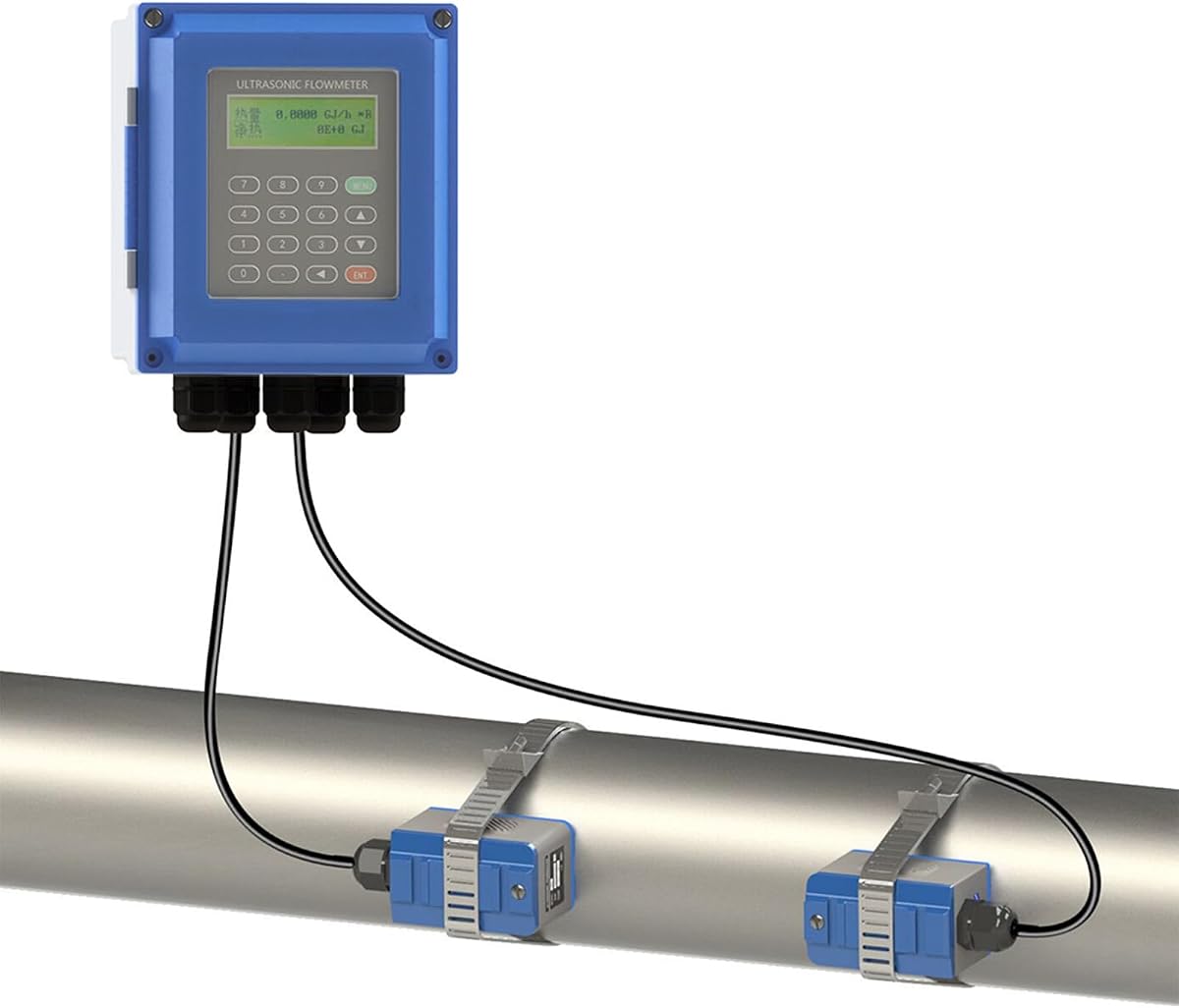
The Digital Ultrasonic Water Flow Meter is a practical clamp-on alternative for water-supply monitoring where cutting into the pipe or adding an inline sensor is undesirable. It uses a flow meter and separate TS-2 and TM-1 ultrasonic transducers, providing a stated measurement accuracy of plus or minus 1% without requiring an obstructing element in the water line.
We may earn a commission when you buy through this link, at no additional cost to you.
Power flexibility is one of its most useful features. The host accepts AC85-264V or DC8-36V, and the complete kit includes transducers, signal cable, steel straps, and silicone sealant. It is described as suitable for copper and PVC pipes and for liquids including seawater, alcohol, and river water.
It does not use magnetic sensing, so buyers searching strictly for an electromagnetic meter should keep that distinction in mind. Clamp-on ultrasonic performance can also depend on pipe material, diameter, wall condition, and transducer placement. The stated liquid and pipe compatibility should therefore be checked against the actual installation rather than treated as a universal guarantee.
This model is best for installers who prioritize a non-intrusive setup, broad electrical compatibility, and a complete installation package. It is a useful alternative for home water supply, heating, water-conservancy work, and light industrial applications where pipe access is limited.
The transducers mount externally, helping preserve the existing pipe and avoid inserting a wetted sensor assembly. Correct spacing, coupling quality, and stable pipe surfaces remain important for dependable readings.
The unusually wide voltage range allows the meter to fit more control environments than a fixed-voltage-only device. Select the correct supply type and follow the wiring requirements for the installation.
We may earn a commission when you buy through this link, at no additional cost to you.
The Bonvoisin Handheld Ultrasonic Flow Meter is built for technicians who need to check flow in an operating pipe temporarily rather than install a permanent meter. Its S1 and M2 sensors clamp outside the line, cover DN15-700mm pipe sizes, and are advertised for copper and PVC applications involving water, alcohol, sewage, and several oils.
We may earn a commission when you buy through this link, at no additional cost to you.
The specifications include plus or minus 1% accuracy, 0.50% linearity, 0.20% repeatability, and a 0.1-6 meter per second velocity range. Readings can be switched between liters and gallons, while a backlit rechargeable Ni-MH battery supports up to 12 hours of continuous work.
The main drawback is the 3.7 customer rating, which is lower than those of the other rated products in the list. In addition, the internal logger can record up to 2,000 groups of data, but the software must be requested from the seller. That creates a small extra step when historical analysis or export is required.
This meter makes sense for maintenance audits, pump checks, temporary flow verification, and surveying several lines without interrupting production. It is not the right choice for permanent automated monitoring because it is handheld and uses clamp-on ultrasonic rather than magnetic sensing.
External transducers allow the operator to survey a live pipe without cutting the line or inserting an obstruction. This is particularly useful for spot checks and comparative measurements across multiple assets.
The internal logger preserves up to 2,000 measurement groups for later review. Accessing the downloadable software requires contacting the seller, so verify that workflow before relying on the meter for formal audit records.
We may earn a commission when you buy through this link, at no additional cost to you.
The RAINPOINT Bluetooth Smart Water Flow Meter is designed for garden sprinklers, hose nozzles, and RV filling where the goal is to understand consumption rather than operate a full industrial process. It connects to the Smart Life app, displays water usage in gallons or liters, and can retain up to one year of historical information.
We may earn a commission when you buy through this link, at no additional cost to you.
Its hardware is thoughtfully adapted to outdoor use. A 180-degree flippable backlit LCD remains readable from different orientations, while 360-degree rotating brass inlet and outlet fittings simplify positioning. An anti-clog filter and IPX5 waterproof design support outdoor hose connections and long-term irrigation use.
Bluetooth is both its key feature and its limitation. The product does not support Wi-Fi, so remote access depends on being within Bluetooth range. Users who require internet-only monitoring from any location should instead consider the YoLink kit with its included hub. The app also remains central to reviewing segmented usage and historical consumption.
This is an appealing choice for homeowners, RV users, and gardeners who want simple water-usage visibility without configuring a programmable industrial transmitter. Its 4.2 customer rating reflects a solid smart-meter option, and the app-focused design makes conservation and irrigation scheduling more convenient.
Dual total counters support five measurement modes, allowing users to separate consumption into useful periods such as monthly or yearly tracking. This makes the data more actionable than a single undifferentiated lifetime total.
Brass fittings, an anti-clog filter, and IPX5 protection make the meter better suited to outdoor hose work than a bare plastic device. The filter still needs routine inspection if the connected water contains sediment or debris.
We may earn a commission when you buy through this link, at no additional cost to you.
The YoLink FlowSmart Kit is the most complete smart-home water monitoring package in the guide. It combines a 0.75-inch meter, monitor, and hub, and it sends real-time leak alerts through the YoLink app on iOS and Android. The included hub is important because the meter does not provide the full feature set without it.
We may earn a commission when you buy through this link, at no additional cost to you.
Its reporting capabilities extend beyond a simple running total. Users can review hourly, daily, weekly, and monthly consumption, save reports, and export the data. Leak detection supports up to six time slots, custom leakage parameters, maximum-volume rules, and automatic valve shutoff behavior when the required hardware and setup are in place.
The kit also supports third-party integration with Amazon Alexa and Google Assistant, making it a natural fit for an existing connected home. The manufacturer advertises battery life of up to 10 years, but actual longevity depends on use, signal conditions, and operating environment. The installation warning is significant: the device should not be exposed to flooding, standing water, condensation, extreme temperatures, or excessive moisture unless properly protected.
This is the best choice for homeowners who want remote alerts, consumption reports, and smart-home integration rather than merely an inline display. The hub-based design adds setup complexity, but in return it supports a more complete and flexible monitoring approach.
Six configurable time slots and both constant and conditional detection modes make the meter adaptable to predictable household use. Maximum-volume thresholds can also help identify abnormal consumption patterns.
The included hub enables remote app operation and potential Alexa and Google Assistant integration. It should be placed where it has a reliable link to the meter and the connected network or compatible smart-home system.
We may earn a commission when you buy through this link, at no additional cost to you.
The RESTMO Water Flow Meter is the most affordable product here that still uses a hall-type magnetic sensor to measure flow. It combines a 4.5 customer rating with real-time flow, last-session consumption, weekly average, and lifetime total modes. A single button controls the display, and a long press changes gallons to liters or resets selected data.
We may earn a commission when you buy through this link, at no additional cost to you.
Its brass inlet and outlet fittings are intended to withstand repeated hose and faucet installation. Heavy-duty ABS adds impact resistance, while the stated IPX6 waterproof grade helps it cope with rain, ultraviolet exposure, and sunshine. The meter also sleeps after one minute without operation or flow to reduce unnecessary power use.
Accuracy is the key compromise. The product states a measurement tolerance of less than 5%, which is useful for checking watering volume and spotting gross overuse, but it does not provide the precision expected from a professional electromagnetic process meter. It also lacks the analog output, totalization pulse, and formal process-control features found in industrial models.
This is the best budget pick for a gardener, cleaner, RV owner, or homeowner who wants an inexpensive way to monitor a hose or faucet. Its magnetic sensing, readable display, durable connectors, and simple controls make it far more useful than a manual estimate, provided the measurement needs are not mission-critical.
Four modes provide a good balance between detail and simplicity. Users can check instantaneous flow, a recent session, a rolling weekly average, or accumulated consumption without configuring a hub or account.
The brass threads are more appropriate for repeated hose removal and installation than lightweight plastic fittings. Keep washers seated correctly and avoid overtightening, which can damage threads or sealing surfaces.
We may earn a commission when you buy through this link, at no additional cost to you.
The TUF-2000B Ultrasonic Water Flow Meter is a more instrument-oriented clamp-on option, with bidirectional measurement, a backlit LCD, and detailed flow information. It supports DN15-700mm pipes and is described as compatible with carbon steel, stainless steel, cast iron, cement, copper, PVC, aluminum, water, wastewater, seawater, and oils.
We may earn a commission when you buy through this link, at no additional cost to you.
Its stated flow-meter accuracy is plus or minus 1%, with a water-meter figure of plus or minus 2%. The maximum flow speed is listed as 64 meters per second with 0.001 meter per second velocity resolution. The fluid-temperature range is 32 to 320 degrees Fahrenheit, and the maximum turbidity figure is 20,000 ppm.
Protection is a major strength. Both transducers have IP68 protection, while the host has IP65 protection, and a fault self-diagnosis function is included. Despite those ratings, transducer spacing, pipe surface condition, coupling method, and diameter still influence measurement consistency, so installation should follow the supplied guidance carefully.
This model is best for maintenance teams that need forward, reverse, net cumulative, and velocity information across varied pipe systems. It is not technically a magnetic water flow meter, but it is a relevant high-specification alternative when a non-invasive industrial survey is needed.
Bidirectional measurement separates positive, negative, and net cumulative flow, which is useful when investigating recirculation, reverse movement, or net transfer. This visibility makes the meter more useful than a model that reports only one flow direction.
IP68 transducers and an IP65 host suit wet or dusty utility environments. Protection ratings reduce environmental risk, but correct cable routing, sensor spacing, and secure strap placement remain essential to measurement quality.
We may earn a commission when you buy through this link, at no additional cost to you.
The IP68 Metal Garden Hose Flow Meter combines an aluminum alloy body with a stated accuracy of up to plus or minus 1%, making it a compelling outdoor option for garden hoses, RV filling, pools, and lawn sprinklers. Its 4.4 customer rating places it among the better-reviewed products in the guide.
We may earn a commission when you buy through this link, at no additional cost to you.
The sealed IP68 construction is designed to withstand rain, splashes, and wet outdoor conditions. A 360-degree rotatable LCD keeps readings visible from different hose positions, while automatic screen shutdown after 10 minutes extends standby life to more than a year. A low-battery alert and replaceable-battery design simplify long-term maintenance.
The aluminum housing offers better impact resistance than plastic, but the meter remains intended for relatively compact hose and sprinkler work rather than large industrial pipelines. The supplied data also provides less detail about connection size, output signals, and flow range than some other listings, so those specifications should be confirmed before purchase.
This model is best for outdoor users who prioritize a rugged body, strong sealing, and a readable display over smart connectivity. It offers a useful blend of accuracy and durability for tracking batch volume, total use, and real-time flow in frequently handled outdoor systems.
The aluminum alloy housing is less prone to cracking during connection, removal, or accidental drops than a typical plastic shell. It remains important to avoid crushing the display or seals with tools during installation.
Automatic shutdown and easy battery replacement reduce the need for frequent servicing. A low-battery warning provides notice before readings become unreliable, although actual standby duration varies with use and environmental conditions.
We may earn a commission when you buy through this link, at no additional cost to you.
The right water flow meter depends on what you need to measure, where it will operate, and how the reading will be used. Start with the sensing principle and required flow range, then narrow the field by pipe size, installation method, outputs, accuracy, and environmental protection.
A true magnetic water flow meter uses electromagnetic induction or a magnetic hall effect to detect moving conductive liquid. Full-bore electromagnetic meters are suited to industrial water, wastewater, and process lines, while compact hall sensors are common in appliances, purifiers, and maker projects. Ultrasonic clamp-on models are not magnetic, but they can be useful alternatives when a pipe cannot be opened or drained.
Match the meter's connection to the actual pipe inside diameter, not merely the nominal pipe label. The DN25 model uses a one-inch DIN flange connection, the DN100 model targets a four-inch line, and the hall sensor uses a half-inch NPT thread. Compact hose meters need compatible fittings, while clamp-on meters must fit the permitted pipe-diameter range and have enough straight pipe and surface area for sensor placement.
A meter should cover the lowest and highest flow rates expected during normal operation. The DN25 industrial model is rated for 1.0-16 cubic meters per hour, and the half-inch hall sensor covers 1-30 liters per minute. Small hose meters may lack published maximum-flow figures, while ultrasonic systems use pipe size and fluid velocity to determine practical capacity. A sensor that is too large may lose resolution at low flow, while one that is too small may be overloaded.
Accuracy should reflect the purpose of the measurement. A plus or minus 1% instrument is appropriate for process control, irrigation audits, and detailed water management, while a less-than-5% hall meter is more suitable for rough household conservation. The product specification sometimes uses several terms, including accuracy, linearity, repeatability, and tolerance, so compare like with like and read the complete description rather than focusing on one headline figure.
Decide whether you need a local display, pulse signal, 4-20mA output, Bluetooth app, or internet-connected hub. Pulse outputs can be counted by a controller, 4-20mA supports long-distance process signals, Bluetooth works within range, and a hub-based system can support broader smart-home integration. Display-only meters are simplest but offer less automation and historical analysis.
Inline meters require correct fittings, adequate straight pipe, and sometimes grounding, calibration, and a reliable power source. Hall sensors must be oriented with the pipe flow, while ultrasonic sensors require consistent spacing, clean surfaces, and secure straps. Smart inline meters need adequate clearance around the electronics, and clamp-on sensors must be fitted to a rigid, appropriately sized pipe for repeatable results.
Indoor and outdoor requirements differ substantially. IP65 protects an integrated unit against dust and water jets, IP68 indicates stronger temporary immersion protection, and IPX5 or IPX6 offers outdoor splash resistance with different levels of water-jet protection. Also consider UV exposure, temperature extremes, condensation, flooding, corrosion, and whether the meter will be handled frequently. A high IP rating does not excuse poor sealing during installation.
Industrial electromagnetic meters may require a 24V supply, ultrasonic hosts may accept broad AC or DC ranges, and smart residential meters often use replaceable batteries. Bluetooth-only devices depend on local proximity, whereas hub-based products add a network and power requirement. Compare installation complexity with convenience: a permanently wired meter is usually better for continuous process monitoring, while a battery-powered display is more suitable for occasional hose checks.
Begin by identifying the fluid, pipe material, diameter, expected flow range, and required output before installation. Confirm that the meter supports the liquid and pipe size, shut off or depressurize the line where necessary, and follow the orientation markings. Inline electromagnetic models also need proper grounding and suitable straight-pipe arrangements, while ultrasonic sensors must be spaced and coupled consistently.
After installation, check for leaks and verify the reading against an independent estimate or known reference flow. Calibrate the sensor if the device supports user adjustment, particularly for hall-effect units whose pulse rate must be translated into volume. Configure the display, totalizer, alarms, app notifications, or analog scaling before relying on the data for billing, leak response, or automated control.
For care, clean or inspect filters regularly, keep electronic housings dry unless their rating permits wet exposure, and protect cables and seals from sunlight, chemicals, and physical damage. Check battery levels, sensor coupling, and connections periodically. Store portable meters in a dry case, and do not open a wet battery compartment; for industrial equipment, follow the manufacturer's service and calibration schedule.
A magnetic water flow meter detects conductive liquid moving through a pipe using magnetic or electromagnetic principles. Full-bore electromagnetic models provide process-grade flow data and electrical outputs, while compact hall sensors generate pulses that can be counted by a controller. Neither type requires an obstruction in the water path like some older mechanical designs.
Full-bore electromagnetic meters generally require a conductive liquid because the measurement depends on the fluid carrying an induced electrical field. Oils, alcohol, and other low-conductivity liquids may not work reliably. Hall-effect impeller sensors can measure some nonconductive liquids because they detect physical rotation, but each fluid and material combination should be checked for compatibility.
No. An ultrasonic meter measures flow by timing sound signals through moving fluid, while a magnetic meter relies on electromagnetic induction or magnetic sensing. The ultrasonic models in this guide are included as practical alternatives for users who need non-invasive pipe measurement or broader liquid compatibility, not as substitutes for a true magnetic sensing product.
A tolerance below 5% can be adequate for checking hose usage, watering schedules, or identifying obvious waste. A stated accuracy of plus or minus 1% is more appropriate when monitoring irrigation volume, comparing multiple runs, or making process decisions. Accuracy specifications should also be considered alongside repeatability, calibration, pipe fit, and fluid conditions.
Full-size electromagnetic transmitters require a power supply, commonly 24V DC in the products featured here, and they may also require proper grounding. Compact hall sensors also need power for their electronics and signal output. Battery-powered hose and smart meters are more self-contained, while app-connected systems may additionally require a nearby hub.
Clamp-on ultrasonic meters can be installed without cutting the pipe, making them convenient for surveys and operating systems. Inline magnetic and hall meters must interrupt the pipe and use the correct threaded or flanged connections. For an inline installation, isolate and drain the line, secure the fittings, check seals, and reopen the line slowly to prevent damage from trapped pressure.
The RESTMO meter, RAINPOINT smart meter, and IP68 metal garden hose meter are the most directly relevant options in this list. The RESTMO offers an inexpensive local display, RAINPOINT adds app-based history, and the metal model prioritizes rugged outdoor construction. Choose based on whether you need smart tracking, simple readings, or maximum physical durability.
A missing reading can result from incorrect flow direction, inadequate pipe fill, air in the line, poor grounding, incompatible fluid conductivity, or an incorrect flow-rate setting on a hall sensor. Check installation markings and power first, then confirm that the fluid is conductive and the meter is operating within its stated range. Industrial troubleshooting should follow the manufacturer's calibration and electrical-check procedures.
The DN25 Digital Electromagnetic Flowmeter is the leading all-around selection for industrial water and wastewater because it combines 0.5% stated accuracy, durable wetted materials, and dual pulse and 4-20mA outputs. The RESTMO model is the best budget option for accessible garden and hose monitoring, while the DN100 Digital Electromagnetic Flow Meter stands out for large four-inch installations.
Prioritize the measurement method, accuracy, flow range, and connection that match your actual system. Smart meters are best for remote usage reports and leak alerts, compact hall sensors suit maker projects and appliances, and clamp-on ultrasonic meters help when a pipeline cannot be interrupted. Also consider outputs, power, environmental protection, and the amount of setup you are prepared to maintain.
Finally, verify current product specifications, package contents, availability, and prices on the seller's listing before purchasing. Listings can change over time, and pipe standards, accessories, installation requirements, and included components may vary. Taking a few minutes to confirm compatibility will help avoid a meter that is accurate in theory but unsuitable for the real installation.