
Brother P-Touch PT-D210
4.6Editor score
Full QWERTY keyboard and display
Multiple tape width compatibility
Preview, templates, and styles
Compare the best label makers for crafting, including portable Bluetooth models, desktop labelers, print quality, features, tape compatibility, and ease of use.
A label maker for crafting can turn loose supplies, giftable objects, storage containers, and handmade products into neatly identified, professionally finished projects. The right machine should make labels easy to design, produce crisp text, handle your preferred tape size, and complement both your creative workflow and your experience level.
We compared these ten label makers across print technology, label dimensions, editing options, connectivity, portability, included accessories, and practical organization features. The list covers Bluetooth models for phone-based designs, keyboard-equipped desktop labelers for direct typing, and simple handheld options for quick, straightforward labeling.
Each review highlights the product's strongest use case, meaningful limitations, and ideal buyer. Ratings reflect the supplied customer feedback, while features and specifications come from the available product information. Product availability, accessories, and prices can change, so confirm the current listing before making a final purchase.
Choosing the right label maker can make organizing a busy craft room feel effortless. The best options balance creative freedom with dependable results, whether you are decorating handmade goods, cataloging materials, preparing classroom supplies, or adding polished identifiers to everyday storage items.
4.6Editor score

4.5Editor score

4.5Editor score
This side-by-side overview highlights the principal differences in input method, connectivity, print capabilities, tape support, and portability, making it easier to match a label maker to your preferred crafting workflow.




The SUPVAN T50M Pro is a versatile Bluetooth label maker that combines a broad supported label range with an extensive phone, tablet, and computer editing environment. Its 4.5 customer rating reflects a generally favorable reception, while the supplied specifications make it especially relevant for crafters who want to design labels rather than merely type short names.
We may earn a commission when you buy through this link, at no additional cost to you.
Its app reportedly provides more than 30 fonts, 50 frames, and 660 icons, along with the ability to import images. That combination gives makers more latitude for gift tags, storage labels, product identifiers, QR codes, barcodes, and decorative storage-bin labels. Labels can be 3/4 to 2 inches wide, a useful range that extends beyond narrow cable markers while accommodating more prominent project labels.
The app automatically recognizes label size, and the machine requires no registration, which reduces setup friction. Its compatibility with square, round, address, cable, jewelry, and file labels also makes it easier to consolidate several labeling tasks into one device. The trade-off is that the T50M Pro depends on an app-based workflow rather than a built-in keyboard, so users who prefer immediate physical typing may find that less convenient.
This is a strong all-around choice for crafters who want images, icons, fonts, and several label formats in one machine. It is particularly suitable for home organization, handmade product packaging, school materials, and small-business identifiers. For a creator who values design flexibility more than standalone keyboard control, the T50M Pro is our leading recommendation.
Before buying, confirm that your planned label rolls use a supported width and format. If you need a 1/2-inch tape, a particular continuous format, or direct keyboard entry, a model designed around that requirement may be a better fit.
Image import, extensive icon choices, and multiple fonts make the app useful for labels that need visual character rather than plain identification. That matters for handmade goods, gift organization, colorful storage systems, and small-business packaging where a simple monochrome code may not convey the intended style.
Support for square, round, address, cable, jewelry, and file labels expands the T50M Pro's usefulness beyond one label format. Buyers should still verify the physical dimensions and roll structure of any additional tape they plan to purchase.
We may earn a commission when you buy through this link, at no additional cost to you.
The NIIMBOT B1 is a compact thermal printer with a 4.3 rating, Bluetooth connectivity, and app-based editing. It is designed for people who want a portable machine for home, office, school, retail, and jewelry labeling without the complexity of a full-size desktop unit. Its two-inch format also gives makers more room for titles than a narrow handheld model.
We may earn a commission when you buy through this link, at no additional cost to you.
The NIIMBOT app automatically detects label size and provides more than 30 fonts, 100 borders, and 1,500 symbols. Templates can be saved for one-tap reprinting, a useful feature for repeated labels such as classroom bins, product categories, storage containers, and personal-item identifiers. For a small craft business, that combination of graphics and reusable layouts can reduce repetitive work.
Its thermal technology avoids ink and toner, while a built-in rechargeable battery supports mobile use. The ABS housing is designed to be compact and durable, and the package includes two 1.18-inch white label rolls. One important limitation is that the printer is not compatible with tablets. It also works with iOS and Android phones, while PC users connect through USB and the manufacturer's driver.
Choose the B1 if you regularly need to label on the go and prefer a phone-driven creative process. It is less suitable for users whose main device is a tablet or who need to type directly on a physical keyboard. Checking the included labels and current app requirements before ordering will help avoid compatibility surprises.
For a compact, portable, and visually flexible label maker, the B1 offers a strong balance of useful creative controls and straightforward operation. Its rechargeable design makes it especially appealing for school, office, and pop-up craft displays.
Saved templates make it easy to reproduce labels without rebuilding an entire design. This is valuable for batch projects, classroom organization, and small craft businesses that repeatedly use the same wording, icon arrangement, or border.
A rechargeable thermal printer avoids ink and toner while remaining small enough for mobile work. Phone-based editing also keeps the physical device limited to the printing function, reducing desk space requirements.
We may earn a commission when you buy through this link, at no additional cost to you.
The Phomemo M220 is a feature-rich thermal label maker rated 4.3 by customers. It supports thermal label widths from 0.78 to 3.14 inches, giving crafters a wide canvas for text, photos, QR codes, barcodes, logos, and decorative icons. Its Print Master app and broad creative library distinguish it from simple embossing and handheld thermal models.
We may earn a commission when you buy through this link, at no additional cost to you.
The supplied information lists more than 7,900 icons, 458 borders, 1,900 templates, and 550 fonts. It also supports Excel imports, scanning, OCR, and voice recognition. These tools can help with inventory lists, batch label preparation, and design workflows that involve information already stored elsewhere. Phone and tablet users connect through Bluetooth, while PC use requires a USB data cable, the appropriate M220 driver, and the Labelife application.
The 2,200mAh rechargeable battery, 400-gram weight, and compact dimensions make the M220 practical for travel, classrooms, studios, and pop-up displays. It can print at least 36 rolls of labels continuously according to the product information. However, it does not work with 4-by-6-inch labels, and using every advanced app feature may feel overwhelming to someone who only needs basic text labels.
The M220 is a compelling pick for creative makers who enjoy experimenting with photos, icons, templates, imported information, and decorative borders. It also suits teachers and small businesses that need to move between several label designs. Choose it when software flexibility matters more than a built-in keyboard or a highly minimalist interface.
For buyers, the main decision is whether the extensive app tools align with their project style. If visual experimentation and efficient data import are priorities, the M220 offers one of the most capable creative environments in this group.
Thousands of icons, borders, templates, and fonts provide a strong starting point for complex designs. The app can also work with images, logos, QR codes, and barcodes, giving makers several ways to communicate both identity and information.
Excel import, OCR, scanning, and voice recognition can streamline repetitive or information-heavy labeling. They are particularly helpful for inventory, classroom sets, and small businesses, although a new user may need to explore the app before mastering every feature.
We may earn a commission when you buy through this link, at no additional cost to you.
The SUPVAN E11 combines a physical keyboard with Bluetooth app editing, making it unusually adaptable for different labeling habits. Its 4.5 rating reflects generally positive customer feedback, and the supplied features make it a practical option for quick labels as well as more carefully designed crafts.
We may earn a commission when you buy through this link, at no additional cost to you.
Direct keyboard entry is useful when a maker needs to print a short name, date, or reminder without opening an app. The keyboard also creates a more self-contained experience for users who dislike repeated phone interaction. For richer layouts, Bluetooth access provides more than 30 fonts, 50 frames, and 660 icons, along with 17 built-in languages and locally saved templates.
The machine supports both continuous labels and die-cut labels, allowing it to handle names, longer descriptions, and standardized label formats. Its minimal 0.2-inch margins are designed to use less material, while the 1,200mAh rechargeable battery and compact 5.7-by-2.9-by-1.3-inch size support portable use. Four tapes are included, which gives buyers a useful starting assortment.
The main compromise is that the Bluetooth editing experience still depends on a separate app, and the physical keyboard is best suited to shorter text rather than elaborate design composition. Users should also distinguish the stated maximum battery duration from the number of labels produced, which will vary with label size and use.
The E11 is well suited to crafters who alternate between rapid repetitive labeling and customized designs. It is a particularly good fit for classrooms, garage workshops, pantry organization, office files, and home projects where a physical keyboard can save time.
The hybrid input approach offers one of the strongest combinations of speed and creative control. Short labels can be typed directly, while designs with icons, images, or multilingual text can be prepared in the app.
The advertised 0.2-inch margin reduces unused space around printed content, and compatibility with both continuous and die-cut tapes makes the machine adaptable to different batch sizes. Actual results depend on the selected tape and content.
We may earn a commission when you buy through this link, at no additional cost to you.
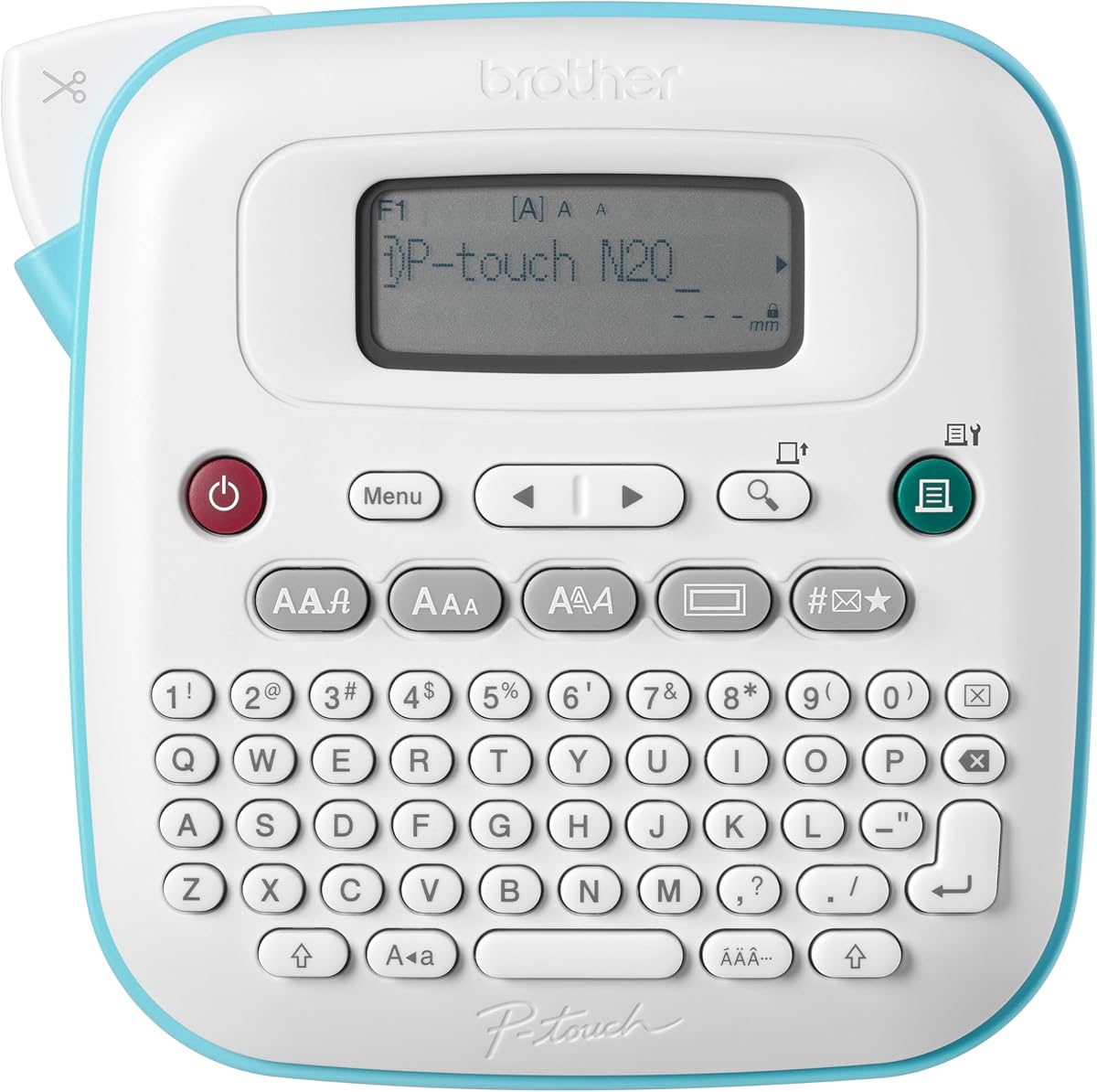
The Brother P-Touch PT-N20 is a standalone desktop-style label maker with a 4.3 rating, full QWERTY keyboard, and support for colorful 12mm Brother Btag tapes. It is a strong fit for crafters who want an aesthetic label without managing a separate phone or computer.
We may earn a commission when you buy through this link, at no additional cost to you.
The supplied information lists three fonts, seven font styles, 15 frames, and 250 symbols. Labels can carry up to two lines of text with a combined height of 9mm, allowing short names, dates, and decorative messages. The 16-character display previews content before printing, helping users avoid labels that do not fit the available space.
Unlike direct-thermal models, this machine prints the colorful Btag tape and uses a built-in cutter to create clean edges. The tape has split, easy-peel backing and is described as damage-free to remove. These qualities make it especially appealing for gift tags, storage containers, seasonal decorations, and other projects where appearance matters as much as identification.
The principal limitation is that it works exclusively with Brother P-Touch Btag tape measuring 12mm wide and 13.1 feet long. That proprietary format may be less convenient for buyers who want a broad assortment of unusual widths. Its two-line capacity is adequate for concise labels but not for long descriptions.
The PT-N20 is a strong recommendation for label makers who value color, a physical keyboard, and a simple all-in-one design process. It is particularly suitable for dorm rooms, studios, workshops, and home organization projects with short, highly visible labels.
The dedicated keyboard and display make colorful personalization approachable without an app or computer. This reduces workflow friction for quick labels that still need fonts, frames, and symbols.
The integrated cutter creates smooth label edges, while split backing allows users to peel the label away cleanly. These details improve the finish of finished craft projects and organized storage areas.
We may earn a commission when you buy through this link, at no additional cost to you.
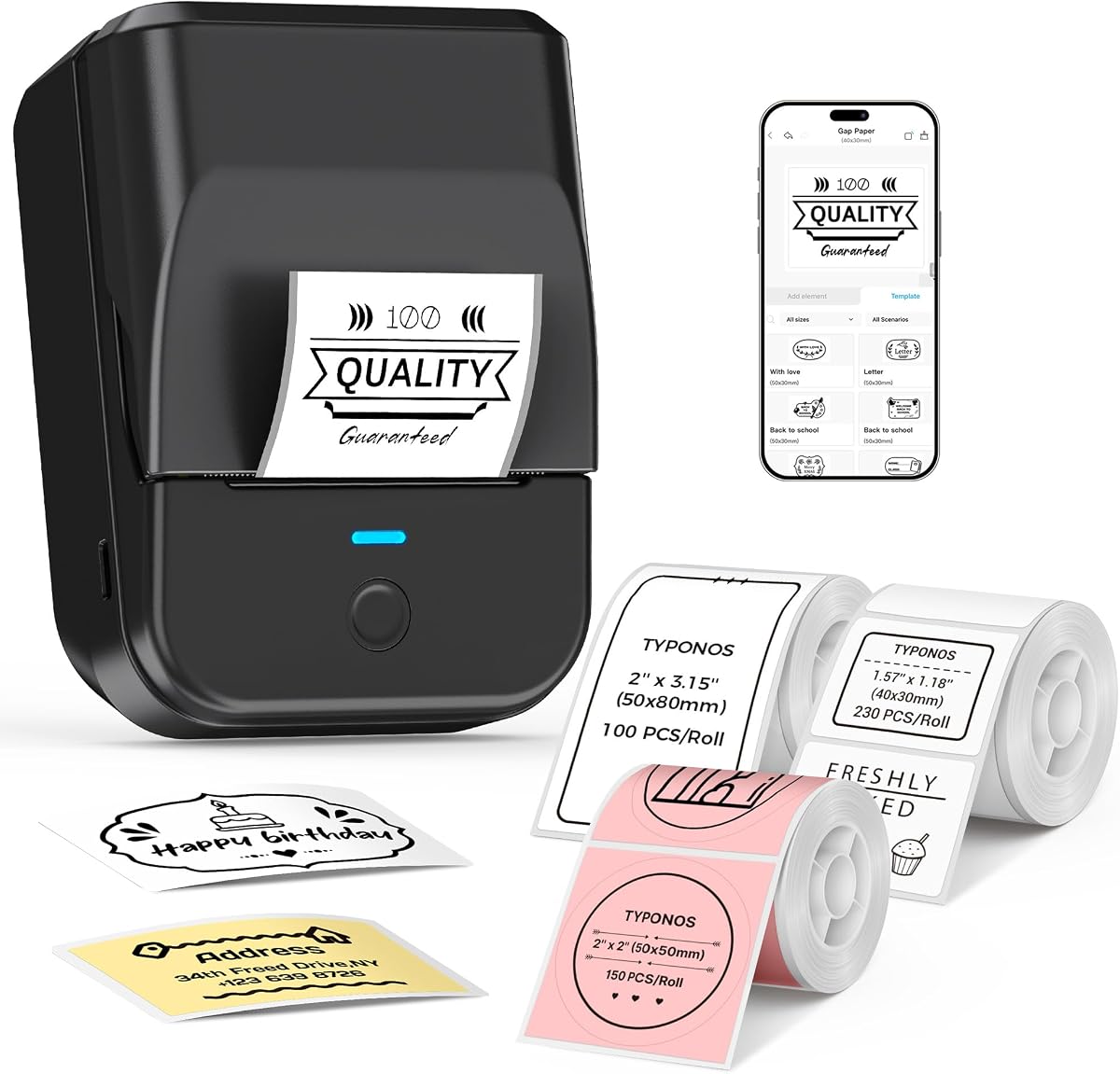
The PM240 Label Maker is a portable thermal model with a 4.4 rating, automatic label detection, and a broad app-based design library. Its supplied package includes rectangular and round labels in multiple sizes, making it useful for school, classroom, home, and small-business organization.
We may earn a commission when you buy through this link, at no additional cost to you.
Compatible TYPONOS labels use built-in RFID chips that let the Labelnize app identify size automatically. The app includes more than 2,500 icons, 3,800 templates, and 430 fonts, along with Excel import, batch printing, AI text-to-image, and OCR recognition. These functions support repeated tasks such as cubby names, classroom bins, supply containers, shipping addresses, and product labels.
The print head operates at 203 DPI, and compatible labels are described as waterproof, oil-resistant, tear-resistant, durable, and BPA-free. That makes them relevant to kitchens, workshops, and other settings where labels may face moisture or handling. The machine weighs 207 grams and includes a 1,500mAh rechargeable battery with up to 100 days of standby time per charge.
It is a monochrome printer, so color printing is not available. The power adapter is also not included, and Bluetooth and USB cannot be used simultaneously. While the automatic size detection is convenient, users should leave the green liner sticker on compatible rolls because removing it may lead to printing errors.
The PM240 is a well-rounded pick for teachers, dorm residents, and home organizers who value automatic setup and repeatable labels. It is also a good option for a craft room that handles many small containers and varied label dimensions, provided monochrome output satisfies the intended design.
RFID-equipped compatible rolls allow the app to identify label size without manual configuration. This reduces the chance of selecting the wrong format and is helpful when moving between several projects.
Excel import and batch printing can streamline larger sets of names, categories, or classroom identifiers. Combined with the included rectangular and round rolls, the feature set supports a broad mix of organization tasks.
We may earn a commission when you buy through this link, at no additional cost to you.
The DYMO Embossing Label Maker is a mechanical, handheld option with a 4.0 customer rating. It is included in an Organizer Xpress Pro starter kit with two black and one red label cartridge, making it a straightforward option for basic craft and household identification.
We may earn a commission when you buy through this link, at no additional cost to you.
Unlike thermal printers, it physically embosses characters into the label. A 49-character wheel includes letters, numbers, and symbols, and the turn-and-click mechanism provides a clear alternative to app-based editing. This makes the machine simple to use without software, account setup, or a device connection.
The included colored cartridges give buyers a useful starting palette, and the embossing process is particularly appropriate for labels that need a tactile, decorative look. The machine is lightweight and portable, so it can sit comfortably in a craft drawer or travel to another workspace when needed.
Its limitations are substantial for anyone seeking elaborate graphics. There are no image imports, decorative frames, QR codes, or multi-line templates, and the fixed character wheel restricts design choices. The 4.0 rating also places it below the higher-rated models in this roundup, although rating alone does not tell the whole story for a simple offline device.
The DYMO Embossing Kit is best for straightforward names, dates, basic categories, and decorative labels on compatible DYMO embossing tapes. Choose it when simplicity and tactile lettering matter more than app flexibility or high-resolution graphics. It is less appropriate for digital product catalogs or complex branding.
The turn-and-click wheel lets a new user begin labeling almost immediately. For occasional crafters or anyone who prefers an offline tool, this simplicity can outweigh the creative limitations of a phone-based app.
Embossed characters create a dimensional finish, and the included black and red cartridges show how different cartridge colors can change the appearance. Buyers should use authentic DYMO embossing labels for the intended performance.
We may earn a commission when you buy through this link, at no additional cost to you.
The DYMO LetraTag LT-100H combines a compact pink design, direct thermal printing, and a straightforward physical interface. Its 4.5 rating makes it one of the stronger-rated products in the group, while its slim body is well suited to a portable craft kit or a small organization station.
We may earn a commission when you buy through this link, at no additional cost to you.
The 13-character LCD helps users compose text before printing, and the machine supports fonts, symbols, styles, box options, date stamping, and two-line output. Printed at 7mm per second, it is intended to produce smudge-free labels without ink or toner. That combination of physical controls and thermal output is approachable for users who want more design choices than a mechanical embossing wheel but do not need a smartphone app.
The machine supports 12mm LetraTag tapes in paper, clear, opaque plastic, and textile finishes. This variety is useful for distinguishing the surface and purpose of a label: a paper tape may suit a temporary container, while a textile finish can better match a fabric item. Easy-peel construction and direct thermal technology support convenient placement and lasting readability.
The format is constrained to 12mm tape, and the device does not offer image import or the extensive app graphics found on several Bluetooth models. Its selection of styles is also narrower than large app-driven libraries. However, for concise labels with a polished appearance, these restrictions may not matter.
The LetraTag LT-100H is an excellent pick for home, school, and office organizers who want compact, stylish, standalone equipment. It also appeals to crafters making simple personalized labels for containers, gifts, and fabric items where a narrow tape and clean typography are desired.
The slim housing, one-handed operation, and distinctive pink finish make the LetraTag LT-100H feel more like a lifestyle accessory than a conventional office printer. It is easy to store in a bag, drawer, or portable craft organizer.
Paper, clear, plastic, and textile tape finishes allow users to match labels to different storage materials and project requirements. The common 12mm size keeps the system straightforward while offering meaningful material variety.
We may earn a commission when you buy through this link, at no additional cost to you.
The Brother P-Touch PT-D210 is the highest-rated product in this roundup, carrying a 4.6 customer rating. It is a fully standalone label maker with a QWERTY keyboard, preview display, broad tape-width compatibility, and an extensive collection of built-in fonts, frames, symbols, and templates.
We may earn a commission when you buy through this link, at no additional cost to you.
Compatible tape widths include 12mm, 9mm, 6mm, and 3.5mm, allowing users to select the right scale for craft jars, storage boxes, files, cables, garments, school supplies, and small retail goods. The display previews a label before printing, which helps prevent errors and wasted tape. One-touch keys provide direct access to fonts, symbols, frames, and templates.
Its creative library includes 10 styles, 14 fonts, 98 frames, more than 600 symbols, and 27 templates. The bundle includes one sample of black-on-white tape and three full-length black-on-white rolls. Brother Genuine TZe laminated tapes are described as water-resistant and fade-resistant, with specialty options for cables, photos, and iron-on clothing applications.
The PT-D210 requires six AAA batteries, which are sold separately, and an optional AC adapter is available for desk use. It also lacks a smartphone app, but that is not necessarily a drawback: its physical controls and display are designed to make the machine self-contained. Users who want extensive graphics, photos, or QR-code workflows should look to a Bluetooth model instead.
This is the strongest premium recommendation for crafters who value dependable physical typing, a wide tape ecosystem, and polished standalone operation. It is equally suitable for a home office, dorm, workshop, classroom, or small business that needs consistently organized labels.
Support for 3.5mm, 6mm, 9mm, and 12mm tapes lets users match label size to the object and amount of text. That flexibility is particularly valuable in a craft room containing tiny containers, narrow cable identifiers, and larger storage bins.
A character preview, one-touch menus, 14 fonts, 98 frames, more than 600 symbols, and 27 templates create a broad design vocabulary without computer or phone dependence. The physical interface also makes repeated label sets faster once the controls are familiar.
We may earn a commission when you buy through this link, at no additional cost to you.
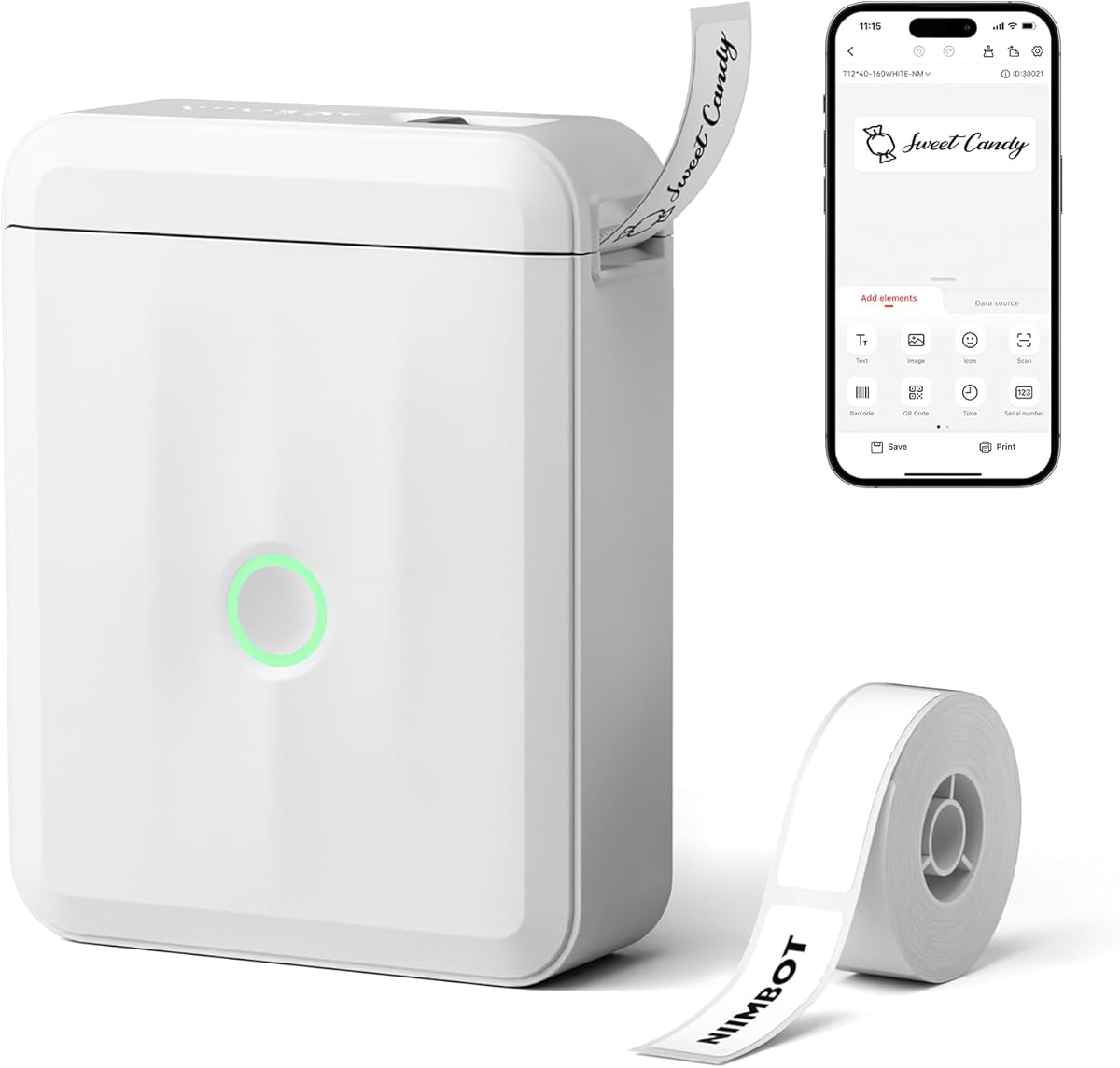
The NIIMBOT D110 Mini is a lightweight, phone-connected label maker with a 4.5 rating. At 149 grams, it is the most compact option in this list and is intended for users who want to create and print small labels almost anywhere without occupying a permanent desk area.
We may earn a commission when you buy through this link, at no additional cost to you.
The upgraded rewind function automatically calibrates the position of the first label when the machine is turned on. According to the product information, this helps prevent offset printing and avoids wasting the first label. Automatic label recognition and a maximum printing width of 15mm support common rolls such as 12-by-40mm, 14-by-30mm, and 15-by-30mm formats.
Its 203-DPI direct thermal print head produces high-definition text without ink or toner. The built-in 1,500mAh battery is stated to provide up to four hours of continuous printing after a full charge. The NIIMBOT app adds fonts, text, symbols, icons, borders, logos, and templates, allowing more decorative output than a basic text-only labeler.
Its limits include the reliance on an iOS or Android phone and a maximum width of 15mm. The product is best suited to small labels for jars, cosmetics, food dates, school materials, files, jewelry, cables, and personal items. Users should avoid tearing or damaging the sensor chip on the side of the roll, as the product information warns that this can affect printing.
The D110 Mini is a compelling choice for a craft kit that needs to travel, a student organizing a small space, or a maker who primarily wants inexpensive compact labels. It is less suitable for long labels, large shipping formats, or buyers who want to type directly on the machine.
At 149 grams, the D110 Mini is easy to carry in a pouch, backpack, or craft tote. It is particularly useful for labeling items at markets, workshops, classrooms, or home while moving between containers.
Automatic first-label calibration is intended to reduce offset prints and unused material. The feature helps make short label runs more efficient, provided the sensor chip on the roll remains intact.
We may earn a commission when you buy through this link, at no additional cost to you.
The right label maker depends on the labels you need, the creative tools you enjoy, and where you will use the machine. Consider print width, editing method, supported media, portability, and durability before choosing a model.
Label width is often the first practical constraint because it determines what can be printed. The SUPVAN T50M Pro supports widths from 3/4 to 2 inches, the Phomemo M220 extends to 3.14 inches, and the PM240 works with 1- to 2-inch formats. These wider machines can accommodate fuller names, short descriptions, larger icons, and QR codes, but they require bulkier rolls and may use more material.
App-based machines are ideal for users who want graphics, imported images, QR codes, barcodes, templates, and multilingual text. The SUPVAN T50M Pro, NIIMBOT B1, Phomemo M220, PM240, and NIIMBOT D110 Mini all support mobile editing. Physical keyboards offer a faster, more self-contained route for short labels. The SUPVAN E11 provides both approaches, while the Brother models and DYMO LetraTag LT-100H operate without a companion app.
A label maker is only as useful as the media it can print. Some products support square, round, address, cable, jewelry, and file labels, while others are restricted to a specific tape family. The Brother P-Touch PT-N20 requires 12mm Btag tape, and the DYMO LetraTag LT-100H supports 12mm tapes in paper, clear, plastic, and textile finishes. The PM240 works with compatible RFID-equipped TYPONOS rolls for automatic size detection.
Direct thermal machines use no ink or toner and are convenient for text, icons, and monochrome graphics. The PM240 prints at 203 DPI, as do the NIIMBOT D110 Mini and other listed thermal devices. The Brother P-Touch PT-N20 prints colorful Btag tape rather than relying on a thermal print head. Mechanical embossing produces raised lettering and a different decorative finish, but it cannot reproduce photographs or detailed graphics.
Portable label makers are valuable for craft markets, classrooms, and organizing projects away from a desk. The NIIMBOT D110 Mini weighs 149 grams, the PM240 weighs 207 grams, and the Phomemo M220 weighs 400 grams. Rechargeable models include the SUPVAN E11, NIIMBOT B1, Phomemo M220, PM240, and D110 Mini. The Brother PT-D210 uses six AAA batteries, while the mechanical DYMO Embossing Kit requires no battery for its stated operation.
Design features determine whether a label can become part of a polished handmade project. The Phomemo M220 offers the broadest stated selection, with more than 7,900 icons, 458 borders, 1,900 templates, and 550 fonts. The PM240 includes 2,500-plus icons, 3,800-plus templates, and 430 fonts. The SUPVAN models offer a more focused collection of 30-plus fonts, 50 frames, and 660 icons. Physical-keyboard options provide built-in frames, symbols, and templates without external graphics imports.
Automatic size detection can prevent many common setup errors. The SUPVAN T50M Pro and NIIMBOT B1 automatically recognize label size, while the PM240 uses RFID-equipped compatible rolls for detection. The NIIMBOT D110 Mini calibrates the first label position during startup. For larger projects, the Phomemo M220 and PM240 support Excel import and batch printing, which can save considerable time when producing repeated names or categories.
A permanent craft station can comfortably accommodate a desktop model, while a mobile maker may prioritize a small Bluetooth printer. The Brother PT-D210 is portable but benefits from a desk, and the NIIMBOT D110 Mini is designed to travel comfortably. Battery and connection notes also matter: the NIIMBOT B1 does not work with tablets, computer connections require appropriate drivers, and the PM240's Bluetooth and USB modes cannot operate simultaneously.
Begin by confirming that the machine is compatible with the tape already in the package and with the devices you intend to use. Charge a rechargeable model fully, install the appropriate app when required, and select the exact label model and size before creating a first design. Automatic recognition works best when the roll and its sensor or RFID chip remain intact.
Design each label around its final surface. Keep important wording clear, test a short example, and check alignment before printing a full batch. For projects involving glass, fabric, cable, or storage containers, confirm that the chosen material is suitable for the surface. Peeling slowly at a low angle helps preserve the finish of the object as well as the label.
Store the machine in a dry area, keep the print head and sensor clean, and avoid pulling labels from the roll by hand when the model is designed to feed and cut them automatically. Close or power down the device during long storage periods, and keep spare tape sealed away from heat, moisture, and direct sunlight. Follow the current manufacturer instructions for compatible supplies and cleaning.
Thermal label makers are better when you want fonts, icons, QR codes, barcodes, photographs, or more detailed text because they use a print head to produce crisp monochrome output. Embossing label makers are better for simple lettering with a raised, tactile finish and do not require a device connection. The right choice depends on whether visual detail or decorative texture is more important to your project.
Most Bluetooth models need a phone or computer for editing, even though the printer itself is wireless. The Brother P-Touch PT-D210, Brother P-Touch PT-N20, and DYMO LetraTag LT-100H have physical keyboards and can be used without an app. The SUPVAN E11 offers a useful hybrid approach by allowing direct keyboard printing and app-based design.
A 12mm or 15mm format works well for names, dates, and short identifiers on jars, bins, and personal items. Wider formats such as 1.5 to 2 inches allow more words, larger graphics, and room for QR codes. Choose based on the longest text you expect to print rather than the size of the container alone.
The thermal and direct-thermal models listed here do not require ink or toner because they print onto specialized labels using heat. The Brother P-Touch PT-N20 also prints without consumable ink, although it uses colorful Btag tape rather than a monochrome thermal process. The DYMO Embossing Kit forms raised letters mechanically and likewise needs no ink.
Use the app's automatic size detection when available, and do not remove the RFID chip or green liner from compatible PM240 rolls. The NIIMBOT D110 Mini calibrates the first label when switched on, so allow it to complete startup before printing. For other models, manually confirm the selected tape size and let the machine advance the roll before adding the final design.
No. Some machines support several widths and shapes, while others use a proprietary cartridge or roll system. The Brother P-Touch PT-N20 works exclusively with 12mm Btag tapes, and the DYMO LetraTag LT-100H is designed for compatible 12mm LetraTag tapes. Always check both width and cartridge structure before buying additional media.
The PM240 is especially well suited to classroom organization because it includes round and rectangular rolls, automatic size detection, batch printing, and Excel import. The NIIMBOT B1 is also useful for smaller sets because it saves templates for one-tap reprinting. The DYMO Embossing Kit remains the simplest option when only basic names and short categories are required.
Several app-based models can create QR codes and barcodes as part of a label design. The SUPVAN T50M Pro and Phomemo M220 explicitly support these functions, while the PM240 supports QR codes and barcodes among its small-business uses. The DYMO Embossing Kit has a fixed character wheel and cannot produce graphical codes, so buyers should verify a specific model before planning a code-based system.
The SUPVAN T50M Pro is the most flexible all-around option, combining broad label support with images, fonts, icons, and automatic setup. The Brother P-Touch PT-D210 stands out for standalone operation, a physical keyboard, multiple tape widths, and a rich built-in design library. The NIIMBOT D110 Mini is the practical choice for buyers who prioritize portability and a small footprint.
Before choosing, prioritize label dimensions, editing method, material compatibility, and where the machine will be used. A large app library matters for illustrated or data-rich projects, while a physical keyboard is better for concise, repeatable labels. Portable thermal printers are ideal for mobile organization, and color or embossed systems may better suit decorative craft finishes.
Check the current product listing, included accessories, and replacement tape before purchasing. Prices, bundles, app requirements, and device compatibility can change, and those details may affect which model delivers the most useful setup for your projects.

