
Teslong USB-C Two-Way Articulating Borescope
4.2Editor score
180-degree articulating probe
Joystick-controlled viewing
Three lighting levels
USB-C phone support
Our iPhone Endoscope Camera guide compares ten borescopes for image clarity, cable control, lighting, waterproofing, phone compatibility, and inspection value
An iPhone endoscope camera turns a smartphone into a practical inspection tool for plumbing, HVAC ducts, engine bays, wall cavities, wiring, drains, and other confined spaces. The best models combine a slender probe, usable low-light illumination, a controllable cable, dependable phone connectivity, and an app that displays live images clearly enough to support diagnosis rather than guesswork.
This guide compares ten phone-connected borescopes based on the specifications and features supplied for each model. It considers resolution, probe diameter, lens arrangement, cable length and rigidity, LED lighting, waterproof protection, connector coverage, app requirements, accessories, and the kinds of inspections each camera can handle. Both broadly compatible models and USB-C-focused options are included.
Each review identifies the product's strongest use case and any meaningful limitations, helping you narrow the field before purchasing. The standout options include a high-rated dual-lens camera for general inspections, a 2K model for finer visual detail, and an articulating premium scope for more directional control. Product listings and prices can change, so confirm the current details before buying.
4.2Editor score

4.7Editor score

4.2Editor score
The comparison below highlights the major differences in resolution, lens design, probe control, cable length, lighting, and connection options across all ten iPhone endoscope cameras.




This dual-lens borescope combines 1920P HD capture, eight adjustable LEDs, and a 16.4-foot semi-rigid cable, earning a 4.3 rating among the products in this guide. It is a balanced option for homeowners, mechanics, and plumbers who want to inspect pipes, engines, wiring, wall cavities, and vehicle interiors without immediately dismantling surrounding parts.
We may earn a commission when you buy through this link, at no additional cost to you.
The dual cameras provide front-facing and side-facing perspectives, reducing the need to repeatedly rotate the probe when inspecting corners. Its 7.9mm probe should enter many narrow passages, while the semi-rigid cable can be steered around bends without becoming completely floppy. Eight adjustable lights make dark cavities more accessible, and the stated IP67 protection permits underwater use to 3.28 feet for up to one hour.
Compatibility is broad, with iOS 9.0+ and Android 7+ support through the supplied interface options. The package includes Android and Lightning connectors, a Type-C connector, and useful retrieval accessories such as a magnet, hook, mirror, and protective cap. The main caveat is that image quality can vary by Android device, and the listing notes that iOS systems generally produce clearer results. The app must also be installed before use.
This is the strongest all-around choice for buyers who want dual-lens flexibility, useful cable length, and a reasonably complete accessory set. Choose it when your inspections span multiple household and automotive systems and you want more capability than a basic single-lens camera without moving to an articulating premium model.
Switching between the front and side lenses helps reveal details that one direction may miss. The side view is especially useful around pipe joints, engine components, and recessed areas where bending the tip alone would be awkward.
Eight adjustable LEDs make the probe useful in wall voids, ducts, and other poorly lit locations, while the IP67 housing allows controlled wet-area inspection. The stated one-meter, one-hour underwater limit provides a clear operating boundary.
We may earn a commission when you buy through this link, at no additional cost to you.
The DEPSTECH NTC55 is the detail-focused selection in this roundup, with a 4.2 rating and 2560 by 1440 resolution. Its 3.69-megapixel camera and dual-lens configuration target users who need finer visual information than a conventional 1920P phone borescope can provide.
We may earn a commission when you buy through this link, at no additional cost to you.
The manufacturer describes the lens as 80% sharper than standard 1920 by 1080P and uses Blaurt 3.0 technology to produce detailed, low-grain images. Front and side lenses provide complementary viewing angles, while an 80-degree viewing field and 7.9mm probe diameter balance visibility with access. The DEPSTECHCAM app adds photo and video capture, 2× zoom, 90-degree rotation, and gallery review.
Its 16.5-foot semi-rigid cable can follow curved passages while retaining directional stability. Eight-plus-one adjustable LEDs support visibility in darkness, and the IP67 housing is suitable for damp or underwater tasks. Android users must confirm OTG support and enable it before using the app, while iOS 11.0+ and Android 9.0+ are the stated supported versions. The app operates locally without registration or an internet connection.
This camera is best for technicians and serious DIY users who regularly inspect small components, suspect hidden damage, or want more detail in still images. It is not the right choice if your device lacks OTG or if you need an articulating probe tip. For users able to operate it correctly, its higher resolution and app tools make it unusually versatile.
The 2560 by 1440 output offers more pixel information than the 1920 by 1440 cameras in the list. That extra detail can help when examining hairline cracks, corrosion, seals, fittings, or small engine components under favorable lighting.
Zoom, rotation, capture, and gallery review are handled in the DEPSTECHCAM app. The app works locally without user registration, which can appeal to buyers who prefer not to create an account for a utility tool.
We may earn a commission when you buy through this link, at no additional cost to you.
This 1920P endoscope has a 4.2 rating and focuses on the practical combination of a slim probe, eight adjustable LEDs, a 16.4-foot semi-rigid cable, and broad connector support. It is designed for plumbers, mechanics, and homeowners who regularly need to examine pipes, HVAC passages, wiring, and engine compartments.
We may earn a commission when you buy through this link, at no additional cost to you.
The camera records at 1920 by 1440, giving it more pixels than a full 1080P image while remaining in the resolution class shared by many competing borescopes. The semi-rigid construction is particularly useful in drain lines and ducts because it bends smoothly but tends to retain the shape you give it. Adjustable lighting improves visibility in dark and damp conditions.
Type-C, Micro-USB, and Lightning connectors are included, allowing setup with a broad selection of smartphones and tablets after downloading the relevant app. The kit also contains a magnet, hook, and protective cap, while the product listing mentions one-year manufacturer support and 24-hour professional service. The supplied title refers to a dual-lens wiring harness, but the detailed description does not clearly define the lens arrangement, so buyers should verify the camera configuration and what is physically included before purchase.
This is a sensible choice for general inspections when connector flexibility and a long, controllable cable matter more than a specialized articulating tip. It offers most of the core functions sought from an iPhone endoscope camera, but buyers who need a precisely specified front-and-side lens system may prefer one of the models whose dual-lens design is documented more clearly.
The cable is designed to negotiate drain bends and HVAC routes without requiring a fully articulating tip. Its retained shape also makes it easier to hold a selected viewing angle while working around pipe joints or behind household fixtures.
Detachable Type-C, Micro-USB, and Lightning connectors make the scope usable with more phones than a USB-C-only design. Android compatibility still depends on the device's port and system support, so the included adapter should be matched carefully.
We may earn a commission when you buy through this link, at no additional cost to you.
The BAZO borescope earns a 4.4 rating through a combination of a narrow 6.9mm probe, a long 18.04-foot semi-rigid cable, eight adjustable LEDs, and straightforward phone connectivity. It is especially attractive for deep pipe work, narrow household channels, and inspections where access is the primary challenge.
We may earn a commission when you buy through this link, at no additional cost to you.
Its 1920P resolution produces sharp images and video for confined areas, and the 80-degree field is not stated, so image coverage must be judged mainly through the product's dual perspective and close-range use. The IP67 design allows underwater and other damp applications. The 18.04-foot cable is the longest listed here and offers substantial reach for sewer lines, wall cavities, and engine bays.
Compatibility extends to Android 4.4 and later and iOS 9.0 and later. After downloading the UseePlus app, users can connect without Bluetooth, Wi-Fi, or separate charging, which keeps setup relatively uncomplicated. The listing notes that updating the app may be necessary if connection problems occur. Included accessories include an iPhone/Micro-USB adapter, magnet, hook, mirror, mounts, and a protective cap.
Choose this model when reach and a slim probe outweigh having the highest possible resolution or a motorized tip. It is a capable general-purpose borescope for automotive repair, plumbing, HVAC, wiring, and home maintenance. Buyers should keep the app updated and confirm their device compatibility before ordering.
The 18.04-foot cable gives the user more room to navigate long drain runs, wall cavities, and narrow mechanical passages. Because the cable remains semi-rigid, the probe can be advanced and held at a useful angle instead of drifting uncontrollably.
At 6.9mm, the listed probe is the narrowest in this comparison. That smaller size can make the difference when the camera must pass around a cramped pipe fitting, inside an appliance, or through a restricted access opening.
We may earn a commission when you buy through this link, at no additional cost to you.
This dual-lens borescope has a 4.4 rating and combines a two-megapixel sensor, 1920 by 1440 capture, eight adjustable LEDs, and a 16.4-foot semi-rigid cable. It is a practical all-round choice for checking vehicle engines, HVAC appliances, wall structures, sewer pipes, and other areas where direct viewing is difficult.
We may earn a commission when you buy through this link, at no additional cost to you.
The dual-lens arrangement lets users switch between viewpoints, which is useful for looking into a space and then examining a feature along the side of the probe. The 7.9mm camera diameter balances access with sensor size, while the flexible cable bends around curves while maintaining enough shape for controlled positioning. Photo and video recording both work at the stated HD resolution.
The IP67 waterproof housing makes the probe suitable for wet environments, although the listing advises against prolonged use below three meters and does not provide a specific maximum operating time. A hook, magnet, side mirror, and protective cap support inspection and small-object retrieval. The camera connects directly to an iPhone or iPad through the recommended app, and 24-hour after-sales service is listed.
This camera fits buyers who want dual-lens versatility and dependable cable handling without moving to a more specialized articulating model. Its straightforward feature set and useful accessories make it well suited to occasional home inspections as well as regular automotive and plumbing work. Keep the camera within the listed depth guidance and clean the lenses before each use.
A front lens provides a direct view into a cavity, while the side lens helps expose surfaces that sit alongside the probe. This is useful for pipe walls, engine recesses, and concealed connections where a single angle may hide the relevant detail.
Eight LEDs can be brightened or dimmed to suit the environment. This is important in dark ducts and pipes, while more moderate illumination can help avoid washed-out reflections on shiny metal or wet surfaces.
We may earn a commission when you buy through this link, at no additional cost to you.
This 1920P borescope is the budget-focused option in the roundup, with a 4.2 rating and a core feature set suited to common plumbing, HVAC, automotive, and household inspections. It delivers sharp 1920 by 1440 images, an eight-LED light source, a 7.9mm probe, and a 16.4-foot semi-rigid cable.
We may earn a commission when you buy through this link, at no additional cost to you.
Its relatively slim probe should fit into many narrow pipes, ducts, and access openings, while the semi-rigid cable helps preserve the direction in which the lens is pointed. The app displays live images after the appropriate connector is selected, avoiding the need for a separate monitor, Wi-Fi setup, or dedicated handheld display.
The package includes Type-C, Micro-USB, and Lightning connection options, along with a magnet, hook, protective cap, side-view mirror, and manual. The IP67 probe is intended for wet and dark environments, making it useful around plumbing leaks, drains, and damp HVAC areas. The main limitation is that the supplied information does not describe a dual-lens system, so buyers should not expect the side perspective offered by several dual-camera alternatives.
This is the best budget choice for first-time owners who need a capable phone-connected inspection camera without paying for a 2K sensor or articulating hardware. It provides enough resolution, reach, lighting, and accessories for many common jobs. For users who only need to look into a pipe, wall cavity, or engine compartment, it covers the essential functions cleanly.
The camera provides live viewing, HD recording, illumination, and broad connector support, which covers the fundamentals of a phone borescope. There is no motorized articulation or second lens, so setup and operation remain simple.
A magnet and hook can retrieve small items encountered during an inspection, while the side-view mirror may help view a recess indirectly. The protective cap adds protection when the probe is stored or handled outside the housing.
We may earn a commission when you buy through this link, at no additional cost to you.
The Teslong 10FT USB C Endoscope has a 4.4 rating and is designed for modern USB-C phones, including the iPhone 15, 16, and 17 series, USB-C iPads, and compatible Android devices. Its direct USB-C approach makes it particularly convenient for buyers who want to avoid carrying a Lightning adapter.
We may earn a commission when you buy through this link, at no additional cost to you.
After downloading the app, the camera connects by USB-C and provides live inspection imagery. Eight high-brightness LEDs and integrated white balance support visibility and color consistency in pitch-dark or poorly illuminated spaces. The probe has an IP67 rating for protection from dust and water, making it suitable for automotive, plumbing, and household work in damp environments.
The 10-foot, or three-meter, semi-rigid cable offers a useful compromise between reach and compactness. It can flex around corners and through openings while retaining enough shape to keep the camera pointed where the user directs it. Android users must enable OTG, while older iPhones and iPads with Lightning ports, Windows PCs, and MacBooks are explicitly not compatible.
Choose this model if your primary device uses USB-C and you value a direct connection over support for older hardware. It is less suitable for a mixed-device household or anyone who needs a longer probe. Its short, focused feature set and straightforward setup make it a practical choice for car owners, plumbers, and DIY users inspecting engines, pipes, and hidden home areas.
Newer iPhones, USB-C iPads, and many current Android phones can connect without a separate adapter. This reduces setup steps and eliminates the risk of choosing or losing the wrong connector while preparing for a repair job.
Integrated white balance helps the camera compensate for the mixed colors and harsh reflections common in engines, ducts, and pipes. Combined with eight LEDs, it provides a more balanced view in locations where lighting is inconsistent.
We may earn a commission when you buy through this link, at no additional cost to you.
This 16.5-foot snake camera combines 1920 by 1440 resolution, a 360-degree view rotation, eight adjustable LEDs, and broad iOS and Android compatibility. With a 4.4 rating, it is a practical option for users who want a long-reach borescope and convenient screen rotation for changing the orientation of the image.
We may earn a commission when you buy through this link, at no additional cost to you.
The two-megapixel camera captures short-range HD still images and video, and the Useeplus app provides live viewing with rotation. The 5-meter semi-rigid cable gives it enough reach for deeper drain lines, wall cavities, and mechanical spaces, while the 7.9mm probe diameter supports access through relatively narrow openings.
The phone end supports Type-C directly, with an iPhone/Micro-USB adapter included. iOS 9 and later are supported, while Android 4.4 and later require both OTG and USB UVC functionality; the listing recommends checking with a USB OTG checker app. The camera is IP67 waterproof and suited to dim, wet, or submerged areas. It is not designed for use with a computer.
This is a good choice for households or repair teams using several generations of phones and tablets, especially when image rotation is important. Its long cable and adjustable lighting make it versatile across plumbing, automotive, construction, aviation, agriculture, and home inspection applications. Verify Android UVC support before purchase to prevent compatibility surprises.
The 360-degree rotation allows the on-screen orientation to be adjusted without physically twisting the cable. This is particularly helpful when the probe must remain in a narrow pipe or around a fixed engine component.
The 16.5-foot cable is among the longer options in the guide and can reach farther into extended drain and conduit systems. Its semi-rigid construction helps maintain navigation while still allowing the user to curve around obstacles.
We may earn a commission when you buy through this link, at no additional cost to you.
This dual-lens camera has the highest product rating in the roundup at 4.7 and offers a well-rounded feature set for serious home, automotive, and plumbing inspection. It combines 1920P HD imagery, a 115-degree field of view, front and side lenses, three phone adapters, and a stated one-meter water-resistance limit.
We may earn a commission when you buy through this link, at no additional cost to you.
Front and side perspectives can be changed with one tap, helping users inspect surfaces from different directions without constantly repositioning the probe. A stated optimal focus distance of 1.5 to 5 inches also gives buyers useful guidance for obtaining sharp footage; holding the lens too far from the subject can produce blur. The semi-rigid cable retains its shape around corners and helps keep the view stable.
The camera is submersible to 3.28 feet for up to one hour, making it appropriate for drain pipes, plumbing leaks, and pool inspections. It works with iPhone 8 through 16 devices using USB-C or Lightning, supports iPad, and works with Android OTG devices. The free Useeplus app requires no registration, and the package includes a magnetic pickup, retrieval hook, inspection mirror, and all three connection adapters.
This is the most complete general-purpose kit in the comparison and a particularly strong recommendation for mechanics, plumbers, and serious homeowners. It covers a wide range of scenarios while maintaining a straightforward phone-based workflow. The main operational consideration is to keep the lens close enough for the best focus and to enable OTG before using an Android device.
Moving between front and side views is fast, which helps when a pipe joint, engine cylinder, or wall cavity requires two distinct angles. This reduces repeated probe withdrawal and reinsertion during an inspection.
The included Lightning, USB-C, and Micro-USB adapters cover major connector types, while the magnet, hook, and mirror support retrieval and indirect viewing. That makes the package practical for both diagnosing problems and recovering small items.
We may earn a commission when you buy through this link, at no additional cost to you.
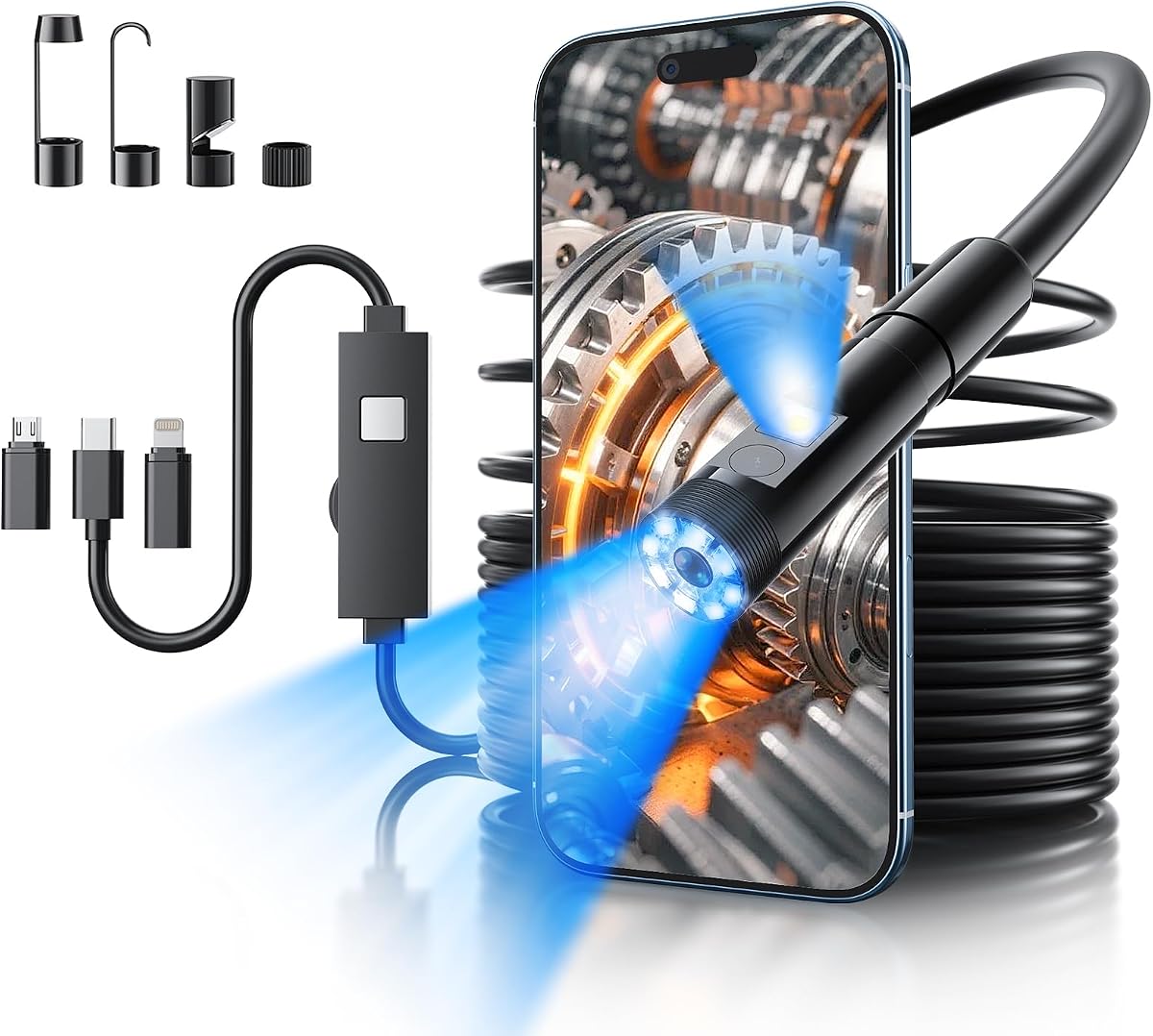
The Teslong USB-C Two-Way Articulating Borescope is the premium selection because its joystick-controlled probe can bend 180 degrees around corners, behind walls, and inside cylinders. Although its 1080P, one-megapixel camera is not the highest resolution in the guide, directional control is a capability the other semi-rigid scopes cannot match.
We may earn a commission when you buy through this link, at no additional cost to you.
The articulating tip is moved with a joystick, and a nearby photo button is designed to fall under the user's thumb. A phone holder supports one-handed operation, which is useful in automotive and home-repair work where the other hand may be occupied. The app provides photo and video capture without requiring an account or subscription.
Eight adjustable LEDs are grouped into three brightness levels, allowing the user to match illumination to dark ducts or reflective metal surfaces. The five-foot semi-rigid gooseneck retains its shape and can reach wall cavities, HVAC passages, plumbing traps, and areas behind appliances. The phone holder fits most devices, although thick cases on an iPhone Pro Max or Samsung Ultra may need to be removed.
This is the best choice for users who need the tip to turn beyond the steering limitations of a standard snake camera. It is especially useful for inspecting around corners and inside confined engine or plumbing spaces. Its USB-C requirement excludes Lightning iPhones, and the 1080P image is less detailed than the 2K DEPSTECH model, so buyers should prioritize articulation over maximum pixel density.
The 180-degree probe movement lets the camera look behind bends and into cylinders that a fixed front-facing lens could not examine. This directional control is the premium feature that sets the model apart from the other borescopes in the comparison.
The joystick and capture button sit under the thumb, while the phone holder keeps the display in view. This arrangement helps when working overhead, behind an appliance, or in another position where manipulating a separate control would be inconvenient.
We may earn a commission when you buy through this link, at no additional cost to you.
The right iPhone endoscope camera depends on connector compatibility, the spaces you need to reach, and how much control and detail you require. Consider resolution, probe design, lighting, water resistance, app operation, and included accessories before deciding.
Start with the port on the device you expect to use. Lightning connectors support many older iPhones and iPads, while USB-C models are designed for current iPhones, USB-C tablets, and many recent Android phones. Micro-USB adapters can broaden support for older Android equipment, but the adapter must match the device's actual charging port rather than a visually similar connector. Android users should also verify that the phone supports OTG, and some models also require USB UVC support.
In short, check your exact phone model, operating system, port, and OTG status before ordering. A native USB-C scope is the simplest option for a modern all-USB-C setup, while a multi-adapter kit is safer for mixed devices.
Most of the listed cameras capture at 1920 by 1440, providing 2 million pixels, while the DEPSTECH NTC55 raises the comparison to 2560 by 1440 and 3.69 million pixels. Higher resolution can make hairline cracks, corrosion, seals, and small component details easier to examine, but it does not replace good lighting or correct focus. The dual-lens model with the 4.7 rating notes an optimal 1.5-to-5-inch focus range, illustrating how close positioning can influence clarity.
Prioritize adequate resolution for the task rather than assuming the highest number solves every optical issue. For general household and automotive work, 1920P is practical, while 2K is worthwhile for detailed technical inspection.
A dual-lens camera provides both a forward view and a side view, making it easier to inspect a pipe wall, recessed engine part, or internal corner. An articulating scope adds another layer of control: its motorized tip bends as much as 180 degrees, allowing the camera to look back around a bend or deeper into a cylinder. Semi-rigid scopes remain easier to use for straight routes and modest curves.
Choose a dual lens when blind spots are the main concern, and choose an articulating model when steering around corners is essential. For many users, a well-controlled semi-rigid cable is enough and remains simpler to operate.
Probe diameter determines whether the camera can enter the opening, while cable length determines how far it can travel. The listed diameters range from 6.9mm on the BAZO model to 7.9mm on several others, and the cable lengths range from 5 feet on the articulating Teslong scope to 18.04 feet on the BAZO. A longer cable is useful for deep drains and long wall cavities, but it also takes more space to store and control.
Match the tip size to the narrowest expected access point and choose enough cable for the longest routine inspection. A 16-foot semi-rigid cable is a versatile middle ground, while the shortest option is easier to maneuver in tight engine bays.
Every model in the list includes multiple adjustable LEDs, but the configurations differ. Some offer eight lights, the DEPSTECH provides eight-plus-one LEDs, and the articulating Teslong divides its eight LEDs across three brightness levels. Adjustability matters because a fixed high setting can reflect harshly off wet pipe walls or polished engine components. A darker cavity, by contrast, may need maximum illumination.
Look for adjustable brightness and, where available, white balance or image rotation. These controls improve usability more than simply increasing the number of LEDs, particularly when the camera is used in changing environments.
All ten products are described as IP67 waterproof, but their stated operating boundaries differ. The first model is rated for underwater use to 3.28 feet for one hour, the dual-lens 4.7-rated model has the same stated limit, and the 1920P dual-lens model cautions against prolonged use below three meters. These figures are not interchangeable, and an IP67 label should be treated as a specific operating condition rather than permission for indefinite submersion.
For plumbing, pool, sewer, and damp HVAC inspections, check both the rating and the listed depth and duration. Dry the probe and connectors after wet use, and avoid charging a phone through a wet connection.
All listed cameras use an app for live viewing and image handling, so app requirements should be considered part of the purchase. Useeplus is named for several products, DEPSTECHCAM is required for the 2K model, and SmartEndoscope controls the articulating Teslong. The DEPSTECH app states that it works locally without registration or an internet connection, while the Teslong app likewise requires no account or subscription. Download and test the app before an important job when possible.
Prioritize models with clear offline operation and straightforward setup. If you share the tool among multiple phone types, make sure everyone has the correct adapter, compatible operating system, and any required OTG or UVC setting.
Hooks, magnets, side mirrors, protective caps, and phone mounts can make an inspection more effective. A hook or magnet may recover a dropped fastener or small object, while a side mirror can help view a recess that is difficult to observe directly. The dual-lens 4.7-rated product includes a full retrieval kit with three adapters, whereas the articulating model emphasizes a phone holder and one-handed controls.
Check what is actually included rather than assuming standard accessories arrive with every scope. The best kit is the one that matches your work: retrieval tools help with dropped items, while a mount benefits prolonged automotive or overhead inspections.
Before the first inspection, confirm that the phone port, connector, operating system, and required OTG or UVC setting are compatible. Download the named app, connect the correct adapter, and test live viewing in an open area. Wipe the front and side lenses with a clean microfiber cloth, and familiarize yourself with the brightness control, image rotation, capture button, and lens-switching function before entering a confined space.
For an inspection, advance the probe slowly and keep the lens close to the subject when sharp detail matters. Use the side lens to inspect surfaces alongside the probe, and rotate the image rather than sharply twisting the cable when a different orientation is needed. In dark areas, increase the LED brightness gradually to reduce glare. When using an articulating model, move the joystick gently so the tip follows the desired path without scraping nearby components.
After use, disconnect the camera from the phone, switch off the illumination, and wipe the probe and lenses dry. Allow connectors to dry completely before storage, and replace the protective cap when appropriate. Do not charge a phone through a wet connection, exceed the stated underwater depth or duration, or force the probe through an opening smaller than its diameter. Periodic cleaning and careful storage help protect image clarity and cable performance.
It depends on your iPhone model and the borescope's included connectors. Recent iPhones use USB-C, while older models use Lightning. Products in this guide include either a native USB-C connection, a Lightning adapter, or both, so check the port on your exact device before ordering and avoid buying a USB-C-only model for a Lightning iPhone.
Android phones generally need OTG support, and OTG must be enabled before connecting the camera. Some models also require USB UVC functionality, as noted for the 1920P snake camera. Confirm both requirements with your handset, download the required app, and check whether the scope includes the connector matching your phone's charging port.
A dual-lens model is usually more useful when you need both a forward and side perspective. It helps reveal pipe walls, recessed components, and spaces hidden directly behind the probe. A single-lens camera may still be sufficient for straight inspections, while an articulating tip can offer even greater directional flexibility in tight corners.
Only within the product's stated limits. The relevant models here are described as IP67 waterproof, and some specifically list a 3.28-foot depth for up to one hour. Other listings warn against prolonged use below three meters. Always follow the exact product guidance, keep connectors dry, and disconnect the camera before operating the phone near water.
Clean both lenses first and increase the adjustable LED brightness while the probe is still outside the space. Insert the camera slowly, keep it close to the feature being inspected, and use the side lens or image rotation when appropriate. Very bright light can create glare on wet or reflective surfaces, so adjust the level rather than leaving it at maximum.
Most cameras in this guide provide 1920 by 1440 images, which is suitable for many household and automotive tasks. The DEPSTECH model increases resolution to 2560 by 1440 and may be worthwhile for very small components, fine cracks, or technical documentation. Lighting, focus distance, probe control, and stable positioning can matter as much as nominal resolution.
Many of these cameras include a small hook or magnet that can be attached near the camera tip. Success depends on the object's material, the available space, and the camera's maneuverability. The accessory must be fitted correctly, and the protective cap may need to be removed before attaching certain tools.
A semi-rigid camera is simpler, lighter, and effective for straight routes and moderate bends. An articulating camera offers motorized tip movement, making it better for looking around corners, behind components, and deeper into cylinders. Articulation adds control but also cost, so it is most valuable when your inspections repeatedly involve obstructed or highly directional access.
The Dual-Lens Endoscope Camera with Light stands out as the strongest all-around pick because it combines a 4.7 rating, 1920P imagery, front and side perspectives, broad adapter coverage, a complete tool kit, and stated water-resistance limits. The DEPSTECH 2K camera is the option for buyers who prioritize maximum resolution and app-based zoom, while the Teslong Two-Way Articulating Borescope is the premium choice for motorized directional control.
Prioritize device compatibility first, because a sophisticated camera is not useful if it cannot connect. Next, match probe diameter and cable length to your typical access points, then decide whether dual lenses, higher resolution, or an articulating tip will solve the problems you actually encounter. Accessories, repair coverage, and clear app requirements can further influence the decision, but they should remain secondary to core inspection capability.
Before ordering, confirm the current product listing, included adapters, app availability, and operating requirements. Ratings, included components, technical specifications, and prices can change over time, so the latest listing should serve as the final source of truth. With those checks in place, you can choose an iPhone endoscope camera that balances reach, visibility, control, and everyday usefulness.