
RectorSeal Metacaulk Firestop Putty Pad 66335
4.8Editor score
Up to three-hour fire rating
STC 60 sound performance
Hand-moldable non-curing formula
Seven-inch square pad size
Fire putty pads are moldable barriers designed to seal openings around electrical boxes, cabinets, conduits, pipes, and other penetrations. The right pad can help preserve a fire-rated assembly, limit smoke and flame movement, and reduce unwanted sound transfer. Performance depends on fit, adhesion, tested rating, and proper installation.
This guide compares ten fire putty pads across practical criteria including dimensions, quantity, material behavior, intended applications, environmental handling, and documented test standards. It covers options ranging from compact packs for a few outlets to larger quantities suited to renovation projects, contractors, offices, studios, and multi-box installations.
Each review highlights the product's strongest use case and any limitations visible in its specifications. Three overall picks are identified for budget value, editorial selection, and premium professional performance. Product availability and pricing can change, so readers should confirm current listing details and assembly requirements before purchasing.
4.8Editor score

4.6Editor score
4.5Editor score
As an Amazon Associate we earn from qualifying purchases.
The table below compares all ten products by size, pack quantity, documented fire performance, and practical application. It is a quick reference, while the detailed reviews explain installation, handling, adhesion, and sound-control considerations.


ABOAT T's ten-pack combines 7.5-inch square pads, a three-millimeter thickness, and two pairs of disposable gloves. It carries a 4.6 rating, and its most appealing characteristic is the non-setting, hand-workable formula. That design makes the material suitable for users who may need to reshape a seal or service an opening later.
We may earn a commission when you buy through this link, at no additional cost to you.
The listed features emphasize strong adhesion to concrete, metal, and brick, along with compatibility with metal and nonmetal socket boxes and electrical cabinets. Its reusable nature is particularly useful during renovation work because a piece can be removed and repositioned instead of being discarded after the first placement. The gloves also simplify handling, although gloves are not a substitute for following site safety procedures.
The main limitation is the absence of a stated ASTM, UL, or other tested fire duration in the supplied product information. Buyers needing a specific listed-hour performance should verify compatibility with the complete rated assembly rather than assuming that the words fire putty establish a particular rating. The product also spans electrical, plumbing, and construction uses, so its general versatility is more persuasive than a narrowly documented standard.
This is a practical choice for homeowners, maintenance workers, and remodelers who value reusability and straightforward hand installation. It is especially appealing for sealing electrical boxes, wall openings, cabinets, and water-supply-box gaps where flexibility and adhesion matter. For projects governed by a formal hourly rating, confirm the required listing first; otherwise, the generous pack and disposable gloves make it convenient for general use.
Because the putty does not set like a conventional sealant, it remains workable and serviceable. That can make repeated layout adjustments easier and may reduce waste when a penetration is not properly aligned on the first attempt.
The listed substrates include concrete, metal, and brick. This broad compatibility is useful in mixed-material walls, though the surface should still be clean and dry for the adhesive to establish a reliable bond.
We may earn a commission when you buy through this link, at no additional cost to you.
The 3M MPP+ is a 20-pack of red, 7-inch square putty pads with a 4.6 rating. It stands out for clear fire-test documentation and immediate usability. The product is listed as tested and assembled for up to a two-hour rating under ASTM E814, UL 1479, and CAN/ULC S115, giving buyers stronger performance information than many competing listings provide.
We may earn a commission when you buy through this link, at no additional cost to you.
This is a one-part intumescent material designed for electrical-box protection, wall openings, and other fire-rated assemblies. It forms a secure, lasting seal while helping address draft, cold smoke, and noise transfer. Its noncorrosive composition is also compatible with synthetic cable jackets, an important detail when the pad will contact wiring or conduits.
One consideration is that a fire rating is not automatically transferable to every opening. The effectiveness of a putty pad depends on the surrounding wall assembly, penetration, quantity of material, and installation method. Buyers should therefore have the project specifications available and confirm that the pad belongs to the appropriate tested system. The case quantity may also be more than a homeowner needs for a single outlet.
The 3M MPP+ is the strongest all-around recommendation in this guide for users who prioritize documented standards, broad substrate adhesion, and simple installation. Electricians, facility managers, and serious renovators can appreciate the clear two-hour testing information, while homeowners can use the one-part format without measuring or mixing components. It is a balanced, professional-style choice for several types of penetrations.
ASTM E814, UL 1479, and CAN/ULC S115 references make this listing easier to evaluate against project requirements. Confirm that the wall or barrier configuration matches the tested assembly before installation.
The one-part material requires no mixing and is designed for electrical boxes and wall openings. Its noncorrosive, cable-jack-compatible formulation makes it well suited to installation around modern wiring.
We may earn a commission when you buy through this link, at no additional cost to you.
This 10-piece fire and acoustic putty pack includes 7-inch square, three-millimeter pads and two pairs of disposable gloves. Its 4.5 rating and dual-purpose positioning make it especially relevant to home theaters, recording studios, offices, and other spaces where both compartmentation and acoustic control matter.
We may earn a commission when you buy through this link, at no additional cost to you.
The sticky, pliable material adheres aggressively to metal boxes, plastic junction boxes, concrete, and brick. Its seven-inch dimensions allow it to cover standard electrical boxes, switch plates, ceiling gaps, pipe penetrations, and window-frame gaps. The listing says the material can handle both smaller gaps and larger pipe penetrations, although a large opening may require multiple pieces or additional firestop components.
The supplied information does not identify a tested hour rating or listing standard. That limits its usefulness for a buyer who must document a formal fire-rated assembly, even though the product is clearly marketed to limit flame and smoke movement. It also does not provide detailed storage or temperature limits, so keeping the pads dry and following the seller's current instructions would be prudent.
This product is a good fit for DIY users, installers, and studio builders who want an easy-to-shape pad for both electrical and acoustic gaps. Its included gloves, strong adhesion, and flexible sizing simplify a hands-on installation. For regulated commercial work, verify the applicable tested system first; for renovation and acoustic-sealing projects, it offers a particularly approachable and versatile package.
Using an intumescent-style barrier around an opening can address both fire and smoke movement while reducing sound transfer. That combination is particularly useful where a room requires acoustic separation as well as safer compartmentalization.
The seven-inch format suits common boxes, switch plates, and service openings. Because the putty is pliable, installers can press it around irregular shapes and split or combine material as the opening requires.
We may earn a commission when you buy through this link, at no additional cost to you.
Amylove supplies 60 red, 7-inch square pads measuring approximately three millimeters thick. With a 4.4 rating, it is the largest multipack in this comparison and targets homeowners, property managers, and installers completing many boxes across a home, office, or collection of buildings.
We may earn a commission when you buy through this link, at no additional cost to you.
The putty is sticky, moldable, and designed to fit electrical boxes and other nooks around penetrations. It adheres to metal and nonmetal socket boxes, metal electrical cabinets, and other electrical enclosures, while also being promoted for limiting flame, sound, gas, and water movement. The manufacturer says no extra tools are needed, allowing the pads to be shaped with gloved hands.
Handling is more involved than with several alternatives. The instructions advise against water, wet environments, freezing, and temperatures above 120 degrees Fahrenheit, and recommend thawing frozen pads before use. The listing also notes that high temperatures can create bubbles during extrusion, with the resulting pits closing as the material cools. Users should store the pads dry and allow them to reach a workable temperature.
Amylove is best for projects where a large quantity of consistently sized pads is more useful than a highly specialized tested system. The generous count can support many outlets and wall openings, and the 4.4 rating still reflects generally favorable user feedback. For formal fire-rated construction, request applicable test documentation, and store the material carefully to protect its adhesive and moldable properties.
The large quantity is useful for multi-box renovations, rental properties, or commercial fit-outs. It reduces the need to split a smaller project into repeated purchases while keeping every pad dimensionally consistent.
The material should remain dry and above freezing. If cold storage causes the pads to stiffen, the instructions advise thawing them before use, which may require advance planning when many penetrations need to be sealed.
We may earn a commission when you buy through this link, at no additional cost to you.
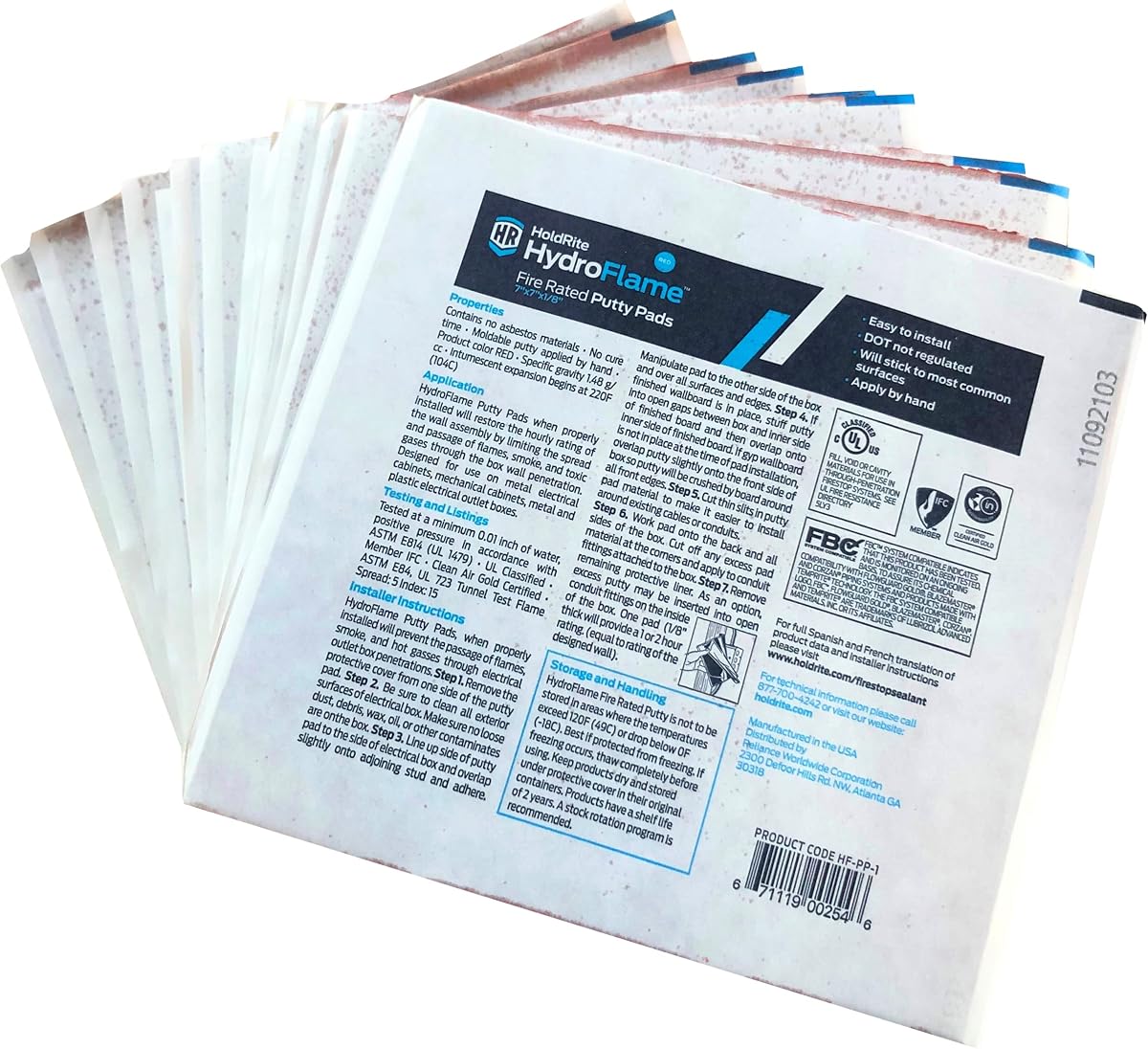
Holdrite's HydroFlame HF-PP-1 pack includes twenty 7-inch square pads, each measuring one-eighth inch thick. Its 4.5 rating, three-hour test documentation, and stated expansion at 220 degrees Fahrenheit make it one of the strongest premium options for users who need a clearly defined fire performance.
We may earn a commission when you buy through this link, at no additional cost to you.
The intumescent pads are intended to help prevent the spread of flames, smoke, gas, and water through penetrations. Applications include metallic and nonmetallic outlet boxes, electrical and mechanical cabinets, and other electrical enclosures. The material expands when heated, creating an insulating barrier, and it can be applied by hand without mixing.
Storage requires more attention than installation. The product should not be exposed to water, heavy moisture, freezing temperatures, or temperatures above 120 degrees Fahrenheit. Frozen pads must be thawed before use and kept dry in their original container. These restrictions are manageable in a controlled workshop, but less convenient on a damp or exposed construction site.
The HydroFlame is well suited to electricians, contractors, and facility teams specifying tested firestop materials. It combines a recognized manufacturer, documented ASTM E814, UL 1479, and ULC/CAN4-S115-M testing, and a solvent-free, asbestos-free formulation. Choose it when the project requires up to three-hour performance and the assembly can be matched to the applicable tested system.
The listing identifies ASTM E814, UL 1479, and ULC/CAN4-S115-M testing for performance up to three hours. This gives project teams a clearer basis for comparison than a listing that merely describes the material as fire rated.
At elevated heat, the pad expands to help form an insulating barrier. That response is central to its fire-protection function and makes correct placement around the full penetration especially important.
We may earn a commission when you buy through this link, at no additional cost to you.
This Rectorseal package contains twenty 7-inch square, fire-rated intumescent pads and a pair of AWF PRO gloves. It has no available customer rating in the supplied data, so buyer feedback is currently limited. Its strongest documented feature is performance in systems tested for up to four hours.
We may earn a commission when you buy through this link, at no additional cost to you.
The compound helps restrict flames, smoke, and hot gases while maintaining the integrity of fire-rated assemblies. It is a solvent-free, asbestos-free, single-component material that expands under heat and remains flexible and repositionable instead of hardening or cracking. The manufacturer positions it for conduit, EMT pipe, cabling, electrical boxes, and commercial, industrial, or residential construction.
Because the listing does not yet have a rating, it is difficult to assess the consistency of customer experiences. The product's stated benefits also rely on correct use within a tested system, so the specific wall construction, penetration, and quantity of fill material must be verified by the project professional. Calling it non-curing does not mean it should be reused indefinitely; it primarily means the compound remains workable rather than forming a rigid seal.
The product is a strong option for commercial contractors, industrial maintenance teams, and builders seeking a four-hour-system claim plus a useful glove inclusion. The non-curing behavior aids positioning during installation, and the broad intended applications make the pack versatile. For a buyer comfortable relying on manufacturer specifications rather than customer feedback, it is a credible premium professional choice.
The stated performance of systems tested up to four hours makes this one of the most ambitious specifications in the guide. Actual performance depends on matching the pad to the exact tested wall, barrier, and penetration configuration.
The non-curing compound can be repositioned and does not harden or crack according to the listing. This gives installers more time to shape the material around cables, conduits, and irregular box openings.
We may earn a commission when you buy through this link, at no additional cost to you.
LalaKoo offers 24 flexible, sticky pads measuring 7.5 inches per side and about three millimeters thick. Its 4.2 rating is the lowest among the customer-rated products here, but the simple formulation remains appealing to users who prioritize easy shaping and uncomplicated installation.
We may earn a commission when you buy through this link, at no additional cost to you.
The putty is designed to fill nooks and crannies around electrical boxes, sockets, cabinets, and similar openings. It can be molded by hand, requires no mixing, and is described as soft, flexible, sticky, non-toxic, and environmentally friendly. Its sizing is intended to suit most electrical boxes and sockets while allowing enough material to be trimmed or pressed into irregular spaces.
The product information does not cite a formal fire-test standard or a specific tested duration. It should therefore be treated as a general fire-barrier putty rather than assumed to satisfy a particular hourly requirement without verification. The listing also says to keep the pads in a dry environment and use them below 120 degrees Fahrenheit, which is a sensible storage limit for a moisture-sensitive adhesive material.
LalaKoo is a reasonable choice for homeowners, electricians, and maintenance installers working on a limited number of electrical openings. Its 24-pad count is generous, and the soft, sticky formula makes the material easy to place around sockets. For noncritical repairs, it offers straightforward handling; for a commercial rated assembly, request the relevant certification information before specifying it.
The putty is specifically described as soft, flexible, and sticky, making it easy to press into corners and around cables. A pair of gloves can make the adhesive process cleaner and more controlled.
At 7.5 inches square, the pads are sized for many standard electrical-box openings. The three-millimeter thickness also provides a useful starting point when comparing them with system requirements.
We may earn a commission when you buy through this link, at no additional cost to you.
Rectorseal's 66340 pad measures 6 by 7 inches and 1/8 inch thick. It carries a 4.5 rating and is aimed at electrical and mechanical cabinets, outlet boxes, and through-penetration firestop systems where a slightly smaller footprint is useful.
We may earn a commission when you buy through this link, at no additional cost to you.
The non-curing compound is applied by hand without mixing, special skills, or additives. It is documented as rated for up to three hours under ASTM E 814, UL 1479, and ULC/CAN4-S115-M standards. The listing also gives it an STC 60 sound-transmission rating and states that one pad thickness can address a one- or two-hour fire rating when properly installed.
The key trade-off is size. A 6-by-7-inch pad may not cover a full 7-by-7-inch box footprint, which can mean cutting, overlapping, or using multiple pads depending on the tested configuration. The supplied information also does not state how many pads are in the package, so buyers should confirm the quantity before planning a multi-opening project. These limitations do not reduce the value of the documented performance for a properly sized installation.
This is a practical budget-oriented pick for electricians and maintenance professionals who need a compact, tested, moldable pad for smaller cabinets or outlet-box applications. Its combination of three-hour test documentation, STC 60 performance, and hand installation is strong. Match the pad to the exact assembly and use the required amount of material rather than assuming a single piece always completes a larger opening.
The six-by-seven-inch format is useful where a full square pad would be excessive. It may fit compact cabinets and smaller box details more neatly, subject to the tested installation requirements.
The documented three-hour performance and STC 60 rating make the pad relevant to both rated walls and noise-control work. That dual role can simplify material selection around electrical boxes.
We may earn a commission when you buy through this link, at no additional cost to you.
The RectorSeal Metacaulk 66335 is a 7-inch square, one-eighth-inch-thick firestop putty pad with the highest customer rating in this guide at 4.8. It combines a clear three-hour fire-performance claim with an STC 60 rating, making it a well-balanced choice for electrical-box and cabinet work.
We may earn a commission when you buy through this link, at no additional cost to you.
Its non-curing material is applied directly by hand and requires no mixing or additives. The product is designed to protect metal electrical cabinets, outlet boxes, and mechanical cabinets while helping maintain a fire-rated wall's hourly rating and reducing sound transmission. It also contains no asbestos fillers and expands when exposed to fire.
The supplied listing does not state the number of pads included, which is important for planning multi-box projects. Users should also recognize that the material's rating applies only when installed as part of a compatible tested system. Complete coverage, depth, and placement around cables or box edges must follow the applicable design. The pad's sound benefits likewise depend on the surrounding construction rather than the putty alone.
For professionals and informed DIY users, the 66335 stands out for the combination of customer feedback, clear standards, and a standard 7-inch format. It is particularly attractive for outlet boxes, electrical cabinets, and mechanical enclosures where both firestopping and noise reduction matter. Confirm quantity and assembly compatibility, but for a single well-known pad with a three-hour claim, it is a compelling recommendation.
Its 4.8 rating is the strongest numerical rating among the listed products. While customer scores do not replace testing, they provide useful context when combined with clearly stated ASTM, UL, and ULC performance information.
The 7-inch square shape aligns with a common electrical-box format and is easier to compare with the requirements of many standard openings. Its one-eighth-inch thickness is also consistent with the stated one- or two-hour application guidance.
We may earn a commission when you buy through this link, at no additional cost to you.
This compact pack includes three 7-inch square, one-eighth-inch-thick acoustical putty pads. With a 4.5 rating, it is specifically positioned for fire stopping around electrical boxes and outlets while reducing noise transfer in studios, offices, and other acoustically sensitive spaces.
We may earn a commission when you buy through this link, at no additional cost to you.
The flexible material is easy to work and can be cut without tearing, allowing it to fit around outlet boxes, cables, and irregular penetrations. Its intumescent construction is intended to help stop flames, smoke, and gas from moving through openings. The listing also cites ASTME84 performance specifications with flame-spread and smoke-development figures of five, adding context beyond general soundproofing claims.
The pack contains only three pads, making it more appropriate for targeted work than a whole-home renovation. No specific tested hour duration is stated, even though the product is marketed with UL and STC positioning. Buyers should therefore request or verify the appropriate system documentation before treating it as a substitute for a listed electrical-box firestop assembly. Acoustic results also depend on wall construction, leaks, and flanking paths.
This is a strong option for recording studios, home theaters, offices, and other rooms where electrical boxes are a source of sound leakage. The ability to cut the pads cleanly without tearing makes detailed fitting around cables easier. For a few openings, the three-pad quantity is focused and convenient; for broader installation, it is best supplemented with a larger pack.
Flexible, cuttable material can be shaped closely around outlet boxes and cables. That close fit helps reduce direct sound paths while the intumescent formulation addresses fire, smoke, and gas movement.
The listing specifically highlights that the pads can be cut without tearing. This makes them useful for intricate fits and reduces the risk of leaving gaps around cables or box edges.
We may earn a commission when you buy through this link, at no additional cost to you.
Choose fire putty pads by matching the material's documented performance to the rated assembly, then considering size, quantity, adhesion, storage conditions, and the demands of the installation environment.
A fire putty pad should be evaluated as part of a system, not as an isolated sheet of material. Look for an ASTM E814, UL 1479, or CAN/ULC S115 claim and note the stated duration, whether one, two, three, or more hours. Confirm the wall construction, barrier type, box, cable, pipe, and quantity of fill material used in the test. A manufacturer may offer several tested designs with different ratings, so the product description alone is not the final authority.
Most products in this guide measure approximately 7 by 7 inches or 7.5 by 7.5 inches, while one Rectorseal option is 6 by 7 inches. Compare the pad's edge length, thickness, and coverage area with the size of the opening. A small cabinet may suit a compact pad, whereas a large electrical box may require multiple pieces. Thickness matters too, because some listings specify that one 1/8-inch pad is sufficient for a particular one- or two-hour configuration.
Many fire putty pads are intumescent, meaning they expand when exposed to heat. Others are described as non-setting, non-curing, reusable, or repositionable. These traits affect both installation and future service. A non-setting pad can be shaped more freely and may be removed for access, but the manufacturer's directions and the tested system still govern whether reuse is appropriate. Look for a product whose physical behavior matches how often the penetration will be disturbed.
Adhesion should be considered on the actual substrate present at the job site. Common building materials include metal, plastic, concrete, and brick, and some listings explicitly mention synthetic cable jackets. A noncorrosive product is advantageous around metal cabinets and wiring, but compatibility does not replace proper preparation. Remove dust, debris, moisture, loose material, and anything that would prevent the putty from bonding to the full intended contact area.
Quantities range from three pads to sixty, with many products falling between ten and twenty-four. A small pack may be sufficient for a studio or a handful of outlets, while contractors renovating multiple properties will need a larger supply. Do not assume one pad equals one opening; calculate coverage using the pad dimensions, the penetration size, required depth, and any tested design details. A larger count can also be useful when sections must overlap around irregular shapes.
Electrical boxes and service penetrations can transmit impact noise and airborne sound between rooms. Some products carry an STC 60 claim, while acoustical putty is marketed specifically for studios, offices, and home theaters. STC is one element of a complete acoustic design, so pads should not be viewed as a substitute for dense walls, resilient channels, or proper insulation. For sound-sensitive work, favor a flexible pad that can be cut and fitted closely around box edges and cables.
Several listings warn against water, heavy moisture, freezing, and excessive heat. Adhesive putty can lose consistency after cold storage, while heat may affect its surface or handling. Keep unused pads dry in their original packaging and allow frozen material to thaw before shaping. During installation, work with clean hands or suitable disposable gloves, and store extra pads in a controlled location rather than directly on a wet or exposed job site.
All featured products emphasize hand application, no mixing, and a moldable consistency. That makes them more approachable than multi-component firestop systems, although large or irregular openings may still require shaping, trimming, and multiple pieces. Included gloves can improve handling, but users should also consider accessibility, lighting, and whether enough material is available to complete the assembly without interruption.
Begin by confirming the rated wall or barrier system, the penetration type, and the required quantity of firestop material. Remove loose debris, dust, moisture, and obstructions from the box edges and surrounding surfaces. Wear suitable gloves, remove the required pad portion from its release material, and press the putty firmly into every intended contact area without leaving voids around the box, cables, conduits, or pipes.
Shape the pad with gloved hands or simple hand tools, following the tested installation instructions. Work the material around irregular edges and openings, then verify complete coverage and the required depth. Avoid creating unnecessary excess where it could interfere with a cover plate, trim, or adjacent equipment. Electrical work should be de-energized and performed by a qualified person, and any penetrations containing wiring should remain accessible in accordance with electrical and fire-code requirements.
After installation, keep unused pads sealed, dry, and within the manufacturer's storage temperature guidance. Do not expose the material to water, heavy moisture, freezing, or excessive heat. If a pad becomes frozen, thaw it before use according to the seller's instructions. Treat every seal as part of a rated system: avoid cutting, removing, or reusing it unless the manufacturer and applicable tested design allow that action.
Many are specifically designed for electrical boxes, outlet boxes, and metal cabinets, but suitability depends on the exact tested system. Check the listing for electrical-box applications, the required pad size and depth, and the applicable fire-test standards. A general adhesive or acoustical putty should not automatically be treated as a compliant firestop for a rated wall.
The featured products are designed to be moldable and applied by hand without mixing. Gloves are useful for keeping hands clean and improving grip, while simple trimming tools may help with larger sheets. The required amount, depth, and placement should still follow the manufacturer's tested installation instructions.
Fire putty is generally intended to limit the movement of flames, smoke, gases, and sometimes sound through a penetration. Some products list an STC rating, while others emphasize acoustic sealing. Whole-room sound performance still depends on the wall, insulation, adjacent penetrations, and installation quality.
Non-curing putty remains moldable and may be repositioned or removed when the manufacturer allows it. A setting or curing compound becomes more permanent after application. Non-setting behavior can simplify fitting, but it does not automatically make a pad suitable for reuse or remove the need to follow a listed firestop design.
Choose a pad that covers the intended opening with the required depth and overlap specified by the tested system. Many options are approximately 7 by 7 inches, but one featured product is 6 by 7 inches and others are 7.5 inches square. Large openings may require several pieces or a different firestop method.
Several manufacturers say frozen pads should be thawed before use and should not be installed while cold or stiff. Keep the material dry and follow the current seller's thawing instructions. Repeated freezing or moisture exposure may affect consistency, so damaged or contaminated pads should be replaced.
No. Coverage can depend on the pad dimensions, the box size, the amount of cable, the required depth, and the tested design. Some listings state that one 1/8-inch pad is enough for a particular one- or two-hour configuration, but that guidance should be confirmed for the exact assembly and penetration.
Store unused pads in a dry, protected location within the manufacturer's temperature guidance, generally away from water, heavy moisture, freezing, and excessive heat. Keep them in their original container or packaging so they do not collect dust or lose shape. Allow cold pads to warm before installation.
The RectorSeal Metacaulk 66335 stands out for its 4.8 customer rating, three-hour performance claim, and STC 60 specification. The 3M MPP+ is a balanced alternative with explicit two-hour testing and strong substrate and cable compatibility, while the Rectorseal 66340 offers a compact six-by-seven-inch format for tighter installations.
For larger professional requirements, the Holdrite HydroFlame pads provide documented three-hour performance, and the newer Rectorseal 20-pack states performance in systems tested up to four hours. Prioritize the complete rated assembly over marketing language, then verify size, thickness, quantity, storage conditions, and whether your project needs fire protection, sound control, or both.
Availability, seller information, and prices can change, so check the current listing before ordering. Compare the documented standard with your wall and penetration requirements, and follow the manufacturer's current installation and storage instructions. For formal construction, have a qualified professional confirm the selected firestop system.

