Elitech VGW-760Pro
4.1Editor score
Full 760,000-micron range
Wireless app monitoring
Offline recording and export
A digital vacuum gauge converts difficult-to-read vacuum levels into clear numerical readings, helping technicians monitor evacuation, identify leaks, and assess system conditions. The best model for a job depends on pressure range, sensor accuracy, unit support, alarms, connection type, and whether wireless documentation adds meaningful value in the field.
The products in this guide were compared using their stated specifications, measurement ranges, accuracy figures, display features, alarm functions, connectivity, and included accessories. The list covers compact HVAC tools, full-range wireless gauges, a professional wired model, and an automotive diagnostic instrument so readers can distinguish between different uses.
Each review explains the product's strongest capabilities, practical limitations, and ideal user. Ratings and specifications reflect the supplied product information, while product availability and prices can change, so readers should confirm current listing details and compatibility before making a purchase.
4.1Editor score

4.5Editor score
4.4Editor score
As an Amazon Associate we earn from qualifying purchases.
This side-by-side comparison highlights the different pressure ranges, connection styles, display features, and workflow strengths of each gauge, from automotive negative-pressure testing to detailed HVAC evacuation and leak monitoring.


The CPS VG200 is a broadly capable digital vacuum gauge built around straightforward controls, a large five-digit LCD, and four commonly used pressure units. Its stated 4.5 rating reflects a strong balance of measurement features, portability, and field convenience, making it a practical choice for technicians who want dependable information without a complicated interface.
We may earn a commission when you buy through this link, at no additional cost to you.
Its principal strength is the combination of automatic temperature compensation and simple unit selection. The display can show microns, millibar, torr, and inches of mercury, allowing users to compare readings with the terminology used in different service procedures. The included gauge hook, T-fitting, and padded vinyl case add practical value by supporting a complete setup and helping protect the instrument between jobs.
The VG200 also has a cleanable sensor and is stated to withstand up to 400 PSI positive pressure. That makes it more adaptable than a strictly deep-vacuum-only instrument, while the two-button layout reduces the learning curve. The limitation is that the supplied information does not mention wireless connectivity, smartphone reporting, or a dedicated pressure leak-detection workflow.
This gauge is best for HVAC and refrigeration professionals who want a clear, portable instrument with automatic compensation and a useful set of accessories. It is less compelling for users whose priority is remote monitoring or automated documentation, but for direct vacuum readings and service-port work, the CPS VG200 is the most complete all-purpose option in this guide.
The five-digit LCD provides a prominent numerical display for monitoring changes during evacuation. Two-button operation keeps unit switching and setup straightforward, which can be valuable when wearing gloves or working in a cramped mechanical area.
The supplied hook, adapter T-fitting, and padded case make the gauge easier to deploy and carry. These included components also reduce the need to search separately for common connection accessories before beginning a job.
We may earn a commission when you buy through this link, at no additional cost to you.
The Digital Vacuum Gauge Pro stands out for turning basic vacuum measurement into two defined workflows: smart evacuation and pressure leak detection. Its 3.6 rating is lower than those of several alternatives, but the stated diagnostic functions and tight ±0.2% full-scale accuracy give it a distinct appeal for service professionals who want more than a single pressure value.
We may earn a commission when you buy through this link, at no additional cost to you.
Evacuation mode displays the vacuum level alongside temperature difference, water-vapor saturation temperature, and elapsed time. Leak-test mode adds differential pressure, starting pressure, and test duration. These parameters can make it easier to determine whether a sealed system is holding vacuum and whether moisture or non-condensable gases remain after evacuation.
The main limitation is its stated relative vacuum range of 0 to 50 mbar, or approximately 37,500 microns. That is useful for many evacuation and leak checks but is not the broad atmospheric-to-deep-vacuum coverage offered by the Elitech VGW-760Pro. The unit also relies on a relative 0.2% full-scale specification, so buyers should understand that it refers to full scale rather than a percentage of each displayed reading.
Choose this model when the diagnostic display matters more than maximum range. It is particularly suited to users who want evacuation context, alarm thresholds, and leak-test duration information in one instrument. It is less suited to a technician who must follow a procedure extending into deeper vacuum levels than its stated range supports.
Temperature difference, saturation temperature, and elapsed time give the evacuation display meaningful context. These readings help distinguish simply reaching a target from assessing whether the system remains stable and whether moisture is likely still present.
A user-defined vacuum threshold triggers a flashing display and audible alarm as the reading approaches the setpoint. The large backlit screen helps maintain visibility in direct light, while the alarm provides an additional cue during longer operations.
We may earn a commission when you buy through this link, at no additional cost to you.
The Super Stars ST-VG90 is a compact HVAC digital vacuum gauge with a stated range from 99,999 Pa down to 0.1 Pa, equivalent to approximately 740,000 to 0.75 micron. Its 3.1 rating is the lowest among the listed products, so the model deserves careful consideration rather than treating its feature list as proof of superior performance.
We may earn a commission when you buy through this link, at no additional cost to you.
The gauge includes a professional Pirani sensor, four selectable units, a backlit LCD, one-key calibration, and an alarm that provides both sound and visual notification when a preset vacuum level is reached. Automatic power-off is also useful for conserving battery life between calls, particularly given the pocket-sized design.
Its listed operating guidance says it works with vacuum pumps of 5 CFM or higher. That compatibility detail is important because a gauge's displayed performance can be affected by the pump and system configuration. The model also lacks the detailed evacuation and leak-test modes, app export, and water-state assessment offered by higher-end digital tools.
The ST-VG90 is best for a technician who values portability, quick controls, and a broad vacuum range in an HVAC-focused tool. Its low supplied rating suggests checking recent customer feedback and product support closely. Those comfortable with a simpler feature set may still find its alarm, calibration, and multiple units useful.
The pocket-sized housing and straightforward single-key controls support fast deployment. A backlit display improves readability in dim service areas, and automatic shutdown helps manage battery consumption when the gauge is not in active use.
The stated measurement span covers atmospheric pressure down to very deep vacuum. A built-in alarm marks arrival at a chosen level, helping technicians follow a target without continuously watching the LCD.
We may earn a commission when you buy through this link, at no additional cost to you.
The Pro HVAC Micron Gauge focuses on live monitoring, rapid updates, and clear alerts during a system evacuation. It measures from 0 to 75,000 microns with a stated accuracy of ±5%, while its dual calibration system covers both full-scale and zero-point adjustments.
We may earn a commission when you buy through this link, at no additional cost to you.
A professional Pirani sensor, a 0.5-second refresh rate, and real-time temperature compensation make this model useful when a technician wants the displayed value to update quickly. The backlit LCD supports low-light work, while immediate audio and visual alerts indicate that a selected target has been reached.
Its 1/4-inch SAE tapered connection and 14 PSI overpressure protection align the gauge with common HVAC practices. The included bend sensor connector, tee, storage bag, manual, and three batteries create a well-equipped package. On the other hand, its 3.2 rating is among the lower scores in the group, and it does not offer the app-based records or dedicated leak mode found on more specialized models.
This gauge is a reasonable option for HVAC technicians who prioritize fast feedback, compensation, and target alerts over wireless reporting. Its strengths fit everyday evacuation work, but users requiring detailed pressure differentials or formal digital records should look toward a diagnostic or connected alternative.
The half-second refresh interval helps reveal whether pressure is still falling or beginning to stabilize. That immediacy makes the gauge practical for monitoring a pump's progress and watching how the system responds during the final stages of evacuation.
Full-scale and zero-point calibration provide two points of adjustment, while the temperature-compensation algorithm corrects for ambient-related sensor drift. Together, these features support more consistent readings when working conditions change.
We may earn a commission when you buy through this link, at no additional cost to you.
The Supco VG64 combines a 4.2 rating with a feature set centered on fine resolution, durable construction, and uncomplicated field operation. Its title identifies a 0-to-12,000-micron range, while the supplied description gives a broader 0-to-20,000-micron full range and ultra-fine resolution from 0.5 to 1,000 microns.
We may earn a commission when you buy through this link, at no additional cost to you.
Seven selectable units and a fast 0.5-second response make it adaptable to different service procedures and quick-changing readings. The sensor is described as durable around oil residue and as typically requiring no cleaning, an important consideration for HVAC work where contamination is common.
Compatibility with A2L refrigerants is another meaningful strength. The compact housing, durable shell, and removable magnetic hanging strap support field use, although the supplied information does not mention wireless connectivity or app-based documentation. Buyers should also note the slight difference between the listing title and the wider range stated in the product details.
The VG64 is best for HVAC and refrigeration technicians seeking fine resolution, a durable sensor, and broad unit support. It is especially relevant to users working around oil residue or A2L refrigerants. Those needing atmosphere-to-micron coverage, wireless records, or explicit leak diagnostics should consider one of the more specialized models.
The sensor is described as maintaining accuracy when exposed to oil residue and typically needing no cleaning. That resilience is valuable in refrigeration work, where contamination and repeated service connections are common.
Ultra-fine resolution begins at 0.5 micron within the specified working region, and the display responds in half a second. Seven units improve compatibility with procedures written in torr, inches of mercury, or other standards.
We may earn a commission when you buy through this link, at no additional cost to you.
The Elitech VGW-Mini is built for technicians who want to monitor an evacuation away from the gauge while retaining digital records. It supports wireless operation through the Elitech Tools app, configurable target notifications, offline recording, and export to Excel and PDF formats.
We may earn a commission when you buy through this link, at no additional cost to you.
Its stated vacuum range extends from 19,000 microns, representing atmospheric pressure in the listed specification, down to zero. Accuracy is given as ±10% or ±10 micron. The large full-view LCD keeps the measurement visible locally, while the app adds remote monitoring and alert delivery.
An intelligent water-status feature compares ambient temperature with the saturation temperature corresponding to the system vacuum. This provides useful context when judging whether moisture remains, although it should complement rather than replace the technician's broader diagnostic process. The product's oil-proof film can delay the initial numerical display when connected directly to a vacuum pump; the supplied guidance recommends removing it for pump connection and reinstalling it for system connection.
The VGW-Mini is best for users who value app records and remote monitoring in a compact, rechargeable format. Its 3.6 rating is moderate, and its range is less expansive than the VGW-760Pro. Still, for standard HVAC evacuation workflows, the combination of local display, app alerts, and exportable records is highly practical.
A target can be set in the Elitech Tools app, with notifications sent when readings exceed the chosen value. Offline recording and export to Excel or PDF help preserve evacuation data for reporting and later review.
By comparing ambient temperature with the water-saturation temperature associated with the measured vacuum, the gauge can assess the physical state of water. This makes the display more informative during moisture-related diagnostic work.
We may earn a commission when you buy through this link, at no additional cost to you.
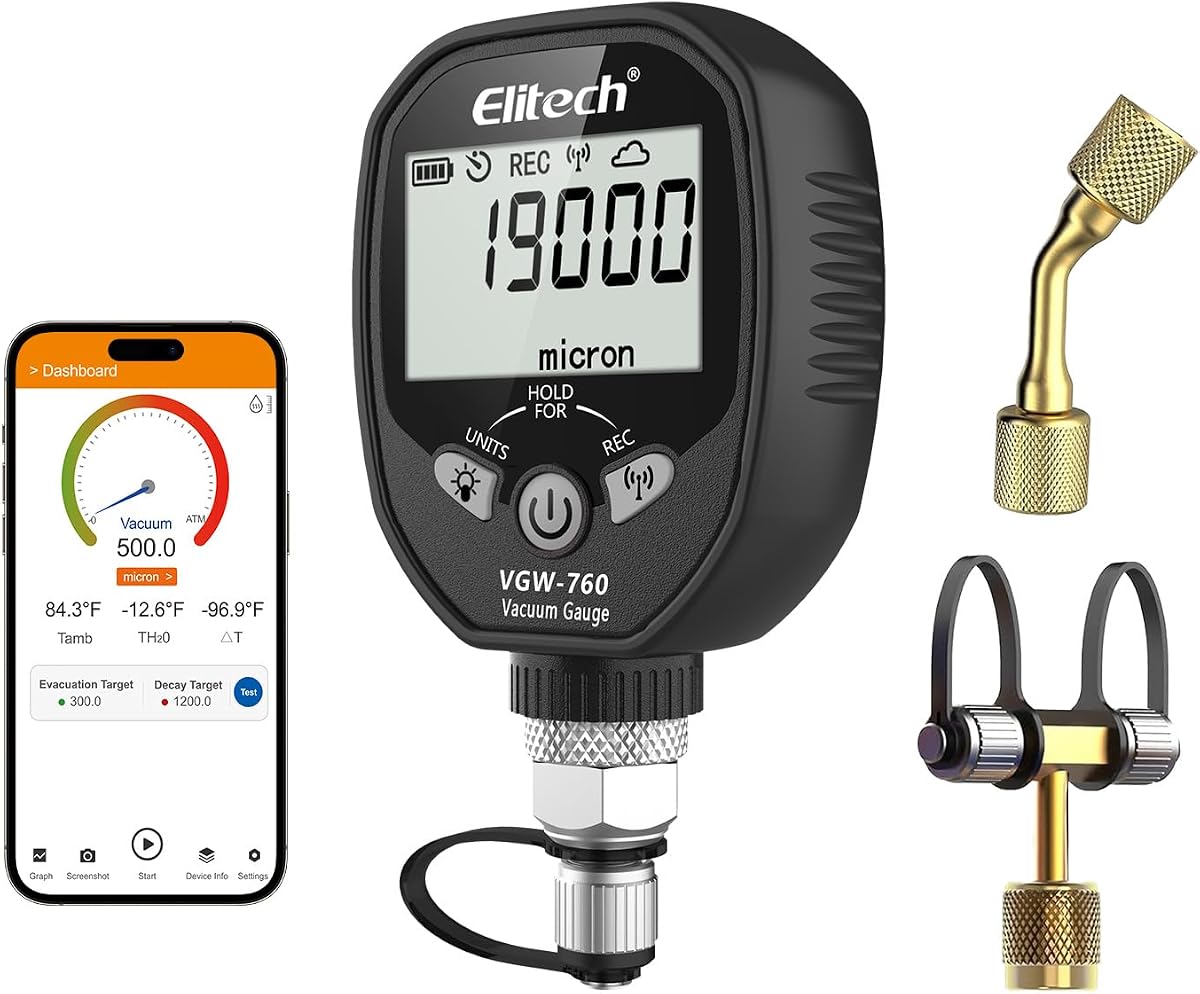
The Elitech VGW-760Pro is the most fully featured premium model in this roundup, combining a 4.1 rating with a stated range of 0 to 760,000 microns. That broad coverage allows it to move from atmospheric conditions into deep vacuum, making it suitable for service procedures that require more than a conventional deep-vacuum-only display.
We may earn a commission when you buy through this link, at no additional cost to you.
Wireless app support, configurable target notifications, offline recording, and data export form the core of its professional workflow. The gauge also assesses the state of water by comparing ambient temperature with water-saturation temperature at the measured vacuum. Its stated accuracy is ±10% or ±10 micron.
Premium capability comes with added operating considerations. Users need to operate and maintain the app connection for remote functions, and the same oil-proof film caveat applies: the supplied instructions recommend removing it when connecting to a vacuum pump and reinstalling it when connecting to the system because it can delay a numerical display.
The VGW-760Pro is best for HVAC and refrigeration professionals who want one gauge to cover a very wide range and document results digitally. It is a particularly strong fit for service businesses that value records and alerts. Users who only need a simple direct readout may find a smaller, less connected instrument easier to manage.
The 760,000-micron ceiling makes the model useful for monitoring the transition from atmospheric pressure toward deep vacuum. This range flexibility can simplify tool selection for technicians who work across different stages of evacuation.
Offline recording protects the ability to collect data when connectivity is limited, while app notifications alert users when a target is reached. The result is a workflow that supports both active supervision and post-job documentation.
We may earn a commission when you buy through this link, at no additional cost to you.
The testo 552i is a wireless digital vacuum probe designed specifically for HVAC evacuation, with a 4.3 rating and a strong focus on deep-vacuum resolution. It provides single-digit resolution and a stated accuracy of ±10 micron plus 10% of the measured value from 100 to 1,000 micron.
We may earn a commission when you buy through this link, at no additional cost to you.
Its integrated 45-degree angle is a practical design feature for connecting at a service port. The IP54 housing adds protection in demanding service environments, and wireless operation allows live data to appear on compatible testo digital manifolds and in the testo Smart App without requiring the technician to look away from the system.
The app can document results, support service and maintenance tasks, and help create reports from the job site. Automatic connection to compatible testo digital manifolds streamlines setup and may reduce refrigerant loss by simplifying operation through a single service port. The trade-off is ecosystem dependence: the strongest workflow benefits apply when other compatible testo tools and software are part of the job.
The 552i is best for HVAC professionals already using testo digital manifolds or interested in wireless reports and live manifold displays. Its angled connector, protected housing, and deep-vacuum clarity make it a strong field tool, while non-testo users may get more value from a standalone gauge with a larger local screen.
The integrated 45-degree angle makes the probe easier to position at a service connection. Wireless data transfer also removes the need to follow a cable while the instrument remains connected to the system.
Single-digit resolution supports precise low-pressure monitoring, while the Smart App records results and supports report generation. Compatible digital manifolds can show live measurements as part of a broader connected workflow.
We may earn a commission when you buy through this link, at no additional cost to you.
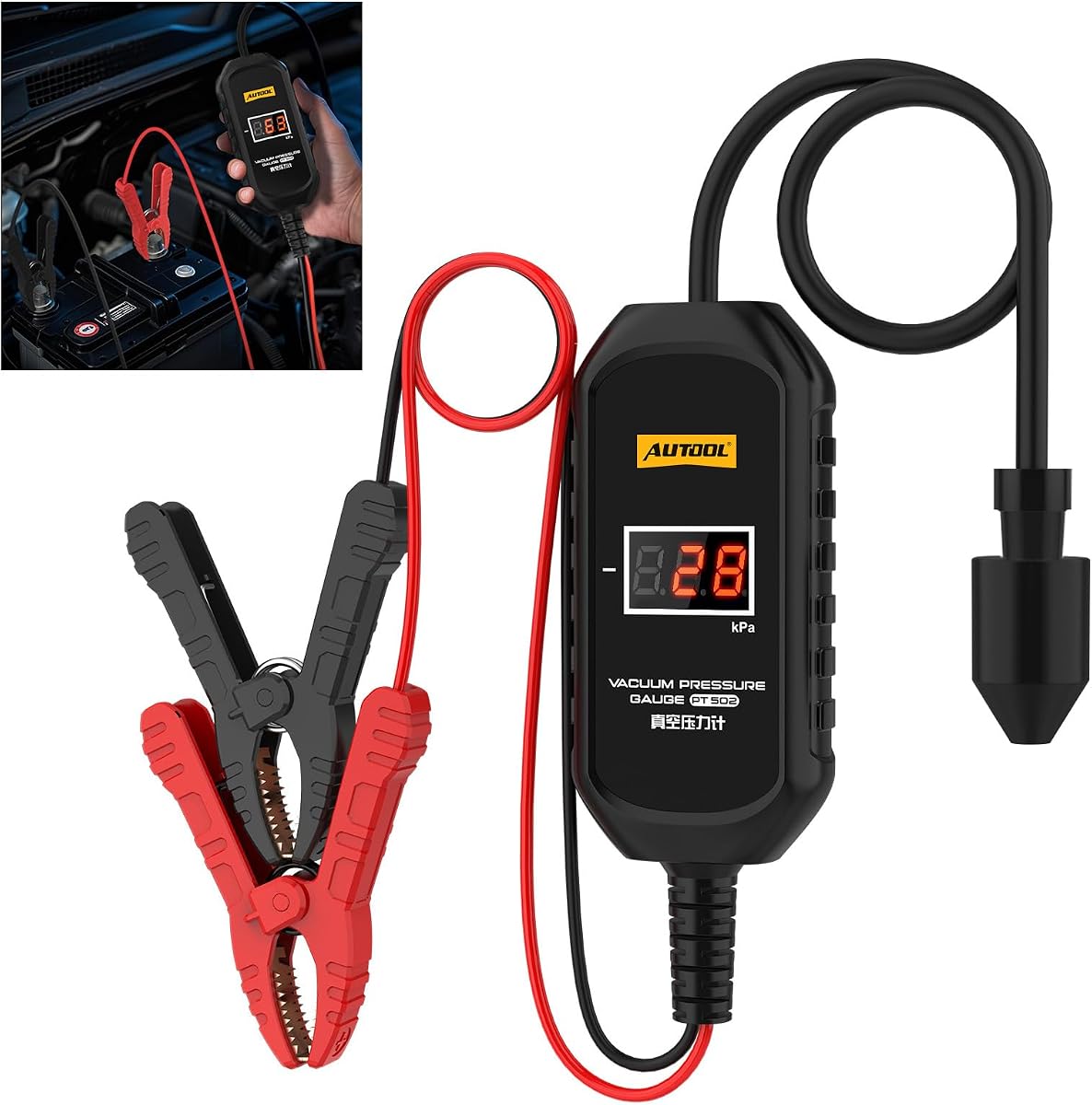
The AUTOOL PT502 is the best budget choice for automotive diagnostics because it measures negative pressure in sealed systems and hoses rather than focusing exclusively on deep refrigeration vacuum. Its 4.4 rating is among the strongest in the list, and the instrument provides a clear digital alternative to estimating pressure with analog equipment.
We may earn a commission when you buy through this link, at no additional cost to you.
The stated range runs from -101 kPa to 0 kPa, covering the full atmospheric vacuum side of the scale. A real-time display allows technicians to observe pressure changes without repeatedly dismantling components, and automatic temperature compensation supports consistency from -10°C to 60°C.
Power comes from an external 12V source, and reverse polarity protection helps reduce the risk of damage from an incorrect connection. The main limitation is its purpose: this is not a deep-vacuum gauge for reaching micron-level HVAC evacuation targets. It also needs vehicle power rather than operating as a self-contained handheld tool for remote service locations.
The PT502 is best for automotive technicians diagnosing intake, exhaust, EGR, hose, or sealed-system vacuum issues. It offers an affordable, specialized alternative to the refrigeration-focused models in this guide. For HVAC refrigerant evacuation, choose a gauge with micron-level coverage and a service-port connection instead.
A full -101-to-0 kPa range is suited to observing vacuum in engine intake, exhaust, and EGR-related systems. Real-time readings make pressure changes easier to see and compare during diagnosis.
Automatic compensation helps stabilize the reading across the stated -10°C to 60°C operating range. Reverse polarity protection adds an additional layer of safety when connecting the tool to a 12V source.
We may earn a commission when you buy through this link, at no additional cost to you.
The Digital Vacuum Gauge with 11 Units has the highest supplied customer rating in the group at 5.0. It is a straightforward HVAC tool centered on real-time pressure monitoring, a Pirani sensor, four display units, and a target-vacuum mode that adds audible and visual prompts.
We may earn a commission when you buy through this link, at no additional cost to you.
The stated accuracy is ±5% from 0.1 to 1,000 Pa, with resolution of 0.01 below 10 Pa. The working temperature range is -23°F to 122°F, and the 1/4-inch SAE connection uses 7/16-20 UNF threads. A large backlit LCD and non-slip rubber housing support everyday field handling.
Its monitoring workflow is easy to understand: set a target with the SET button, save it, and activate monitoring. The display flashes and the buzzer sounds at the preset vacuum. The tool can also stop manually with any key or automatically after 35 seconds. The package includes a portable bag, three AA batteries, an extension connector, tee connector, and manual.
This is a good choice for a technician who wants a conventional local display, target alerts, and a complete accessory bundle without a connected-app workflow. The exact 5.0 rating should not be interpreted as proof of laboratory performance, and buyers should note that the stated accuracy range is limited. Even so, the supplied user feedback is strong and the feature set is well suited to routine HVAC vacuuming.
Set a desired vacuum level once, then let the gauge alert you when that level is reached. The periodic buzzer, flashing screen, and automatic timeout make the tool practical for hands-free monitoring during evacuation.
The backlit LCD, non-slip housing, and included carrying bag focus on portable operation. Extension and tee connectors add flexibility, while three AA batteries are supplied for immediate use.
We may earn a commission when you buy through this link, at no additional cost to you.
The right digital vacuum gauge depends on the system being tested, required pressure range, accuracy expectations, connection method, and the amount of diagnostic or reporting functionality your workflow needs. Comparing those factors before buying prevents an instrument with attractive features from becoming an inconvenient or unsuitable field tool.
Choose the range that matches the readings your procedure actually requires. A deep HVAC evacuation gauge may begin near atmospheric pressure and continue through tens of thousands of microns, while the AUTOOL PT502 focuses on automotive negative pressure from -101 to 0 kPa. The Elitech VGW-760Pro and Super Stars ST-VG90 provide especially broad coverage, whereas some compact models are optimized for deeper service work.
Accuracy specifications are not directly interchangeable. Some products quote a percentage of full scale, some state a percentage within a defined range, and others combine a percentage with a fixed micron tolerance. The Digital Vacuum Gauge Pro claims ±0.2% of full scale, the Supco VG64 lists ultra-fine resolution, and several Pirani-based tools state ±5% or ±10% depending on the model. Calibration features are also worth comparing because they can help maintain confidence after use or exposure to changing conditions.
Pressure terminology varies by region and service procedure. Useful digital gauges support combinations such as microns, millibar, hPa, torr, Pa, mmHg, and inches of mercury. The Supco VG64 offers seven selectable units, while most competing models provide four. A large, backlit LCD is also important: it reduces interpretation errors in dark spaces and lets the user monitor a changing value without repeatedly moving closer to the instrument.
Many HVAC gauges use a 7/16-20 UNF thread compatible with 1/4-inch SAE service ports, but the connection should still be confirmed against the equipment being used. Adapters and tee fittings can improve flexibility, and the CPS VG200 includes both a T-fitting and hook. Pump capacity also matters: the Super Stars ST-VG90 is described as compatible with pumps of 5 CFM or higher. Confirming mechanical compatibility before a job prevents connection problems in the field.
Alarms reduce the need to watch the display continuously. Most products offer a target level with audible and visual notification, while the Digital Vacuum Gauge Pro adds a dedicated pressure leak-test mode and a smart evacuation mode. Elitech's connected gauges provide app notifications, and their water-state assessment adds saturation-temperature context. These functions are most valuable when they match a recurring workflow rather than adding complexity the technician will never use.
Wireless gauges can display readings on a phone, tablet, or compatible digital manifold and may store evacuation records for later export. The Elitech models support app-based alerts, offline recording, and Excel or PDF export, while the testo 552i documents results in the testo Smart App. Connectivity is advantageous for reporting, but it also introduces app pairing, charging, or ecosystem considerations that may not suit every technician.
A service gauge should tolerate repeated connection, storage, and transport. Consider the stated housing protection, positive-pressure tolerance, resistance to oil residue, and included storage. The testo 552i has an IP54 housing, the CPS VG200 has a cleanable sensor with stated 400 PSI positive-pressure tolerance, and the Supco VG64 emphasizes an oil-resistant sensor. A non-slip body, backlight, and compact size can also improve daily usability.
Temperature compensation helps prevent ambient changes from distorting a reading. All of the listed products include some form of compensation in their supplied specifications, but the methods differ, and compensation does not replace good installation technique. Power requirements are another practical factor. The AUTOOL PT502 uses an external 12V source with reverse polarity protection, the Elitech VGW-Mini is rechargeable, and several other gauges use replaceable batteries.
Begin by confirming that the gauge, adapters, service port, and vacuum pump are mechanically compatible. Inspect threads and seals, then install the gauge according to its instructions. If the model includes an oil-proof film, follow the manufacturer's directions for pump and system connections. Before pulling a strong vacuum, verify that the display is powered, the selected unit is correct, and the readings are responding normally.
For an evacuation, start the pump as directed and monitor the gauge rather than relying only on an elapsed-time estimate. Record the target vacuum and use the alarm or notification function when available. On connected models, confirm that readings appear in the app and that offline records are being saved if the technician may be outside wireless coverage. After reaching the target, observe stability and follow the applicable service procedure before disconnecting the equipment.
Power down the instrument when the job is complete, remove it from the service port, and inspect connectors for debris or oil. Keep the sensor and display clean, protect the housing from impact, and store the gauge in its case or bag. Review calibration, battery, firmware, and app-update requirements periodically, and never rely on a compensated reading if the sensor is contaminated, damaged, or operating outside its stated temperature and pressure limits.
A digital vacuum gauge measures negative pressure and displays the result numerically, making it easier to monitor HVAC evacuation, refrigeration service, or automotive vacuum systems. In HVAC work, it helps technicians observe whether a system reaches and maintains a specified vacuum level. Automotive versions can be used to examine intake, exhaust, EGR, and hose-related pressure changes.
No. A broad selection is useful only if it improves compatibility with the user's procedures. Most technicians need a small group of familiar units, and a clear display may matter more than supporting many formats. The Supco VG64 offers seven units, while several other models focus on four common choices such as microns, millibar, hPa, torr, Pa, or mmHg.
The appropriate target depends on the equipment, refrigerant, service procedure, and manufacturer guidance. Digital gauges can cover broad ranges from atmospheric pressure to deep vacuum, so users should select one that includes both the starting condition and the required final target. A target alarm can help track progress, but it should be set according to the applicable service specification rather than a universal number.
A wired or local-display gauge is often simpler and can be sufficient for routine readings and target alarms. Wireless models are valuable when a technician wants remote monitoring, app notifications, reports, or data export. Connected options can also integrate with compatible digital manifolds, but they require attention to pairing, charging, software, and compatibility with the rest of the tool ecosystem.
No. Temperature compensation corrects readings for declared changes in ambient temperature, but it cannot compensate for a dirty or damaged sensor, incorrect connections, leaks, oil contamination, or operation outside the specified limits. The gauge should still be handled carefully, inspected regularly, and kept in a protective storage case when it is not in use.
A micron vacuum gauge is designed for deep HVAC and refrigeration vacuum, often extending from atmospheric pressure into the low-micron region. An automotive gauge measures engine-related negative pressure, commonly in kPa, from zero down to approximately -101 kPa. The AUTOOL PT502 belongs to the latter category and is not a substitute for a gauge intended to reach a deep HVAC evacuation target.
The supplied information states that an oil-proof film inside the gauge head may cause a delayed numerical display when the instrument is connected directly to a vacuum pump. The stated recommendation is to remove the film when connecting to the pump and reinstall it when connecting to the system. Users should follow the manufacturer's instructions carefully to preserve the intended protection.
Read the entire claim, including whether accuracy is based on full scale, the measured value, or a limited operating range. A percentage of full scale has a different meaning from a fixed micron tolerance, and the two should not be compared as if they were identical. Also consider calibration features, sensor type, and the environmental conditions under which the stated accuracy applies.
The CPS VG200 is the strongest all-around selection for direct HVAC and refrigeration measurement, combining a clear five-digit display, automatic compensation, multiple units, and useful included accessories. The Elitech VGW-760Pro is the premium choice for users who need broad atmospheric-to-deep-vacuum coverage alongside app alerts, offline recording, and exportable data, while the AUTOOL PT502 is the practical budget pick for automotive negative-pressure diagnosis.
Before deciding, prioritize the measurement range, connection, accuracy definition, and workflow that matter most in your day. A simple local display can be ideal for routine evacuation, whereas connectivity may justify a more advanced instrument when remote monitoring and documentation are recurring needs. The Digital Vacuum Gauge Pro is worth considering for dedicated evacuation and leak-test modes, and the testo 552i is compelling for technicians already invested in its connected ecosystem.
Finally, check the current product listing, included accessories, compatibility requirements, customer feedback, and availability before ordering. Ratings and specifications can evolve, and product details may change between revisions. Confirming those details ensures that the chosen digital vacuum gauge fits both the equipment and the service procedure it will be used to support.