
Cosmo Mini 100
4.3Editor score
Compact smartphone and camera support
Floating magnetic alignment board
Quick-adjustable aluminum bracket
Explore the best copy stands for film scanning and photo digitizing, comparing stability, camera compatibility, alignment, and ease of use for home users today.
A copy stand keeps photographs, film, documents, and small objects exactly where you want them while a camera captures a straight-down image. A useful model balances a stable base, smooth height adjustment, accurate alignment aids, and compatibility with the camera or smartphone you already use.
We compared all ten products by examining their base size, support system, camera positioning options, original-holding features, and stated device compatibility. The list covers compact home stands, larger overhead photography rigs, dedicated film-scanning hardware, and magnetic platforms that can complement a separate stand.
Each review identifies the most suitable use for the product, explains its main advantages, and notes practical limitations. Ratings reflect the supplied customer feedback, while availability and prices can change, so confirm current product details before making a final purchase.
4.3Editor score

4.6Editor score

4.2Editor score
This side-by-side comparison highlights the principal differences in working area, support capacity, camera adjustment, alignment aids, and intended level of use so you can identify the most appropriate stand for your photographs, negatives, documents, or small objects.


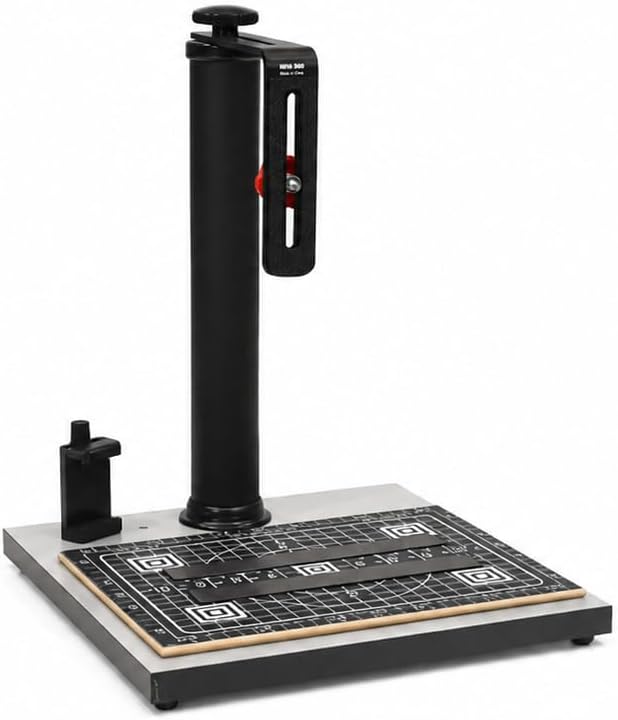


The Cosmo Mini 100 is a compact copying stand intended for photographs, documents, checks, jewelry, coins, and other small items. Its customer rating of 4.3 reflects generally favorable experiences, particularly for users who want a straightforward way to photograph originals with a smartphone. Rather than requiring a complicated studio arrangement, it provides a defined base, an elevated support, and a magnetic platform for positioning subjects.
We may earn a commission when you buy through this link, at no additional cost to you.
The stand assembles in under one minute and has a 10.5 by 8.5 inch base that is easier to store than a full-size photographic workstation. Its adjustable aluminum L-bracket can move both vertically and horizontally, while the column adjusts from 11 to 16 inches. A center opening accommodates compact cameras under one pound, and a side opening helps position a smartphone over the middle of the board. The included 9 by 7 inch Floating Magnet Board uses two magnetic strips and printed half-inch grid lines to keep originals flat while helping with framing and focus.
The main limitation is clearly defined by the manufacturer: this is a mini stand for students, hobbyists, and casual users rather than a professional or large-format system. A heavier camera, a large negative arrangement, or an oversized collection would quickly exceed the compact base and light-duty camera support. The floating board is also smaller than many standard photographic formats, so it is most effective with small prints, documents, and individual collectibles.
This is a compelling choice for a first copy stand, especially when a smartphone is the primary imaging device. Its rapid setup, portable construction, and included alignment board make it convenient for preserving family photographs, making mobile-deposit images, or producing consistent listings for small objects. Choose it when convenience and a modest footprint matter more than heavy-camera support or professional capacity.
The side camera opening helps center a smartphone over the working area, while the included holder supports phones between 2.25 and 3.5 inches wide. Together with the half-inch grid, it reduces the trial-and-error involved in finding a straight overhead position.
The floating magnetic board keeps paper originals and lightweight small objects from shifting between exposures. That makes the Mini 100 practical for checks, loose photographs, coins, jewelry, and other subjects that benefit from a consistent flat surface.
We may earn a commission when you buy through this link, at no additional cost to you.
The Cosmo Mini 300 is a compact US-made stand for amateur and hobbyist digitizing work, and it holds a 4.2 customer rating. It offers a meaningful step up from small smartphone-oriented stands by accommodating cameras up to 3 pounds as well as compatible phones. The result is a versatile platform for photographs, documents, artwork, and lightweight creative projects.
We may earn a commission when you buy through this link, at no additional cost to you.
Its 12 by 9.5 inch melamine base provides more room than a minimal desktop holder while remaining portable. The steel tube column, combined with a reversible anodized aluminum L-bracket, offers vertical adjustment from 7 to 17 inches and two horizontal positions spaced one inch apart. The included 10 by 7.5 inch Floating Magnet Board has half-inch alignment grids and two magnetic strips, allowing the board to be moved while the original remains flat for a more attractive crop.
Despite its larger support capacity, this remains an amateur and hobbyist product rather than a professional copy station. The entire unit weighs eight pounds and takes up more space than the Mini 100, so it is less convenient for truly mobile use. Its floating board is still too limited for large-format negatives, oversized artwork, or multiple film strips without additional planning.
Buyers who want to photograph with both a smartphone and a compact or modestly weighted camera will appreciate the broader compatibility. It is a good middle ground for family archives, art studies, and online listings where more working room is useful. Those who routinely work with larger originals or demanding professional equipment should consider a more substantial system.
A three-pound camera limit gives users more freedom than light-device stands while remaining manageable for home use. The center camera hole and side smartphone opening support two distinct ways of establishing an overhead axis.
The wider L-bracket can be reversed, and its two horizontal positions make it easier to trade working distance for subject coverage. This is helpful when a tightly framed image is more important than maximizing the amount of space around the original.
We may earn a commission when you buy through this link, at no additional cost to you.
The Copy Macro Stand is a purpose-built film digitization station rather than a general-purpose tabletop photography copy stand. It is designed around 135 and 120 negatives and uses a full metal construction intended to support serious camera and lens combinations. No customer rating was supplied, so its performance should be evaluated primarily from its documented design rather than an aggregated score.
We may earn a commission when you buy through this link, at no additional cost to you.
A sturdy aluminum base measures 240 by 200 millimeters, and adjustable leveling feet help compensate for an uneven desk. The quick-release mounting plate allows the camera to be raised or lowered to frame negatives and slides consistently. A bubble level provides a visible indication of tilt, while the locking knob helps maintain the selected setup. The quick-release clip works with DSLRs, mirrorless cameras, and L-brackets.
The primary trade-off is specialization. Although its stable construction and precise leveling are attractive for film, it does not include the broad floating magnetic board found on several Cosmo options. Users primarily photographing prints, recipes, checks, or small consumer objects may find a general copy platform more convenient. It also lacks information about camera load capacity in the supplied specifications.
The stand is best suited to photographers who have already chosen a compatible camera and want a stable, level platform for scanning film. Its quick-release plate, metal frame, and adjustable feet make it a compelling dedicated option for 135 and 120 formats. For mixed creative projects involving documents, prints, and objects, a more versatile stand may be a better investment.
Uneven support can introduce tilt into a carefully framed negative image. The adjustable feet and bubble level give this stand several ways to confirm that the camera, base, and subject are aligned before an exposure begins.
The quick-release plate shortens the process of moving among framing positions. Compatible DSLRs, mirrorless cameras, and L-brackets can be mounted or removed without repeatedly working with a conventional threaded fastener.
We may earn a commission when you buy through this link, at no additional cost to you.
The Kaiser 205411 Copy Stand RS 2-XA combines thoughtful adjustment features with a customer rating of 4.6, the highest established score among the listed products that includes a numerical feedback value. It is a strong all-around choice for photographers who want precise positioning without the footprint or complexity of a full professional stand.
We may earn a commission when you buy through this link, at no additional cost to you.
The non-reflective matte gray base carries a fine printed grid and inch-and-centimeter scale, helping users judge size, focus, and camera placement. A matte black anodized aluminum column is marked with matching scales. The camera arm adjusts in height, the column rotates through 180 degrees, and approximately 2.7 inches of horizontal adjustment is available between the arm and column. Cameras attach through a quarter-inch mounting thread.
Its maximum stated load of 3.3 pounds keeps it in a lighter equipment class, so a small digital camera, CCD camera, or CMOS camera is the more natural fit than a large modern DSLR with a heavy lens. Optional lighting kits are available but not included. The limited one-year warranty against manufacturing defects is another point worth checking before purchase, especially for a long-term archiving setup.
This Kaiser is an excellent choice for careful home or studio work involving prints, documents, slides, and smaller objects. The printed scales are particularly useful when you need to repeat a framing or measure the subject area. It is less appropriate for heavy pro bodies, expansive negative strips, or a requirement for a large illuminated working surface.
Inch and centimeter markings appear on both the base and column, allowing camera height and working area to be established from readable references. This is valuable when producing a sequence of images under consistent dimensions.
Rotating the column through 180 degrees expands the angles from which the camera arm can approach the base. That flexibility helps users frame subjects that are difficult to capture with a completely vertical camera position.
We may earn a commission when you buy through this link, at no additional cost to you.
The Cosmo Mini 500 is a compact but substantial stand for digitizing and creative photography, earning a 4.2 customer rating. It is designed for people who want to move beyond simple document capture into slides, negatives, artwork, sketches, tattoos, restorations, presentations, and video work without moving to a large studio copy system.
We may earn a commission when you buy through this link, at no additional cost to you.
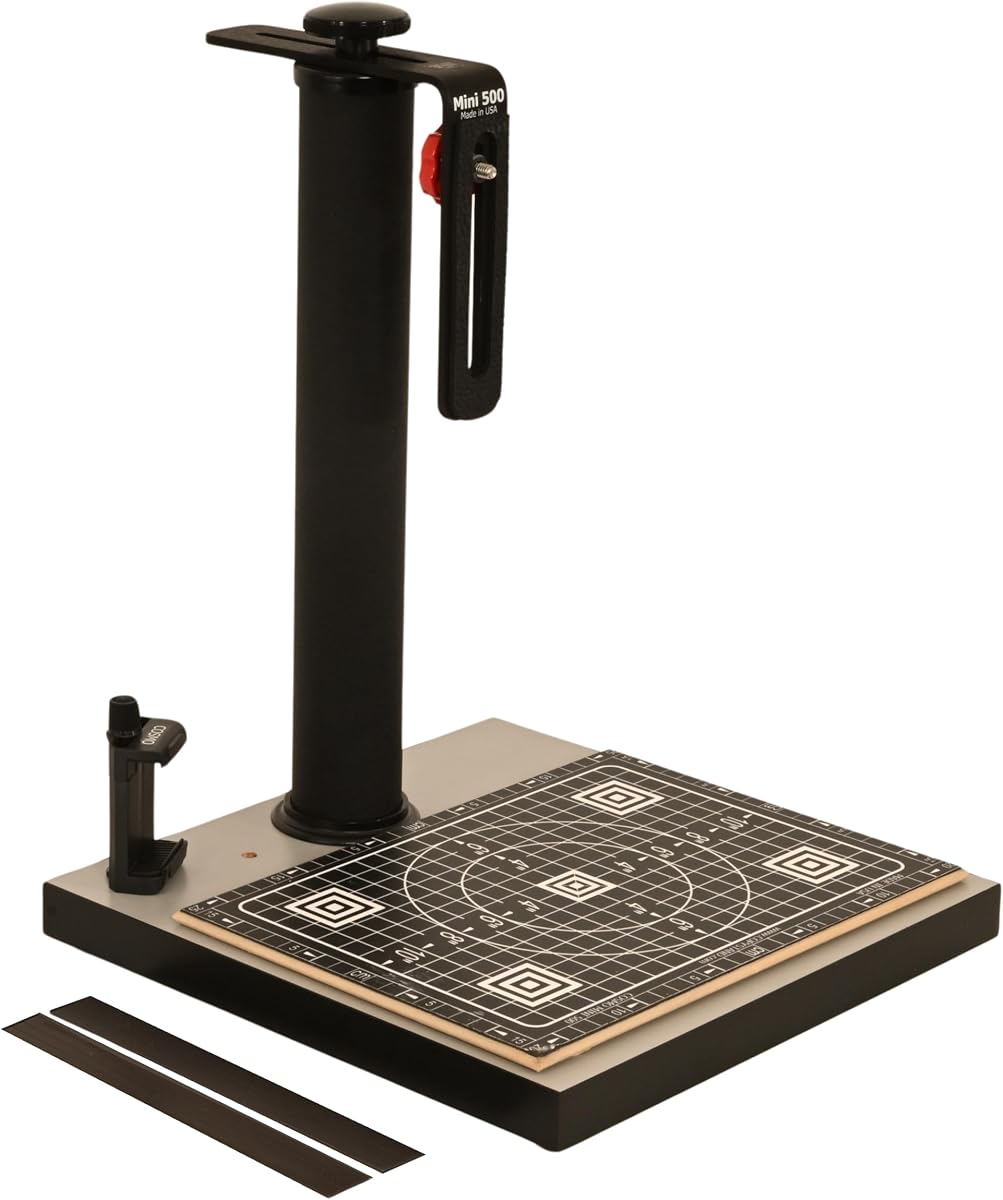
A heavy-duty 12 by 12 inch gray melamine base supplies a stable platform. The reversible anodized aluminum bracket adjusts vertically from 9 to 19 inches and offers approximately four inches of horizontal travel, supported by a rigid two-inch fixed steel column. The stand accommodates cameras up to 3 pounds and phones between 2.25 and 3.5 inches wide. Its 8.5 by 11.5 inch Floating Magnet Board includes half-inch grid lines and two magnetic strips for keeping originals flat.
The manufacturer explicitly notes that this is not a professional copy stand. Its eight-and-a-half-by-eleven-and-a-half-inch floating board is a useful general size, but it cannot accommodate unusually large artwork or multiple full-width film strips. Some applications, particularly work with transparent negatives, may require an LED light box, and one is not included. The nine-pound weight also makes it less convenient to carry regularly than a truly mini setup.
For a home creator, the Mini 500's versatility can be more valuable than maximum capacity. It is a good central station for producing instructional images, cataloging artwork, documenting tattoos, photographing sketches, and digitizing standard photographs. Buyers should plan their lighting carefully and choose it when a substantial square base and long vertical adjustment are more useful than maximum portability.
The wide base and adjustable bracket allow the same stand to handle paper records, artwork, slides, and small displays. This flexibility makes the Mini 500 useful for creators who alternate between archival, instructional, and presentation projects.
Vertical adjustment from 9 to 19 inches gives the camera enough elevation to capture larger working areas or smaller subjects with less perspective distortion. The reversible bracket adds another four inches of lateral positioning flexibility.
We may earn a commission when you buy through this link, at no additional cost to you.
This Cosmo Mini 500 version offers a slightly wider base and the same adaptable support system found in the original Mini 500. No numerical customer rating was provided, so buyers should consider its documented dimensions and features carefully. It is aimed at home users who want a stable platform for photographs, documents, and small objects.
We may earn a commission when you buy through this link, at no additional cost to you.
The base measures 13 by 12.5 inches and uses a three-quarter-inch gray melamine construction. Its two installation holes provide options for a camera or a smartphone camera aligned over the board. A two-inch fixed steel column supports a reversible anodized aluminum bracket that adjusts from 9 to 19 inches vertically and approximately four inches horizontally. The 8.5 by 11.5 inch Floating Magnet Board has a half-inch grid and two magnetic strips.
The product shares important limitations with the related Cosmo Mini 500 listing. It is not positioned as a professional stand, and its magnetic platform remains smaller than a full archival work surface. Transparent slides or negatives may need a separate light source because none is specified as included. The absence of a rating also makes it harder to use customer feedback as a direct buying signal.
This listing is a practical alternative for users who want more lateral stability than a narrow mini platform. The larger base may be especially helpful when the camera needs to sit farther from the edge during overhead work. It remains most appropriate for standard-size photographs, papers, and lightweight small objects captured with a phone or camera within the stated support range.
At 13 by 12.5 inches, the base offers more surrounding support than many compact copy stands. That additional area can reduce the chance of placing a camera holder too close to the edge.
The magnetic board's grid helps keep a subject centered while the half-inch references make repeated framing easier. Moving the board without lifting the original also allows the user to refine the final crop.
We may earn a commission when you buy through this link, at no additional cost to you.
The Cosmo Mini 700 is built for users who need a large working area rather than a lightweight desktop arrangement. It supports large documents, photographs, food plates, jewelry, coins, collectibles, and other three-dimensional objects. No numerical rating was supplied, so its appeal rests on the unusually large board, flexible support system, and clearly stated compatibility.
We may earn a commission when you buy through this link, at no additional cost to you.
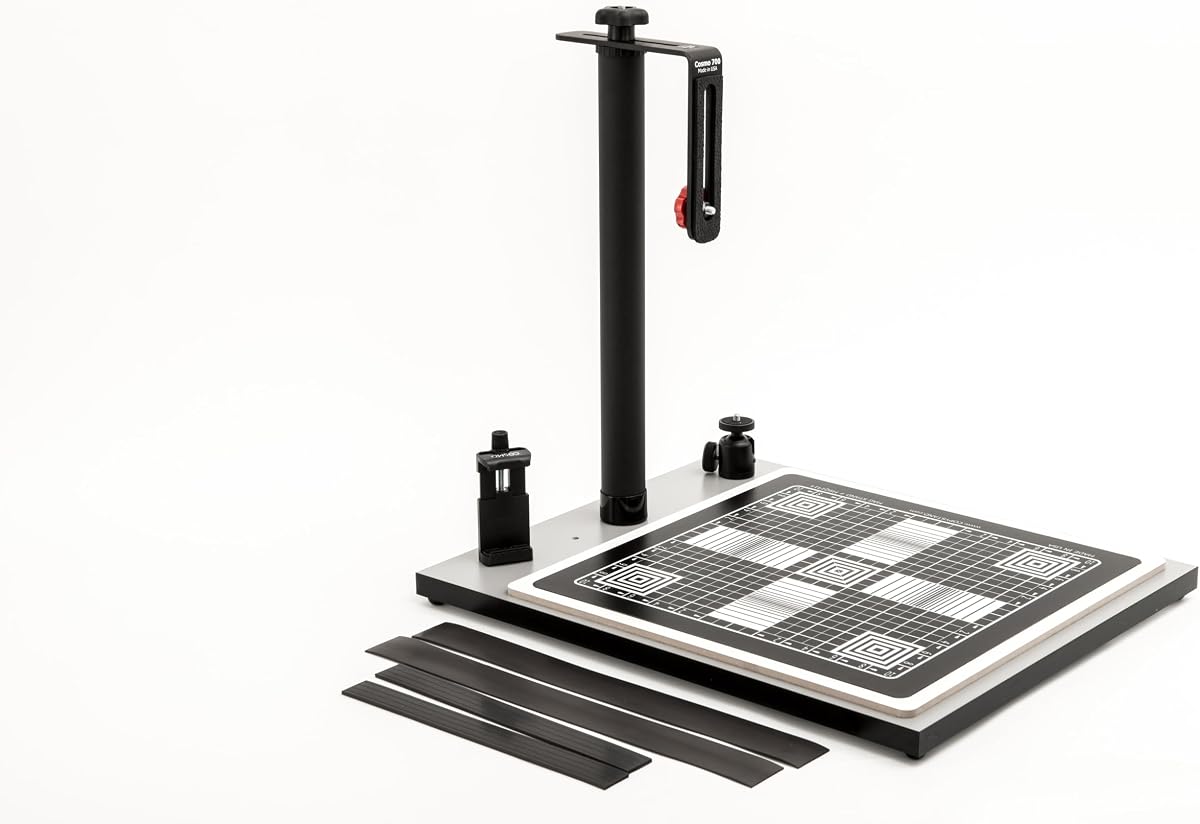
The gray melamine base measures 15.5 by 18.5 inches and includes center and side mounting holes. The included 15 by 15 inch Floating Magnetic Board has a 14 by 14 inch magnetic working area, half-inch grid lines, and four magnetic strips. A 1.5-inch powder-coated steel column carries an aluminum L-bracket with multiple vertical and horizontal positions, a ball head for angle changes, and a holder for phones 2.25 to 3.5 inches wide. Cameras under 3 pounds are also supported.
The tradeoff is substantial size and weight. At 14 pounds, this is not a highly portable stand, and its footprint demands more desk space than the smaller Cosmo models. It is also not intended as a professional copy stand, despite its useful precision grid. Users shooting glossy objects may need to manage reflections carefully, while transparent film may require a separate light box.
This is a strong choice for online sellers, food photographers, art students, and family archivists with oversized prints or varied subjects. The large magnetic area and multiple holding strips make it especially useful when subjects would otherwise shift on a smaller platform. Choose it when working space and flexibility matter more than easy storage.
A large board is valuable for panoramic documents, family groupings, plated meals, and collections that exceed the dimensions of conventional floating holders. The surrounding base also provides ample room to position a camera support.
The included ball head allows smoother angle adjustments than a basic fixed bracket. This is valuable for tall objects or subjects that cannot be photographed from a perfectly vertical position.
We may earn a commission when you buy through this link, at no additional cost to you.
The Cosmo Mini 700 listing carries a 4.8 customer rating, the strongest established numerical rating in the group. It combines a large working area with the flexibility to photograph with a smartphone or a compatible camera, making it a practical choice for food photography, documents, art, collectibles, and large pictures.
We may earn a commission when you buy through this link, at no additional cost to you.
Its 15.5 by 18.5 inch base and 15 by 15 inch Floating Magnetic Board create a generous area for arranging subjects. The board provides a 14 by 14 inch magnetic working zone, four magnetic strips, and half-inch grid lines for alignment, focusing, and sizing. A 1.5-inch diameter, 16-inch powder-coated steel column supports the adjustable L-bracket, included ball head, and phone holder.
Despite the strong customer feedback, this is still described as a compact, USA-designed solution rather than a professional copy stand. Its 14-pound weight and broad base make storage inconvenient for a small apartment or mobile setup. The camera guidance refers to DSLR models under 3 pounds, so users should verify the actual weight of any body-and-lens combination. Glossy subjects may also reveal reflections that require careful lighting.
The Mini 700 is a strong all-around choice when a large board and flexible camera positioning are the priority. It gives online food vendors enough room to finish a plate, gives students a practical surface for artwork, and gives archivists a stable platform for larger photographs. Its combination of customer feedback, extensive working area, and multiple holding strips makes it especially appealing for varied creative projects.
Four magnetic strips provide more ways to secure wide originals than a two-strip board. The large surface can therefore remain useful for prints, documents, menus, and plated compositions that need to stay flat.
The ball head and multi-position L-bracket make it easier to move from a centered overhead position to a slightly angled composition. These adjustments are particularly useful for dimensional objects with visual depth.
We may earn a commission when you buy through this link, at no additional cost to you.
The Kaiser RS1 with RA1 camera arm is the premium choice in this collection, combining an extra-wide column, refined adjustment hardware, and spring weight compensation. Its 4.2 customer rating indicates a positive overall reception, while the mechanical design is aimed at users who value repeatability and control more than a minimal footprint.
We may earn a commission when you buy through this link, at no additional cost to you.
The extra-wide, vibration-resistant column is made from matte black anodized aluminum tubing and carries printed inch-and-centimeter scales. The camera arm adjusts in height, while interchangeable quarter-inch and three-eighth-inch threaded bushings expand mounting compatibility. A roll-off spring mechanism offsets camera weight, making vertical positioning easier and helping the selected camera height remain stable.
Compared with a compact home stand, the RS1 demands more space and provides a more specialized workflow. The supplied information does not specify maximum load, overall dimensions, or whether a smartphone holder is included, so buyers should confirm those details for their particular device. A true flatbed scanner may also be more appropriate for certain documents, particularly when depth of field and color consistency are the dominant concerns.
This Kaiser is best for serious photography enthusiasts, archive creators, and small studios that repeatedly photograph flat originals. Its spring-assisted arm and rigid column are especially useful when the same camera position must be reproduced across many sessions. Choose it as a long-term workstation when precision hardware justifies a larger and more specialized setup.
The roll-off spring mechanism supports the camera as the arm moves vertically. That makes fine height changes less tiring and reduces the chance that a heavier camera will drift away from the selected position.
Interchangeable quarter-inch and three-eighth-inch threaded bushings allow the stand to work with different mounting standards. The included camera adjustment tool supports a more repeatable setup process.
We may earn a commission when you buy through this link, at no additional cost to you.
The Photography Copy Holder 1612DTM is a magnetic document platform rather than a complete overhead copy stand, and it has a 5.0 customer rating. Its strong feedback and useful 16 by 12 inch surface make it an attractive option for users who already own a camera support or who want an inexpensive way to improve the positioning of flat originals.
We may earn a commission when you buy through this link, at no additional cost to you.
The holder is constructed from three layers of wood, rubber steel, and a laminated car-wrapping film surface. A printed half-inch precision grid with squared corners assists initial setup, focusing, alignment, adjustment, and sizing. Two magnetic strips keep originals in place, and the board can be moved to change the final composition without moving the subject. It may sit directly on a desk or on the base of another copy stand.
The main limitation is that it does not include a camera arm, column, or light source. It therefore cannot create a complete overhead imaging station by itself. Users must supply suitable lighting and a stable way to position the camera directly above the platform. The magnetic retention is also intended for compatible original surfaces rather than unusually thick or nonmagnetic three-dimensional subjects.
This copy holder is best for photographers who want a refined alignment surface without a full support system, or for owners of a separate stand who need a replacement or supplementary magnetic platform. The five-star customer feedback is notable, but the narrow product scope should determine the decision. Choose it for document and print positioning, and pair it with a stand when a complete system is required.
The holder can sit on a desk beneath a separately mounted overhead camera. This makes it useful when a full copy stand is unnecessary but a flat, accurately marked working surface is still helpful.
The magnetic strips keep a document or photograph fixed while the entire platform is shifted. Photographers can therefore improve composition or create a tighter crop without disturbing the original's alignment on the strips.
We may earn a commission when you buy through this link, at no additional cost to you.
The most useful copy stand is the one that fits your subjects, supports your camera comfortably, remains stable during long sessions, and provides enough adjustment to create repeatable images. These factors determine whether a compact hobby stand or a more specialized workstation will serve you better.
Start with the dimensions of the originals you expect to photograph. Small photographs, checks, coins, and jewelry can work on compact boards, while large prints, documents, food plates, multiple negatives, or artwork require a broader base and a larger magnetic or flat holding surface. Check both the overall base dimensions and the actual working area, since a large stand can still include a smaller movable platform.
Choose a working area that leaves space around the subject and gives the camera support a stable position. A cramped platform can force awkward camera angles and make edge distortion more likely.
Determine what imaging device you will use before purchasing. Some stands are optimized for smartphones, some include a centered phone opening and holder, and others use a standard threaded camera mount. If you already own a camera, verify its weight, dimensions, mounting thread, and lens clearance against the stand's stated limits.
Smartphone users should check the supported width and whether the holder can secure the device without contacting the lens. Camera users should look for a quarter-inch connection, sufficient capacity, and a quick-release system that suits their workflow.
A stable base is essential because even slight movement changes focus and framing. Look for a broad footprint, rigid column, solid material, and adjustable feet if your desk may be uneven. Heavier camera bodies benefit from a wider base, while a well-positioned lightweight camera can work with a smaller platform.
Do not equate portability with instability. A compact stand should still resist movement when the camera is raised, lowered, or released. Choose the least mobile design that comfortably holds your equipment.
Height adjustment lets you frame different subject sizes and reduce perspective distortion by keeping the camera farther from smaller objects. Horizontal movement is useful for centering, while a rotatable arm or ball head provides additional angles for three-dimensional subjects. Note the actual adjustment ranges rather than relying on a large maximum height alone.
A reversible bracket or rotatable column can make a compact system more versatile. For documents and film, a repeatable vertical position is often more valuable than dramatic angular movement.
Printed grids, inch-and-centimeter scales, and camera-position references simplify framing and help you reproduce results across sessions. Magnetic strips keep paper originals flat and let you reposition the working surface without moving the subject. A floating board is particularly useful for choosing an attractive crop while preserving alignment.
Make sure the holding method suits the material. Magnetic strips are appropriate for paper and compatible light objects, while thick, loose, or nonmagnetic items may require a different surface or support.
Several products in this guide are explicitly designed for hobbyist or amateur use, while others present more specialized professional-style mechanics. The intended level affects acceptable camera weight, working area, durability expectations, and the availability of accessories. Buying a compact stand for occasional family archives is different from selecting a durable workstation for thousands of slides.
Match the product to your workload rather than to the word professional on its own. Consistent lighting, careful focusing, and repeatable alignment often contribute more to final quality than a large stand label.
A copy stand does not automatically solve lighting. Glossy photographs can reflect lamps, uneven room light can create gradients, and transparent negatives or slides need a suitable backlight for contrast. Some stands expressly mention that an LED light box is required for certain applications but do not include one.
Plan a diffuse, even light source and check whether it can be moved independently of the camera. For transparent film, choose or add a light box large enough for the entire negative and adjust the camera angle to avoid reflections.
Consider how often the stand must be moved and how much desk space is available. Compact models assemble quickly and fit into smaller storage areas, while wide platforms can be awkward to carry. A large board may also be valuable in a permanent studio even if it is inconvenient to transport.
For mobile digitizing, prioritize quick assembly, a manageable weight, and a protected surface. For a fixed workspace, choose the largest stable system that fits comfortably without obstructing your lighting or working posture.
Begin with a clean, level work surface and assemble the base, column, bracket, and camera support according to the product instructions. Confirm that the stand is fully stable before placing an original. Connect the camera or phone, disable automatic adjustments that may change between frames, and confirm that the lens is parallel to the copy surface.
Place the original on the magnetic board or working platform and use the grid, grid lines, or printed scales to establish a consistent position. Adjust the camera height so the subject fills the desired portion of the frame without introducing perspective distortion. Turn off room lights or other stray sources when controlled lighting is needed, and use a diffuse source to reduce glare on glossy prints.
After the session, remove the camera and original, then wipe the platform and grid with a soft, dry cloth. Do not use harsh liquids on printed, laminated, or magnetic surfaces. Keep the column and adjustment hardware free of dust, retighten loose fittings by hand, and store the stand in a dry area with heavy items removed from the board. For film, store originals in proper archival sleeves or containers rather than directly against the magnetic strips for long periods.
A copy stand can be an effective way to photograph old photographs, especially when you want flexible camera control, a phone-based workflow, or support for items that are awkward to feed through a scanner. A flatbed scanner may still be preferable for unattended batch capture, very consistent page dimensions, and certain archival workflows. Image quality depends on the camera, lens, lighting, and careful alignment rather than the stand alone.
Transparent negatives and slides generally benefit from a suitable light source behind them because they need even illumination to produce good contrast. Several stands in this guide note that an LED light box may be required and is not included. A copy stand can still be used without one for opaque prints, documents, and other reflective or solid subjects.
A modern smartphone can produce excellent results when it is held steady, the lens is clean, the original is evenly lit, and the camera is positioned squarely above the subject. The side opening and holder on compatible Cosmo stands help establish a repeatable position. The Floating Magnet Board keeps originals flat and aids alignment, but image quality also depends on camera stabilization and exposure control.
The relevant limit is the load stated for the specific model. The Cosmo Mini 300 and Mini 500 support cameras up to 3 pounds, the Cosmo Mini 700 supports cameras under 3 pounds, and the Kaiser RS 2-XA lists a 3.3-pound maximum. Always include the combined weight of the camera body and lens, and avoid exceeding the stated limit.
A floating magnetic board holds the original flat with magnetic strips while allowing the platform to be moved beneath it. This makes it easier to improve framing without changing the original's position relative to the strips. It is also useful for keeping prints and documents aligned during a long sequence of images.
Yes, provided the subject is compatible with the working surface and the camera angle. Paper prints benefit from a flat board, while jewelry, coins, food, and other three-dimensional objects need enough space, controlled lighting, and sometimes an angled camera position. Larger Cosmo Mini 700 models are particularly versatile for these mixed creative tasks.
Printed scales are helpful when you need measurements, repeated dimensions, or consistent camera positioning. A grid is particularly useful for centering, focusing, and estimating the subject area. Models that provide both, such as the Kaiser RS 2-XA, offer the greatest control for repeatable archival or production work.
Large, diffuse sources placed to avoid reflecting the lamp toward the lens generally produce more even illumination than a small bare bulb. You may also need to angle the original slightly, though that can introduce perspective distortion. Turning off ambient lighting and using a consistent setup helps make the result more repeatable.
The Cosmo Mini 100 is the practical entry point for small originals and smartphone users, while the Kaiser 205411 RS 2-XA stands out for measured adjustment and a 4.6 customer rating. The Kaiser RS1 with RA1 arm is the premium pick for users who want a rigid, spring-assisted support system, and the large Cosmo Mini 700 models are ideal when a generous magnetic working area matters more than portability.
Prioritize subject capacity, camera compatibility, stability, and repeatable alignment before considering smaller details. A dedicated film stand such as the Copy Macro Stand may suit 135 and 120 negative workflows, while the Photography Copy Holder is best used as a platform alongside another support system. For mixed creative work, a medium Cosmo model offers the most balanced feature set.
Before ordering, confirm the current dimensions, included accessories, device limits, and lighting requirements for the exact listing you select. Product availability and prices change, and the same model may appear in slightly different configurations. Checking the latest product page ensures that the stand you choose still matches your camera, originals, and workspace.