
Zoom F6
4.7Editor score
Six XLR inputs
Up to 14 tracks
32-bit float recording
Timecode input and output
Our guide compares the best audio field recorders for film, covering inputs, recording formats, timecode, portability, and production features.
Audio field recorders for film give crews a dependable way to capture clean dialogue, ambience, and isolated sound effects away from camera audio. The right unit balances input flexibility, recording reliability, synchronization features, manageable controls, and enough portability for demanding location work.
We compared ten recorders based on their supplied specifications, focusing on microphone inputs, 32-bit float support, timecode, storage, monitoring, power options, and standalone recording. The list covers professional location recorders, compact stereo units, wearable recorders, and USB audio interfaces for film workflows.
Each review explains what the recorder handles best, where it fits into a production, and which trade-offs deserve consideration. Ratings reflect the supplied customer feedback, while features and prices can change, so confirm the latest specifications and current availability before purchasing.
4.7Editor score

4.6Editor score

4.0Editor score
This side-by-side comparison highlights the differences in input count, recording resolution, synchronization, storage, and portability. It helps filmmakers identify a recorder that matches their crew size, sound sources, and post-production requirements.



The Zoom F3 is a professional location recorder with a 4.6 rating, and it stands out as a focused tool for filmmakers who want clean, low-noise capture without carrying a large multitrack system. Its two locking XLR inputs, 32-bit float recording, and ultra-low-noise preamps address the central challenges of recording dialogue and production audio in changing environments.
We may earn a commission when you buy through this link, at no additional cost to you.
The dual locking XLR connectors are especially useful when a recorder is mounted away from the operator or incorporated into a larger rig. 32-bit float recording captures a wide range of levels without requiring constant gain changes, which reduces the risk of losing a take when someone speaks suddenly or a source becomes unexpectedly loud. The recorder can operate on its own or through a USB workflow, giving crews flexibility before and after the shoot.
Its main limitation is input count. Two XLR inputs are appropriate for a sound recordist handling a boom operator and one additional source, but they do not offer the simultaneous channel count of the F6 or F8n Pro. There are also no built-in microphones, so it is less convenient for quick reference recordings or interviews without an external mic.
Despite those limitations, the F3 is an excellent choice for independent filmmakers, small crews, and location recordists who prioritize sound quality, reliable connections, and manageable size. It is particularly convincing when a production needs a dedicated dialogue recorder or a focused two-channel setup rather than a larger all-purpose mixer.
The combination of 32-bit float recording and ultra-low-noise preamps gives the F3 an advantage in unpredictable locations. Filmmakers can capture quiet dialogue, pass without clipping, and avoid excessive gain adjustments between takes.
Locking XLR inputs are valuable on active sets where vibration, cable movement, or a distant mounting position could interrupt a conventional connection. The recorder is designed for professional rigs without requiring the channel capacity of a larger field mixer.
We may earn a commission when you buy through this link, at no additional cost to you.
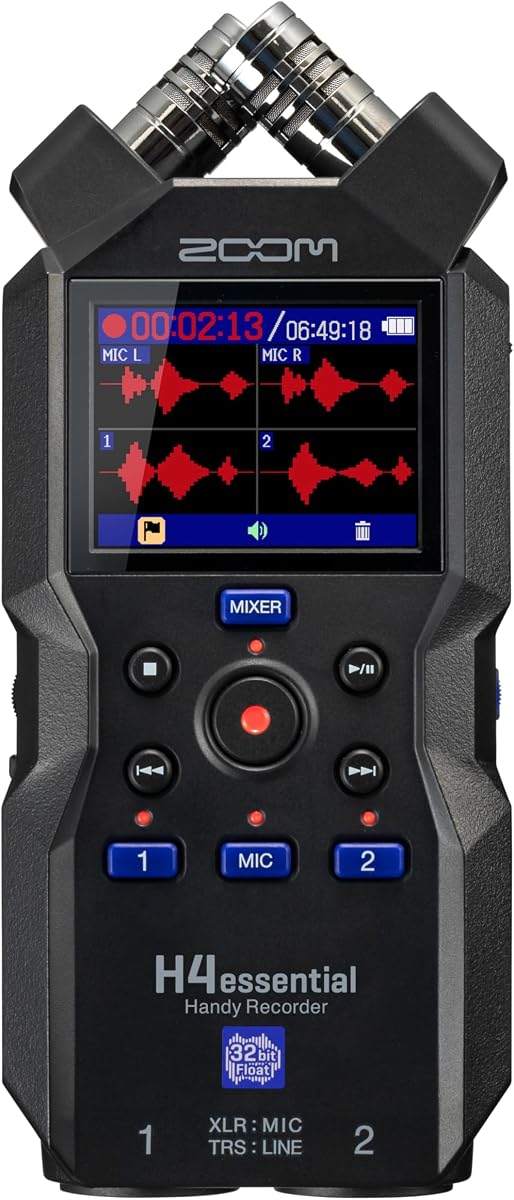
The Zoom H4 Essential earns a 4.4 rating by combining a compact four-track format with enough connectivity for interviews, voice-over sessions, video audio, and small location assignments. Built-in stereo microphones make it useful immediately, while two XLR/TRS inputs expand the options when the production requires external microphones, instruments, or a feed from another device.
We may earn a commission when you buy through this link, at no additional cost to you.
Its USB-C connection can turn the unit into a practical bridge between a camera, computer, tablet, or phone. It can record or stream through USB while also writing a backup to an SD card, which is valuable when a production wants a separate safety copy of important material. Four-track capture gives creators room to record more than one source at once without moving to a dedicated professional field mixer.
Compared with the F6 or F8n Pro, it offers fewer physical inputs and does not emphasize timecode I/O. A crew that needs frame-accurate synchronization across many cameras should look to those larger recorders. Even so, the H4 Essential is more versatile than many entry-level stereo units, and its built-in microphones are useful for location sound, room tone, and production references.
This is a strong selection for independent filmmakers, documentary makers, and small production teams that want multiple recording paths in a portable device. It is particularly useful when the same recorder must support dialogue, room ambience, interviews, and quick video narration.
Four-track recording expands the H4 Essential beyond a simple point-and-shoot stereo unit. External microphones, built-in stereo capture, and USB sources can serve different parts of a film production while remaining in one portable enclosure.
Recording to an SD card while connected through USB-C creates a convenient redundancy path. It also allows a computer or mobile device to participate in the recording workflow without replacing the recorder's standalone function.
We may earn a commission when you buy through this link, at no additional cost to you.
The Zoom F6 carries a 4.7 rating and is the most fully featured premium option in this guide. Six XLR inputs, support for up to 14 tracks, 32-bit float recording, dual AD converters, and timecode I/O give it the capabilities of a professional location recorder while retaining a portable design for field work.
We may earn a commission when you buy through this link, at no additional cost to you.
Dual AD converters are important when a scene moves between a whisper and an explosive source. Together with 32-bit float recording, this architecture provides a wide range for capturing quiet dialogue, practical effects, and sudden peaks. Six microphones can be recorded simultaneously, and the available track count creates room for production flexibility without requiring a separate multi-channel interface.
Timecode input and output make the F6 well suited to productions that need its audio aligned with camera files. It can work as a standalone recorder or as a USB audio interface, while headphone monitoring and line input support a complete working setup. Rugged construction and multiple power options help it handle location assignments, although six inputs can be more than a solo filmmaker needs.
The F6 is an excellent choice for sound recordists, documentary crews, and small-to-mid-size film teams that need multichannel capture and timecode. It offers a strong balance of capability and portability, making it easier to recommend as a long-term professional field-recording tool.
Six XLR inputs allow a location team to capture several microphones at once, including boom, plant, and isolated sources. Up to 14 tracks offer additional routing flexibility for demanding production audio.
Timecode input and output support frame-accurate synchronization with picture. This makes the F6 more suitable than simpler recorders for crews that rely on separate camera and audio workflows.
We may earn a commission when you buy through this link, at no additional cost to you.
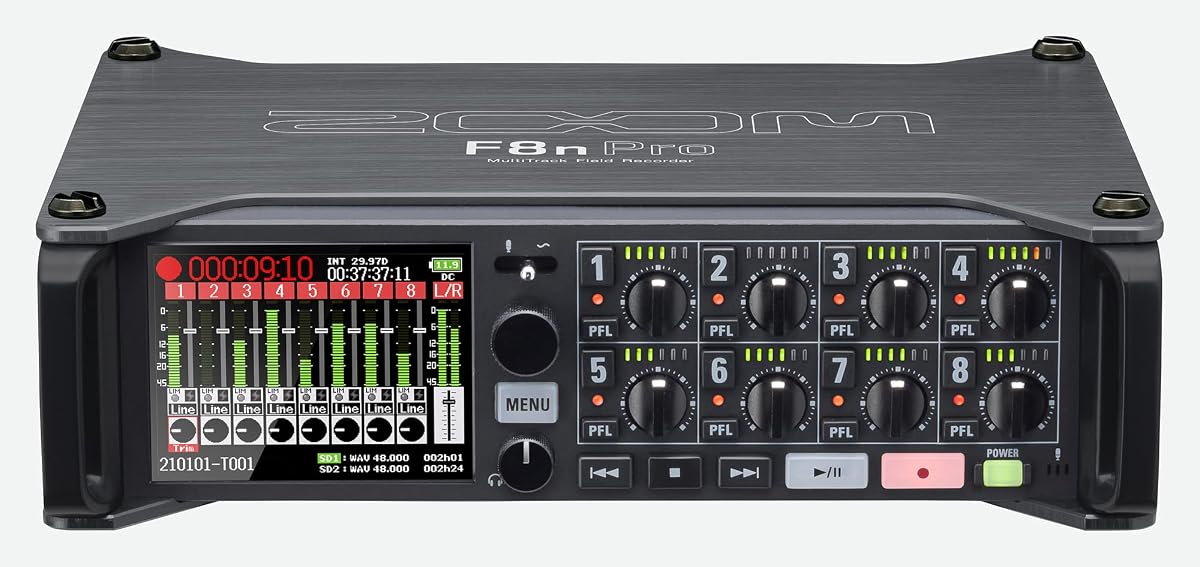
The Zoom F8n Pro is a high-capacity field recorder with a 4.6 rating, designed for productions that need to capture more microphones while maintaining precise timing and reliable storage. It records eight channels and up to ten tracks with 32-bit float and dual AD converters, giving it the widest input and track specification among the products in this guide.
We may earn a commission when you buy through this link, at no additional cost to you.
Its preamps offer up to 75dB of gain and an EIN of -127dBu, supporting clean capture of quiet sources without requiring extreme post-production gain. The timecode clock is specified at 0.2ppm accuracy through a TCXO, an important detail for crews aligning separate audio and camera files. Three outputs support camera feeds, headphones, and external devices.
Two SD card slots support redundant recording, with each slot accommodating cards up to 1TB. The recorder can also operate as an 8-in/4-out USB audio interface at 32-bit float and 96kHz while continuing to record to SD. This combination is professional and flexible, but the larger control surface and greater power demands are less convenient for lightweight solo production.
The F8n Pro is best for established crews, location sound professionals, and productions with several simultaneous sources. It is the logical choice when redundant recording, precise synchronization, and high channel capacity matter more than minimal size.
Eight inputs accommodate complex microphone arrays without forcing the crew to change recorders. The ten-track maximum provides extra flexibility when a production needs multiple mixes, isolated channels, or additional recording paths.
Dual SD slots allow the same recording to be written to two cards. That redundancy is valuable during a production with limited opportunities to repeat a scene or recover lost data.
We may earn a commission when you buy through this link, at no additional cost to you.
The Zoom H1 XLR is a compact two-channel recorder with a 4.5 rating, offering a useful middle ground between a simple stereo unit and a professional location recorder. Its two XLR/TRS combo inputs support microphones, instruments, and other line sources, while 32-bit float recording at 96kHz helps preserve detail and reduce the impact of unexpected level changes.
We may earn a commission when you buy through this link, at no additional cost to you.
The OLED waveform display is a particularly useful filmmaking feature. Instead of relying only on numerical meters, a sound operator can view the signal shape and make quicker decisions about gain, headroom, and potential clipping. A 3.5mm stereo input and headphone output add further connection options for monitoring and external equipment.
Its biggest limitation is that it lacks built-in microphones, so it cannot serve as an all-in-one stereo recorder. The two-input ceiling also makes it less suitable than the F6 or F8n Pro for large crews, but that limitation helps maintain a compact footprint. Storage support for SDXC cards up to 1TB is generous for extended sessions.
The H1 XLR is an appealing choice for independent filmmakers, student crews, and solo professionals who want external microphone capability and visual level monitoring in a portable device. It is especially suitable for two-person interviews, small documentary setups, and compact documentary production kits.
The OLED waveform display gives operators a clearer view of signal behavior than a basic level screen. This helps identify clipping early and judge whether a take has useful dynamics.
Two XLR/TRS inputs and 32-bit float recording give the H1 XLR more serious production potential than a basic handheld stereo recorder. It stays appropriately focused for creators who only need to manage a few sources.
We may earn a commission when you buy through this link, at no additional cost to you.
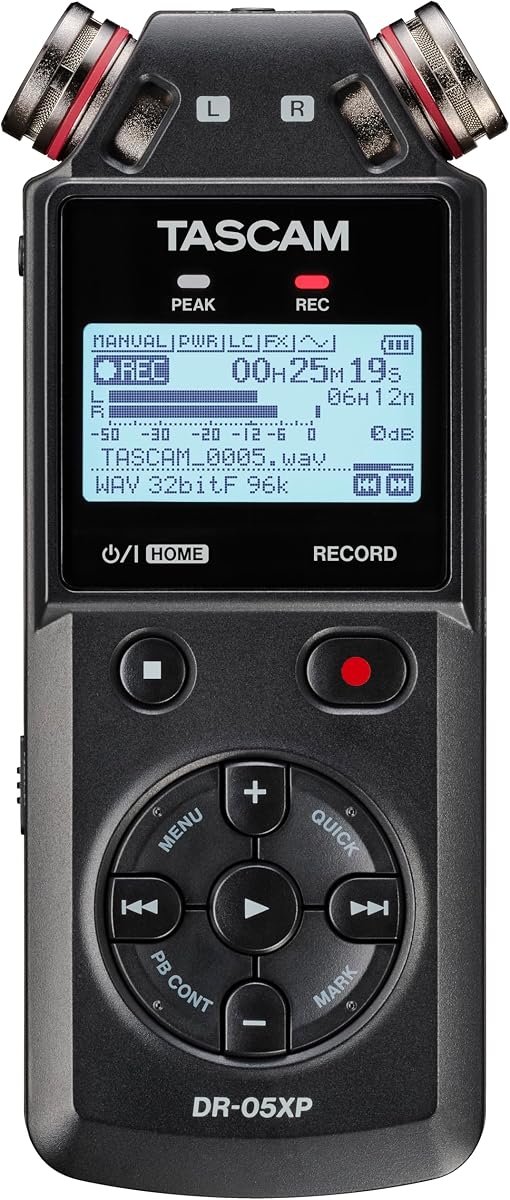
The TASCAM DR-05XP is a portable stereo field recorder with a 4.2 rating, positioned as an accessible option for filmmakers who want dedicated sound capture beyond a camera or phone. It supports 32-bit float, 24-bit, and 16-bit recording, along with 96kHz, 48kHz, and 44.1kHz sample rates, providing flexibility for different production and delivery requirements.
We may earn a commission when you buy through this link, at no additional cost to you.
Its built-in omnidirectional condenser microphones are rated to handle loud environments and sources up to 125dB SPL. That makes the unit useful for ambience, rehearsals, production references, and general stereo sound. It also includes a two-in/two-out USB-C audio interface, allowing a creator to record directly to a computer.
The DR-05XP does not include XLR inputs, so it cannot directly accept the balanced microphones and radio packs commonly used on narrative sets. Its stereo microphones also lack the directional selectivity many recordists prefer for dialogue. The SD card and batteries are not included, which should be considered when assembling a complete kit.
Despite those limitations, it is a convincing pick for beginners, student filmmakers, and creators who need a straightforward dedicated recorder. The combination of 32-bit float, long stated operation, and USB-C connectivity covers the essentials without introducing the complexity of a multichannel location recorder.
Built-in stereo microphones make the DR-05XP immediately useful for ambience, room tone, sound effects, and reference material. It can improve a production's sound library even when the camera handles primary dialogue.
Multiple bit depths and sample rates let creators match a recording choice to their storage and delivery needs. The USB-C interface also creates a direct path for computer-based editing and recording.
We may earn a commission when you buy through this link, at no additional cost to you.
The Zoom H5 holds a 4.7 rating and remains a versatile four-track recorder for filmmakers and musicians. Its most distinctive feature is the interchangeable input capsule system, which lets users change the microphone configuration according to the assignment. The included detachable X/Y capsule uses shock-mounted microphones to reduce handling noise during handheld stereo recording.
We may earn a commission when you buy through this link, at no additional cost to you.
Two XLR/TRS combo inputs provide connections for microphones or line-level sources, with selectable phantom power and a -20dB pad on each input. Four-track simultaneous recording offers enough capacity for a boom microphone, wireless feed, and additional production sources. Compatibility with all Zoom input capsules expands the creative range beyond the included configuration.
The H5 records to SD or SDHC cards up to 32GB, which is less generous than the capacity supported by several newer recorders. It also uses two AA batteries, and productions should plan power and storage carefully. On the positive side, it can operate as a multichannel and stereo USB audio interface for PC, Mac, and iPad, with a Loop Back function.
The H5 is a strong fit for filmmakers who want a flexible microphone system and four-track capability without moving to a larger professional recorder. Its interchangeable design is especially valuable for crews that alternate between dialogue, stereo ambience, and production sound.
Interchangeable capsules let a crew shift between a detachable X/Y stereo setup and other compatible configurations. That flexibility supports different scenes without committing to one fixed microphone arrangement.
Two combo inputs and four simultaneous tracks cover common documentary and independent-film situations. Phantom power and the input pad add useful control when combining microphones and line sources.
We may earn a commission when you buy through this link, at no additional cost to you.
The TASCAM DR-10L Pro is a specialized wearable field recorder with a 4.4 rating, designed primarily for discreet personal audio. It includes a matched TM-10L clip-on lavalier microphone, making it a practical choice for dialogue, interviews, behind-the-scenes coverage, and productions that prefer a dedicated body-mounted recorder for each performer.
We may earn a commission when you buy through this link, at no additional cost to you.
Its 32-bit float recording captures a wide range between a whisper and a loud shout without requiring the operator to react to sudden level changes. The compact form also reduces visual distraction, which can be helpful for documentary and narrative work where equipment should remain unobtrusive. Support for high-capacity microSDXC cards extends recording time for extended sessions.
Firmware version 2.0 adds LTC Jam Sync for multi-device synchronization, while the CONNECT App can control up to five simultaneous recordings. The recorder also supports Atomos Wireless Timecode through the separately sold AK-BT1 Bluetooth adapter, but it is not compatible with the AK-BT2. That distinction matters for crews assembling timecode accessories.
This is not a general-purpose multitrack mixer, but it is highly effective for focused personal recording. Independent filmmakers, documentary crews, and production teams recording several performers can benefit from its combination of discreteness, 32-bit float capture, and centralized multi-unit control.
The included matched lavalier and wearable format keep the recording setup close to the subject. That can provide a clean dialogue track with less visual interruption than a larger stand-mounted recorder.
LTC Jam Sync and CONNECT App control help coordinate several DR-10L Pro units. The supported AK-BT1 adapter also opens a path to Atomos Wireless Timecode workflows when the correct accessory is available.
We may earn a commission when you buy through this link, at no additional cost to you.
The Zoom H1 Essential is a compact stereo recorder with a 4.0 rating, built for creators who want dedicated audio for video, social content, interviews, and ambience. It is especially relevant to filmmakers who need room tone, environmental sound, sound effects, or reference recordings rather than a full production-audio mix.
We may earn a commission when you buy through this link, at no additional cost to you.
Built-in stereo microphones keep the setup simple and portable. The unit can capture natural stereo sound for tutorials, behind-the-scenes clips, video narration, music, and real-world location audio. Its USB-C connection supports use as a microphone for livestreams, remote meetings, video calls, podcasts, and desktop or mobile recording, expanding its role beyond standalone capture.
The lack of XLR inputs is the central constraint. A filmmaker cannot connect a boom microphone, wireless receiver, or other production microphone directly, so the H1 Essential does not replace a professional location recorder for primary dialogue. It also lacks the multitrack and timecode features needed for complex multi-camera synchronization.
For beginners, vloggers, and documentary makers collecting environmental tracks, however, it offers a simple and useful solution. The best use is as a dedicated ambience or effects recorder, or as a backup tool for short-form content, rather than as the primary source for a narrative film soundtrack.
Stereo capture is well suited to recording room tone, nature, travel scenes, and everyday environmental sound. These layers can add depth to a film and are often more difficult to reproduce later.
USB-C makes the H1 Essential useful as a computer or mobile microphone. This allows a creator to upgrade the audio of calls, streams, tutorials, and short video content with a dedicated recorder.
We may earn a commission when you buy through this link, at no additional cost to you.
The Zoom F2 is a compact wearable field recorder with a 4.0 rating and an emphasis on simplicity. It records 32-bit float at 44.1kHz or 48kHz without requiring gain changes, helping creators capture a wide range of voice levels while remaining focused on the scene in front of them.
We may earn a commission when you buy through this link, at no additional cost to you.
The included LMF-2 omnidirectional lavalier microphone has a screw-lock connector, windscreen, and lapel clip. This provides a ready-to-use package for interviews, vlogs, on-camera recordings, weddings, and other productions where a body-mounted recorder is desirable. The physical form can be discreet and comfortable for a subject who needs to move or perform.
Up to 15 hours of operation on two AAA batteries makes the F2 efficient for extended field sessions. It supports microSD, microSDHC, and microSDXC storage up to 512GB. A REC Hold switch helps prevent accidental stopping, while the internal clock is specified at +/-0.5ppm for audio and video synchronization.
The F2 is best for solo creators, small documentary teams, and productions seeking an inexpensive dedicated dialogue track. It is not intended to replace a multichannel location recorder, but for a single lavalier signal it combines attractive recording features with a practical wearable form.
The included LMF-2 lavalier and screw-lock connection remove the need to match a separate microphone with the recorder. The clip and windscreen make the package easy to place for an interview or on-camera appearance.
Long stated battery operation and broad storage support suit full shooting days. The REC Hold control adds useful protection against an accidental stop during a critical take.
We may earn a commission when you buy through this link, at no additional cost to you.
The right field recorder depends on the number of sources, the need for timecode, the required recording format, and how the unit will be carried. These factors help separate a simple ambience tool from a professional location-recording system.
Begin by counting the audio sources that must be recorded simultaneously. A recorder with two inputs is sufficient for a boom microphone and one additional feed, while four to eight inputs suit productions with more microphones, wireless systems, or isolated sound-effect channels. XLR/TRS combinations offer broader source compatibility than a stereo recorder with fixed built-in microphones.
Choose an input layout that matches the production without adding unnecessary complexity. More inputs are useful only when the crew can monitor and manage every channel.
Float recording captures a much wider range of signal levels than conventional fixed-gain recording, reducing the risk of clipping and making sudden changes in dialogue easier to handle. It is particularly useful for unpredictable location sound and performances where repeated takes may be unavailable. It does not replace good microphone placement or disciplined monitoring.
Prioritize 32-bit float when the recorder will be used for critical dialogue or action audio. A fixed-format recorder may still work for less demanding assignments.
Timecode is essential when separate cameras and recorders must align in post-production. Look for timecode input and output, a precise internal clock, or support for a suitable synchronization workflow. Frame-accurate features are more important on narrative sets and multi-camera productions than on projects that will create a single stereo track for editing.
Match synchronization features to the complexity of the camera workflow. Also check which adapters or companion devices are supported before relying on a specific ecosystem.
Recording capacity should be sufficient for the longest expected session, including the chosen format and sample rate. Dual card slots provide valuable redundancy by allowing a production to write to two cards. Single-slot recorders can still work well when the workflow includes frequent backups or a disciplined card-management plan.
Check supported card formats and maximum capacities before buying. A larger capacity is helpful for long shoots, but reliable card management remains essential.
A field recorder must fit the way the crew works. Compact handheld units suit a sound recordist working from a bag, wearable recorders suit performers and discreet dialogue capture, and larger multichannel machines suit dedicated location audio teams. Consider size, viewing angles, button access, and whether the recorder will be mounted or held during movement.
Prioritize the form factor your team will use most. A feature-rich recorder is not an advantage if it is awkward to carry or monitor on location.
Clear level monitoring helps a sound operator prevent distortion and judge a take before it ends. Waveform displays, reliable headphone outputs, accessible gain controls, and spoken menu guidance can make a recorder easier to operate in the field. Physical controls are often faster than navigating a touchscreen when the operator is wearing gloves or handling several tasks.
Test the control layout and display visibility before a shoot. Good monitoring is only useful if the operator can read and adjust it quickly.
Long battery life and flexible power options reduce interruptions during location work. USB connectivity can also turn a recorder into an audio interface for computer capture or provide backup recording to removable media. Check whether USB operation supports simultaneous local recording, because the workflow differs among models.
Plan spare batteries or a dependable external power solution for long productions. Treat USB as a workflow benefit rather than a complete substitute for field power planning.
Before a shoot, format a compatible memory card in the recorder, confirm the battery or power plan, and test every microphone, cable, adapter, and timecode connection. Set the intended sample rate and recording format, create clearly labeled folders if supported, and record a short test with the final microphone arrangement. This reveals noise, clipping, channel imbalance, and synchronization issues before the crew leaves the preparation area.
On location, place microphones with attention to perspective and proximity rather than relying on gain to fix an unsuitable recording. Monitor with headphones at a responsible level, watch the waveform or meters, and leave enough headroom for unexpected sound. Start a take before the action, avoid unnecessary handling noise, and use a visual or physical method to confirm that each unit is recording.
After filming, save a second copy of critical files, label each card or folder by scene and take, and create a temporary backup before formatting media. Keep the recorder dry, protect its connectors and screen, and store it in a padded case away from extreme heat or moisture. Periodically check firmware compatibility, battery condition, and recording settings before the next production.
A separate field recorder is not always essential, but it can provide isolated tracks, greater input capacity, higher-quality preamplification, redundant recording, and more reliable timecode. A camera XLR input may be adequate for a small crew with simple dialogue needs. A dedicated recorder becomes more valuable when the camera cannot handle the required microphone count, when sound recordists need independent control, or when a production wants a safety copy of critical audio.
Conventional recorders usually capture a fixed digital ceiling once the selected gain is reached. A 32-bit float recorder captures a much broader range of input levels, making sudden peaks less likely to clip and reducing the need for rapid gain changes. It is especially useful for quiet dialogue mixed with unpredictable environmental sound, although correct microphone placement remains important.
A solo interview may need only one microphone input, while a typical dialogue setup might use a boom microphone and a wireless backup. Documentaries and narrative scenes can require four or more isolated sources. Choose the number of inputs that matches the planned microphone tree, and consider whether the recorder must also handle a camera feed, headphone monitoring, and synchronized timecode.
Timecode is most useful when separate audio and video files must be synchronized precisely in post-production. It can still help on small productions that use a dedicated sound recorder, particularly when there are multiple takes, long recording sessions, or mixed frame rates. For a single-camera shoot with a simpler audio workflow, a recorder with a precise internal clock may be sufficient.
Built-in microphones are convenient for ambience, sound effects, reference tracks, and quick content creation. XLR inputs are preferable for primary film dialogue because they accept professional microphones, wireless receivers, and longer balanced cables. A recorder offering both is useful for broad production work, provided its controls and storage remain manageable.
Several models in this guide can connect by USB and function as an audio interface. The exact supported channel count, format, and whether local SD recording can continue simultaneously vary by model. Check those details against the computer or mobile workflow before relying on a feature for a shoot.
Start with memory cards that are formatted, tested, and clearly labeled. If the recorder supports dual SD slots, use redundant recording for critical sessions. Otherwise, copy files to a separate device or workstation and confirm the copy before formatting a card. Keeping the original files untouched until post-production has begun provides a useful safety layer.
No. A 96kHz sample rate can provide extra resolution for certain production and post-production workflows, but it also increases file sizes and storage demands. Many final deliverables do not require that resolution. Choose the recording format based on the delivery requirements, available storage, and overall workflow rather than selecting the highest available setting by default.
The Zoom F6 stands out as the premium all-rounder, combining six XLR inputs, multitrack recording, 32-bit float capture, and timecode in a portable form. The Zoom F3 is an excellent focused choice for two-channel production audio, while the Zoom F2 provides the most budget-friendly dedicated lavalier workflow. Each addresses a different crew size and level of recording complexity.
Prioritize the sources you must record, the need for synchronization, and the way the unit will be carried. A simple stereo recorder may be perfect for ambience and effects, but primary dialogue often benefits from XLR inputs and float recording. Larger productions should also examine redundant storage, timecode accuracy, monitoring, and power requirements before selecting a recorder.
Finally, check the current specifications, customer feedback, compatibility requirements, and price before purchasing. Recorder firmware, accessories, storage support, and market availability can change over time, so the final choice should reflect both the current product information and the specific demands of your film production.