
HiLetgo ESP8266 ESP-01 3-Pack
4.2Editor score
Three ESP8266 modules included
AP, STA, and AP+STA
Arduino-compatible development format
Compact wireless transceiver design
This Arduino WiFi Module guide compares ten top options for compatibility, connectivity, processing power, features, and project suitability.
Arduino WiFi modules range from compact add-in transceivers to complete development boards with wireless radios, processors, USB programming, and sensor-ready interfaces. A strong choice depends on whether you need a simple connection accessory, a modern connected board, or a flexible module for custom electronics.
We compared all ten products using their supplied specifications, including wireless support, processor capability, flash memory, operating modes, voltage requirements, programming interfaces, expansion connections, and intended applications. The list covers standalone ESP8266 modules, ESP32 development boards, and Arduino-branded connected platforms.
Each pick highlights a distinct route into wireless projects, from cost-conscious ESP-01 bundles to powerful UNO R4 and Nano ESP32 boards. Ratings and technical details reflect the supplied listing information, while availability and prices can change, so confirm the current listing before purchasing.
4.2Editor score

4.7Editor score

4.5Editor score
The comparison below places the ten modules side by side, emphasizing their form factors, wireless capabilities, processing platforms, programming options, and the kinds of Arduino projects they suit.



The Arduino UNO R4 WiFi is the most complete Arduino WiFi Module in the group, combining a Renesas RA4M1 ARM Cortex-M4 microcontroller with an ESP32-S3 wireless processor. Its supplied 4.7 rating reflects a strong balance of features, and the board stands apart through built-in Wi-Fi, Bluetooth 5.0, USB-C, CAN, a Qwiic connector, a 12-bit DAC, an operational amplifier, and a 12×8 LED matrix.
We may earn a commission when you buy through this link, at no additional cost to you.
The dual-processor arrangement gives builders more freedom than a conventional WiFi add-on. The RA4M1 can handle general embedded control while the ESP32-S3 manages wireless communication, yet the exact division of work depends on the software design. USB-C simplifies programming and power, while CAN expands the board's usefulness for industrial, automotive, and robotic projects. Qwiic also makes it possible to add compatible I2C sensors and peripherals without a complex wiring harness.
The analog features set this model apart from simple ESP8266 modules. A 12-bit DAC and integrated op-amp are useful for projects that need generated or conditioned analog signals, including sensor interfaces and audio experiments. The LED matrix is another practical feature, allowing status information, messages, and real-time visualizations to be displayed directly on the board without a separate display.
This is the right choice for makers who want a recognizable Arduino platform with serious wireless capability and room for expansion. It may be more elaborate than required for a simple temperature logger, but the additional connectivity and interfaces create a versatile foundation for connected controls, edge projects, and IoT prototypes.
Overall, the UNO R4 WiFi offers the strongest all-around feature set in this roundup. It is especially attractive for users who want Arduino ecosystem familiarity, modern programming hardware, and advanced wireless functions without assembling a separate radio module.
This board provides Wi-Fi, Bluetooth, USB-C, CAN, analog conversion, expansion, and onboard visual feedback in one package. That integration reduces the number of separate accessories needed for a sophisticated connected prototype.
The Qwiic connector supports straightforward expansion with compatible I2C devices, while the built-in LED matrix provides immediate status feedback. Both features are particularly helpful during iterative prototyping and troubleshooting.
We may earn a commission when you buy through this link, at no additional cost to you.
The HiLetgo ESP8266 ESP-01 set provides three wireless transceiver modules and lands at the most accessible end of this roundup. It is built around the ESP8266, a platform familiar to many Arduino experimenters, and supports AP, STA, and AP+STA operating modes. Its 4.2 rating remains positive while reflecting the simplicity of the product relative to the more advanced boards.
We may earn a commission when you buy through this link, at no additional cost to you.
The three operating modes make the module versatile for different network roles. Access Point mode creates a local wireless network, Station mode connects to an existing network, and combined mode supports both functions. This flexibility is useful for configuration, direct device-to-device communication, remote control, sensor networking, and projects that need a local fallback connection.
Its appeal comes from the small footprint and straightforward serial WiFi interface. The modules can be used with Arduino-compatible ecosystems when the appropriate board support and programming workflow are configured. A three-unit pack also gives makers enough hardware to prototype several nodes, demonstrate a client-server system, or keep spare modules for a separate project.
The trade-offs are clear. Bare ESP8266 modules require careful power and signal handling, and this option lacks the integrated USB interface, enclosure, breakout conveniences, and expanded I/O found on development boards. It also does not provide Bluetooth, and it is primarily a 2.4GHz Wi-Fi solution.
Choose this product when affordability, multiple modules, and Arduino compatibility matter more than integrated programming or advanced connectivity. It is a sensible starting point for small wireless nodes, but users should plan the supporting circuitry and confirm their preferred programming method before committing.
AP, STA, and AP+STA support allows the module to join existing infrastructure, create its own network, or operate in both roles. This makes the three-pack useful for testing complete wireless ecosystems.
Having three identical units helps when a project requires a server and multiple clients. It also reduces the need to source separate modules for prototypes and spare builds.
We may earn a commission when you buy through this link, at no additional cost to you.
The ESP8266 ESP-01S is a compact WiFi serial transceiver module with 4MB of flash memory and a stronger-signal design. Its 4.4 rating places it comfortably above the basic multipack alternative, while the single-module format makes it appropriate when a project needs just one wireless node.
We may earn a commission when you buy through this link, at no additional cost to you.
The 4MB flash specification is the main practical distinction from many 1MB ESP-01 variants. It gives the firmware more room and makes the module better suited to sketches that need slightly more stored code or data. Its serial wireless interface and Arduino compatibility also make it a familiar choice for connected sensors, household controls, and remote monitoring experiments.
Programming requires selecting the Generic ESP8266 Module board option in the Arduino IDE, according to the supplied information. That setup note is important because the module is not a plug-and-play development board. It still provides an opportunity to create a lean embedded system in which the builder controls the supporting power, programming, and application circuitry.
Compared with a full development board, the ESP-01S lacks an integrated USB connection, status controls, and a larger pin header. That makes it less convenient for initial experimentation but potentially preferable in a compact final assembly. As with other bare ESP8266 devices, appropriate power regulation and careful handling of the serial interface are important.
This module is a good middle ground for makers who want more flash than a basic ESP-01 without paying for an entire development board. Select it when compactness, familiar ESP8266 software support, and 4MB storage are the priorities.
The included 4MB flash provides additional storage compared with 1MB ESP-01 variants. That capacity can be valuable for larger sketches, stored assets, and connected applications with more demanding code.
The compact module format is valuable when the final device needs to be smaller than a standard development board. Builders must provide the necessary programming and power arrangements around it.
We may earn a commission when you buy through this link, at no additional cost to you.
The Aitrip five-pack combines five ESP8266 ESP-01 serial wireless modules with 1MB SPI flash. Its 4.4 rating makes it a solid multipack option, especially for projects that require several wireless nodes or a mixture of active and spare modules. The modules are described as compatible with Arduino and ready for AT commands.
We may earn a commission when you buy through this link, at no additional cost to you.
The ability to operate in AP, STA, or AP+STA modes gives each module considerable flexibility. In an AP configuration, a device can create a local network; in station mode, it joins an existing network. Combining them supports scenarios where a direct local connection and access to a broader network are both useful.
A key consideration is the strict electrical specification. The supplied information states that the modules only support 3.3V and have a maximum I/O tolerance of 3.6V. Connecting them to a 5V signal can damage the hardware, so the supporting circuit must use a compatible voltage level and provide stable 3.3V power.
Flash memory is limited to 1MB, which makes this a less spacious platform than the 4MB ESP-01S products. Users should also provide their own programming interface and supporting components. These characteristics make the kit more demanding for newcomers, but it remains appropriate for compact custom projects, sensor networks, and multi-device demonstrations.
Choose the Aitrip pack when five units, Arduino compatibility, and flexible WiFi modes are more important than an integrated development experience. Confirm the entire project operates at 3.3V and inspect the module documentation before powering it.
A five-unit set is useful for client-server demonstrations, distributed sensing, or keeping project stock on hand. Matching modules also makes it easier to compare behavior across several wireless endpoints.
The module is limited to 3.3V, with the supplied information noting a 3.6V maximum I/O tolerance. A level shifter, compatible controller, or properly designed interface is necessary when connecting it to 5V signals.
We may earn a commission when you buy through this link, at no additional cost to you.
The ELEGOO three-board set uses ESP32 development boards based on the ESP-WROOM-32 platform. Each board combines a dual-core processor capable of running up to 240MHz, Wi-Fi, Bluetooth 4.2, and USB-C programming through a CP2102 interface. Its 4.7 rating places it alongside the strongest products in this guide.
We may earn a commission when you buy through this link, at no additional cost to you.
These are development boards rather than bare radio modules, which makes them convenient for rapid prototyping. GPIO, UART, SPI, and I2C interfaces allow the boards to connect with sensors, displays, motor drivers, and other peripherals. Power-saving modes support projects where dynamic clock scaling and lower energy use are important, including connected sensing and monitoring devices.
USB-C provides a modern connection for power, sketch uploads, and serial monitoring. However, the supplied listing notes that a USB-C cable is not included, so buyers should confirm they have an appropriate cable. The CP2102 bridge may also require a suitable driver on the computer, depending on the operating system.
Over-the-air update support is another significant advantage. Once firmware is configured in a compatible framework, deployed devices can receive revisions through Wi-Fi without being physically reconnected by USB. This can simplify maintenance across installations containing several boards.
This set is an excellent choice for creators who want several immediately programmable ESP32 platforms. It suits smart-home prototypes, sensor nodes, remote controls, Bluetooth accessories, and connected automation. The inclusion of three boards makes it especially useful for projects with multiple endpoints.
USB-C programming, exposed interfaces, and familiar development-board construction remove much of the setup work associated with bare modules. This makes experimentation and repeated testing more approachable.
Wi-Fi supports network connectivity, while Bluetooth Classic and BLE broaden the available communication options. The same platform can therefore address Internet-connected devices and local wireless peripherals.
We may earn a commission when you buy through this link, at no additional cost to you.
The Arduino Nano ESP32 combines the compact Nano format with an ESP32-S3 processor, Wi-Fi, Bluetooth 5.0, USB-C, and support for both HID and MicroPython. Its 4.5 rating reflects a capable and modern platform, while the product's feature depth justifies considering it as the premium Arduino-focused option here.
We may earn a commission when you buy through this link, at no additional cost to you.
At the heart is a dual-core Xtensa 32-bit LX7 processor operating up to 240MHz. That processing capacity supports wireless applications, smart sensors, real-time data processing, and edge machine-learning experiments. Bluetooth 5.0 and Wi-Fi provide broad connectivity for remote sensors, smart-home devices, connected wearables, and local network projects.
USB-C supports programming, power delivery, and a stable connection, reducing the inconvenience associated with older connector formats. HID support expands the possible applications into custom keyboards, mice, controllers, and other input devices. MicroPython compatibility offers a productive alternative for developers who prefer Python-style embedded workflows and rapid interactive iteration.
The phrase “Without Headers” is an important practical detail. This version does not include the usual pin-header assembly, which may be ideal for a compact final build or custom soldering arrangement. It can be less convenient for projects that expect to clip wires or fit standard shield-style accessories immediately.
Choose the Nano ESP32 for compact wireless work that benefits from modern processing, flexible software options, and Arduino identity. It is particularly compelling for custom input devices, connected wearables, and edge-oriented prototypes where Bluetooth 5.0, HID, and MicroPython add meaningful value.
The ESP32-S3 provides substantially more processing capability than basic ESP8266 modules. That headroom supports connected sensing, real-time processing, and more ambitious edge-oriented experiments.
Arduino compatibility supports the familiar embedded workflow, while MicroPython gives Python-oriented developers an alternative environment. HID support expands the platform into custom input-device territory.
We may earn a commission when you buy through this link, at no additional cost to you.
This ESP8266 ESP-01S four-pack supplies four wireless transceiver modules for projects that need multiple distributed endpoints. Its 4.4 rating makes it a favorable compact bundle, and the supplied description emphasizes reusable construction and complete, self-calibrated RF design.
We may earn a commission when you buy through this link, at no additional cost to you.
Four units are enough to build a small network without immediately running out of hardware. Typical possibilities include wearable electronics, wireless location-sensing devices, home automation nodes, and sensor networks. The ability to reuse the modules across experiments also makes the pack useful for educational programs or iterative development.
Self-calibration of the RF section can support consistent wireless behavior across the set. That consistency is valuable when several devices need to communicate reliably, since variation between individually assembled nodes can complicate testing. The reusable format is also practical for prototypes that may be disassembled and redeployed.
The listing does not specify flash capacity, and the bare-module format means the user must provide suitable programming and power arrangements. It also lacks Bluetooth and the convenience of a full development board. Those limitations make it less attractive for quick desktop experiments than the ELEGOO or Arduino boards.
This pack is a practical choice when several compact ESP8266 endpoints are needed for a coordinated project. It suits makers comfortable designing around small modules and wanting enough units to test communication between multiple devices.
Four matching units make it easier to create a small network and observe how clients, sensors, or controllers interact. The bundle supports more realistic testing than a single isolated module.
The modules can be reused across different prototypes, helping reduce waste and simplify iterative learning. A self-calibrated RF design supports consistent operation within the set.
We may earn a commission when you buy through this link, at no additional cost to you.
The five-pack ESP8266 ESP-01S combines a useful amount of storage with a generous number of wireless modules. Each has 4MB of flash, and the supplied information lists a 115200 baud rate along with DOUT protocol and SPI programming mode. Its 4.5 rating makes it one of the stronger multipack choices.
We may earn a commission when you buy through this link, at no additional cost to you.
Five modules allow a substantial multi-node experiment, from home automation endpoints to distributed sensing. The 4MB flash improves upon 1MB modules and provides more room for code and data. ESP8266 Wi-Fi remains well established in Arduino-oriented Internet of Things projects, giving builders access to a large body of familiar examples and workflows.
The programming instructions are specific: select “Generic ESP8266 Module” in the Arduino IDE, and choose SPI MODE as DOUT when programming the 01S variant. Paying attention to these settings can prevent unnecessary connection or upload problems. The module also operates at 3.3V, and the supplied listing explicitly warns against using 5V.
As a bare serial transceiver, the product requires additional circuitry or an adapter for programming and power. It lacks the convenience of USB-C, onboard user controls, and a large development-board header. The five-pack does, however, reduce the need to acquire identical modules separately for a multi-device design.
Choose this bundle for ESP8266 projects that need several nodes, 4MB flash, and a clearly specified programming configuration. It is particularly appropriate for makers who can manage 3.3V circuitry and want more firmware capacity than basic 1MB ESP-01 modules.
With 4MB of flash on each module, the bundle provides more storage than standard 1MB ESP-01 options. This is valuable when multiple nodes run similar, relatively substantial firmware.
Programming requires the Generic ESP8266 Module selection and SPI MODE as DOUT. Supplying 3.3V rather than 5V is equally important for protecting the hardware.
We may earn a commission when you buy through this link, at no additional cost to you.
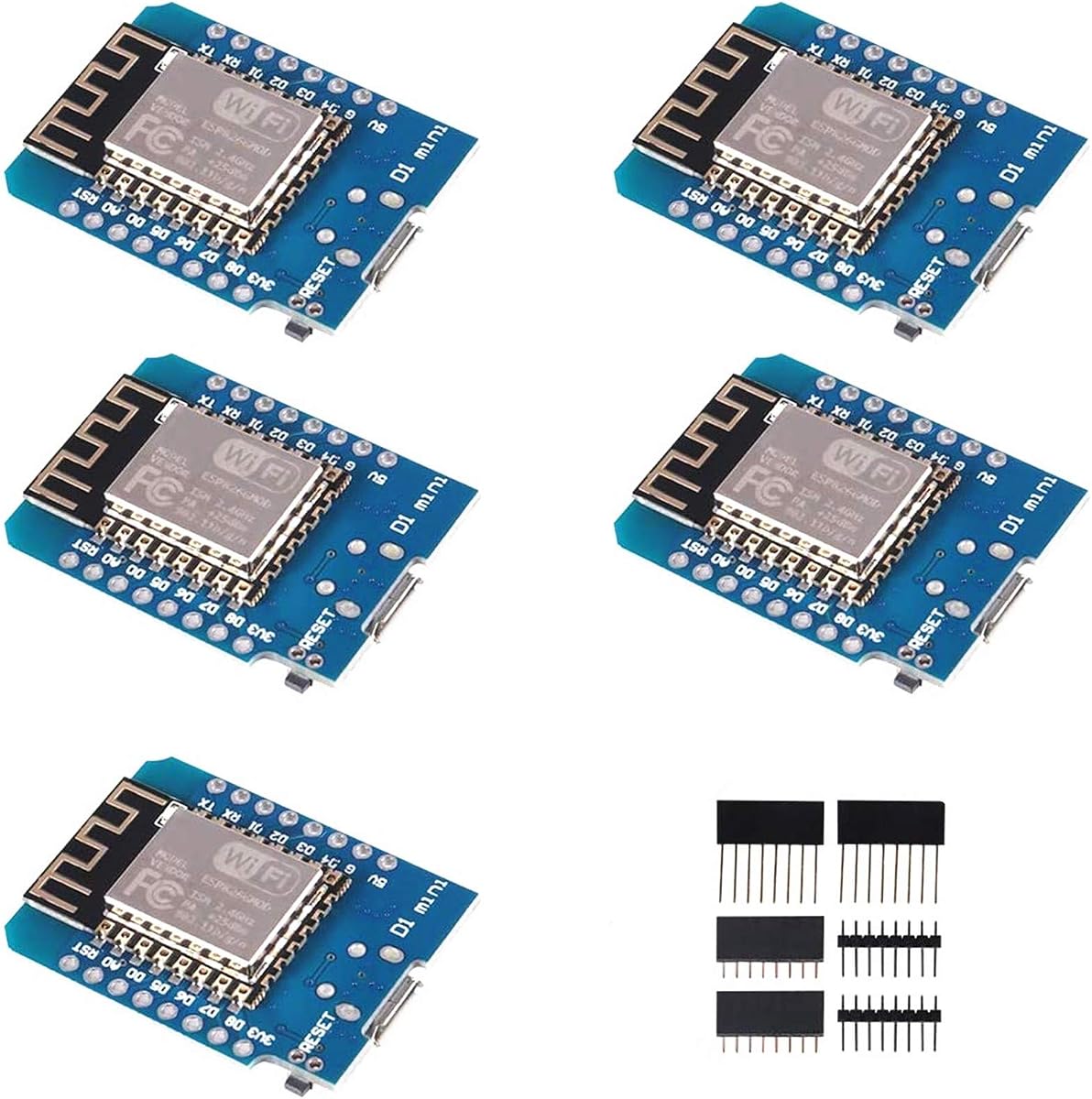
The WeMos D1 Mini set is a particularly approachable way to work with the ESP8266EX. Five compact development boards are included, each based on the ESP-12F module and compatible with Arduino, WeMos, and NodeMCU-style workflows. Its 4.5 rating reflects a strong balance of usability and practical hardware access.
We may earn a commission when you buy through this link, at no additional cost to you.
Each board exposes 11 digital input/output pins with support for interrupts, PWM, and I2C, apart from the D0 exception noted in the supplied information. It also provides one analog input with a stated maximum of 3.2V. Those accessible interfaces make it easier to connect sensors, indicators, actuators, and other peripherals without building a custom breakout.
Micro-USB provides power and programming, while the onboard switching power supply and resettable fuse support more convenient everyday use. The board can be programmed in a compatible Arduino IDE environment and works with the Lua-oriented D1 Mini ecosystem. This combination of familiar tooling and physical connectors reduces the learning curve.
There are some generational limitations. Micro-USB is less convenient than the USB-C found on newer boards, and the absence of Bluetooth keeps this product focused on Wi-Fi. The stated 1MB flash in the detailed description also differs from the “4M Bytes” wording in the title, so buyers should verify the installed configuration before relying on a particular capacity.
This five-board set is an excellent choice for beginners, classroom use, and projects that need several accessible ESP8266 development boards. Choose it when straightforward pin access and simple programming matter more than modern connectors or added wireless standards.
Eleven digital pins with interrupt, PWM, and I2C support provide enough flexibility for many sensor and control projects. The dedicated analog input expands the options for analog measurement.
The multipack is useful for teaching, demonstrations, and multi-node experiments. Its development-board layout is easier to prototype with than an extremely compact bare module.
We may earn a commission when you buy through this link, at no additional cost to you.
The ten-pack ESP8266 ESP-01 provides the largest module inventory in the guide, making it suited to ambitious multi-node builds. Its supplied 5.0 rating is the highest numerical rating among the listed products. Each compact unit offers on-board processing and storage and supports AP, STA, and AP+STA operating modes.
We may earn a commission when you buy through this link, at no additional cost to you.
Ten identical modules are useful for distributed sensor networks, classroom deployments, automation demonstrations, and projects that need many independent wireless endpoints. The three Wi-Fi modes provide flexibility in network architecture, while LWIP support is called out for AP+STA use. Arduino compatibility also makes the familiar ESP8266 toolchain applicable.
The compact design supports custom embedded assemblies where a full development board would be unnecessarily large. On-board processing allows each module to handle connected tasks rather than acting as a completely passive radio. At the same time, users retain control over the final board, power arrangement, and enclosure design.
The main disadvantage is convenience. A bare ESP-01 module does not provide an integrated USB programming connector or a development-board pin arrangement, so it is not the easiest choice for a first electronics project. Power regulation, programming connections, and appropriate voltage handling must be planned carefully. Ten units may also be excessive for a single-node design.
Choose this option for large distributed builds, educational inventories, or makers who want plenty of matching modules on hand. Its generous quantity and flexible operating modes make it the most scale-oriented ESP8266 bundle in the roundup.
Ten matching modules make it practical to build coordinated networks rather than isolated demonstrations. The quantity is especially helpful for classroom use, multi-node sensors, and automation experiments.
Bare modules allow compact custom assemblies, but they require careful design around programming, power, and signal connections. Experienced builders gain more control than they would from fixed development boards.
We may earn a commission when you buy through this link, at no additional cost to you.
The right Arduino WiFi Module depends on project complexity, the number of wireless nodes required, programming preferences, available expansion options, and whether Bluetooth or only Wi-Fi is necessary.
A bare module gives you a small wireless building block but leaves the programmer, voltage regulation, programming connector, and much of the surrounding support circuitry to you. A development board integrates those conveniences and exposes usable pins, making it easier to prototype, troubleshoot, and repeat experiments. The ESP-01, ESP-01S, and D1 Mini products in this guide illustrate that distinction clearly: the bare modules are leaner, while the D1 Mini is ready for immediate bench use.
In short, choose a development board for learning and rapid iteration, and choose a bare module for a custom or space-constrained final design.
Access Point mode lets a module create its own wireless network, while Station mode connects it to an existing router or network. AP+STA combines both roles, which can be useful during configuration or in projects that need a local connection alongside broader network access. Several ESP8266 products in this roundup explicitly support all three modes, making them adaptable to different network architectures.
Decide whether each node should join existing infrastructure or operate as a local hotspot before choosing. More flexible mode support is valuable when the network design may evolve.
The ESP8266 is sufficient for many straightforward connected sensors and control tasks, but ESP32 boards add considerably more processing capability. The ELEGOO and Arduino Nano products use dual-core ESP32-family processors capable of running up to 240MHz, making them better prepared for real-time processing, more demanding peripherals, and edge-oriented experiments. Flash also matters: the 4MB ESP-01S options provide more room than 1MB versions.
Match memory and processing to the actual workload. Extra capacity is useful, but a simpler module may be more appropriate for a small, stable sketch.
Wi-Fi is sufficient for Internet access and local network communication, but Bluetooth can simplify direct connections to phones, sensors, wearables, and other peripherals. The ESP8266 selections provide Wi-Fi only. The ELEGOO boards add Bluetooth 4.2, while the Arduino UNO R4 WiFi and Nano ESP32 provide Bluetooth 5.0. HID support on the Nano ESP32 also makes it possible to explore custom input devices.
Choose Wi-Fi alone for focused networking projects. Add Bluetooth support when local wireless control or peripheral communication is central to the design.
USB-C development boards are straightforward to connect and monitor, while the D1 Mini uses micro-USB and the bare ESP8266 modules require an external programming interface. The Arduino-branded options support the familiar Arduino ecosystem, and the Nano ESP32 also supports MicroPython. Bare ESP8266 modules need the appropriate board selection in the Arduino IDE, including Generic ESP8266 Module and, for the 01S DOUT version, SPI MODE as DOUT.
Prioritize the workflow you already know, but also consider driver requirements, serial monitoring, and whether the programming interface remains available in the finished build.
Expansion options determine how easily a board can accept sensors, displays, motor drivers, and other components. The UNO R4 WiFi includes a Qwiic connector for compatible I2C accessories, while its 12-bit DAC and op-amp support analog signal generation and conditioning. The ELEGOO and D1 Mini boards expose conventional GPIO, UART, SPI, and I2C connections. The Nano ESP32 arrives without headers, so permanent or carefully planned connections are important.
Check the interface needs of every peripheral before buying. A connector-based ecosystem can simplify wiring, while exposed pins offer broader flexibility.
ESP8266 modules in this guide are designed around a 3.3V electrical environment, and some listings explicitly warn against 5V use. The D1 Mini analog input is listed with a 3.2V maximum. Development boards usually integrate more of the required power circuitry, while bare modules demand careful regulator selection and appropriate signal levels. ESP32 power-management features can reduce energy use in compatible sensing and monitoring applications, but the complete project still needs an appropriate supply.
Never assume a module can connect directly to 5V signals. Verify supply voltage, logic levels, current requirements, and grounding before the first power-up.
The listed multipacks range from three to ten modules and are especially useful for node-based systems. A three-pack can support a small client-server demonstration, four or five units allow more elaborate network testing, and ten modules suit larger classroom or distributed deployments. Single-module options make sense when one wireless endpoint is enough. Development-board multipacks reduce setup time, whereas bare-module packs provide more compact custom hardware.
Estimate the number of active nodes, prototypes, and spares before choosing a pack. Buying too few interrupts a build; buying too many may leave unused inventory.
Begin by identifying the exact board or module, checking its supply-voltage and logic-level requirements, and reviewing the supplied programming notes. For a bare ESP8266, install the appropriate ESP8266 board support, select Generic ESP8266 Module, and use SPI MODE as DOUT when working with the specified ESP-01S DOUT version. Connect a compatible programmer, provide regulated power, and confirm all signal levels before uploading the first sketch.
Develop the project in stages. First verify serial communication, then test basic GPIO or sensor readings, and only afterward connect the board to the intended wireless network. Store network credentials securely in the project configuration, test reconnection behavior, and use meaningful status output through serial messages or an available display. Development boards with a USB interface make this sequence especially straightforward, while bare modules need more careful external support.
Care for the hardware by avoiding exposed conductive contacts, static discharge, accidental short circuits, and unsupported voltages. Keep modules away from long periods of excessive heat or moisture, and do not repeatedly unplug a powered system unless the design explicitly supports it. For projects that rely on wireless links, add error handling for dropped connections, monitor power consumption, and update firmware through a controlled process. Over-the-air updating is available on the listed ELEGOO boards when configured through a compatible framework.
ESP8266 boards are generally simpler and well suited to basic wireless sensors, controls, and home automation nodes. ESP32 boards provide more processing power, more memory options, and Bluetooth support in addition to Wi-Fi, making them more appropriate for real-time, multi-peripheral, and edge-oriented projects. The simplest rule is to choose ESP8266 for focused network connectivity and ESP32 when processing demands or local Bluetooth are likely to grow.
Yes, with the appropriate ESP8266 board support installed. The supplied product information specifically instructs users to select Generic ESP8266 Module when programming the ESP-01S. Some DOUT versions also require SPI MODE as DOUT. Because these products are bare modules rather than complete development boards, you also need suitable power and programming connections.
No. The supplied specifications for several of these modules state that they support 3.3V only, and one listing gives a maximum I/O tolerance of 3.6V. A 5V supply or 5V logic signal can damage the module. Use a regulated 3.3V source and confirm the voltage requirements of both the module and any connected peripherals before powering it.
No. Every ESP8266 option in this guide provides Wi-Fi but not Bluetooth. The ELEGOO ESP-WROOM-32 boards add Bluetooth 4.2, while the Arduino UNO R4 WiFi and Nano ESP32 provide Bluetooth 5.0. If your project depends on direct phone communication, local peripheral pairing, or Bluetooth HID, select one of those Bluetooth-capable platforms.
A development board is generally the easiest starting point because it integrates programming, power management, and accessible connectors. The D1 Mini has a familiar ESP8266 environment, while the ELEGOO ESP32 boards add USB-C and Bluetooth. The UNO R4 WiFi offers a broader feature set, and the Nano ESP32 provides a compact modern option with MicroPython support.
Access Point mode makes the module create its own wireless network, while Station mode makes it join an existing network. AP+STA allows both functions at once. These modes determine how the device receives commands, exchanges data, or connects to a network, so choosing the correct mode is essential when planning multiple-node projects.
It depends on your firmware, memory, and board design. The ESP-01S options listed here provide 4MB flash and a stronger-signal designation, while the standard ESP-01 bundles generally list 1MB. The DOUT version also has a specific Arduino programming setting. Check flash requirements, board configuration, signal performance, and available storage before deciding whether to upgrade.
Yes, that is one of the strongest use cases for this product category. ESP8266 modules can connect sensors to an existing network, while ESP32 boards offer more processing and lower-power operating features for compatible monitoring devices. Choose the number of units, network mode, power arrangement, and memory capacity based on how many nodes you need and how often they must report data.
The Arduino UNO R4 WiFi stands out as the most complete platform, combining dual processors, Wi-Fi, Bluetooth 5.0, USB-C, CAN, analog features, Qwiic expansion, and an LED matrix. The HiLetgo ESP8266 set is the leading budget-oriented option, while the Nano ESP32 earns the premium distinction for modern processing, compact construction, Bluetooth 5.0, HID, and MicroPython support.
For simple custom nodes, the ESP8266 and ESP-01S packs provide affordable ways to build multi-device wireless systems. The WeMos D1 Mini is especially approachable for beginners, while the ELEGOO ESP32 set offers ready-to-program boards, useful power-management features, and over-the-air update support. Prioritize voltage compatibility, flash capacity, programming workflow, expansion needs, and the number of nodes before choosing.
Ratings can change as buyers add reviews, and prices, availability, bundle contents, and board revisions may also vary over time. Check the current product listing and confirm the specifications shown on the seller's pages before purchasing, especially for bare modules where package size, flash configuration, and programming settings matter.
