
Taramps TS 400×4
4.3Editor score
Four-channel Class D design
RCA inputs included
Supports bridged output
This guide compares the best amp for component speakers, covering power, connectivity, channel flexibility, controls, and installation needs.
An amplifier for component speakers can determine how much control, clarity, and output a separated speaker system delivers. The right unit must match speaker impedance, provide clean power at the intended listening level, and offer the inputs, crossover controls, and connections required by the installation.
We compared ten amplifiers using the supplied specifications, including channel count, power ratings, impedance support, input options, bass and treble controls, crossover functions, wireless connectivity, and intended application. The list includes compact home-audio models, streaming amplifiers, and dedicated car-audio units for component systems.
Each review identifies the product's strongest qualities and practical limitations, helping readers distinguish between a home stereo amplifier and a car-audio solution. Ratings and availability can change, and current prices should be checked before buying to confirm that a model still suits the intended system.
4.3Editor score

4.6Editor score

4.5Editor score
The table below compares the ten amplifiers by channel configuration, power capability, connectivity, and the features most relevant to component-speaker installations.




The Taramps TS 400×4 is a compact four-channel car-audio amplifier with a 4.3 rating and a 400-watt RMS class-D design. Its most useful distinction is channel flexibility: it can serve as a multichannel amplifier for separate component speakers rather than forcing a single stereo allocation.
We may earn a commission when you buy through this link, at no additional cost to you.
The included RCA input makes it straightforward to connect an aftermarket head unit, processor, or other line-level source. Full-range operation also fits a conventional component system, while the advertised two-channel bridged capability creates additional possibilities for carefully matched loads. Class-D efficiency and the small enclosure help keep installation practical in a constrained vehicle.
The main caveat is that raw amplifier power does not remove the need for proper system design. Speaker impedance, wiring, gain settings, and signal quality all influence results. The supplied guidance strongly recommends professional installation, which is sensible for a vehicle where incorrect handling can damage equipment or create safety concerns.
This amplifier is a strong choice for buyers who want several component channels from one relatively compact unit. It is particularly compelling for front and rear component speaker sets, provided the installer verifies load compatibility and follows the manufacturer's wiring guidance.
Four independent channels let an installer build a multi-speaker system without adding separate amplification. The two bridged channels also provide a path to specialized configurations when the speaker loads and wiring plan support that arrangement.
RCA inputs and the compact Class-D format make the TS 400×4 approachable for a car-audio build. Clean routing, secure connections, and correct gain adjustment remain essential to obtain the advertised performance.
We may earn a commission when you buy through this link, at no additional cost to you.
The Fosi Audio BT20A Pro combines a two-channel Class-D amplifier with Bluetooth 5.0 and a TPA3255 amplification chip. Its 4.4 rating reflects a well-rounded package for passive home speakers, particularly when a listener wants both convenient streaming and the option of a physical source connection.
We may earn a commission when you buy through this link, at no additional cost to you.
The stated 300-watt x2 output provides useful headroom for many bookshelf or outdoor speaker systems, although actual results depend on speaker impedance, power-supply conditions, and listening levels. A signal-to-noise ratio of at least 108 dB and total harmonic distortion of no more than 0.005% indicate an emphasis on clean amplification.
One of the model's most distinctive features is its replaceable NE5532 op-amps. Compatible alternatives include LME49720HA, MUSES02, OPA2604AP, OPA2134PA, LM4562, and NJM4556AD, giving technically inclined users a clear upgrade path. Bass and treble controls add practical tone adjustment without requiring app-based equalization.
The BT20A Pro is well suited to a compact living room, office, patio, or secondary audio system where passive speakers need power and wireless convenience. It is less suitable for anyone prioritizing Wi-Fi, multiroom control, or a large-scale professional installation.
Replaceable plug-in NE5532 op-amps distinguish the Pro model from a basic fixed-design mini amplifier. The listed alternatives offer experimentation for listeners who enjoy refining tonal characteristics rather than accepting a one-size-fits-all circuit.
Bluetooth 5.0 includes a pairing-removal procedure and a memory function for easier reconnects. The supplied antenna, power adapter, AC cord, and manual support a straightforward setup for passive-speaker listening.
We may earn a commission when you buy through this link, at no additional cost to you.
The Fosi Audio TB10D is a two-channel Class-D mini amplifier with a 4.5 rating and a stated 600-watt combined output. Built around the TPA3255 chip, it is aimed at passive speakers ranging from two to eight ohms, making it a versatile option for desktop, living-room, or dedicated component setups.
We may earn a commission when you buy through this link, at no additional cost to you.
The 300-watt-per-channel headline should be read as a maximum capability rather than a guarantee of continuous output across every impedance and power-supply condition. Its broad impedance support, however, makes it easier to pair with a wider selection of passive bookshelf speakers than a more restrictive design.
RCA input, passive speaker outputs, a power switch, and separate bass and treble controls cover the fundamental needs of a simple stereo system. The description also positions the amplifier for use with a bass shaker, giving it relevance to compact home-theater and gaming configurations.
The TB10D is a good fit for buyers who want more stated power and broader speaker compatibility than a small Bluetooth amplifier while retaining a compact enclosure. Its lack of stated wireless streaming means a source with RCA output, or an added external streamer, is needed for phone-based playback.
Support for two- to eight-ohm passive speakers gives the TB10D flexibility across common home-audio loads. Users should still check each speaker's recommended amplifier power and avoid assuming the maximum rating is appropriate for every voice or near-field setup.
The amplifier can serve passive bookshelf speakers or add low-frequency output through a compatible bass shaker. RCA input and straightforward output connections suit phones, computers, televisions, CD players, and other sources through appropriate adapters.
We may earn a commission when you buy through this link, at no additional cost to you.
The AIYIMA A07 Premium is a compact two-channel Class-D amplifier built around the TI TPA3255 chip and NE5532 dual op-amps. Its 4.4 rating and extensive connection options make it appealing for listeners who want more flexibility than a basic desktop amplifier.
We may earn a commission when you buy through this link, at no additional cost to you.
A particularly useful feature is the 3.5 mm AUX pre-out. This full-range output can feed active speakers, another power amplifier, or a powered subwoofer amplifier, allowing the A07 to serve as the central hub in a 2.1-channel system. The pre-out level is controlled by the main volume, simplifying everyday operation.
The supplied power adapter supports the stated 300-watt x2 maximum, while the description notes that a suitable 48V/10A supply can unlock that capability more effectively. Replaceable op-amp chips provide an upgrade route, and the metal housing, upgraded cooling, Japanese ELNA capacitors, WIMA capacitors, and 63V filter capacitors target enthusiast use.
This is a strong choice for a compact hi-fi setup involving passive bookshelf speakers, a turntable with a phono preamp, or a two-channel-plus-subwoofer arrangement. It does not support Wi-Fi, so buyers should not choose it for wireless control without adding a separate streamer.
The AUX pre-out gives the A07 a useful role beyond simply powering a stereo pair. Connecting its output to a powered subwoofer or additional power amplifier can create a more flexible home-theater or music system.
Replaceable op-amps and upgraded internal components reflect a focus on hands-on audio customization. The compact housing and enhanced cooling help such a design fit into a desktop or shelf arrangement.
We may earn a commission when you buy through this link, at no additional cost to you.
The Rockford Fosgate Punch P300X2 is a full-size two-channel Class A/B amplifier with a 4.5 rating. Its 300-watt RMS specification and 2.38-by-7.76-by-9.86-inch chassis distinguish it from compact home-audio units and make it a natural fit for serious vehicle component-speaker systems.
We may earn a commission when you buy through this link, at no additional cost to you.
Output options include 100 watts x2 at four ohms, 150 watts x2 at two ohms, and 300 watts x1 in bridged four-ohm operation. The unit can serve full-range speakers or smaller subwoofers, giving installers more latitude than a fixed-purpose two-channel model.
RCA inputs accept either high- or low-level audio signals without a separate converter. Onboard Punch EQ provides an 18 dB boost at 45 Hz, while variable 12 dB/octave Butterworth crossovers support system tuning. The C.L.E.A.N. setup feature adds another layer of configuration guidance.
For buyers seeking robust car-audio power, traditional controls, and the option to use one amplifier for speakers or a subwoofer, the Punch P300X2 is among the strongest selections here. Its size and lack of wireless functions are drawbacks for compact home systems, but neither is a concern in a planned vehicle installation.
The P300X2 provides distinct output configurations for two-ohm, four-ohm, and bridged use. That range allows an installer to match the amplifier more closely to the selected speaker or subwoofer load.
Punch EQ, variable crossover filters, and selectable input level simplify the process of integrating the amplifier. These controls are especially useful in a multi-speaker car installation where driver placement changes how each channel should reproduce frequency.
We may earn a commission when you buy through this link, at no additional cost to you.
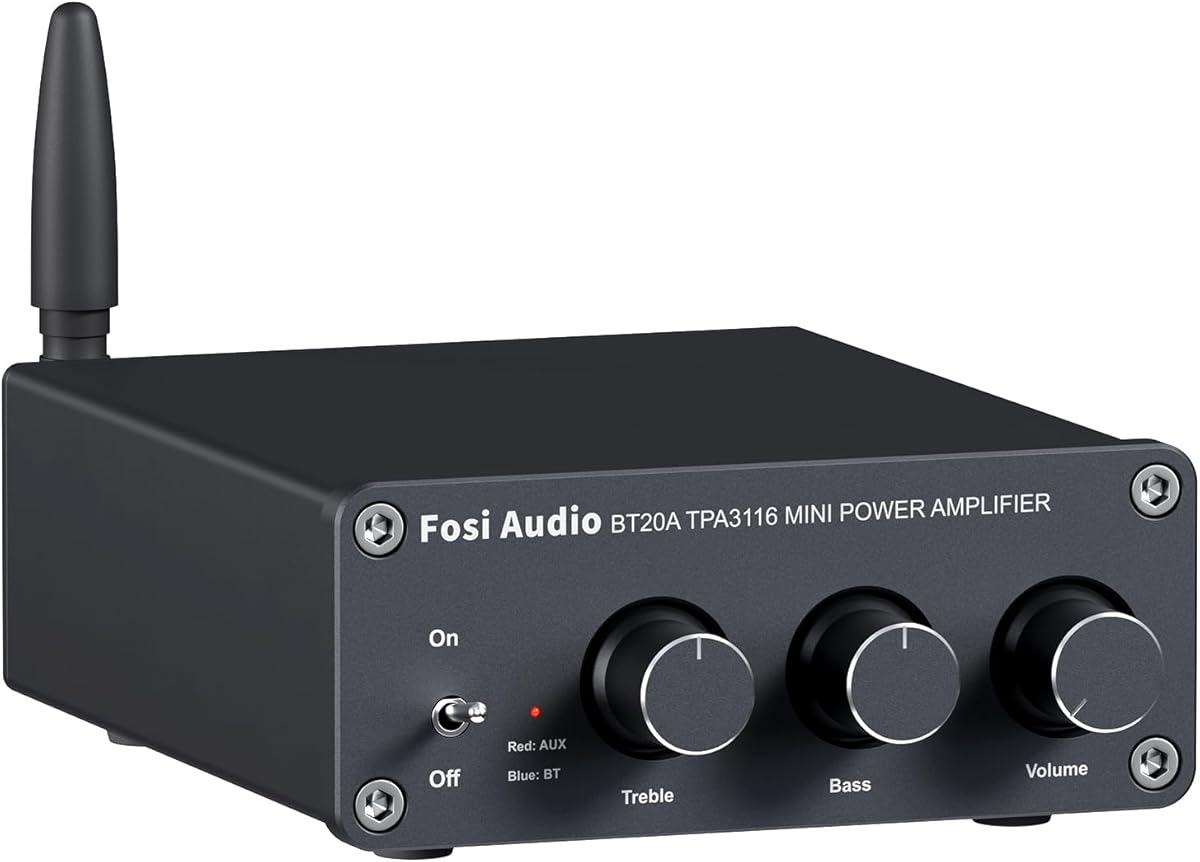
The Fosi Audio BT20A is a compact two-channel Class-D amplifier with a 4.5 rating. It is designed to bring powered output to passive speakers in spaces such as offices, bedrooms, living rooms, garages, patios, and small venues.
We may earn a commission when you buy through this link, at no additional cost to you.
Bluetooth allows music to be streamed directly from a phone, while RCA inputs provide a wired route for other source components. The 100-watt x2 maximum output is sufficient for many modest bookshelf or ceiling-speaker systems, though it offers less power than several larger models in this comparison.
The integrated one-piece black enclosure is designed for shelf placement and durability. A one-touch power switch keeps operation simple, and independent bass and treble controls let listeners tune the output without external software.
The BT20A is best for straightforward secondary-room or outdoor listening where wireless convenience matters more than maximum power or extensive network control. It is less appropriate for demanding large-room systems, although pairing it with efficient passive speakers can still produce balanced results.
Bluetooth and RCA inputs provide two practical ways to connect a source. That makes the amplifier useful for casual phone listening as well as a more permanent home-audio arrangement.
The all-black integrated enclosure can sit unobtrusively on a shelf or cabinet. Its simple power control and physical tone knobs reduce the need to navigate a network app for routine listening.
We may earn a commission when you buy through this link, at no additional cost to you.
The WiiM Amp combines two-channel amplification with streaming, app control, HDMI ARC, and multiroom features. Its 4.6 rating makes it one of the strongest all-around choices for passive speakers, particularly in a modern home where television and online music both matter.
We may earn a commission when you buy through this link, at no additional cost to you.
The specified output is 60 watts per channel at eight ohms and 120 watts per channel at four ohms. These figures suit many bookshelf, floor-standing, architectural, outdoor, and similar passive speakers, although they do not replace a high-power dedicated amplifier.
The WiiM Home App supports streaming services, volume, favorites, alarms, room synchronization, voice commands, and EQ. HDMI ARC adds a straightforward television connection, while a powered subwoofer can provide additional low-frequency impact for movies and games.
Hi-res playback up to 24-bit/192 kHz, room correction, and independent EQ make this amplifier attractive to listeners who want flexible sound shaping. Its key limitation is that it receives AirPlay but cannot transmit AirPlay to other AirPlay-enabled speakers, so AirPlay output should not be assumed.
HDMI ARC lets the WiiM Amp become the central audio hub for a television as well as a streaming music system. This reduces the need for separate amplification when passive speakers are used for both entertainment and listening.
The app centralizes volume, favorites, alarms, room synchronization, and EQ. Support for AirPlay 2, Amazon Echo, Google Home, and other WiiM devices creates options for broader connected-home audio without requiring a separate amplifier for every room.
We may earn a commission when you buy through this link, at no additional cost to you.
The Sundown Audio SFB-500.4D is a four-channel amplifier intended for high-output component-speaker and tweeter installations. Its 4.0 rating is the lowest among the ten products, but the supplied power matrix shows why it remains relevant to demanding car-audio systems.
We may earn a commission when you buy through this link, at no additional cost to you.
At 14.4 volts, the amplifier is rated at 500 watts x4 into one ohm, 320 watts x4 into two ohms, and 200 watts x4 into four ohms. At 12 volts, the four-channel one-ohm output falls to 450 watts, illustrating the importance of the electrical supply when evaluating specifications.
The bridged configuration provides 1,000 watts x2 at two ohms. That gives the installer flexibility for a high-power two-channel arrangement, but proper load selection and wiring are critical. The product is specifically relevant to tweeter, component, and multi-channel vehicle systems rather than conventional home listening.
This model makes the most sense for an installer who understands impedance and prioritizes maximum output across several channels. Because the supplied information is sparse, prospective buyers should consult the full manual and confirm all terminal, control, and protection details before installation.
The published outputs cover one-ohm, two-ohm, and four-ohm loads, giving the installer several ways to pair the amplifier with different speaker configurations. Matching the actual load is essential to use the ratings safely and predictably.
The four-channel format and explicit tweeter orientation suit complex vehicle audio where separate drivers may require different amplification. A professional plan should account for channel balance, signal routing, and appropriate speaker protection.
We may earn a commission when you buy through this link, at no additional cost to you.
The Skar Audio RP-75.4AB is a full-range four-channel Class A/B car amplifier with a 4.6 rating. It combines 500-watt MOSFET marketing output with stated continuous figures of 75 watts x4 at four ohms and 125 watts x4 at two ohms.
We may earn a commission when you buy through this link, at no additional cost to you.
Its strongest feature is system control. The amplifier includes user-adjustable gain, a variable low-pass filter, a high-pass filter, and a bass EQ switch with 0, +6, and +12 dB positions. Those controls allow different channels to handle frequency ranges appropriate to front speakers, rear speakers, tweeters, or another configured system.
A 105 dB signal-to-noise ratio and 20 Hz to 20,000 Hz frequency response indicate attention to clean, full-range reproduction. Four-way protection circuitry adds safeguards for a vehicle installation, where heat, wiring faults, and unstable operating conditions can affect equipment.
The RP-75.4AB is well suited to a four-channel component-speaker build where independent tuning is valuable. Class A/B topology is less thermally efficient than compact Class D units, but it provides a traditional full-range car-audio format that many installers understand well.
Gain, high-pass, low-pass, and bass controls provide useful control over how each channel interacts with the rest of the system. This makes the amplifier adaptable to different speaker roles rather than forcing one fixed frequency strategy.
The stated 105 dB signal-to-noise ratio and broad frequency response support clean reproduction across the audible range. Four-way protection circuitry helps the amplifier operate more securely in a demanding automotive environment.
We may earn a commission when you buy through this link, at no additional cost to you.
The Daakro AK45 is a compact stereo amplifier with a 4.1 rating, a 300-watt power designation, and Bluetooth 5.1. It offers a relatively accessible route to adding power and wireless playback to a pair of passive component speakers.
We may earn a commission when you buy through this link, at no additional cost to you.
Volume, treble, and bass are all available through physical controls, allowing quick tonal changes without navigating software. A remote provides additional control from across the room, which is particularly useful for a living-room or desktop listening position.
Compared with the other mini and streaming amplifiers in the list, the AK45 has the least detailed supplied specification. The available information does not clearly state channel-specific RMS output, supported speaker impedance, input configuration, or distortion and signal-to-noise figures, so those details should be confirmed before purchase.
It is best considered for a simple room setup where Bluetooth convenience, basic tone adjustment, and remote operation are the priorities. Listeners who need verified continuous power, broad impedance support, sophisticated streaming, or advanced crossover control should favor a better-documented model.
Bluetooth 5.1 removes the need for a wired source during everyday listening. The included remote makes basic volume adjustment possible from a comfortable listening position.
Separate bass and treble controls provide quick correction for different speakers or rooms. Because the published specification is limited, buyers should verify compatibility and output details before connecting valuable equipment.
We may earn a commission when you buy through this link, at no additional cost to you.
Choosing the right amplifier requires balancing channel count, continuous power, speaker impedance, source connections, controls, and the intended environment. The best unit is the one that safely drives the selected speakers while providing the inputs and tuning features the installation actually needs.
A two-channel amplifier is sufficient for one stereo pair, while a four-channel model can power separate front and rear component sets or support more elaborate routing. Some four-channel amplifiers can also be bridged into a two-channel configuration, although the allowable speaker load changes and must be checked carefully. A three-channel amplifier is another common approach in car systems, but none of the listed products uses that layout.
Choose the channel count that matches the system without adding unnecessary complexity. More channels offer flexibility, but only when the amplifier provides suitable controls and the installation can feed each channel an appropriate signal.
RMS power is more useful for planning than a headline peak or maximum wattage figure. Match the amplifier's continuous output to the speakers' recommended power range while leaving enough headroom for dynamics. A speaker that requires substantially more clean power than the amplifier can provide may sound strained, while an overly powerful amplifier can introduce unnecessary complexity and heat.
Ignore the largest number on the listing until you know whether it represents clean RMS power, maximum output, or a particular impedance. For the same amplifier, output usually changes with speaker load and available power-supply voltage.
Every speaker has a nominal impedance that must remain compatible with the amplifier. Many mini Class D home amplifiers support two- to eight-ohm passive speakers, while dedicated car amplifiers often publish outputs for one-, two-, and four-ohm loads. Bridged outputs require additional attention because the internal load presented to each channel changes.
Verify both the speaker's impedance and the amplifier's minimum permitted load. If the documentation is unclear, do not guess; ask the manufacturer or a qualified installer before wiring the speakers.
RCA inputs are common for line-level home-audio sources, turntables equipped with phono preamps, CD players, and many car head units. Bluetooth is useful for casual phone streaming, while HDMI ARC is valuable when the amplifier must serve a television. The WiiM Amp's app-based streaming adds another category of connectivity that conventional mini amplifiers cannot provide.
List every intended source before choosing. The best amplifier is one that accepts the source directly or through a clearly supported adapter, without requiring unnecessary conversion equipment.
Bass and treble controls are useful for broad tonal adjustments, but they cannot replace proper speaker placement. Vehicle systems benefit from high-pass and low-pass filters when different channels serve different frequency ranges. The Punch P300X2 and Skar Audio RP-75.4AB provide crossover controls, while the Fosi models emphasize simple tone adjustment and home listening.
Prioritize filters for a multi-way system, room correction for a connected home setup, and straightforward tone controls for uncomplicated listening. More controls are useful only when the installer understands how they affect the result.
Class D amplifiers are compact and efficient, making them well suited to home shelves, desktop setups, and constrained vehicle installations. Class A/B designs, such as the Punch P300X2 and Skar Audio RP-75.4AB, use a more traditional approach and can require additional space and thermal planning. Efficiency does not determine sound quality by itself, but it strongly affects installation practicality.
Choose based on available space, cooling, and system goals. In a car, compact efficiency can be especially valuable; at home, a larger chassis may be acceptable if it offers better control and robust output.
A metal housing, effective cooling, replaceable op-amps, quality filter capacitors, and protection circuitry can improve serviceability or long-term reliability. The AIYIMA A07 includes an enhanced cooling system, replaceable NE5532 op-amps, and several named component types. The Taramps and Skar models explicitly describe protection features, while the Rockford Fosgate includes a one-year warranty.
Look for evidence of physical construction and protection rather than assuming a large wattage number indicates quality. Warranty coverage, thermal design, connectors, and clearly documented controls provide useful evidence of an amplifier designed for long-term service.
The correct amplifier still requires clean wiring, secure terminations, appropriate grounding, ventilation, and careful gain adjustment. Car amplifiers should be installed by a qualified technician when the wiring is extensive or the manufacturer recommends professional service. Home systems require attention to room placement, speaker polarity, source levels, and possible feedback loops.
A safe, deliberate installation protects both the amplifier and the speakers. It also makes the difference between a promising specification and consistent sound in daily use.
Begin by confirming speaker impedance, amplifier minimum load, power requirements, and input compatibility. Connect the source to the correct input, observe channel and speaker polarity, and use appropriately terminated wiring. For bridged operation, follow the manual's exact terminal diagram because the two channels no longer operate as independent stereo outputs.
Start with gain and tone controls at conservative settings, then increase the source and amplifier levels gradually. For home systems, begin with bass and treble at the midpoint and adjust after listening from the normal position. In a car, use the crossovers or filters to assign suitable frequency ranges to each driver rather than relying on broad tone boosts to compensate for poor system design.
Provide ventilation around the amplifier, keep connections dry and secure, and avoid exceeding the documented input or speaker limits. Dust the enclosure with a soft dry cloth, do not use liquids around electrical terminals, and inspect wiring periodically. If distortion, abnormal heat, protection activation, or intermittent output appears, reduce the level, disconnect power safely, and check the load and installation.
Only when the amplifier's electrical, environmental, and signal requirements are suitable. Check speaker impedance, amplifier load limits, power needs, connectors, and whether the home amplifier can tolerate the installation environment. A purpose-built car amplifier is usually better suited to a vehicle because automotive installations face vibration, temperature variation, electrical noise, and demanding wiring conditions.
Choose an amplifier with clean continuous power that fits the speakers' recommended range. The correct figure depends on impedance, enclosure design, sensitivity, listening level, and system headroom. A larger maximum-wattage number does not automatically provide better results, so compare published RMS ratings and match them carefully to the manufacturer guidance for each speaker.
Yes, though unused channels should be disconnected according to the manufacturer's instructions. Some four-channel amplifiers can also be bridged for a two-channel high-power configuration, but bridging changes the minimum load and wiring. Confirm the manual before connecting either configuration.
Class D amplifiers can provide excellent sound while being smaller, lighter, and more efficient. Class A/B designs may appeal to installers who prefer a traditional format and have adequate installation space. Sound quality depends on the complete design, so compare features, distortion specifications, protection, controls, and measured output rather than choosing by class label alone.
The right input depends on the source. RCA works with many line-level sources, Bluetooth supports convenient phone streaming, HDMI ARC connects a television, and a turntable generally needs a phono preamp unless the amplifier includes one. Check the amplifier's supported sources before finalizing the system.
Crossover controls are valuable when a system assigns different frequency ranges to separate drivers, such as tweeters, midrange speakers, and subwoofers. A straightforward two-speaker stereo setup may work well with only bass and treble controls. In a vehicle, filters often help integrate drivers located in different parts of the cabin.
Some two-channel car amplifiers can be bridged to power a subwoofer, while others are intended only for full-range speakers. Check the load ratings, bridge diagram, and any built-in filters. Home mini amplifiers are generally better reserved for passive speakers or left-line pre-out connections, depending on their design.
Too much power occurs when the amplifier's clean output substantially exceeds what the speaker or enclosure is designed to handle at high volume. Match the speaker's recommended amplifier power and pay attention to impedance, sensitivity, distortion, and thermal limits. More headroom is useful, but appropriate matching matters more than selecting the largest available amplifier.
The Taramps TS 400×4 stands out for budget-conscious four-channel car-audio flexibility, while the WiiM Amp is the strongest all-around option for connected home listening. The Rockford Fosgate Punch P300X2 earns the premium recommendation for buyers who want substantial car-audio power, flexible input handling, and integrated crossover controls.
Prioritize verified RMS output, correct impedance support, and the number of channels actually required. Then consider whether the installation needs RCA, Bluetooth, HDMI ARC, streaming apps, crossover filters, or replaceable audio components. The right extra feature is the one that solves a real need in the intended system rather than simply making the specification list look longer.
Ratings, configurations, and prices can change, so readers should confirm the current product details and price directly before purchasing. Reviewing the manual, checking the speaker manufacturer's recommendations, and matching the amplifier to the installation will lead to the most reliable result.