
HGLRC Mini M100
4.6Editor score
Works with 2-7 inch drones
Accepts 3.3-5V input
Ceramic patch antenna
Power and PPS indicators
Compare the best GPS modules for drones, including compass options, satellite support, protocols, update rates, accuracy, and flight-controller compatibility.
GPS modules for drones add position awareness, navigation, rescue logic, and return-to-home support, but the right receiver depends on aircraft size, flight controller, antenna placement, and satellite protocol. A good module should acquire signals reliably without adding unnecessary weight or installation complexity.
We compared these ten GPS and GNSS modules by examining their supported constellations, compass integration, update rates, stated positioning performance, physical dimensions, power requirements, protocol support, and compatibility with common FPV, fixed-wing, Pixhawk, PX4, and ArduPilot systems.
Each review identifies the module's strongest use case and practical limitations. The list includes compact racing options, dual-protocol receivers, Pixhawk solutions, and multi-GNSS units, while availability and prices can change at any time.
4.6Editor score
4.8Editor score

The table below compares all ten modules by their most important selection criteria, including GNSS support, compass hardware, update rate, protocol options, and intended drone applications.




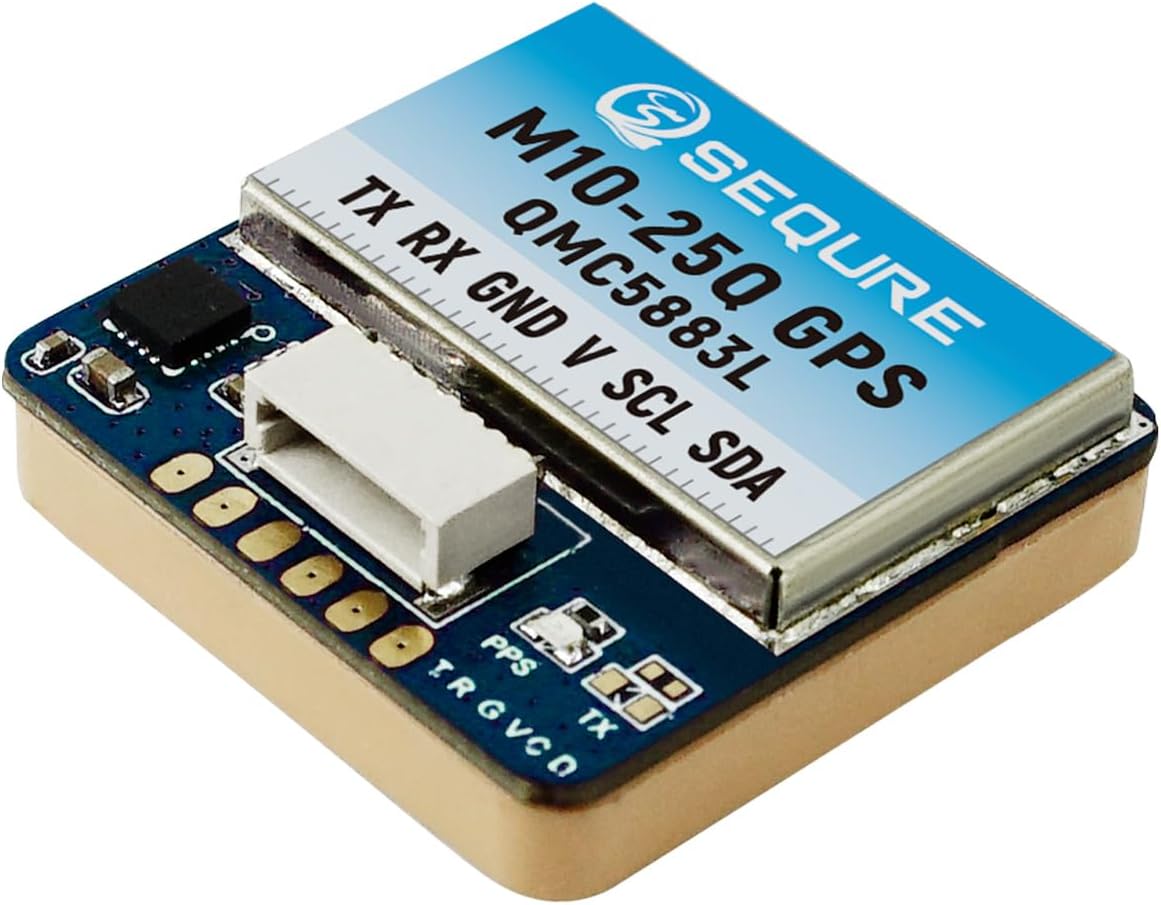
The SEQURE M10-25Q combines a 10th-generation u-blox design with an integrated QMC5883L compass, making it one of the most complete navigation packages in this guide. Its 4.8 rating is also the highest listed among the products with an established numeric score. It is particularly attractive for FPV racers, fixed-wing aircraft, and multirotor builds that need more than a basic position receiver.
We may earn a commission when you buy through this link, at no additional cost to you.
The module supports GPS, GLONASS, BDS, GALILEO, SBAS, and QZSS, giving the receiver several ways to improve satellite availability. A 10Hz output frequency is useful when flight software and control loops favor fresher location data, while the stated low-power design is suitable for battery-powered aircraft. The ceramic antenna and expanded external PCB are intended to improve signal reception, an important consideration when carbon-fiber frames or electronics interfere with the satellite signal.
Installation is flexible because SEQURE offers two connection methods: a plug-in arrangement for users who do not want to solder and direct soldering for builders seeking a permanent installation. The included compass reduces the need to carry a separate magnetometer, although heading performance still depends on correct placement away from motors, ESCs, batteries, and ferromagnetic hardware. Its listed use with 5-inch-and-larger UAVs means it is not the natural choice for the smallest racing quads.
This is the strongest all-around option for pilots who want broad GNSS support, frequent position updates, and a compass in one compact module. Verify the flight controller's protocol configuration, mount the antenna with an unobstructed view of the sky, and complete a compass calibration before relying on return-to-home or waypoint features.
The 10Hz output rate can improve the perceived responsiveness of position-based navigation compared with slower updates. It is particularly relevant to autonomous routes, rescue behavior, and fixed-wing aircraft that depend on accurate position data during movement.
Support for six positioning systems gives the receiver more satellite options than a single-constellation design. That can be useful around buildings, wooded areas, and other locations where a limited signal set may take longer to produce a stable fix.
We may earn a commission when you buy through this link, at no additional cost to you.
The HGLRC M100 Pro is a compact GPS and compass module intended for FPV fixed-wing UAVs and similarly small aircraft. It combines an upgraded 10th-generation chip, a QMC5883L magnetic compass, and an expanded 120-channel receiving capability. The 4.6 rating reflects generally favorable customer reception, while its focused feature set makes it a practical companion for fixed-wing builders.
We may earn a commission when you buy through this link, at no additional cost to you.
The most significant benefit is the combination of satellite navigation and heading measurement in one board. A compass is essential when the flight controller must establish a direction, calculate a home direction, or execute orientation-dependent return logic. Installing both functions together can also simplify wiring and reduce the number of separate modules carried by the aircraft.
The listing does not spell out every supported constellation or protocol, so compatibility should be confirmed with the selected flight stack before purchase. The 120-channel figure also should not be interpreted as a guarantee of positioning accuracy; antenna visibility, interference, and the surrounding environment remain decisive. A ceramic antenna should be mounted on an upper surface without obstruction by the airframe.
Choose the M100 Pro when you operate compact FPV fixed-wing aircraft and want a simple GPS-plus-compass package with a modern receiver generation. It is less obviously suited to pilots seeking a detailed specification sheet or a plug-and-play harness specifically designed for the smallest racing drones.
The QMC5883L provides the heading reference needed by many fixed-wing navigation routines. Correct calibration and careful placement away from interference are essential for dependable direction data.
The 10th-generation chip and 120-channel capability form the core of the M100 Pro's receiver design. Actual lock time and accuracy will still depend on the installation environment and satellite visibility.
We may earn a commission when you buy through this link, at no additional cost to you.
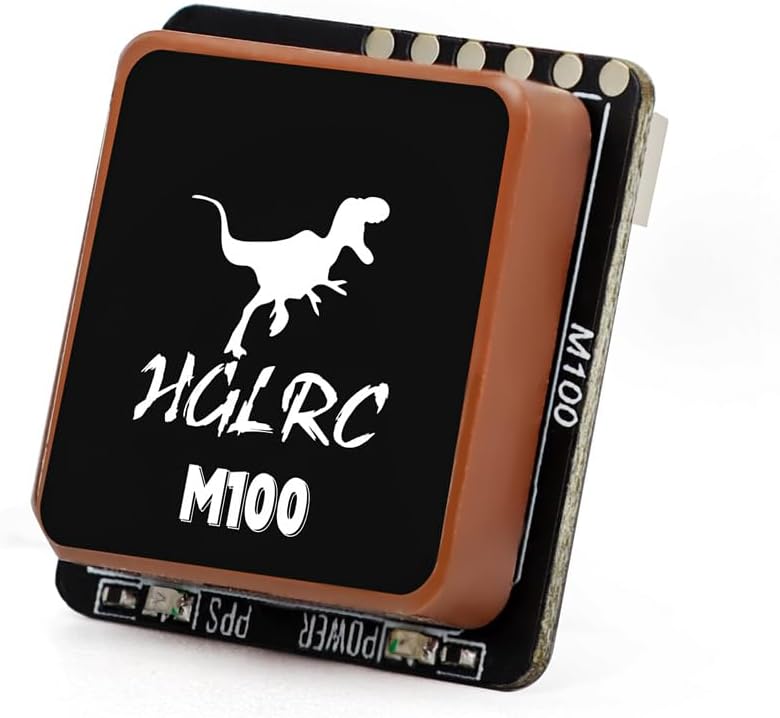
The HGLRC Mini M100 is a straightforward, compact GPS option for FPV racing drones ranging from 2 to 7 inches. It uses a ceramic antenna, supports a 3.3-5V DC input range, and includes onboard power and PPS indicators. Its 4.6 rating and broad size compatibility make it a sensible entry point for builders who need position data without a large navigation package.
We may earn a commission when you buy through this link, at no additional cost to you.
The wide voltage range is useful across different aircraft platforms because it can simplify power planning when the builder's chosen flight controller and receiver arrangement use different logic levels or supply arrangements. Status LEDs are another practical feature: they let the pilot confirm power and pulse-per-second activity without repeatedly connecting to a ground-control interface.
This module is described as UBLOX compatible, but that label does not replace a protocol check. The flight controller's GPS settings, baud rate, and data output mode should be matched to the receiver before flight. Its listing does not identify an integrated magnetic compass, so users who need heading information may need to add one separately. Users should also confirm the board dimensions and connector arrangement against their available mounting space.
The Mini M100 is best for racers and freestyle pilots who specifically need a small GPS receiver for a 2-7 inch aircraft. It is particularly attractive when a clear operating status and broad power-input range matter more than an onboard compass or a large list of supported constellations.
Compatibility from 2-7 inch drones gives the module unusually broad appeal among FPV builders. Buyers should still compare the exact dimensions and wiring with their selected frame and flight controller.
Separate power and PPS indicators provide immediate feedback during setup. They make it easier to distinguish a lack of power from a receiver that is powered but still searching for satellites.
We may earn a commission when you buy through this link, at no additional cost to you.
The JeeFly M8N is a more specialized navigation package designed around a 72-channel u-blox M8N receiver, a 10Hz update rate, and broad support for autonomous flight platforms. It includes an integrated compass, a 270mm cable, and a mounting base, making it a substantial kit for Pixhawk, PX4, and compatible F4 or F7 flight-controller installations.
We may earn a commission when you buy through this link, at no additional cost to you.
The module can receive GPS, GLONASS, BeiDou, and QZSS signals simultaneously and is stated to track more than 26 satellites. Its listed accuracy is 0.5 meters under ideal conditions, while the product description also notes an ideal-condition figure of 30 centimeters. These figures should be treated as best-case specifications because real accuracy varies with antenna placement, sky visibility, multipath interference, and flight dynamics.
A blue LED flashes after a satellite lock and remains solid while searching, giving the installer an immediate diagnostic reference. A separate red LED indicates power. The included cable provides connections for 5V, ground, receive, transmit, SCL, and SDA, but the exact lead connections and voltage requirements should be checked against the flight controller documentation before energizing it.
The JeeFly M8N is our premium recommendation for builders using a Pixhawk-class system or an aircraft that benefits from high-rate navigation data. It is less convenient for a simple FPV racer because the package and connection arrangement are more substantial, and firmware updates may be required for some Pixhawk models. It is also not suitable for APM systems.
The 10Hz refresh rate and simultaneous multi-constellation reception suit autonomous routes, return-to-home logic, and other navigation tasks that benefit from current position information. The aircraft still needs properly configured flight software to take full advantage.
Distinct lock and power indicators help diagnose installation issues, while the included 270mm cable and mounting base reduce the need for extra accessories. The generous cable length also makes it easier to place the antenna away from electronics.
We may earn a commission when you buy through this link, at no additional cost to you.
The Readytosky M10 is designed specifically for the Pixhawk 2.4.8 flight controller and includes an external compass with a GPS holder. Its stated ideal-environment positioning accuracy is 1.5 meters CEP, and onboard flash preserves configuration changes after power is removed. The 4.2 rating is lower than those of several newer competitors, but the targeted platform support remains important.
We may earn a commission when you buy through this link, at no additional cost to you.
The external compass gives installers more control over magnetic sensor placement. On larger autonomous aircraft, separating the compass from high-current electronics and motors can help reduce interference. The included holder is intended to make that placement repeatable, which is valuable when a system must be serviced or reproduced.
This module's central limitation is compatibility. The listing explicitly says that it can only be used with the Pixhawk flight controller and cannot work with other flight controllers. That specificity makes setup easier for the intended audience but eliminates the module for F4, F7, INAV, Betaflight, PX4, or ArduPilot builders unless they use the exact supported platform.
The Readytosky M10 is best for a Pixhawk 2.4.8 aircraft that benefits from an external compass and persistent receiver settings. Buyers should verify the current flight-controller revision and wiring requirements, while pilots with other systems should choose a more broadly compatible receiver.
Moving the magnetic sensor away from motors and power electronics can improve heading reliability on larger airframes. The supplied holder supports a more repeatable installation than improvised mounting.
Onboard flash keeps modified settings after the receiver loses power. This reduces setup time when the module is moved between compatible aircraft or restored after maintenance.
We may earn a commission when you buy through this link, at no additional cost to you.
The BZGNSS BZ-251 Rescue is designed for fixed-wing and RC aircraft that need dependable position data for failsafe return-to-home behavior. It has a perfect 5.0 listed rating, uses a 10th-generation u-blox M10 chipset, and supports both NMEA and UBX protocols. Those qualities make it especially interesting to pilots who want flexible firmware compatibility in a safety-oriented navigation package.
We may earn a commission when you buy through this link, at no additional cost to you.
The default search combines GPS, GLONASS, and BeiDou, allowing the receiver to use more satellites than a single-system design. The stated 2D positioning accuracy is 1.5 meters, and the module supports refresh rates of up to 10Hz. The included oil-sprayed ceramic antenna is designed to resist scratching and oxidation, helping preserve signal performance over repeated handling and flight use.
Return-to-home and rescue functions depend on correct configuration in the flight controller, including the appropriate protocol, baud rate, update rate, and home-direction behavior. The listing references F4 and F7 compatibility, but users should confirm connector pinouts and software requirements before installation. Since the product description does not identify an integrated compass, a separate heading source may be necessary for some navigation routines.
This module is an excellent choice for fixed-wing pilots focused on failsafe and return-to-home reliability, particularly those who need to switch between NMEA and UBX configurations. It is less compelling for a drone requiring a built-in compass or for a user who wants a very lightweight racing setup.
Supporting NMEA and UBX lets the pilot work with a broader range of flight-controller configurations. The selected mode still has to match the firmware and wiring setup.
The product's emphasis on rescue and return-to-home use makes it most relevant to fixed-wing aircraft that benefit from an independent position reference. Reliable operation still depends on proper configuration and a clear satellite view.
We may earn a commission when you buy through this link, at no additional cost to you.
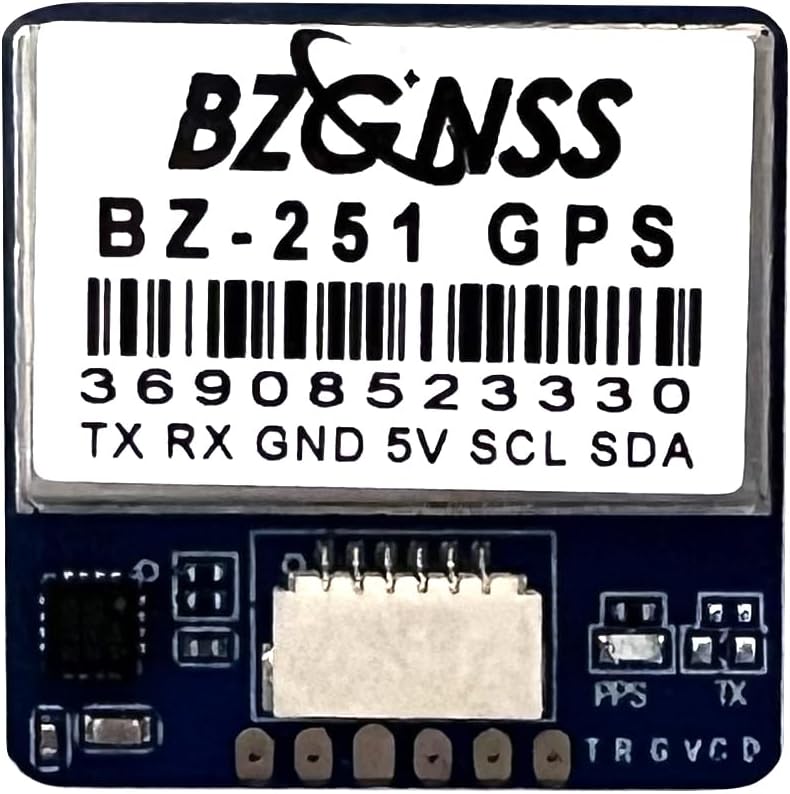
The BZGNSS BZ-251 is a compact M10 GPS module for RC FPV racers, fixed-wing aircraft, and long-range builds using F405 or F722 flight controllers. It supports both NMEA and UBX protocols, includes BDS satellite support, and has a 4.4 customer rating. A built-in battery is included to avoid problems associated with poor battery connections during operation.
We may earn a commission when you buy through this link, at no additional cost to you.
The dual-protocol design reduces the chance that a flight controller configuration will be incompatible with the receiver. Its stated quick satellite-lock behavior and M10 platform target the short preparation periods common in racing and field-flying use. The compact, lightweight construction also makes the module more practical for size-constrained airframes than a larger GPS-and-compass assembly.
The built-in battery should be treated as a convenience feature rather than a substitute for sound power practices. Users still need to understand the module's power requirements and charging or connection procedure before use. The listing does not identify an integrated compass, so pilots requiring a heading reference should verify that their flight stack can source it elsewhere.
The BZ-251 is most suitable for FPV pilots who want a compact dual-protocol receiver and use compatible F405 or F722 hardware. It offers an appealing combination of size, satellite support, and installation convenience, though the other dual-protocol BZ-251 option may be preferable when failsafe and return-to-home use is the primary requirement.
NMEA and UBX support gives the module flexibility across different flight stacks. The selected protocol should be confirmed with the flight controller's GPS configuration before relying on navigation features.
The small design and internal battery reduce the number of separate components to install. Builders should still check cable direction, mounting clearance, and antenna orientation.
We may earn a commission when you buy through this link, at no additional cost to you.
The AERO SELFIE FK-C1 is a remarkably small navigation module measuring 20 by 20 by 8 millimeters and weighing 7 grams. It uses an M9 chipset, supports GPS, GLONASS, Galileo, and BeiDou, and integrates an IST8310 compass. Those attributes make it appealing for FPV and racing drones where every gram and millimeter matters.
We may earn a commission when you buy through this link, at no additional cost to you.
Four-constellation support can improve satellite availability in urban canyons and forested areas compared with a receiver limited to one system. The blue LED blinks at 1Hz when a three-dimensional GNSS fix is acquired, providing an easy visual confirmation that the receiver has moved beyond a basic two-dimensional position. The compass provides the heading reference needed for directional control and waypoint navigation.
Its stated operating current of 80mA is efficient for a battery-powered aircraft, and the listed temperature range from -20°C to 80°C is suitable for many flying environments. The module's protocol and exact connector details are not specified in the supplied information, so pilots should verify compatibility before committing to an installation. The magnetometer also needs careful placement and calibration away from interference sources.
The FK-C1 is a strong choice for compact FPV builders who prioritize size, weight, and integrated heading data. It is less suitable for anyone who needs verified protocol support, a known flight-controller harness, or the reassurance of an established numeric customer rating before buying.
The 20mm square board and seven-gram weight preserve room for batteries and other flight equipment. Its dimensions should be checked against the chosen frame because connectors can affect the usable installation area.
A blue LED blinking at 1Hz indicates a three-dimensional GNSS fix. This gives the pilot a fast installation check before taking the aircraft into an area with an unobstructed sky view.
We may earn a commission when you buy through this link, at no additional cost to you.
The FK-D1 is a general-purpose GNSS module for drones and robotics, combining a 10th-generation M10 chip, 10Hz updates, and a QMC5883L compass. It can track up to 32 satellites across GPS, GLONASS, BeiDou, and Galileo, while the supplied information identifies compatibility with INAV, Betaflight, ArduPilot, and PX4.
We may earn a commission when you buy through this link, at no additional cost to you.
The 25 by 25 by 4 millimeter high-gain ceramic antenna is intended to support reception in urban areas and under dense natural cover. Integrated flash preserves user settings after power cycles, which reduces repetitive configuration work. The 12-gram weight remains practical for many multirotor and robotic platforms, although it is heavier than some highly compact FPV modules.
The UART interface provides a common connection method for serial positioning data, but voltage, pinout, baud rate, and protocol must match the controller. Its broad software compatibility is a major advantage, though support can differ by release and board revision. Compass placement remains important because high-current electronics can distort magnetic readings even when the satellite antenna has a clear view of the sky.
The FK-D1 is a strong all-round module for builders working across drone and robotics platforms. It is especially useful when 10Hz navigation, an integrated compass, and compatibility with several major flight stacks are priorities. It may be less attractive for micro-drone builders who need the smallest possible navigation board.
Compatibility with INAV, Betaflight, ArduPilot, and PX4 makes the FK-D1 usable in more than one ecosystem. The appropriate firmware version, serial settings, and connector wiring still need to be verified for the exact aircraft.
Flash storage retains user configuration between power cycles, while the larger ceramic antenna is designed for stable reception. Together, these features support repeatable setups in professional-looking installations.
We may earn a commission when you buy through this link, at no additional cost to you.
The HGLRC M100-5883 is a small GPS and compass module for FPV fixed-wing UAVs. It measures 21 by 21 millimeters, weighs 7.73 grams, and combines a 10th-generation chip with a QMC5883L compass. Its 4.5 rating indicates solid customer reception, while the integrated heading sensor makes it more versatile than a navigation board that only supplies position coordinates.
We may earn a commission when you buy through this link, at no additional cost to you.
The receiver supports GPS, Galileo, and BDS positioning modes and is designed to acquire satellites quickly. A carefully modulated ceramic antenna and expanded external PCB are intended to strengthen reception, while the compass provides direction data for navigation routines. Those features are particularly relevant in fixed-wing aircraft, where maintaining a home heading and returning from a diverted route can be important.
The compact dimensions and low weight are useful for space-constrained FPV builds, but the user should verify the footprint including its connector and cable. The description does not provide detailed protocol, baud-rate, or flight-controller compatibility information, so software configuration should be checked before installation. Compass calibration is also essential because motors, current-carrying wires, and carbon-fiber structures can affect the magnetic field.
The M100-5883 is a good balanced option for small fixed-wing drones and multirotors that need both position and heading data in a compact board. Buyers seeking a broader range of satellite systems or a fully documented plug-and-play harness may prefer one of the more explicitly specified multi-protocol alternatives.
Combining GPS, Galileo, and BDS gives the receiver several satellite networks to search. The potential benefit is faster acquisition and improved continuity when one system has limited visibility.
Adding the QMC5883L to a 21mm board saves the need for a separate magnetometer. Placement and calibration remain critical for accurate heading in electrically noisy drone frames.
We may earn a commission when you buy through this link, at no additional cost to you.
Selecting a GPS module involves balancing receiver capability, aircraft constraints, and flight-controller requirements. The following factors help narrow the field before you commit to a particular board.
Begin with the flight controller and its supported GPS input, including the connector pinout, supply voltage, serial baud rate, and data protocols. Some modules are explicitly designed for a single platform, such as the Readytosky M10 for Pixhawk 2.4.8, while others list broader support for Pixhawk, PX4, INAV, Betaflight, ArduPilot, and F4 or F7 boards. Check the current documentation rather than relying only on the product title. A receiver can fit physically and still fail to communicate if its protocol or baud rate does not match the flight software.
A module that supports GPS, GLONASS, Galileo, BeiDou, QZSS, BDS, or SBAS can draw from a larger pool of satellites than a single-system receiver. This is particularly useful near buildings, in forests, or anywhere some satellites may be obscured. More constellations do not guarantee identical accuracy in every location, but they can improve acquisition time and signal continuity. The SEQURE M10-25Q supports the broadest stated set in this group, while several other products cover four principal constellations.
An integrated magnetic compass adds heading information without requiring a separate magnetometer, which is convenient for small aircraft. Products such as the SEQURE M10-25Q, HGLRC M100 Pro, and FK-D1 use a QMC5883L, while the AERO SELFIE FK-C1 uses an IST8310. Integrated does not mean immune to interference. Motors, ESCs, batteries, ferrites, and carbon fiber can distort readings, so choose a mounting position that allows proper calibration and keeps the sensor away from high-current equipment.
Update rate indicates how frequently the receiver reports a new position. Modules described at 10Hz can provide fresher data for autonomous flight, rescue behavior, and high-speed movement than slower updates. This does not automatically make every flight more stable, because processing quality, latency, and the flight controller's configuration also matter. FPV racers usually do not need extremely high rates for manual flying, but fixed-wing navigation and automated return functions can benefit from frequent position reports.
A GPS receiver must leave the antenna with a clear view of the sky, and every gram affects aircraft performance. The HGLRC M100-5883 is listed at 21mm square and 7.73 grams, the FK-C1 at 20mm square and 7 grams, and the FK-D1 at 12 grams with a 25mm antenna. Compare the full assembly, including cable, connector, and any compass housing, rather than relying on the board size alone. Also check whether the frame has a carbon-fiber top plate that could block the signal.
Published accuracy figures are usually best-case values under favorable conditions. The JeeFly M8N lists 0.5-meter accuracy and an ideal-condition 30-centimeter figure, while the Readytosky M10 and BZGNSS rescue module list 1.5-meter CEP or 2D accuracy. Real performance can worsen near buildings, under vegetation, beside metal structures, or when the antenna is poorly oriented. A larger high-gain antenna may help reception, but it also changes size and mounting requirements.
NMEA and UBX support provides flexibility across flight-controller configurations. The BZGNSS BZ-251 and rescue variant can work with either protocol, and the SEQURE M10-25Q is described as using the UBLOX protocol. A module with persistent flash is also convenient because modified settings survive a power cycle, a feature offered by the Readytosky M10 and FK-D1. Before installation, identify the protocol expected by the flight software and note whether configuration is possible through a computer or a parameter interface.
Different aircraft benefit from different GPS features. Racing drones need compact size and low weight, while fixed-wing models often value reliable failsafe and return-to-home support. Large autonomous platforms may justify a receiver with more channels, higher update rates, an external compass, and a mounting base. The BZGNSS rescue module specifically targets failsafe use, the JeeFly M8N suits advanced autonomous platforms, and the HGLRC Mini M100 focuses on the needs of 2-7 inch FPV drones.
Install the module on an upper surface where the ceramic antenna can see as much sky as possible. Avoid carbon-fiber plates, batteries, camera hardware, and dense electronics directly above the antenna. Keep the magnetic compass, if integrated, away from motors, ESCs, high-current cables, speakers, and metal fasteners. Use the supplied mounting hardware when available, secure cables so they cannot move near the compass, and confirm that the receiver has a stable power source.
Connect the module using the documented pinout, checking voltage before applying power. Configure the flight controller's baud rate, protocol, update rate, and satellite mode to match the receiver. For dual-protocol modules, begin with the protocol specified by the flight software and the relevant product documentation. Wait outdoors with a clear view of the sky, then use the receiver's LED and the flight controller's status display to confirm that it has acquired satellites.
Complete compass calibration after installation and repeat it if the airframe layout changes or the aircraft has been crashed. Check the displayed position, heading, and home direction on the ground before relying on autonomous routes or return-to-home behavior. Keep the antenna clean, inspect connectors for looseness, and verify the mount before every flight. If satellite quality drops unexpectedly, check for physical antenna blockage, excessive vibration, electrical interference, and an improperly configured compass.
No. A GPS receiver provides position coordinates, while a magnetic compass provides heading. Some compact modules include an integrated compass, but others require a separate magnetometer. The need depends on whether the flight controller requires a direction reference for features such as home-direction calculation, waypoint navigation, or return-to-home behavior.
Not necessarily. The module must use compatible wiring, voltage, baud rate, and protocol. Many modern receivers support NMEA or UBX, but the exact flight controller and firmware still need to be verified. A module designed for Pixhawk may also need a different cable or connector arrangement than an F4 or F7 racing board.
GPS is one satellite navigation system, while GNSS is the broader term for systems such as GPS, GLONASS, Galileo, and BeiDou. A module that supports several GNSS constellations can use signals from multiple systems, potentially improving acquisition time and signal availability. The actual benefit depends on the environment and the receiver's antenna placement.
A poor lock usually results from an obstructed antenna, insufficient power, a wiring or protocol mismatch, excessive vibration, or interference from nearby electronics. Test the receiver outdoors with a clear sky view and confirm that its status light changes from searching to locked. Also verify the serial settings in the flight controller before troubleshooting the hardware itself.
Usually not for purely manual racing, where pilots rely mainly on visual control and the flight controller's other sensors. A 10Hz update can be more valuable for fixed-wing navigation, autonomous flight, rescue functions, and return-to-home behavior. Those features also depend on correct configuration and reliable position data, not update rate alone.
Mount it on the upper surface with the clearest possible view of the sky. Carbon fiber, a battery underneath, a camera mount, or a dense electronics stack can block or reflect signals. For modules with an integrated compass, keep that component away from motors, ESCs, magnets, and current-carrying wiring, then recalibrate after final assembly.
It can provide the position information that the flight controller needs to execute a return-to-home route, but the module does not guarantee a safe return by itself. The receiver must lock onto satellites, report valid location data, and communicate correctly with the flight controller. Fail-safe triggers, home-point setup, compass heading, and aircraft guidance also need to be configured properly.
Use the protocol required by the flight controller and its configured parameters. NMEA is a common general-purpose format, while UBX is associated with u-blox receivers and can expose more receiver-specific functionality. Dual-protocol modules are convenient because they offer more installation flexibility, but the user must still select the correct mode and baud rate.
The SEQURE M10-25Q is the strongest all-around choice because it combines 10Hz updates, six supported positioning systems, an integrated QMC5883L compass, and both plug-in and soldered connection options. The HGLRC Mini M100 is the most budget-conscious choice for 2-7 inch FPV aircraft, while the JeeFly M8N is the premium pick for advanced Pixhawk, PX4, F4, and F7 navigation projects.
Prioritize verified controller compatibility, antenna placement, and correct protocol settings over chipset labels alone. Compact racing drones need a small receiver with clear sky visibility, fixed-wing pilots should consider failsafe features and return-to-home support, and autonomous aircraft may benefit from a higher update rate, more constellations, an integrated or external compass, and persistent configuration storage.
Finally, check current product availability, included accessories, connector details, and the latest flight-controller documentation before ordering. Features and configurations can change between revisions, and prices and promotions vary over time. Comparing the final module against the aircraft's size, power system, navigation tasks, and available mounting space will lead to the most dependable installation.