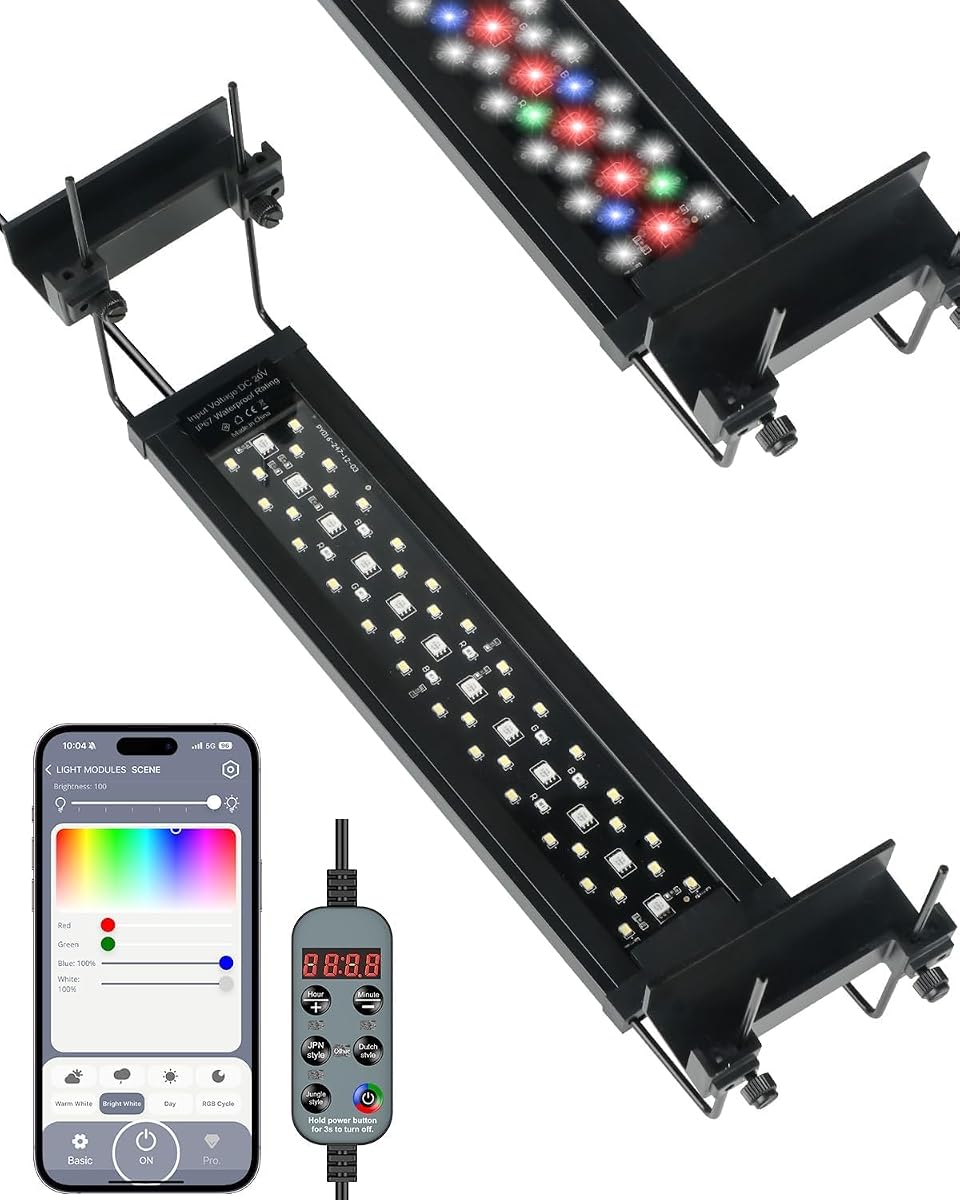
Pawfly 14 W Bluetooth Aquarium Light
3.8Editor score
Bluetooth app color control
100,000+ color selections
Three automatic day-night modes
Designed for 12-18 inch tanks
App controlled smart aquarium lights combine flexible LED illumination with scheduling, color customization, and remote operation from a phone. A capable fixture can make a planted tank look more vibrant, simplify daily lighting routines, and provide consistent day-night transitions for fish and aquatic plants.
The products in this guide were compared using their stated connectivity, lighting specifications, scheduling options, mounting systems, tank-size guidance, and water-resistance features. The list includes rim-mounted fixtures, submersible lights, nano designs, and full-size models for freshwater, saltwater, planted, and reef-style setups.
Each review identifies the feature that makes a particular light useful and also explains its limitations. Ratings reflect the supplied customer feedback, while practical fit matters more than any single specification. Current prices and availability can change, so check the latest listing before purchasing.
3.8Editor score

4.6Editor score

4.1Editor score
As an Amazon Associate we earn from qualifying purchases.
This side-by-side comparison highlights the app connection, light output, scheduling capabilities, physical design, and stated tank coverage of all ten models, helping you find the most appropriate fixture for your aquarium.




The Pawfly 20 W aquarium light is a 4.1-rated Bluetooth fixture intended for tanks measuring 18 to 24 inches. Its defining strength is a generous app-based color system, with access to more than 100,000 choices, adjustable brightness, effects, and programmable start times. The physical 20-watt output is paired with white, red, green, and blue wavelengths for a full-spectrum presentation.
We may earn a commission when you buy through this link, at no additional cost to you.
Three automatic modes—Dutch, Jungle, and Japanese—provide different day-night rhythms without requiring the owner to create every transition manually. The ability to customize start times adds another layer of control, while the app can be updated for the intended experience. The stated 5,000-lux output, PAR of 95, and CRI of 96 make this a credible option for a compact planted aquarium where appearance and plant support both matter.
The fixture should not be treated as a substitute for a tank-specific lighting prescription. Its listed range concentrates on 18-24-inch tanks, and using it on a substantially larger aquarium may leave uneven coverage or insufficient intensity. Bluetooth also means the phone must be nearby for direct adjustments, while the three preset cycles remain useful when you want automatic operation without frequent phone interaction.
This is a good pick for an aquarist who wants app-driven color effects and automatic cycles in a modest planted, freshwater, saltwater, or reef-style tank. It is especially useful when visual flexibility matters as much as raw output. Confirm the bracket fits the tank rim, update the app before setup, and establish a conservative light schedule before adding more intensity.
The app combines extensive RGB color selection with Dutch, Jungle, and Japanese day-night modes. This makes it easy to move between daily plant illumination and decorative effects while preserving repeatable automatic schedules.
A stated PAR of 95, 5,000 lux, and CRI of 96 give the fixture a more complete specification set than many decorative lights. The 18-24-inch target remains the key limitation when judging its suitability.
We may earn a commission when you buy through this link, at no additional cost to you.
The FZONE 36 W aquarium light carries a 4.4 rating and is designed for 24-31-inch tanks. It combines RGB, white, and UV LEDs in a four-inch emission area with six rows of LEDs, producing 1,950 lumens at a stated color temperature range of 6,500-12,000 K. The broad panel is intended to distribute light more evenly than a narrow strip.
We may earn a commission when you buy through this link, at no additional cost to you.
Its strongest feature is the choice among Manual, Auto, and Custom modes. Custom mode supports as many as 24 time points, allowing a detailed sunrise and sunset sequence, while Auto mode simulates weather such as cloudy, rainy, or sunny conditions. The Bluetooth app controls brightness and color, while a memory function restores prior settings after a power interruption.
A temporary light function is particularly useful because it allows maintenance lighting without disturbing saved presets. The aluminum housing is also designed for heat dissipation, and the listed working temperature remains below 120°F. Buyers should still account for the included UV LEDs and confirm that the spectrum fits their livestock and plants rather than enabling every feature by default.
Choose this model if you want detailed control over a medium planted tank and want weather-like variations rather than a fixed color program. It offers a stronger combination of scheduling depth, output, and broad coverage than most compact app lights. Position the panel centrally, begin with moderate brightness, and use the custom timeline to create gradual transitions rather than abrupt changes.
The ability to define 24 time points gives aquarists a much more granular sunrise-and-sunset cycle. Auto weather modes provide a convenient alternative when a handcrafted timeline is unnecessary.
A four-inch emission surface and six LED rows support more even coverage over a 24-31-inch aquarium. The 1,950-lumen output also gives the fixture more useful intensity than a basic decorative bar.
We may earn a commission when you buy through this link, at no additional cost to you.
The hygger 35 W smart aquarium light is a 4.1-rated option for 24-30-inch freshwater planted tanks. It uses 49 RGB LED beads to deliver 2,275 lumens at a selectable color temperature of 3,000-6,700 K. Its appeal lies in the combination of app operation and four physical buttons, so essential functions remain accessible when a phone is not nearby.
We may earn a commission when you buy through this link, at no additional cost to you.
Four default scenes cover sunlight, moonlight, fishlight, and ocean-blue preferences, while two user-defined scenes can store custom color and brightness combinations. A sunrise-and-sunset scene and eight programmable times support a continuous daily cycle. The 300-plus color selection and stepless adjustment of brightness and color temperature make it useful for both planted-tank presentation and changing moods.
Power-off memory restores the previous scene within an hour, which helps preserve routines during short interruptions. The full-sealed body is designed to resist humidity and splashing, although that does not make it an in-tank light. Its stated 24/7 cycle should still be used with an appropriate livestock-specific schedule rather than continuous maximum brightness.
This is a strong choice for a freshwater planted aquarium owner who wants mobile customization without giving up tactile controls. The ready-made scenes make it approachable, while custom programs provide room to refine the routine. Update the firmware, test the buttons and app together, and create a conservative schedule before moving to stronger colors or longer photoperiods.
Four physical buttons cover power, scene selection, and brightness adjustments. That redundancy is useful when the phone is absent or when Bluetooth connectivity is inconvenient.
Sunlight, moonlight, fishlight, and ocean-blue presets provide useful starting points. Two custom scenes expand the system without requiring complicated setup.
We may earn a commission when you buy through this link, at no additional cost to you.
This full-spectrum aquarium light has a 4.4 rating and supports both app and handheld remote control. It is designed around 18-24-inch aquariums and provides 0-100% dimming, multiple preset modes, adjustable white and RGB output, and a timer that can be customized by the minute for particular days of the week.
We may earn a commission when you buy through this link, at no additional cost to you.
The control options are unusually versatile. A phone is useful for building and revising lighting routines, while the remote offers immediate access without unlocking a device. Sixteen million RGB color options support themed effects, and the fixture includes red and blue wavelengths intended to complement plant growth and the visible color of fish and corals.
Its extendable tool-free brackets accommodate glass from 5 to 15 millimeters, and the listed telescoping section helps keep the lamp from slipping into the water. The supplied guidance also emphasizes that a single unit is best for 5-10-gallon tanks, one centered light works for 10-20-gallon tanks, and larger installations may need multiple lights for full coverage.
The fixture is most appealing to beginners who value easy remote access, minute-by-minute scheduling, and a straightforward bracket system. Its 18-24-inch sizing and broad range of aquatic-life references should be treated as general guidance rather than a guarantee of biological performance. Check the bracket clearance, confirm glass compatibility, and select intensity appropriate for the animals and plants in the tank.
The app timer can be set for specific days, weekdays, weekends, and exact times. That flexibility is useful for households with changing routines or aquariums that should not follow a uniform seven-day program.
Tool-free extendable brackets fit several common glass thicknesses. The adjustable design simplifies placement, although adequate rim clearance remains necessary.
We may earn a commission when you buy through this link, at no additional cost to you.
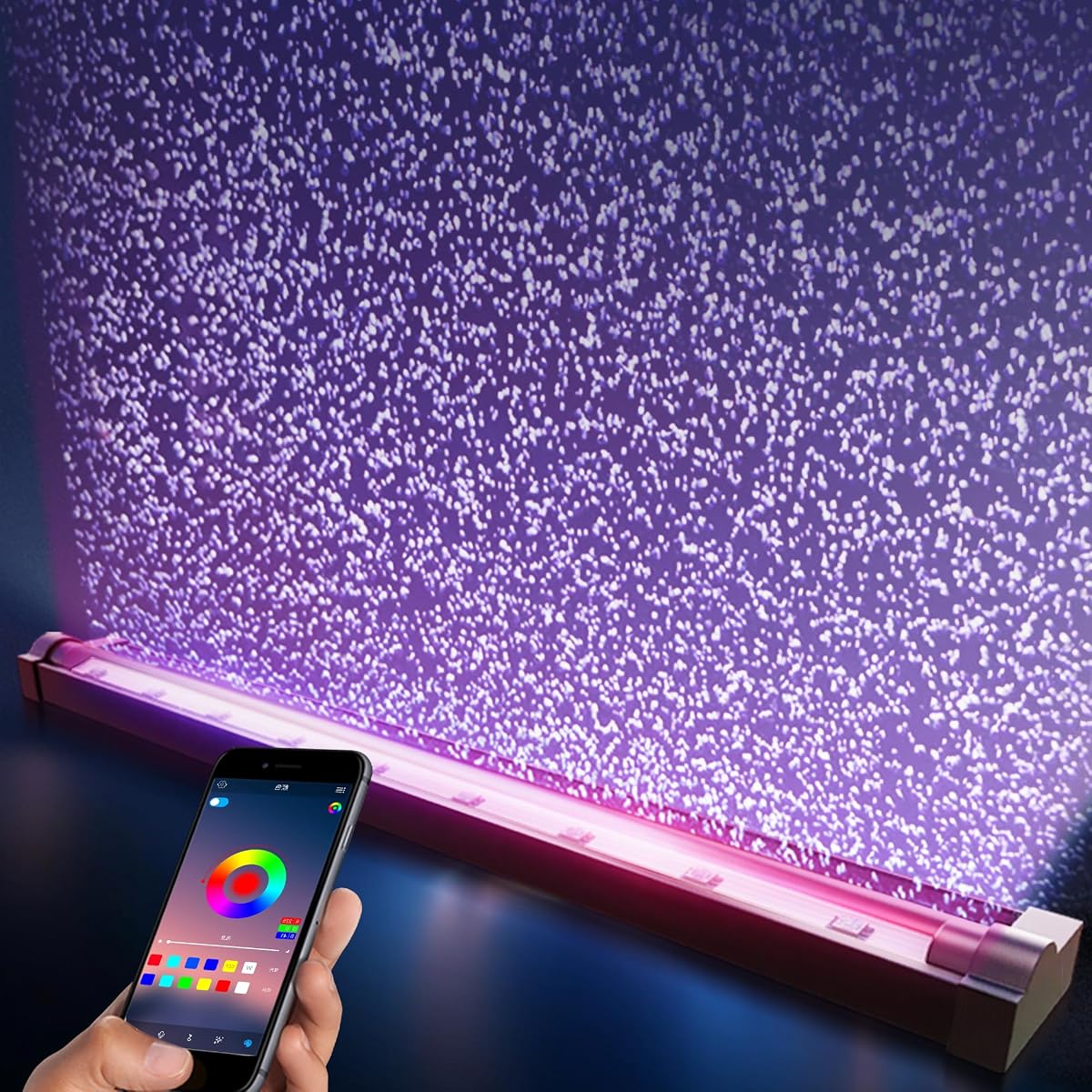
The 23-inch smart aquarium light is a 4.1-rated submersible fixture that combines RGB illumination with a nano air bubbler. It offers 16 million app-selected colors, 12 dynamic effects, timers, and separate brightness and effect-speed controls. The integrated bubbler is a distinctive addition that provides both visual movement and supplemental aeration.
We may earn a commission when you buy through this link, at no additional cost to you.
The nano bubble stone is made from durable nano rubber and is designed to create smaller, denser bubbles than conventional stones. Its IP68 rating supports underwater use, while the stated setup involves connecting the light to a pump, placing it in the aquarium, and downloading the app. This design is especially convenient for owners who do not want a separate hanging light and air stone.
Because the fixture is submerged, correct placement and secure attachment are essential. The light may provide attractive ambient illumination, but high mounting position and coverage limitations can make it less suitable as the sole lighting source for a densely planted aquarium. Air stones and pumps also require routine cleaning, and the bubbler should be checked for clogging.
This product is a compelling choice for a compact decorative tank, betta-style setup, or aquarium where a subtle submerged glow and bubble display are the main goals. It may also suit users seeking a simple app-controlled system without a rim-mounted bracket. Review the pump requirements, ensure the suction cup holds securely, and maintain regular cleaning.
The integrated nano bubbler adds motion to the tank while supporting oxygenation. Combining both functions can simplify compact setups, provided the pump and placement are suitable.
Sixteen million colors and 12 dynamic effects offer more visual variety than a standard white-only lamp. Speed and brightness adjustments make it possible to use a more restrained effect during normal viewing.
We may earn a commission when you buy through this link, at no additional cost to you.
The FZONE Solo Series has a 4.6 rating, the highest among the listed products, and targets freshwater, planted, nano, shrimp, Wabi-Kusa, and terrarium setups. Its compact panel uses 18 RGB LEDs and 18 white LEDs. Each color channel can be adjusted independently, allowing the output to be tailored to the appearance of plants and the desired effect.
We may earn a commission when you buy through this link, at no additional cost to you.
Bluetooth app control covers brightness and color, while Manual, Auto, and Custom modes support immediate adjustments, simulated weather, and a sunrise-sunset program with up to 24 time points. Memory preserves settings after a power interruption, and a temporary light mode supports maintenance without overwriting saved presets.
The mounting system is a major strength. It fits rimless tanks with glass under 8 millimeters, allows the panel to rotate 120 degrees, and lets the stand rotate 360 degrees. Its height is adjustable, and the listed tank range of 20-50 centimeters makes it a more specialized choice than a full-width aquarium bar.
This light is an excellent match for small, design-focused aquascapes where neat placement and precise aiming matter. It works especially well for shrimp tanks, nano aquariums, terrariums, and artistic rimless layouts. Confirm the glass thickness and rim configuration before ordering, and use the app to create a gradual schedule rather than operating every channel at maximum output.
A 120-degree panel rotation and 360-degree stand rotation make it easier to direct light toward plants, substrate, and decorative hardscape. These adjustments are especially valuable in shallow nano layouts.
The Solo supports the same broad scheduling idea as larger FZONE fixtures, including 24 custom time points. Memory and temporary lighting add practical control for compact planted systems.
We may earn a commission when you buy through this link, at no additional cost to you.
The Fluval Aquasky 2.0 is a 4.6-rated 27-watt Bluetooth light intended for 36-48-inch aquariums. It combines 6,500 K white LEDs with full-spectrum RGB lighting for a blend that can reproduce both natural illumination and decorative effects. Its polished design and broad coverage make it a strong candidate for a large planted or fish-only display.
We may earn a commission when you buy through this link, at no additional cost to you.
The FluvalSmart app can program a gradual sunrise, midday period, sunset, and night schedule, along with color intensity and brightness. Weather simulations add storm, lightning, and cloud effects that introduce meaningful variation into an otherwise static daily cycle. This focus on gradual transitions is one of the model's most useful distinctions.
An IP67 waterproof rating allows the fixture to be mounted directly above the water, while each LED's 120-degree beam angle supports broad, even coverage without prominent hotspots or dead spots. The trade-off is its larger size, which makes it less attractive for nano tanks. Bluetooth control also means a phone is required for detailed changes, although programmed schedules can handle routine operation.
This is a particularly well-rounded recommendation for an aquarist with a medium-to-large aquarium who values smooth day-night transitions and atmospheric effects. The combination of white and RGB output, even coverage, and direct-over-water mounting provides a strong balance of function and presentation. Position it centrally, update the app, and tailor the schedule to the requirements of the livestock and plants.
Programmable sunrise, midday, sunset, and night stages create a gradual daily progression. The approach is easier to maintain and often looks more natural than switching a fixed-color light on and off.
A 120-degree beam angle and 36-48-inch sizing create broad, balanced coverage. The IP67 rating also makes direct mounting above the water more practical.
We may earn a commission when you buy through this link, at no additional cost to you.
The Pawfly 14 W is the most compact full-spectrum Pawfly model in the group, with a 3.8 rating and a stated fit for 12-18-inch tanks. It provides 3,500 lux, PAR of 70, and CRI above 94 using 8,000 K white, red, green, and blue wavelengths. The lower output is paired with a highly flexible app for changing brightness and color.
We may earn a commission when you buy through this link, at no additional cost to you.
More than 100,000 app color choices and adjustable effects provide extensive visual customization. Dutch, Jungle, and Japanese day-night modes can operate the fixture automatically, while custom start times allow the routine to be aligned with a household schedule. Bluetooth control does not require an external controller or a separate Wi-Fi network, which can simplify setup.
The main limitation is its 3.8 rating, the lowest among these products, plus a clear restriction to smaller tanks. The stated 12-18-inch range means it should not be evaluated as a single source for a large planted display. Its lower brightness may also require more careful positioning and conservative scheduling for light-sensitive livestock.
This is a value-oriented choice for a small freshwater, saltwater, planted, or reef-style aquarium where colorful effects and automatic cycles are the main priorities. It offers many of the same app functions as the 20 W version in a smaller format. Confirm the bracket dimensions and tank coverage, then start with a moderate cycle to evaluate the light's effect.
The compact 14-watt format is aimed at 12-18-inch tanks while retaining extensive RGB customization. It is better suited to visual flexibility than to illuminating a large planted aquarium.
Bluetooth app operation works without placing the aquarium on a network. Three built-in day-night presets simplify the setup for users who do not want to build a timeline immediately.
We may earn a commission when you buy through this link, at no additional cost to you.
The OYO WATER WCL36-42B is a 4.1-rated smart aquarium light aimed at 36-42-inch tanks. Its listing combines smartphone app control with a programmable timer, multiple color modes, adjustable intensity, and a black housing with mounting brackets. It is designed for users who want connected lighting management rather than a standalone aquarium bar.
We may earn a commission when you buy through this link, at no additional cost to you.
Full-spectrum RGB technology covers wavelengths from 380 to 780 nanometers, allowing different color channels to create a wide range of appearances. The timer can be customized to simulate natural day-night periods, while adjustable mounting brackets simplify placement on many aquarium tanks. A QR code in the manual provides the stated app-download route for iOS and Android.
The most notable ambiguity is the distinction between Wi-Fi and Bluetooth language in the product title and description. Buyers should confirm the current connection method, app requirements, and any network setup steps before purchase. A network-based connection can be convenient for remote management, but it also introduces dependence on the app and a stable connection for certain changes.
This light is best for a larger display where a modern black fixture, app scheduling, and broad RGB output are priorities. The WCL36-42B designation gives a more concrete size reference than many competing listings. Verify bracket dimensions, ensure the app supports your phone, and begin with a light cycle appropriate for the tank's plants and animals.
Custom schedules and programmable day-night periods make it possible to automate a lighting routine. The app is intended to be the main control point for adjusting modes and intensity.
RGB output across 380-780 nanometers supports many color effects, while the black housing and adjustable brackets suit display-oriented installations. Verify connectivity details before committing to the model.
We may earn a commission when you buy through this link, at no additional cost to you.
The Jenklight 19-inch aquarium light has a 4.3 rating and offers a more granular timer than many compact alternatives. It is a fully submersible RGB fixture with a stated 16-million-color range, eleven one-click scenes, and four dynamic presentation modes: Gradient, Jump, Lightning, and Breathing.
We may earn a commission when you buy through this link, at no additional cost to you.
Its app can schedule operation from 0.1 to 24 hours, to the minute, and can cycle through dates from Monday through Sunday. Three independent red, green, and blue bars in the app allow each channel to be set from 0% to 100%. Brightness and effect speed are also adjustable, giving the user a useful degree of color and animation control.
The mounting system uses a thickened, anti-aging suction cup designed for firm attachment. The instructions emphasize squeezing out as much air as possible from the cup for reliable adhesion. Because the light is amphibious, correct positioning is important, and the submerged installation may not provide the broad overhead distribution of a rim-mounted fixture.
This model is a strong option for a compact or medium display that benefits from an underwater glow and animated color. It suits owners who want weekday and weekend timer differences or precise RGB channel mixing. Inspect the suction cup, choose a smooth and clean mounting surface, and avoid placing the cable where it can be snagged or pulled.
The timer can operate from 0.1 to 24 hours and schedule days individually. Minute-level control is useful when the light must align with another automated system.
Independent red, green, and blue controls allow more deliberate color combinations than a simple preset menu. Eleven scenes and adjustable effect speed support both subtle and dramatic presentations.
We may earn a commission when you buy through this link, at no additional cost to you.
The right smart aquarium light depends on tank size, mounting method, desired plant support, color customization, and scheduling needs. Use the following factors to compare app functions and physical designs before choosing a model.
Start with the manufacturer's stated tank range rather than choosing solely by wattage. Some fixtures are built for compact 12-18-inch tanks, while others target 36-48-inch displays. Placement also matters: a broad overhead panel can distribute light differently from a narrow submerged bar. For a large aquarium, one compact light may create bright areas and shadowed corners, so multiple fixtures or a suitably long model may provide more even coverage.
In summary, match the fixture to the full footprint of the tank and inspect whether its output is designed for overhead illumination or decorative underwater placement.
Bluetooth lights generally require a nearby phone for direct changes, while Wi-Fi products may support remote access when the aquarium and phone have an internet connection. Either can automate daily routines, but app quality, firmware updates, and account requirements can affect the experience. Consider whether you need to change the light while away from home or only when standing near the aquarium. The listed connection method should also match your comfort with setup and ongoing app support.
In summary, choose Bluetooth for straightforward local control or Wi-Fi for remote access, while factoring in network reliability and the need for a compatible phone.
A useful timer should match the way light is needed in your home. Basic on-and-off scheduling handles a regular photoperiod, while multiple time points allow gradual sunrise and sunset transitions. Weather effects and named scenes can make routine changes easier, particularly for beginners. Look for memory functions that restore settings after a power interruption and temporary lighting that does not overwrite saved presets.
In summary, prioritize gradual timing, repeatable presets, and power-outage recovery if you want the light to run consistently without frequent intervention.
Full-spectrum descriptions are most useful when accompanied by wattage, lumens, PAR, lux, color temperature, and wavelength information. Plants often benefit from a balanced mix of white and colored wavelengths, while fish-only aquariums may place more emphasis on appearance and effects. Watch the stated color-temperature range: a warmer minimum can produce a more natural display, while a broad or high range offers greater color flexibility.
In summary, evaluate the complete spectrum and output figures together, using the tank's plants and livestock to determine how much intensity and color flexibility you actually need.
Rim-mounted lights keep the fixture outside the water and are often easier to position above tall plants. Submersible lights can create a dramatic underwater glow but may require secure suction cups and careful cable routing. Adjustable brackets, rotatable panels, and narrow rim compatibility are especially important for nano, rimless, and unusual aquascapes. Confirm glass thickness, rim width, and available clearance before ordering.
In summary, verify the physical dimensions and mounting method against your tank, paying special attention to glass thickness, rim space, and the security of submerged fixtures.
An IP67 or IP68 rating indicates a stated level of water resistance, but it does not mean every mounting position is appropriate. Direct-over-water lights and fully submersible bars have different requirements. Follow the instructions, avoid submerging a connector or power supply unless specifically permitted, and inspect seals before installation. Secure any suction cup carefully, keep electrical connections dry, and arrange cables so they do not interfere with maintenance.
In summary, match the water-resistance rating to the stated use, keep connections dry, and install submersible lights securely before filling or moving the aquarium.
Physical buttons are useful for immediate changes and provide a backup when the phone is unavailable. App-only models can still be convenient, but they are more dependent on software and connectivity. Look for clear scene selection, brightness adjustment, color controls, and firmware or app update guidance. More controls are not automatically better; the most valuable interface is one that makes routine adjustments understandable and repeatable.
In summary, favor a control system that supports your habits, especially if you want quick manual changes without reaching for a phone every time.
Memory and automatic recovery keep daily schedules consistent after brief power interruptions. Heat-dissipating housings may support longer component life, while a submerged light adds another surface that must be cleaned. RGB fixtures can collect algae on the housing just as any other aquarium surface does. Look for accessible controls, durable housings, and a design that can be removed without disturbing livestock or decorations.
In summary, account for the upkeep required by the housing and water line, and choose a fixture with a stable schedule and manageable installation.
Begin by confirming that the light is compatible with the tank's size, rim, glass thickness, and chosen mounting position. Install the required app, update it as directed, and check whether the light's firmware also needs an update. Connect by the method stated in the manual, rename the device if the app allows it, and test power, brightness, color, scenes, and timer controls before creating a long-term schedule.
Start with a moderate light intensity and a photoperiod appropriate for the animals and plants in the aquarium. Introduce a gradual sunrise and sunset where possible, and avoid assuming that colorful output or high brightness is automatically beneficial. Check the tank after the first several cycles, observe plant response and fish behavior, and make small schedule changes rather than making several adjustments at once.
For maintenance, disconnect power before moving or cleaning the fixture. Wipe the housing gently with a soft, damp cloth while keeping electrical connections dry, and inspect seals, brackets, suction cups, and cables for damage. Recheck the app connection and timer after an outage or major tank change, and keep the app and firmware current so programmed scenes continue to behave as intended.
It depends on the model. Several options use Bluetooth for local control and do not require a Wi-Fi network, while the OYO WATER listing describes Wi-Fi-enabled app control. For Bluetooth models, the phone generally needs to be within a reasonable distance when making changes, although saved schedules can continue automatically. Confirm the current connection requirements on the product listing and in the app before installation.
A smart light can replace a standard lamp when its coverage, output, and spectrum are appropriate for the tank. A model intended for 12-18 inches may not adequately illuminate a 30-inch planted aquarium, and a decorative underwater light may not provide the overhead distribution required by demanding plants. Match the fixture to the tank and livestock rather than relying on its app features alone.
They are designed for underwater operation when installed according to the manufacturer's instructions. Use the specified power supply, keep incompatible connections dry, and ensure the suction cup is firmly attached to a clean, smooth surface. Remove the light before maintenance and inspect the cable and seals regularly. The stated IP rating helps describe water resistance, but correct installation remains essential.
A continuous 24-hour schedule is rarely necessary just because a light supports automatic day-night programming. Aquatic life benefits from a period of darkness, and the appropriate photoperiod depends on the species and plants. Use the timer to create a suitable daytime period and a dark period, with gradual transitions when possible. The listing's 24/7 language refers to programmable cycle capability, not a requirement to illuminate the tank nonstop.
Lumens describe total visible light output, lux measures illumination per unit area, and PAR relates photosynthetic light availability. None of these figures alone tells the whole story because spectrum, mounting height, beam distribution, and tank dimensions affect results. Compare products using several specifications and consider the needs of the plants and livestock rather than choosing the highest number automatically.
Only if its stated coverage and beam pattern match the aquarium. Large tanks may need a long fixture, a higher-output model, or multiple lights to avoid hotspots and dark areas. A compact 12-18-inch model is unlikely to provide balanced coverage across a 36-48-inch display, and a submerged fixture may create attractive effects without matching the reach of a rim-mounted panel.
The ideal fixture restores its previous scene or continues following the programmed schedule after power returns. Several products in this guide specifically include power-off memory, while the recovery window can vary by model. Save important presets during setup and confirm the behavior after a brief outage. Keeping the app and light firmware updated can also prevent unexpected changes to scene and timer functions.
Use only the intensity and photoperiod needed by the tank, avoid leaving the fixture on continuously, and provide the plant and animal lighting conditions appropriate for the setup. Higher brightness is not automatically better. Clean the housing regularly, remove excess nutrients through normal aquarium maintenance, and introduce changes gradually while observing how plants and algae respond.
The top selections serve different needs. The Pawfly 14 W is the budget-oriented choice for small tanks, the Fluval Aquasky 2.0 stands out for larger displays and natural day-night transitions, and the hygger 35 W combines app operation with physical controls. The FZONE Solo, FZONE 36 W, and Pawfly 20 W are also strong options for aquariums that value detailed scheduling, adjustable output, or extensive color selection.
Prioritize the factors that affect daily use: correct coverage, a suitable mounting method, reliable app control, a schedule that matches the livestock, and enough spectrum and output for the plants. A large color library is useful for decoration, but it should not replace biologically appropriate lighting. A compact model can be an excellent choice when the tank is genuinely small, while a larger aquarium usually benefits from broader or multiple fixtures.
Ratings, app compatibility, included accessories, and availability can change, so review the current product listing before making a final decision. Current prices also vary between sellers and over time. Compare the fixture with your exact tank dimensions and verify installation requirements, then choose the model that provides the right balance of control, coverage, and maintenance.