
Astrobrights Bright White Cardstock
4.8Editor score
Smooth premium finish
Guaranteed printer compatibility
75 bright white sheets
Cardstock printer paper must balance substantial weight with reliable printing performance, making it useful for professional documents, detailed craft projects, invitations, menus, and presentations. The right sheet depends on printer type, desired rigidity, color brightness, finish, and whether heavy-duty handling matters more than economical bulk purchasing.
The ten products in this guide were compared using their stated dimensions, stock weights, brightness, finish, sheet counts, material characteristics, and listed printer compatibility. The selections cover lightweight, medium-weight, and heavy cardstock for inkjet, laser, copier, home-office, school, and craft applications.
Each review identifies the product's most useful qualities and realistic trade-offs, helping buyers match a sheet to a specific workflow. Product details and availability can change, and current prices should always be checked before ordering, especially when comparing different sheet counts and cardstock weights.
4.8Editor score

4.4Editor score

4.6Editor score
As an Amazon Associate we earn from qualifying purchases.
This side-by-side comparison highlights each option's weight, sheet count, finish, brightness, and stated use cases, making it easier to select cardstock for professional printing, crafts, or high-volume office work.


Veritas White Cardstock is a 110lb index-weight option designed for buyers who want a noticeably substantial 8.5 x 11 sheet without moving into the thickest cover-stock category. Its 4.4 rating reflects a balance of strong physical construction and stated printer-friendly performance, while its defining advantage is the combination of 199gsm weight, smooth presentation, and broad creative uses.
We may earn a commission when you buy through this link, at no additional cost to you.
The manufacturer specifically describes the stock for both laser and inkjet printers, emphasizing clean results without jamming or smudging. That makes it a practical choice for business cards, invitations, certificates, resumes, flyers, and art projects. Its acid-free construction is particularly relevant for documents that need to resist yellowing, while the white surface offers a clean background for text, photographs, and detailed graphics.
The main consideration is printer capacity. At 110lb, this is heavier than ordinary document paper and many entry-level printers are designed primarily for standard media. A manual feed tray or a printer explicitly rated for heavy cardstock would be preferable. The 100-sheet count may also require more frequent reordering for large school or office projects, but the stock's rigidity justifies that consideration for premium-looking results.
This is an excellent recommendation for buyers who need a versatile professional sheet, especially when the same cardstock will serve both office printing and handcrafted pieces. Check the printer's supported media specifications first, then choose it for durable invitations, polished presentations, certificates, or artwork where a heavier white stock can make a meaningful difference.
The 110lb index construction offers meaningful rigidity while remaining within a category commonly used for business reply cards, letterheads, menus, and brochures. It is a practical middle ground for projects that should feel substantial without resembling packaging board.
Acid-free paper is especially useful for certificates, resumes, records, and keepsake projects. Combined with the smooth white surface, it provides a clean base for typography and color-heavy designs intended to remain presentation-ready over time.
We may earn a commission when you buy through this link, at no additional cost to you.
Astrobrights Bright White Cardstock is an accessible 65lb sheet that earns a 4.8 rating and stands out as the most budget-conscious selection here. Rather than targeting only specialty crafts or heavy office jobs, it offers a smooth, dependable surface for a broad range of printing and paper-handling tasks.
We may earn a commission when you buy through this link, at no additional cost to you.
Its guaranteed compatibility with inkjet, laser, copier, and offset equipment is unusually useful because it reduces the need to guess how a sheet will behave across different devices. The smooth finish is designed for superior printing, and the acid-free, lignin-free construction helps preserve the quality of finished pieces. At 75 sheets, the package is practical for a first project, a focused school assignment, or a modest creative batch.
Its limitations come from the relatively light 65lb weight and compact sheet count. It will not create the same dimensional rigidity as an 80lb cover stock or 110lb index paper, so it is less suited to elaborate layered constructions or demanding business-reply applications. Conversely, that lower weight makes it less likely to challenge a typical home printer than several heavier choices in this guide.
Buyers seeking an uncomplicated cardstock for invitations, classroom printing, greeting cards, reports, or routine craft projects will find this option especially approachable. It is a strong first purchase or occasional-use option because its low weight, smooth finish, and wide equipment compatibility cover many common needs without specialized printer settings.
The 65lb weight offers enough substance to feel different from ordinary copy paper while remaining accessible to many printers. It works well for classroom settings, simple invitations, certificates, flashcards, and light craft work where moderate rigidity is useful.
Compatibility with inkjet, laser, copier, and offset equipment is the defining practical advantage. That broad support makes it easier to move between home, school, and professional workflows without maintaining multiple types of cardstock.
We may earn a commission when you buy through this link, at no additional cost to you.
Manilaus White Cardstock is an 80lb, 235gsm option built for projects that need clear definition and a reasonably rigid surface. It has a 4.8 rating, and its stated capabilities cover detailed graphics, text, crafts, cards, invitations, and formal prints. The smooth, bright white base is intended to improve contrast and give printed work a professional appearance.
We may earn a commission when you buy through this link, at no additional cost to you.
The product information emphasizes reliable handling without smudging, as well as resistance to bleed-through. It is also described as suitable for layering, folding, and embossing, giving crafters more ways to manipulate the sheet than they would have with a thin paper product. Because it fits standard 8.5 x 11 printer dimensions, it integrates easily into everyday letter-size workflows.
The trade-off is that 30 sheets is a small quantity for intensive crafting, classroom distribution, or repeated home printing. Its 235gsm construction can also exceed the comfortable capacity of some compact or older printers. It is worth checking the manual and selecting a compatible tray or manual-feed path before a large print run.
This cardstock is best for makers who value a combination of substantial weight, detailed output, and creative flexibility. It can serve as a dependable base for card making, Valentine-style decorations, invitations, artwork, or layered paper projects. Those willing to manage heavier media and buy in smaller quantities will find the 4.8-rated option compelling.
Stiffness makes folding, scoring, embossing, and layered construction more practical. The heavier surface also supports clean edges and gives assembled paper projects a more substantial, professional feel.
The smooth white surface is intended to support sharp text and detailed graphics. That makes it a useful option for illustrated cards, formal invitations, presentation inserts, and other designs where definition matters.
We may earn a commission when you buy through this link, at no additional cost to you.
Neenah Exact Index is the premium bulk option in this roundup, combining 110lb index weight, 94 brightness, and 250 sheets in each pack. Its 4.6 rating and extensive professional applications make it well suited to organizations, event planners, and serious home crafters who need consistency and quantity.
We may earn a commission when you buy through this link, at no additional cost to you.
The product is explicitly noted as meeting the USPS 7-point minimum for business reply cards, an important detail for mail pieces that must meet postal requirements. Its smooth finish supports crisp printing, while stated inkjet and laser compatibility and jam-free performance make it suitable for routine office production. It is also lignin- and acid-free, supporting long-lasting documents, and FSC certified for responsible forestry practices.
Not every printer can comfortably handle this weight, and the product's professional rigidity is more than many casual projects require. Buyers should distinguish it from cover stock: the listing describes it as heavier than standard 65lb cardstock but lighter than 80lb cover stock, an important distinction when comparing product names across brands.
For high-volume professional work, the 250-sheet count makes this a particularly compelling selection. It is ideal for menus, letterheads, brochures, documents, and business reply cards where a bright, durable, consistent sheet is more valuable than minimal weight. It is less suited to casual school printing or printers designed only around standard media.
A 250-sheet pack reduces the disruption of frequent replenishment and supports consistent output across a large project. It is a better fit for office production and mail pieces than for one-off craft experiments.
The 94 brightness supports clean text and strong contrast, while 110lb index weight provides lasting structure. That combination is well suited to menus, brochures, letterheads, and documents meant to be handled repeatedly.
We may earn a commission when you buy through this link, at no additional cost to you.
Cranium Press White Cardstock delivers an 80lb weight, smooth finish, and 50-sheet package for buyers who want one paper to bridge business printing and detailed craft work. Its 4.8 rating complements features that include strong ink holdout, minimal show-through, and suitability for die-cutting, scoring, and folding.
We may earn a commission when you buy through this link, at no additional cost to you.
The bright-white shade is intended to make colors appear bolder and more realistic, which is valuable for business cards, menus, invitations, and stationery. Effective ink holdout can also improve the appearance of dense graphics by helping the ink sit cleanly on the surface. Its strength gives designers confidence when the sheet will be cut, folded, or assembled rather than simply passed through a printer.
The specifications use both 80lb and 176gsm terminology, so buyers should not treat those numbers as interchangeable with every other 80lb product on the market. It is also heavier than entry-level cardstock and may require a printer with a supported heavy-media setting. That consideration matters most for home inkjet models with limited feed paths.
This is a well-rounded option for office users, art students, and dedicated crafters who value consistent color reproduction and physical strength. It works particularly well for professionally printed stationery, menus, business cards, and handcrafted pieces that need to hold up after cutting and folding.
The high bright-white shade and ink holdout support crisp color and clear contrast. At the same time, its strength makes the paper suitable for pieces that will be handled, folded, or assembled after printing.
FSC certification and domestic manufacturing are meaningful sourcing details for buyers who consider environmental practices. These qualities complement the stock's suitability for school, home, and professional projects.
We may earn a commission when you buy through this link, at no additional cost to you.
White Cover Cardstock is an 85lb, 230gsm option with a smooth matte surface and a 4.8 rating. It is positioned for both writing and printing, with even ink absorption and a double-sided design that should appeal to students, artists, office users, and crafters who draw or print on the same sheet.
We may earn a commission when you buy through this link, at no additional cost to you.
The matte face provides a smooth feel for pens, markers, pencils, and crayons, while the stated ink absorption supports rich color and sharp images. Suggested uses range from posters and illustrations to brochures, menus, photo mats, book covers, inserts, and maps. Cutting, folding, and gluing are also presented as practical ways to customize the paper.
Its primary drawback is equipment compatibility. At 230gsm, it may be beyond the comfortable media range of many home printers, and the product information specifically advises consulting the printer manual. The 30-sheet count is another limitation for large print runs, while the double-sided matte surface may not offer the same sheen or snap as some coated alternatives.
Buyers with a compatible printer and multifunction copier can use this as a versatile heavy sheet for creative and office tasks. It is especially useful when a project requires more substantial material than ordinary cardstock but does not require the business-reply features of 110lb index stock.
The smooth double-sided finish is designed to accept various writing and drawing tools without a rough texture. It also gives laser and inkjet output a controlled matte appearance that works well for posters and professional layouts.
This cardstock crosses the boundary between craft paper and office stock. Its range of suggested applications allows buyers to use one package for illustrations, printed documents, menus, covers, mats, and assembled projects.
We may earn a commission when you buy through this link, at no additional cost to you.
Cream Ivory Cardstock offers a warm alternative to bright white stock, with 40 sheets of 200gsm paper in an 8.5 x 11 size. Its 4.6 rating and stated suitability for invitations, greeting cards, photo frames, wedding stationery, scrapbooking, and seasonal crafts distinguish it from the many pure-white choices in the guide.
We may earn a commission when you buy through this link, at no additional cost to you.
The smooth ivory surface is designed to enhance colors and designs, particularly warm and muted palettes. It is double-sided and blank, supports both writing and artwork, and is described as preventing ink bleed-through. Its consistency also makes it suitable for cutting, folding, stamping, and multi-layered constructions.
Color perception varies with lighting, and the listing explains that the pictured color reflects natural light. The product label's reference to milky white refers to its cream tone, so buyers who need a neutral, stark white should choose one of the bright-white products instead. With 40 sheets, it is more of a focused project package than a bulk office supply.
This is a compelling recommendation for wedding invitations, formal stationery, holiday cards, greeting cards, and vintage-inspired artwork. The warm ivory tone creates a softer presentation than bright white and can pair well with metallic, botanical, or earth-toned designs. Confirm that the warmer color suits your design before committing.
The ivory tone provides visual warmth and can make delicate inks, botanical motifs, and elegant typography feel more cohesive. It is especially appropriate for wedding stationery and premium greeting cards.
The 200gsm construction provides meaningful durability for stacked elements, die cuts, folds, and stamps. The smooth double-sided surface also gives makers a versatile base for writing and artwork.
We may earn a commission when you buy through this link, at no additional cost to you.
PrintWorks White Cardstock is a 67lb Bristol option that combines a large 250-sheet package with a 4.8 rating. At 147gsm and 92 brightness, it occupies a useful middle ground for schools, offices, and crafters who need substantial bulk without moving to the heaviest index or cover weights.
We may earn a commission when you buy through this link, at no additional cost to you.
Its semi-smooth matte finish supports crisp text and vibrant color while maintaining a natural, professional appearance. The stock is listed as compatible with inkjet and laser printers, copiers, and die-cut machines, making it particularly adaptable for mixed equipment environments. Acid-free and lignin-free construction supports long-lasting results, and SFI certification reflects attention to responsible forestry practices.
It is lighter and less rigid than the 80lb, 90lb, 110lb, and 85lb options elsewhere in this guide. That may be a drawback for elaborate dimensional crafts, but it can be an advantage for schools and offices that need to print many standard letter-size pages efficiently. The semi-smooth finish may also produce a different texture than a completely polished sheet.
For bulk classroom printing, presentations, brochures, flyers, cards, invitations, and everyday crafts, PrintWorks offers a useful balance of quantity and substance. The 250-sheet count reduces restocking frequency, while domestic manufacturing and material certifications may matter to institutional buyers. It is a strong option when reliability and volume matter more than maximum rigidity.
A 250-sheet package is well suited to classrooms, administrative offices, event teams, and craft rooms that consume cardstock regularly. It also offers enough material to standardize a large batch of cards or printed materials.
Compatibility with inkjet, laser, copiers, and die-cut machines broadens the number of tasks this stock can handle. That makes it a practical foundational paper for organizations using several production methods.
We may earn a commission when you buy through this link, at no additional cost to you.
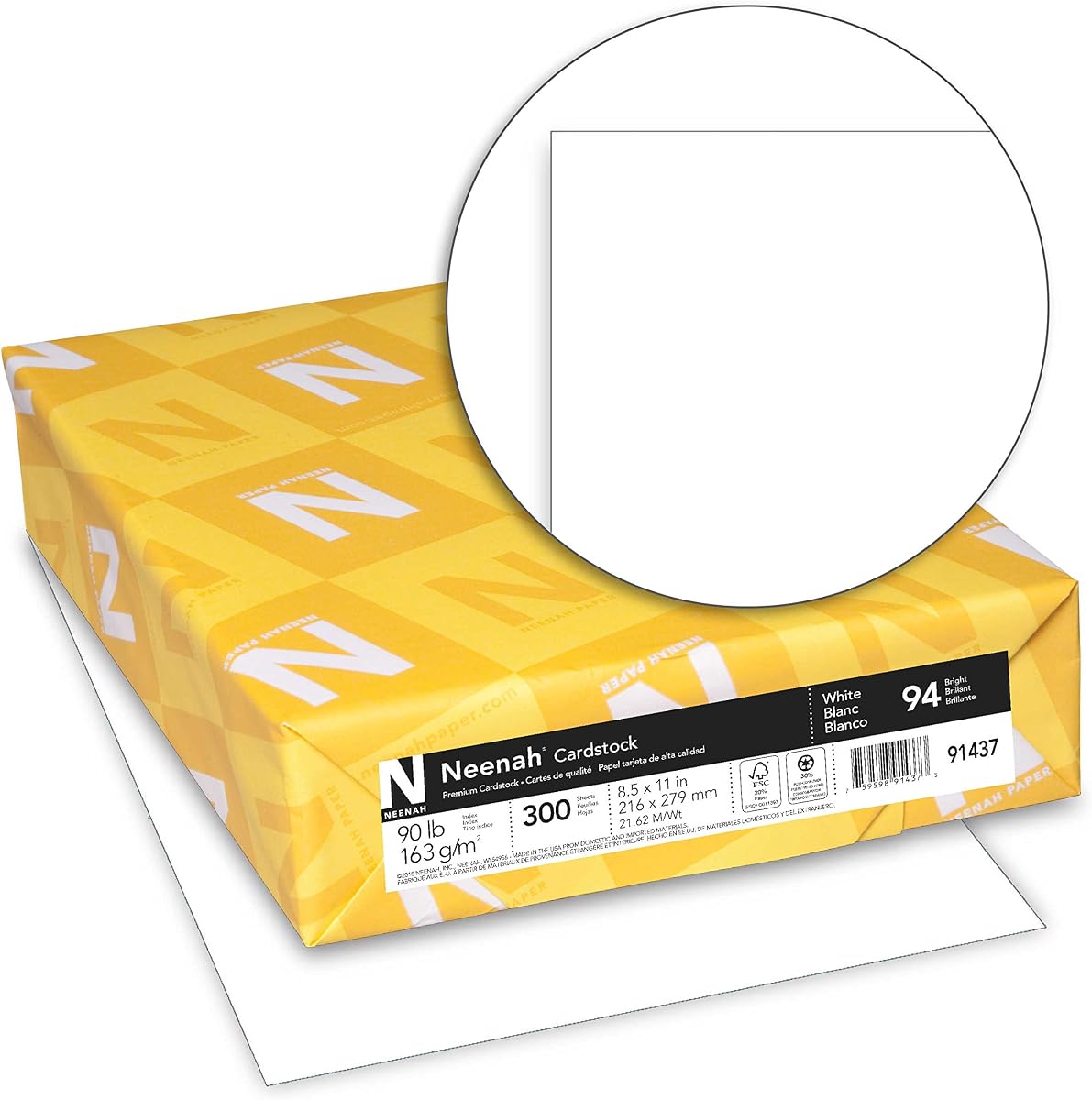
Neenah Index Cardstock provides 300 sheets of 90lb, 163gsm white stock with 94 brightness and a 4.6 rating. It is an attractive option for buyers who want professional texture and high volume without moving to a 110lb index weight or true cover stock.
We may earn a commission when you buy through this link, at no additional cost to you.
The smooth texture is designed to produce high-resolution images and professional-looking documents. Suggested uses include documents, flyers, brochures, calligraphy, hand lettering, and crafts, while stated inkjet and laser compatibility supports everyday printing. Acid-free and lignin-free construction helps preserve finished work, and the ability to mix it with other Neenah and Astrobrights products can simplify coordinated color projects.
The weight classification deserves attention. The listing explains that 90lb index is measured differently from cover stock and compares it as heavier than 67lb Bristol but lighter than 65lb cover stock. As a result, label numbers alone should not be used to infer thickness across brands. Buyers should also verify that their printer can handle the stock consistently.
This option is best for high-volume projects that need substantial white cardstock, including classroom sets, professional document runs, calligraphy bases, and event materials. The 300-sheet count is the largest in the guide and supports a steady supply. For those needing maximum bulk with serious professional presentation, it is especially difficult to overlook.
With 300 sheets, this package offers the deepest supply for offices, schools, event planners, and prolific crafters. It helps keep a single paper specification available across many separate assignments.
The 94-brightness white surface and smooth texture are intended to make images, text, and hand-lettered designs stand out. It is particularly relevant when consistency across hundreds of sheets is important.
We may earn a commission when you buy through this link, at no additional cost to you.
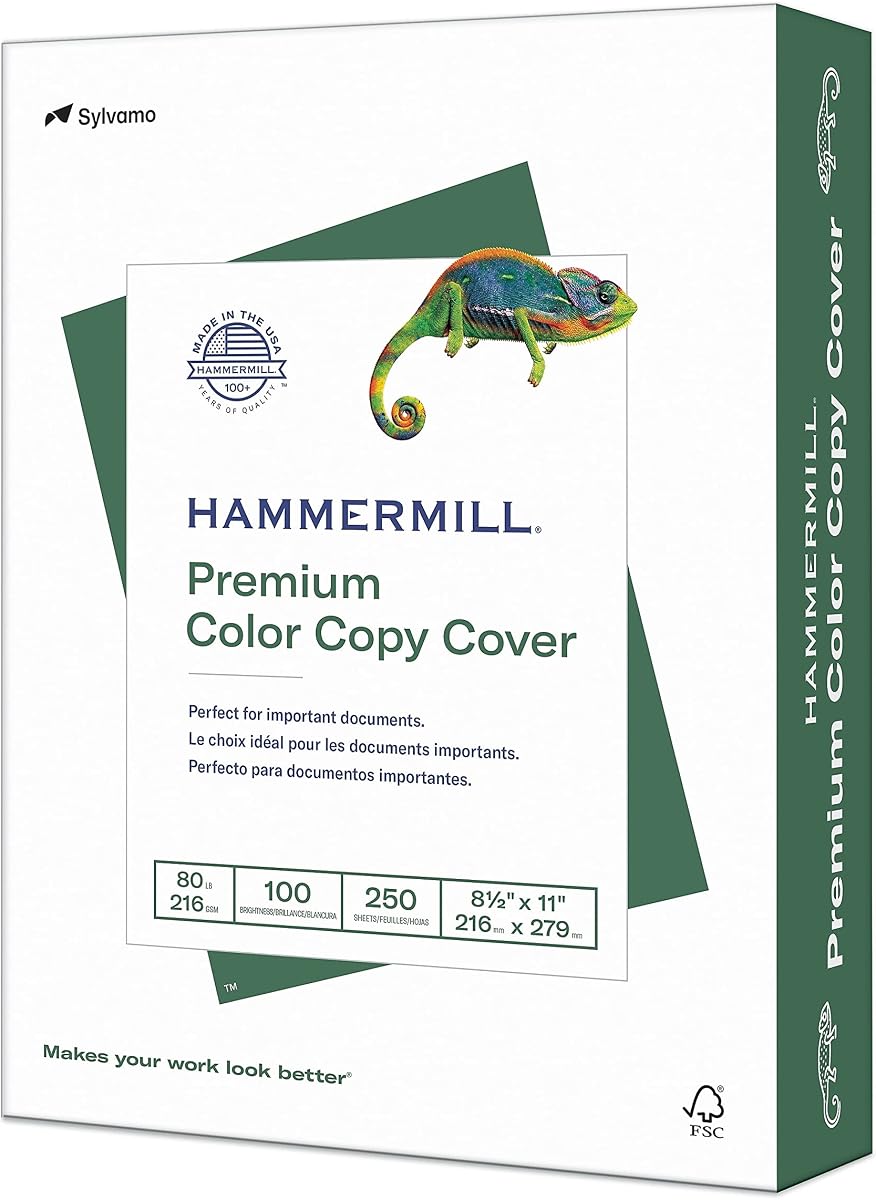
Hammermill Color Cardstock is an 80lb cover-weight option distinguished by 100 brightness, a super smooth surface, and a 4.6 rating. With 250 sheets, it combines professional color capabilities with a substantial supply for offices, design workflows, and print-intensive educational environments.
We may earn a commission when you buy through this link, at no additional cost to you.
The stock is specifically designed for color copiers and color laser printers. Its smooth surface can withstand heavy toner application while supporting photographic reproductions, full-color presentations, direct mail, menus, design proposals, and double-sided documents. The product also carries a 99.99% jam-free guarantee on high-speed digital equipment, providing a strong operational benefit where uninterrupted production matters.
At 80lb cover weight, it is denser than conventional copy paper and may not work smoothly in every home printer. The guarantee applies to specified high-speed digital equipment rather than all consumer machines. Brightness of 100 also produces a notably white appearance, which can be ideal for presentations but may not provide the softer tone some invitation buyers prefer.
Hammermill is an excellent recommendation for organizations with color laser printers or copiers that need large runs of bright, durable output. Its domestic manufacturing, FSC certification, acid-free construction, and jam-free assurance add practical value. For reliable high-speed color work, it is one of the most focused choices in this guide.
The super smooth surface is designed to accept heavy toner while preserving photographic detail and true color. It is a strong match for color laser printers, color copiers, direct mail, and presentation production.
The stated jam-free guarantee and 250-sheet count make this cardstock well suited to high-speed digital workflows. FSC certification and domestic manufacturing also support procurement decisions that include sourcing criteria.
We may earn a commission when you buy through this link, at no additional cost to you.
The most useful cardstock is not simply the thickest or brightest option. Weight, finish, printer support, sheet count, and intended use should be evaluated together to avoid paying for unnecessary stiffness or choosing media that cannot run reliably.
Index and cover labels use different measurement conventions, so the same pound number does not always mean the same thickness across brands or categories. Index stock is commonly used for business cards, reply cards, and documents that require substantial structure, while cover stock is often selected for presentations, packaging concepts, menus, and heavier craft work. A product description may also provide grams per square meter, which offers useful additional context when comparing papers from different manufacturers.
Choose by physical purpose and printer limits, not by the pound number alone. Buyers who want professional rigidity should compare gsm and category together, then review printer specifications before selecting a heavy sheet.
Cardstock requires a sturdier feed path than ordinary copy paper, and not every printer can handle the heaviest choices. Look for explicit compatibility with your specific printer type and verify the manufacturer's supported media weights. Laser printers and copiers often include a manual-feed slot or heavier-media tray, while some compact inkjet models have limited capacity. Selecting the correct media setting is also important because it helps the printer calibrate its feed and ink or toner behavior.
Check compatibility before ordering a large pack. A lightweight, broadly compatible sheet is usually better for a home printer than a premium stock the machine cannot handle consistently.
Lightweight cardstock is useful for classroom handouts, basic cards, and high-volume documents, while medium weights offer a more premium appearance for invitations and presentation inserts. Heavy index or cover stock provides better stiffness for business cards, mailing pieces, layered crafts, menus, photo mats, and pieces that will be repeatedly handled. Greater weight can also make folding and scoring more demanding, so consider the entire production process rather than only the finished appearance.
Use the lightest weight that will give the project the structure it needs. This approach can improve printer performance, reduce material costs, and make hand finishing more manageable.
Brightness ratings indicate how white the paper appears under standardized testing. Values around 92 to 94 provide a bright commercial look, while a rating of 100 creates an especially crisp appearance for photographs, full-color documents, and presentations. Warm cream or ivory cardstock offers a different visual result and may pair better with wedding, seasonal, or vintage-inspired designs. Lighting, monitor settings, and the printing process can all affect how the final color appears.
Choose a bright white stock for high-contrast professional documents and a warm tone when the design benefits from a softer, more traditional character. Review both the rated brightness and actual intended aesthetic.
Smooth finishes generally support fine text, detailed graphics, and sharp photographic images, while semi-smooth or matte surfaces create a softer presentation and can be forgiving for writing and drawing. Matte paper tends to minimize glare under lighting, which may be helpful for presentations. Ink absorption, holdout, and resistance to bleed-through are equally important: quality stock should retain vivid color and defined edges without forcing excessive ink into the fibers.
For inkjet work, prioritize stated ink absorption and bleed resistance. For laser or toner systems, look for a smooth surface engineered to withstand heavy application without compromising image detail.
A smaller package may be enough for a single invitation set, school assignment, or handmade card batch, while 250- or 300-sheet packs suit classrooms, offices, event production, and frequent crafting. Before purchasing, estimate how many pages are required for each finished item and allow for test prints, waste, and cutting failures. Bulk packs also make it easier to keep colors and finishes consistent across a large series.
Choose the count that matches your total workflow. Buying extra is useful for repeat use, but an unnecessarily large pack may be wasted if the printer cannot handle its weight.
Acid-free and lignin-free paper is a valuable feature for certificates, records, photographs, keepsake invitations, and other work expected to age without premature yellowing. FSC or SFI certification provides information about responsible forestry practices, while domestic manufacturing may appeal to buyers who value production location. These characteristics do not guarantee archival longevity for every printed ink or coating, but they indicate attention to material quality and responsible sourcing.
Prioritize acid-free construction for keepsakes and professional records. Add certification details to your decision when institutional sourcing standards or environmental considerations are important.
Cardstock is often folded, scored, die-cut, embossed, stamped, glued, or layered. A strong, smooth sheet can handle these processes more cleanly than a lighter option. If a project uses markers or pens, confirm that the surface supports smooth strokes without excessive feathering. For double-sided printing or crafting, verify that the product is designed to accept ink on both sides and that your printer can maintain registration.
Consider every finishing step before buying. Heavier material is not automatically easier to work with, so choose a stock that matches the techniques and skill level involved in the project.
Store cardstock flat in a dry, temperature-stable location away from direct sunlight, moisture, and strong drafts. A standard letter-size drawer or archival folder can protect the sheets from bending, while an opaque box is useful for projects where light sensitivity or fading matters. Keep different weights and finishes separated to avoid accidental mixing, and avoid leaving opened packs near doors, windows, bathrooms, or other humid areas.
Before a large print run, test one or two sheets using the correct cardstock or heavy-media setting on the printer. Clean the feed rollers if the machine is due for maintenance, and make sure the correct tray is selected. Allow inkjet ink or toner to dry fully before stacking, sorting, trimming, or folding the output, since newly printed heavy sheets can smudge or offset under pressure.
For cutting and scoring, use a sharp craft knife, guillotine, or appropriate die-cutting machine, and always work on a protected surface. Use an old bone folder to crease heavier cardstock cleanly instead of forcing a hard edge through the sheet. Keep printed sheets away from food, excessive fingerprints, and damp materials, and insert finished projects into archival sleeves or folders when they need long-term protection.
A 65lb or 67lb cardstock is generally a safer starting point for many home printers because it is easier to feed than heavier index and cover stocks. An 80lb sheet may work well in a modern inkjet or laser model, but the printer manual should be checked first. Always select the matching cardstock or heavy-media setting when one is available.
It can be, especially with compact inkjet models that support only ordinary print media. Some laser printers and multifunction devices include a manual-feed tray or heavier-paper setting that can handle it. The paper should be loaded only when the manufacturer lists a compatible weight range, and a test sheet should be printed before a large project.
Many modern laser printers and inkjet models support duplex printing with compatible cardstock, but compatibility depends on the printer, driver, and paper weight. Heavy cover stock may be restricted to one-sided output. Check the printer specifications and make a test print to confirm registration, ink coverage, and drying quality before producing a full set.
Index cardstock is generally used for professional documents and mail pieces, while cover cardstock is traditionally associated with presentations, covers, and heavier creative work. Their weight scales are not directly equivalent, so a 90lb index sheet should not be assumed to match an 80lb cover sheet. Compare category, gsm, thickness, and intended use together.
A brightness rating of 100 creates a very bright white background that can support crisp photographic contrast, especially in color laser workflows. Brightness alone does not determine photo quality; smoothness, toner holdout, tonal range, and printer capability also matter. Inkjet printers may benefit from a surface specifically described as compatible with photographic and detailed color output.
Yes, as long as the weight and dimensions fit the printer or desktop workflow. Medium-weight cardstock works well for most invitations and standard business cards, while heavier index stock is useful when mailing pieces need more rigidity. The 110lb Neenah Exact Index option is specifically noted as meeting the USPS minimum for business reply cards.
Bright white is best for crisp professional documents, presentations, and high-contrast color work. Standard white can be a versatile, economical choice for school and office printing, while cream or ivory creates a warmer, more traditional look for weddings, formal invitations, and decorative crafts. Consider the design palette and the brightness rating when deciding.
Store the sheets flat in a dry location, use the printer's recommended cardstock setting, and confirm that the selected media weight is supported. Keeping the feed rollers clean also helps with reliable pickup. Very heavy stock may still curl slightly after printing, but flattening it under weight after the ink has fully dried can restore a flatter result.
The strongest overall choice for professional weight and versatile printing is Veritas White Cardstock, while Astrobrights Bright White offers an accessible, broadly compatible entry point and Neenah Exact Index delivers premium brightness, durability, and substantial bulk. For detailed crafts, Manilaus and Cranium Press provide useful medium-weight options with strong creative handling characteristics.
Prioritize printer compatibility first, then select the lightest cardstock that satisfies the project's structural requirements. Match brightness and color to the design, consider whether high-volume supply is necessary, and check whether the sheet must support folding, embossing, die-cutting, or double-sided printing. Those decisions will usually matter more than a small difference between similar-looking sheets.
Product availability, printer settings, and current prices can change over time, so compare the live listing before purchasing. Review the stated dimensions, weight, finish, and sheet count carefully, and buy a small quantity or make a test page when experimenting with a new printer-paper combination.
