
LISEN 72W Retractable Car Charger USBC Fast Car Charger RV Power Adapters
4.5Editor score
72W combined charging output
30W PD retractable cable
31.5-inch cable extension
Compact three-device design
Our expert guide compares 10 retractable USB C car chargers, evaluating power, ports, retractable cables, compatibility, safety, and vehicle fit before you buy.
A retractable USB C car charger combines a 12-volt socket adapter with cables that extend when needed and disappear into the unit afterward. The result is a tidier cabin, convenient access for passengers, and fewer loose charging cables competing for space around the center console. A worthwhile model also needs dependable power, useful ports, secure fit, and broad device compatibility.
We compared all ten products by examining their stated total output, individual charging connections, cable lengths, adjustable designs, supported protocols, safety protections, and vehicle compatibility. The list covers compact three-device units, four-device models, higher-output six-device chargers, dual-USB-C designs, and a premium option designed to charge larger USB-C devices as well as phones.
Each pick below highlights the charger best suited to a particular need, while also calling out important limitations such as socket restrictions, unsupported data functions, or device-specific compatibility. Customer ratings are included for quick reference, but the final choice should come down to output, connector mix, cable reach, and fit. Prices and promotions can change, so check the current listing before purchasing.
4.5Editor score
4.8Editor score

4.7Editor score
The comparison below highlights the major differences in total power, retractable cable support, open charging ports, device capacity, and vehicle electrical compatibility. It is designed to make the differences between basic three-device chargers and more capable four- or six-device systems easy to see at a glance.


The LISEN 84W 4-in-1 combines two retractable charging cables, two additional charging outputs, and up to 84W of combined power. Its 4.5 rating reflects a generally well-received balance of useful capacity and cable organization. The most distinctive feature is the pair of integrated cables: one USB-C and one Lightning-style cable, each extending as far as 31.5 inches before retracting into the housing.
We may earn a commission when you buy through this link, at no additional cost to you.
Its strongest argument is flexibility across passenger types. A driver can use the 45W PD USB-C connection with a compatible modern phone, while another passenger may use the retractable Lightning cable. Two additional outputs provide room for a third and fourth device, and the stated smart power distribution manages demand across connected devices. That makes the unit more versatile than a simple fixed-port adapter for family commutes and long trips.
The main limitation is its electrical and functional scope. It is designed for 12V cigarette-lighter sockets, so it may not suit vehicles that use a different socket arrangement. It also does not support CarPlay, Bluetooth, or data transfer, and the product information specifically excludes Micro-USB devices. The 45W maximum PD output also requires 24V vehicle power, while a standard 12V installation limits the peak to 36W.
This is a strong recommendation for drivers who want a tidy four-device setup without carrying several separate cables. It suits mixed phone ecosystems better than a dual-USB-C-only model, and its 180-degree adjustment helps it fit around awkward console layouts. Buyers seeking laptop charging, data transfer, or 24V compatibility should consider a more specialized charger instead.
Including both USB-C and a Lightning-style retractable cable reduces the need to carry a separate lead for each common phone ecosystem. The open outputs further expand compatibility with tablets and USB-A accessories.
Extending only as much cable as needed helps keep the center console free of loose cords. Once the trip ends, the integrated leads retract into the body and leave the surrounding storage areas easier to use.
We may earn a commission when you buy through this link, at no additional cost to you.
The LISEN 84W Dual USB-C is designed for vehicles whose occupants primarily use USB-C devices. It has a 4.5 rating, two 31.5-inch retractable USB-C cables, a 36W PD USB-C port, and a USB-A port, with total output stated at up to 84W. The two built-in leads make it easy for the driver and a passenger to connect phones without searching through a storage compartment.
We may earn a commission when you buy through this link, at no additional cost to you.
This charger stands out for the balance between dedicated high-power charging and shared open ports. The 36W PD connection is intended for compatible modern smartphones, while the integrated cables serve two additional USB-C devices. Together with the USB-A port, the unit can handle up to four devices. The product information also lists compatibility with recent iPhone families, Samsung devices, tablets, and other USB-C equipment.
Its limitations are straightforward. Unlike several competing models, it has no built-in Lightning cable, so an older iPhone user would need an appropriate adapter and cable. The stated product details focus on charging rather than CarPlay or data transfer. It also lacks some of the more explicit voltage-display and broad protocol information supplied by other products in the list.
This is a compelling pick for couples or families with modern USB-C phones who value clean storage and front-seat access. It is particularly useful when both occupants need a cable at the same time and want to avoid carrying separate charging leads. Buyers still using predominantly Lightning devices should favor a mixed-cable alternative.
Separate retractable USB-C leads reduce the need to share one cable between occupants. Each user can pull out a comfortable length, connect a phone, and let the lead retract when it is no longer needed.
The PD USB-C and USB-A ports provide permanent charging locations for devices that are not using the integrated cables. This creates a more adaptable setup for trips involving several different accessories.
We may earn a commission when you buy through this link, at no additional cost to you.
The LISEN 138W 6-Port is the most capable option in this group by total stated output and device count. It carries a 4.8 rating and provides two 31.5-inch retractable USB-C cables, three open USB-C ports, and one USB-A port. Together, those connections can charge six devices simultaneously, making the charger a strong fit for large families, commercial vehicles, and passengers carrying several gadgets.
We may earn a commission when you buy through this link, at no additional cost to you.
The 138W headline figure is supported by a mix of 45W and 36W retractable cable outputs, three 15W USB-C ports, and a 12W USB-A port. That hierarchy is important because the highest wattage is concentrated in the built-in USB-C cables, while the additional ports are intended for lower-power phones, earbuds, accessories, and secondary devices. Smart allocation should help balance performance when several devices are connected.
This is not necessarily the simplest choice for a driver with only one or two devices. The many outputs can encourage charging more hardware than necessary, and total output is shared among connected devices. The stated dimensions are compact at 1.93 by 1.26 by 2.96 inches, and the 180-degree body helps it fit around different socket positions. Built-in protection covers overcurrent, overvoltage, overheating, and short circuits.
Our top overall pick is best for people who regularly travel with multiple people and devices. It avoids relying on a separate charger for every passenger and puts every connection in one place. For solo drivers or short commutes, one of the smaller three-device models would be more streamlined, but nobody in this list offers the same six-device flexibility.
The 45W and 36W retractable leads are the centerpiece of the design. They provide strong dedicated charging for compatible USB-C phones while reaching the front or rear seating areas when a passenger needs access.
Three open USB-C ports and one USB-A port allow the same adapter to serve tablets, earbuds, accessories, and additional phones. It is a practical way to reduce the number of separate adapters carried on family trips.
We may earn a commission when you buy through this link, at no additional cost to you.
The SUPERONE 69W 4-in-1 is a four-device charger with two retractable cables, an open USB-C port, and a USB-A port. Its 4.6 rating places it among the stronger-rated products here. It supports 12V and 24V DC vehicle systems, making it unusually versatile for cars, larger trucks, and other compatible vehicles with the appropriate socket.
We may earn a commission when you buy through this link, at no additional cost to you.
Maximum total output is stated at 69W, with up to 30W available from the Type-C port and up to 18W from USB-A. The two integrated cables are 80 centimeters, or roughly 31.5 inches, long. Although that is shorter than the 31.5-inch language used by several competitors, the physical reach is comparable, and the shorter wording should not be mistaken for a 31.5-foot cable.
Its most notable differentiator is protocol support. The product information lists PD, QC3.0, AFC, MTK, and FCP, covering a broad range of modern phones and other devices. A voltage display can show the vehicle battery condition, and the lower plug uses a clasp-and-anti-slip approach to remain secure on uneven roads. It does not support CarPlay through USB.
This model is well suited to mixed Android fleets, families with different brands, and vehicles operating on either 12V or 24V. It may be less useful for passengers sitting far behind the front row because the integrated cables are shorter than the physical cable length might initially suggest. It also includes no Apple cable, so iPhone users should confirm whether the built-in connector type meets their needs.
Support for both 12V and 24V DC systems broadens the potential applications beyond a standard passenger car. Drivers should still verify that their vehicle has a compatible cigarette-lighter socket.
PD, QC3.0, AFC, MTK, and FCP support make the adapter more adaptable to phones from different manufacturers. This is helpful when passengers do not all use the same device brand.
We may earn a commission when you buy through this link, at no additional cost to you.
The LISEN Carbon-Black 84W combines a restrained exterior with a mixed USB-C and Lightning-style cable system. It has a 4.5 rating and charges up to four devices through two retractable leads and two additional outputs. The carbon-black finish is designed to blend into a modern vehicle interior while retaining the practical functions expected from a high-output cigarette-lighter adapter.
We may earn a commission when you buy through this link, at no additional cost to you.
The charging specification includes a 45W PD USB-C port, a 12W USB-A port, and two additional outputs, with 84W stated in aggregate. Smart power distribution is intended to optimize available wattage when several devices are connected. The retractable leads extend to 31.5 inches and use a pull-past-the-desired-length-and-release mechanism for automatic retraction.
This model is limited to 12V cigarette-lighter sockets and does not provide CarPlay, Bluetooth, or data transfer. It also excludes Micro-USB devices. The adjustable 180-degree body and shockproof construction are designed to keep the charger stable, but a 12V requirement rules it out for vehicles without a compatible accessory socket.
The LISEN Carbon-Black is a good match for drivers who use a current USB-C phone but travel with a family member who still relies on Lightning. Its understated styling, automatic cable management, and four-device capacity make it more versatile than a basic dual-port charger. If your car runs on 24V or you need data connectivity, choose a more specialized model.
The carbon-black housing is intended to avoid the visual clutter often created by bright or bulky accessories. Integrated cables and smart retraction preserve that tidy appearance during normal use.
A high-output PD connection serves demanding USB-C devices, while the lower-output USB-A and additional connections handle secondary electronics. This makes simultaneous charging easier when device requirements differ.
We may earn a commission when you buy through this link, at no additional cost to you.
The DreamBee 108W 6-in-1 stands out because it combines three retractable cables with two additional ports, allowing up to six devices to charge at once. It carries a 4.6 rating. Two of the integrated cables are USB-C, with stated maximum PD output of 30W, while the third is a Lightning-style iOS cable. Additional USB-C and USB-A ports provide permanent connection points.
We may earn a commission when you buy through this link, at no additional cost to you.
Its 108W total output is distributed across a 30W PD USB-C retractable cable, another 30W PD USB-C retractable cable, the iOS retractable cable, a USB-C port, and a USB-A port. The iOS cable is rated at 5V/2.4A, the additional USB-C port at 5V/3A, and USB-A at 5V/2.4A. This structure makes it easy to serve high-power USB-C devices while reserving lower-output connections for accessories.
A voltage display provides information about the vehicle battery and connected phone, and the housing combines aluminum alloy with ABS. A 15A fuse and smart chip are included for protection against overcharging, overheating, and short circuits. The charger supports 12V and 24V systems and common protocols including PD, QC3.0, AFC, MTK, and FCP. It cannot be used for CarPlay.
This is a good choice for mixed-device families that want more than two people to charge simultaneously. The main limitation is that the iOS retractable cable offers substantially less output than the two USB-C leads. Buyers whose devices are exclusively USB-C can also achieve similar multi-device flexibility with another six-port model.
Most retractable chargers include one or two built-in leads. Adding a third gives the DreamBee more immediate options for different passengers and device ecosystems without requiring them to unpack separate cables.
The digital voltage display gives the driver a quick way to check the vehicle's electrical condition. A fuse, smart chip, and thermal protections add safeguards for multi-device use.
We may earn a commission when you buy through this link, at no additional cost to you.
The Lamicall 87W is a four-device USB-C charger with two retractable cables, two additional USB-C ports, and a 4.5 rating. Its most distinctive qualities are the anodized aluminum housing, digital voltage display, and stated ability to deliver 36W from the built-in fast-charging cable on 12V passenger-car systems or up to 45W on 24V trucks and buses.
We may earn a commission when you buy through this link, at no additional cost to you.
Both integrated leads extend to 31.5 inches, allowing access from the front cupholders or rear seating area. The charger supports PD 3.0, PPS, QC 3.0, FCP, SCP, and AFC, and it is listed for recent iPhone models, Samsung Galaxy devices, Google Pixel phones, iPads, and other USB-C products. Four devices can charge at the same time, making it a solid choice for a family traveling with several modern devices.
The product specifically says it does not support iPhone models before the 15, and it has no built-in Lightning cable. That narrows its appeal for mixed older-phone households. Its premium-looking metal construction also adds weight compared with basic plastic adapters, though the locking base and temperature-control chip are designed to improve stability and operating safety.
This Lamicall model is recommended for drivers who value a substantial housing, a readable voltage display, and fast USB-C charging across several modern devices. It is particularly relevant to 24V truck operators who can use the higher cable output. A buyer with older iPhones or a need for a Lightning lead should choose a mixed-cable design instead.
The anodized aluminum body resists scratches and dissipates heat, while the locking base is intended to remain secure over rough roads. Those qualities suit frequent drivers, delivery operators, and truckers.
The digital display allows a driver to check the vehicle battery voltage before a trip. That information can be useful for older vehicles or anyone who wants a quick electrical status check.
We may earn a commission when you buy through this link, at no additional cost to you.
The SUPERONE 105W 6-in-1 combines six charging connections with a notably compact body. It has a 4.6 rating and includes one 36W PD USB-C retractable cable, one 12W USB-C retractable cable, three 15W USB-C ports, and one 12W USB-A port. The product information states that the compact construction is 60 percent smaller than a bulky retractable charger.
We may earn a commission when you buy through this link, at no additional cost to you.
That compactness is one of the model's strongest selling points. The body is designed to fit around gear selectors, central controls, and narrow cigarette-lighter areas without taking up as much room. Two retractable leads extend as far as 31.5 inches, and the 180-degree body uses a buckle and anti-slip connection design to remain secure over bumpy roads.
Total output is listed at 105W, with the 36W PD lead receiving the strongest individual allocation. A smart distribution system is intended to preserve charging speed as devices are added, although six connected devices will inevitably divide the available power. The stated safety protections cover overcurrent, overvoltage, overheating, overcharging, and short circuits, with UL, CE, FCC, and RoHS certifications.
This model is a strong fit for modern families who need many USB-C connections but have limited console space. It offers a better balance of compactness and capacity than many larger six-port adapters. It is less compelling for older Lightning-based devices, and buyers needing higher sustained laptop power should look at a charger with a larger dedicated output.
Six charging positions do not require a large rectangular body. The compact form is particularly helpful in vehicles where the socket sits close to a shifter, parking brake, or center-control panel.
The combination of an adjustable body and reinforced plug connection is intended to prevent intermittent contact. That is particularly useful on uneven routes, in pickups, and during long-distance travel.
We may earn a commission when you buy through this link, at no additional cost to you.
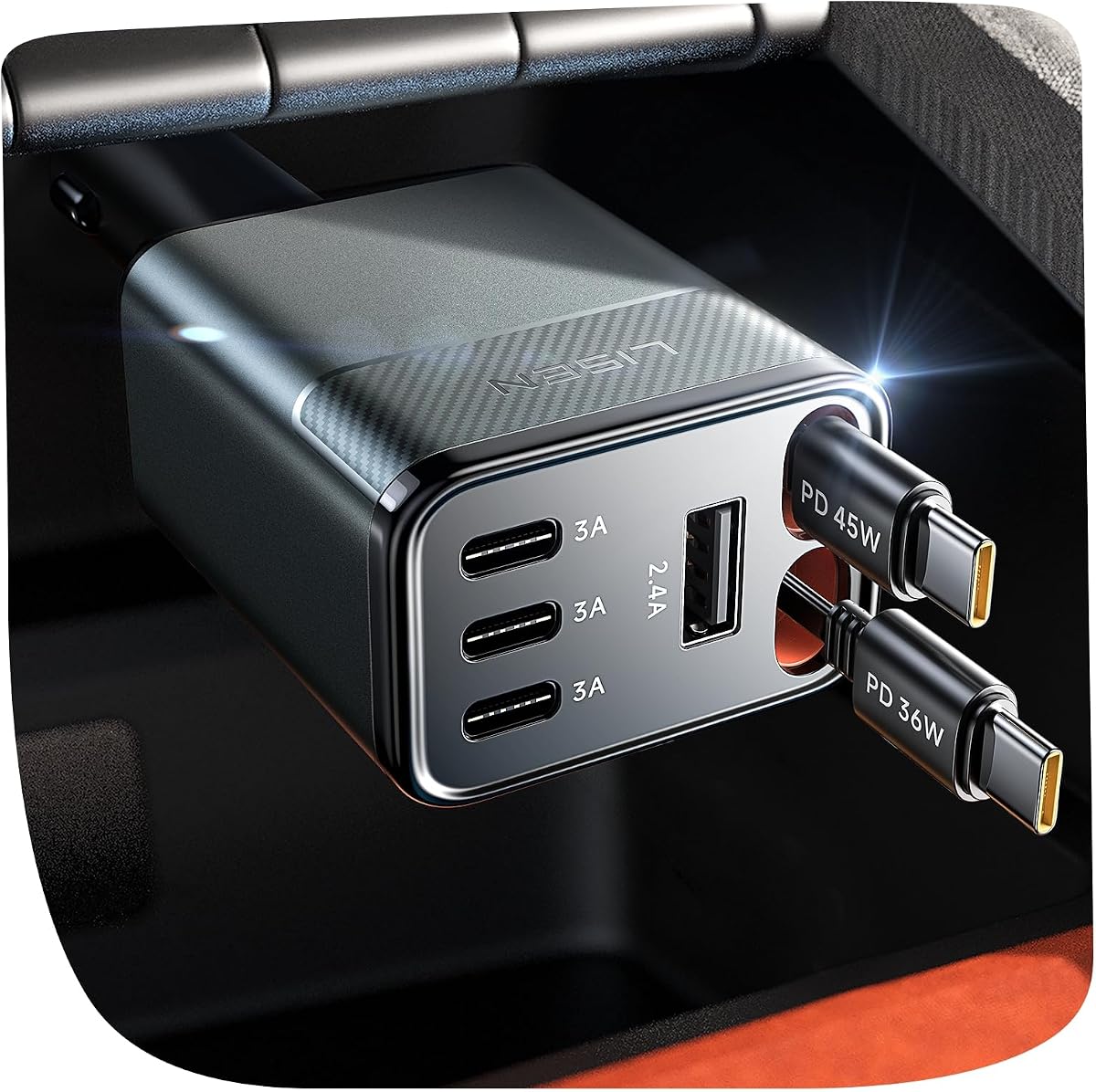
The LISEN 72W Mini focuses on the essentials: one fast retractable USB-C cable and two open ports. Its 4.5 rating reflects a well-liked, straightforward design for charging up to three devices. Compared with the first generation of its retractable charger, the updated housing is stated to be 60 percent smaller, helping it avoid interference with a gear lever or nearby controls.
We may earn a commission when you buy through this link, at no additional cost to you.
The built-in USB-C cable provides up to 30W PD output and extends as far as 31.5 inches. A 15W USB-C port and a 12W USB-A port cover two additional devices. The product information says the cable can charge iPhone 15, 16, and 17 families, Samsung devices, iPads, and other Android products, while the open ports can serve AirPods and similar accessories.
The 72W headline output provides enough capacity for a fast phone connection plus lower-power secondary devices, but it is not intended to be a full six-device charging station. It also cannot charge iPhone models below 15 through the built-in USB-C cable. The automatic retraction process involves pulling the cable about one centimeter past the desired length before releasing it.
This is our best budget pick for a driver who wants retractable-cable convenience without paying for numerous unused outputs. It is particularly effective in vehicles where console space is tight or where only two or three people need power. Travelers with several devices should look to a four- or six-port model for more connection options.
One retractable lead and two fixed ports cover the most common travel arrangement: a driver's phone, a passenger's phone, and one accessory. The result is organized without adding unnecessary bulk.
The reduced-size enclosure is designed to clear the gear lever and other nearby controls. Its 30W cable output still provides a meaningful fast-charging option for compatible modern phones.
We may earn a commission when you buy through this link, at no additional cost to you.
The Belkin 75W is a premium retractable car charger designed around a single high-output USB-C cable and an auxiliary USB-A port. It carries a 4.7 rating. The 30-inch cable retracts into the housing, while the cable itself can deliver up to 60W, making the charger suitable for compatible laptops and tablets as well as smartphones.
We may earn a commission when you buy through this link, at no additional cost to you.
Maximum combined output is 75W, and up to three devices can charge simultaneously. The product information cites fast charging for an iPhone 16 Pro from 0 to 50 percent in 27 minutes and a Galaxy S25 in 31 minutes. It also lists Chromebook, MacBook Air, iPad Air, Pixel 10, smartwatches, earbuds, and power banks among compatible or supported device categories.
The design is intentionally less elaborate than the six-port models. It has only one retractable cable, so multiple front-seat passengers would need their own USB-C leads. Its selling point is instead concentrated power and broad PD-device support. SmartProtect provides overvoltage protection, while the stated two-year coverage adds reassurance for buyers who want a longer support commitment.
This is our best premium pick for someone who wants one dependable cable that can handle demanding USB-C devices without carrying a separate charger. It is also a natural choice for a vehicle used by one or two people who value established brand support and a compact profile. Families needing a connector for every passenger should consider a multi-cable alternative.
A 60W retractable USB-C connection can serve compatible laptops and tablets, not only phones. That higher output distinguishes the Belkin from chargers whose retractable leads are limited to typical phone wattages.
The built-in 30-inch cable removes the need for a separate charging lead while keeping the unit compact. Belkin's established charging brand, safety testing, and two-year coverage add confidence for frequent users.
We may earn a commission when you buy through this link, at no additional cost to you.
The right retractable USB C car charger depends on how many people need power, which devices they carry, the vehicle's electrical system, and whether you value high output, compact construction, or a specific mix of connectors. Use the following factors to narrow the field before choosing a model.
Total wattage tells you how much combined power the charger can offer, but individual output matters just as much. A 138W six-port model may be excellent for several phones and tablets, while a 75W charger with a 60W cable can be more effective for a laptop. Check the stated maximum for the specific port or built-in cable you intend to use, and consider whether the unit has intelligent power distribution when several devices are connected.
Prioritize the connection you will actually use. A high-output USB-C lead is valuable for fast phone charging and compatible tablets, while open ports are often used by lower-power earbuds, watches, and secondary phones.
Count the people who need to charge during a typical trip. A three-device model is sufficient for a solo driver or couple, while four-device and six-device versions suit larger families and work crews. Built-in cables are especially valuable for rear passengers because they can reach from the front socket into the seating area. Models with two retractable cables should be prioritized when the driver and passenger both want immediate access without unpacking a bag.
Match the cable count to passenger count rather than buying the largest option available. Extra ports are useful only if the devices are present, and a simpler setup can be easier to operate.
Modern USB-C is central to the category, but compatibility still varies. Some models include a retractable Lightning cable for older iPhones, while others use two USB-C leads and omit Lightning entirely. Open USB-C and USB-A ports add flexibility for accessories and devices that do not use the integrated cables. Check the current device requirements before buying, especially if the household includes older iPhones, Micro-USB equipment, or a mix of connector standards.
For a mixed-ecosystem family, one integrated USB-C and one integrated Lightning cable may be more useful than two USB-C cables. For an all-USB-C group, prioritize the number of USB-C ports and their maximum output.
Most of these products use a 12-volt cigarette-lighter style socket, but several also support 24V DC systems found in larger trucks, buses, and RVs. Confirm both the physical socket design and the electrical voltage before purchasing. An adapter that fits physically may still be unsuitable if its input voltage does not match the vehicle, so review the product specifications and the vehicle owner's manual.
A charger rated for both 12V and 24V offers greater vehicle flexibility. If you only drive a conventional passenger car, a 12V model may still be the more focused choice.
Retractable cables are most useful when they extend far enough to reach the intended connection point and retract cleanly afterward. Most models in this round reach approximately 31.5 inches, while the Belkin uses a 30-inch cable. Look for a smooth one-handed mechanism and clear instructions, because a cable that stops unexpectedly or retracts poorly can be more frustrating than a conventional loose lead.
For rear-seat charging, measure the distance from the socket to the passenger's usual device position. A long cable should still retract without leaving loops across the console, cupholders, or shifter.
Look for protection against overcurrent, overvoltage, overheating, overcharging, and short circuits. Some models also include a replaceable or integrated fuse, smart power-management chips, temperature controls, and recognized UL, CE, FCC, or RoHS certifications. Build materials and plug design are worth considering on rough roads: an adjustable body, locking base, or anti-slip clasp can help maintain a stable connection.
Safety claims should be considered alongside a stable connection. A charger that disconnects on bumps may interrupt charging, while one with proper thermal and electrical protections is better suited to prolonged multi-device use.
A multi-port charger can still be frustrating if its body blocks the gear selector, parking brake, cupholders, or a control panel. Compact designs are helpful in older vehicles and crowded consoles, and a 180-degree adjustable body gives the driver more freedom to aim the cables. The adapter's locking grip should also be considered on rough roads, where a loose connection can interrupt fast charging.
Check the stated dimensions and compare them with the space around your socket. More ports are not automatically better if the unit creates a driving or storage obstruction.
A digital voltage display can help drivers monitor the vehicle battery, while some models use the same display to provide charging information. These features are not necessary for basic charging, but they can be valuable for older cars, frequent long-distance drivers, and people who want quick electrical-status information. Consider them useful supplements rather than substitutes for proper charging output, protocol support, and safety protection.
Choose a display only if you will use it. Otherwise, prioritize charging speed, connector compatibility, cable reach, and a secure fit.
Begin by checking your vehicle's socket voltage and confirming that the charger is compatible with the connector arrangement. Start the vehicle or otherwise ensure the accessory socket is receiving power, insert the charger firmly, and then connect your devices. The adjustable body can be rotated to improve cable access or clearance around the center console.
Pull each built-in cable straight out to the length you need. On models that use a positive locking mechanism, extend the cable about one centimeter beyond the intended stopping point and then release it to engage retraction. Do not pull a cable sideways, force it beyond its rated reach, or attempt to repair a lead that has become damaged. When finished, allow the cable to retract fully so it does not obstruct controls or storage areas.
Keep the charger protected from liquids, excessive heat, and physical impact. Clean the socket and housing with a dry or lightly damp cloth, and do not push moisture into the connections. Check the fit periodically on rough roads, monitor for abnormal heat or unstable connections, and stop using the charger if the plug, cable, or housing appears damaged. If the unit includes a voltage display, use it as a quick check of the vehicle's electrical condition.
It depends on the charger and the laptop's charging requirements. The Belkin 75W model provides up to 60W through its retractable USB-C cable, making it the most clearly laptop-oriented option here. Most other models concentrate their strongest output on phones and tablets, so their open ports may not deliver enough power for a demanding notebook.
The products in this guide are designed primarily for charging, and several explicitly state that they do not support CarPlay through USB. They should not be assumed to provide a complete CarPlay connection even when a device could technically charge through one of the ports. Check the vehicle and adapter documentation if CarPlay is an essential function.
The voltage rating tells you whether the charger can operate with your vehicle's accessory socket. Many passenger cars use 12V DC, while larger trucks, buses, and RVs may use 24V DC systems. Some chargers support both, whereas others are restricted to 12V, so compatibility should be verified before installation.
The range in this guide runs from three to six devices, depending on the model. Device count depends on the number of built-in cables and open ports, while actual charging speed also depends on each device's supported protocol and on how the available power is shared among connected hardware.
It depends on the built-in connector. Some models include a retractable Lightning cable, while the dual-USB-C designs require a suitable USB-C-to-Lightning or USB-C-to-USB-C cable for that device. The LISEN 72W Mini and Lamicall model specifically do not support iPhone models below the 15 through their built-in USB-C connections.
Most models in this round extend approximately 31.5 inches, which can reach from the front socket toward a rear cupholder or passenger area. Actual reach depends on the socket position and cabin layout, so measuring the distance in your own vehicle is advisable. The Belkin uses a 30-inch cable, while the SUPERONE 69W model uses 80-centimeter leads.
Many of the listed models use a positive-locking design in which the cable must be pulled slightly beyond the desired length before it is released. For the LISEN models, that instruction is to extend about one centimeter farther and then release. The exact mechanism can vary, so the product instructions should take priority.
Most of the chargers in this comparison are described as charging adapters and do not advertise data transfer. Some explicitly state that they cannot support data functions, and even where a USB-C port is present, that does not guarantee that a cable, device, and charger will negotiate data communication. Choose a product that explicitly confirms the required function if data transfer is important.
The LISEN 138W 6-Port is the strongest all-around choice for maximum capacity, offering two retractable USB-C cables and enough additional ports for six devices. The LISEN 72W Mini delivers the most focused value for drivers who need only three charging positions, while the Belkin 75W stands apart with a powerful 60W retractable cable, broader large-device potential, and longer product coverage.
Prioritize the needs that occur on every trip. Choose a mixed USB-C and Lightning model for a household with different connector standards, a dual-USB-C model for an all-USB-C group, and a high-output six-port unit for frequent family or team travel. Confirm vehicle voltage, socket type, required charging protocols, and rear-seat cable reach before making a final choice.
Current pricing, promotions, availability, and product details can change, so review the latest Amazon listing before ordering. In particular, check the device compatibility notes and the distinction between charging and data or CarPlay support. With those details confirmed, a retractable USB C car charger can keep the cabin organized while providing dependable power for daily drives and longer journeys.