
JBL Marine Multi-Element Subwoofer
5.0Editor score
IPx5 marine-rated construction
Sealed UV-resistant grille
200-watt RMS power handling
Marine subwoofers are built for an environment that is tougher on audio equipment than nearly any other. Salt, spray, ultraviolet exposure, temperature changes, vibration, and limited installation space can quickly undermine a conventional subwoofer, making weather resistance, durable components, and a practical enclosure design essential selection priorities.
This guide compares ten marine-capable subwoofers ranging from bare drivers to loaded and sealed enclosures. The analysis focuses on verified specifications, construction details, impedance options, power handling, frequency response, mounting requirements, and special features such as lighting or passive-radiator bass extension, while clearly separating marine-focused products from versatile models.
Each review explains where the product stands out, what trade-offs buyers should consider, and which installations it best suits. The recommendations reflect the supplied ratings and specifications, not personal testing, and availability can change as production cycles and outdoor-audio demand evolve.
5.0Editor score
5.0Editor score

4.4Editor score
As an Amazon Associate we earn from qualifying purchases.
The table below compares all ten options by driver size, load, power, enclosure format, and marine-oriented construction. It also highlights where each design falls between a bare woofer, a sealed loaded enclosure, and a portable passive-radiator system.
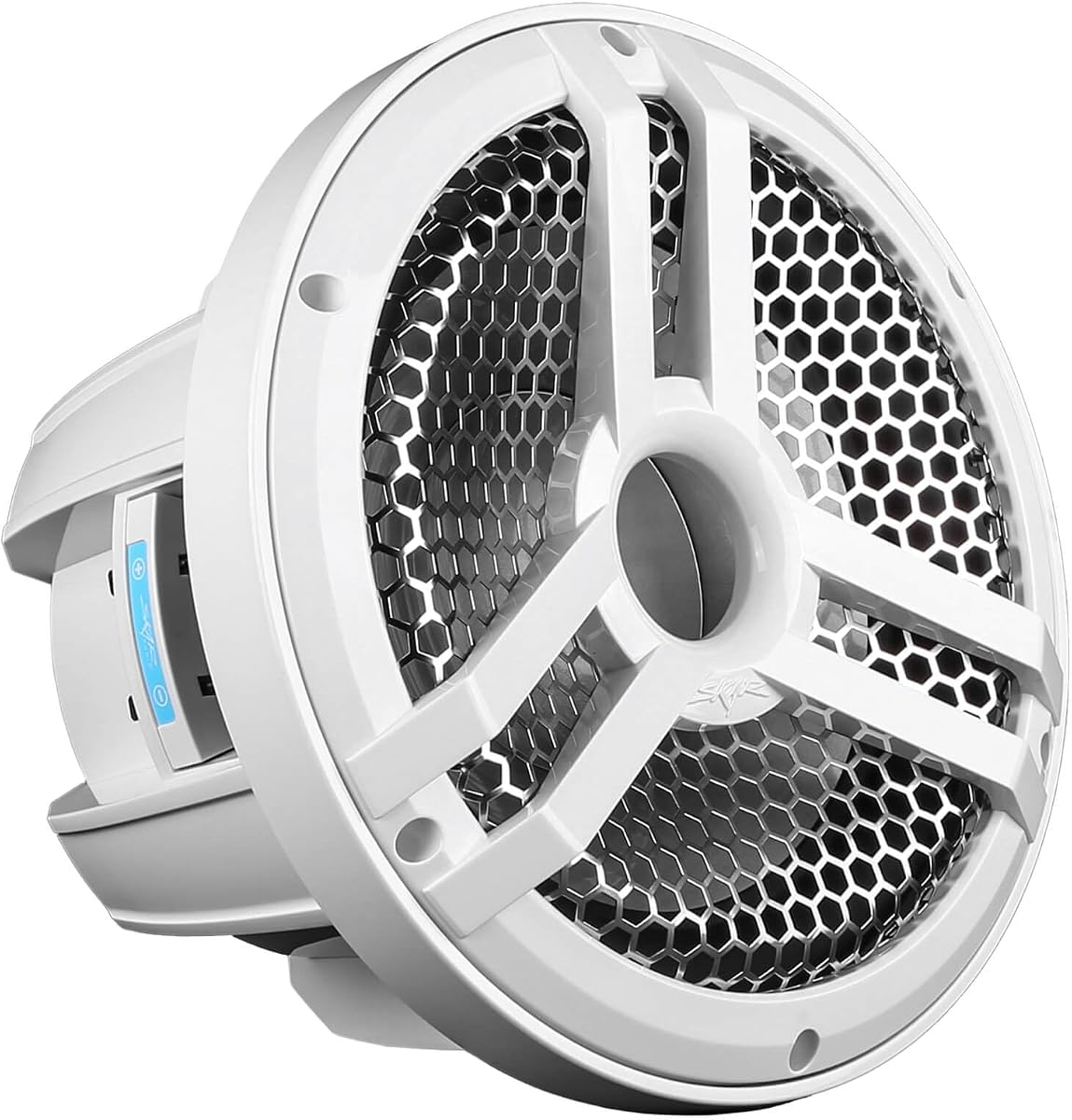


The Skar Audio SKM10WD2 combines a 10-inch format with substantial power ratings, a dual 2-ohm voice-coil configuration, and a clean white finish. Its 4.8 rating reflects strong buyer reception, while the headline capability of 1,000 watts peak and 500 watts RMS makes it a serious candidate for larger marine audio systems that need more output than a compact driver can provide.
We may earn a commission when you buy through this link, at no additional cost to you.
The driver is specified with a 2.4-inch dual 2-ohm high-temperature copper voice coil, a high-flux ferrite motor, and a high-roll rubber surround. Its listed frequency response extends from 34 Hz to 700 Hz, allowing it to cover deep bass while remaining useful for a wider range of low-frequency musical content. The 85.1 dB sensitivity figure also gives installers a useful reference when matching it to an amplifier.
Because this is a bare subwoofer, buyers must provide an appropriate enclosure and amplification rather than expecting a plug-and-play installation. Dual 2-ohm coils provide useful wiring options, although the final load must be matched correctly to the amplifier. The white face also makes this a more visually coordinated option for many boat interiors, but it does not offer integrated illumination or a prebuilt enclosure.
This is a strong recommendation for boaters who want substantial low-frequency output and plan to design their own enclosure. It is especially appealing to installers comfortable selecting enclosure volume, calculating wiring, and matching the dual coils to their amplifier. For buyers seeking a simpler finished system, one of the loaded enclosures or marine tubes may be easier to integrate.
The 34 Hz lower frequency limit and 500-watt RMS rating give the SKM10WD2 a strong foundation for deep, controlled bass. Dual 2-ohm voice coils allow several valid wiring arrangements, giving installers room to match the driver to different amplifier configurations.
Its white finish helps the driver blend into a lighter boat interior, while the rubber surround and high-temperature copper voice coil are designed for demanding operation. A grille and correctly sized enclosure remain important parts of the finished system.
We may earn a commission when you buy through this link, at no additional cost to you.
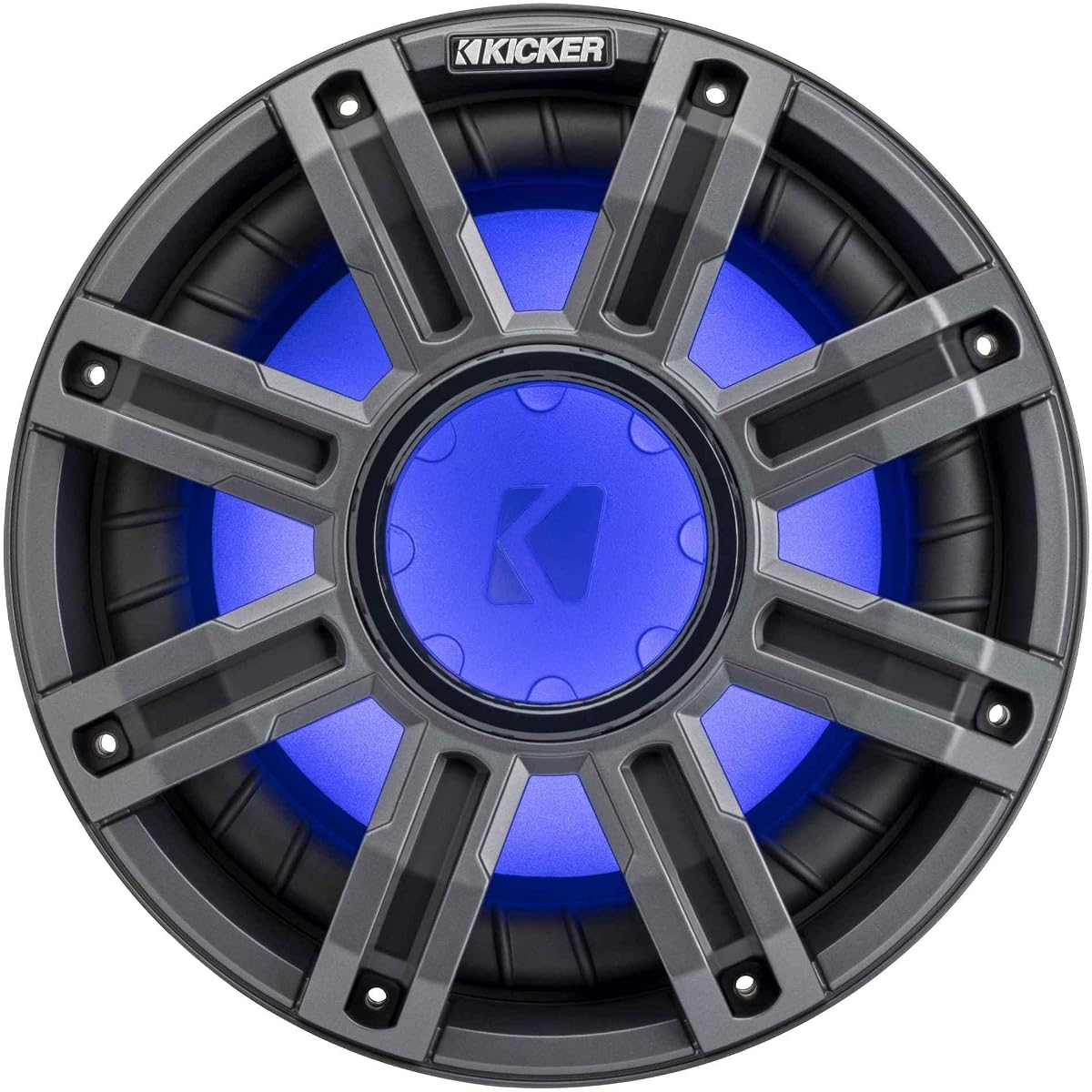
The KICKER 51MWF104 stands out for combining a 10-inch marine subwoofer with integrated RGBW LED lighting and a 5.0 rating. Designed with free-air applications in mind, it brings together a polypropylene cone, co-molded TPE surround, marine-compliant terminals, and enhanced weatherproofing for boats and other outdoor environments.
We may earn a commission when you buy through this link, at no additional cost to you.
Its construction details are unusually comprehensive. Ribbed silicone gasketing, a polycarbonate bridge, a sealed design, and a charcoal grille all contribute to vibration resistance and protection in rough conditions. The product information states that the driver meets or exceeds applicable ASTM standards for UV and salt or fog exposure, while the integrated lighting can be customized when paired with a compatible LED controller such as the Kicker KMLC.
The main trade-off is that the lighting controller and optional white grille are separate accessories, and the product is not presented as a conventional sealed-box driver. Its intended free-air use may require a suitable mounting plan and enough clearance around the enclosure. Buyers should also understand that the appealing lighting feature is a presentation choice rather than an improvement to the underlying bass response.
Choose the 51MWF104 when appearance, marine construction, and customizable illumination are priorities. It is a particularly compelling option for boat owners creating a coordinated nighttime lighting setup. If a basic sealed or ported enclosure is required, a matched driver without the lighting package may offer a more conventional path.
Marine-compliant terminals, splash-and-spray resistance, ribbed silicone seals, and a polycarbonate bridge address the environmental stresses encountered on the water. The stated UV and salt or fog standards also make this a more purposeful marine choice than a generic indoor woofer.
Integrated RGBW LEDs add a visual dimension that conventional subwoofers do not offer. A compatible controller expands the available color options, while the included charcoal grille keeps the standard appearance understated.
We may earn a commission when you buy through this link, at no additional cost to you.
The KICKER 46CWTB84 TB8 is an eight-inch loaded weatherproof enclosure with a 4.5 rating and a stated 300-watt rating. It packages an active CompR woofer with a passive radiator in thick ABS construction, offering a convenient alternative to building a custom enclosure around a standalone subwoofer.
We may earn a commission when you buy through this link, at no additional cost to you.
The passive radiator uses the same surround and cone materials as the active driver and is mounted on the opposite side of the enclosure. This arrangement is intended to produce deeper, louder bass without requiring a conventional rear-facing port. An innovative bracket allows the enclosure to be mounted horizontally or vertically, which is valuable when usable space around a transom, storage area, or deck seat is limited.
As the smaller TB model, it is inherently more modest in output than the ten-inch TB10 versions, and its 8.5 dB sensitivity advantage would also need to be accounted for in amplifier matching. Consequently, a larger enclosure or the ten-inch version may be more appropriate for maximum low-frequency impact. For travel-first systems, however, the TB8 is a manageable option with a ready-made structure and a straightforward installation path.
The TB8 is best for buyers who want bass without constructing a box and need flexible orientation. It is suitable for a boat, UTV, or Jeep where all-weather use and passive-radiator performance matter. Those seeking greater output and deeper extension should compare it closely with the larger TB10 models.
Loading the driver into a purpose-built enclosure removes the need to calculate volume, select construction material, and fabricate a mounting surface. The result is a more approachable installation for boaters assembling a first marine system.
The included bracket can support horizontal or vertical placement, helping the enclosure fit under a seat, beside a console, or within another available area. Planning clearance around both the active driver and passive radiator remains essential.
We may earn a commission when you buy through this link, at no additional cost to you.
The KICKER KMF124 is a 12-inch, four-ohm marine subwoofer rated at 4.6. It combines a large cone with a weatherproof grille and silicone-coated LED lighting, bringing both substantial physical size and a visible style upgrade to the foundation of a boat audio system.
We may earn a commission when you buy through this link, at no additional cost to you.
The driver is described as completely weatherproof, with real-world testing for salt or fog and UV exposure that meets or exceeds ASTM standards. A sealed motor structure, locking or sealed terminal cover, marine-grade cone, and tough Santoprene surround are all designed to improve protection and longevity. Its stated output is 175 watts RMS and 350 watts peak, with a 30–500 Hz frequency response.
The main challenge is physical rather than electrical. A 12-inch driver needs a correctly designed enclosure and sufficient mounting clearance, and it may be impractical for a small boat or an installation with a shallow storage compartment. Because the product is a bare driver, the grille, box, and amplifier are not automatically included. The LED lighting also adds visual appeal without changing the need for careful bass tuning.
This model is a strong fit for larger boats with room for a dedicated subwoofer installation and owners who prioritize low-frequency extension. It may be less convenient for compact installations than the eight-inch TB8 or a portable bass tube. Within a larger vessel, however, the 12-inch format offers meaningful cone area and a response reaching down to 30 Hz.
The 12-inch format gives the driver a larger cone than the eight- and ten-inch alternatives in this guide. That additional area can support strong output while the specified 30 Hz lower response targets the low end.
The locked terminal cover, sealed motor structure, UV-tested components, and protected grille work together for outdoor longevity. Routine washdowns and salt exposure are precisely the conditions that this construction is designed to address.
We may earn a commission when you buy through this link, at no additional cost to you.
The KICKER 46CWTB104 TB10 combines a 10-inch loaded subwoofer, a passive radiator, and a 4.7 rating. Its stated 400-watt rating and larger driver give it a useful middle ground between the more compact TB8 and the very large KMF124, making it a versatile option for boat and powersports installations.
We may earn a commission when you buy through this link, at no additional cost to you.
Thick ABS construction protects the enclosure, while the included bracket permits horizontal or vertical mounting. The active side uses a CompR subwoofer with a ceramic magnet, advanced suspension, and heat-management system. On the opposite side, a passive radiator shares the cone and surround materials of the active driver to extend low-frequency output.
This is still a loaded enclosure rather than a complete amplified system, so buyers need to supply a correctly configured amplifier. The 4-ohm configuration is generally convenient, although the amplifier should still be matched to the manufacturer’s recommendations. Installation also requires adequate space around the passive radiator and the active driver so both can move without obstruction.
The TB10 is a strong general-purpose recommendation for buyers who want a larger driver than the TB8 without moving to a 12-inch footprint. It is well suited to a boat, UTV, or Jeep where weatherproofing, deep bass, and installation convenience all matter. It may be the easiest balance of capability and practicality in this group.
The ten-inch driver provides more cone area than the TB8 while remaining easier to accommodate than a 12-inch model. Its stated 400-watt rating and passive radiator support a strong outdoor bass presentation.
Using the same cone and surround materials on the passive side promotes consistent movement and bass extension. This arrangement is particularly useful where a conventional port would consume or interfere with mounting space.
We may earn a commission when you buy through this link, at no additional cost to you.
The Bazooka MBT1014 takes a different approach with a cylindrical, portable 10-inch marine bass tube. Its 4.5 rating, sealed enclosure format, stainless hardware, and weather-resistant construction make it a practical choice for owners who want to move their subwoofer rather than permanently install a large box.
We may earn a commission when you buy through this link, at no additional cost to you.
The listed 4-ohm driver has a 39–1,000 Hz frequency response and 104 dB sensitivity, giving it a broad useful range and a high sensitivity figure for a passive design. The enclosure measures 21-9/16 inches long, 12-1/2 inches high, and 10-3/8 inches wide according to the supplied information. Velcro-reinforced mounting straps help secure it, while the enclosure is certified for salt fog and UV exposure.
The product information contains two power-handling references: one listing 100 watts RMS and 200 watts peak, and another describing the waterproof subwoofer as having 150 watts of power handling. Because those statements differ, an installer should verify the exact handling guidance for the production unit rather than using the larger figure as an amplifier target. The absence of a passive radiator also means low-frequency extension depends on the enclosure design rather than an added moving section.
The MBT1014 is ideal for removable installations, temporary boating setups, or systems where a rigid cylindrical enclosure is easier to position than a conventional box. It may not deliver the deepest low-end extension of a passive-radiator model, and it still requires suitable amplification. Its portability and marine certification remain its defining advantages.
The tube format is inherently easy to remove and reposition, which is useful when cargo space changes. Its sealed enclosure also provides a self-contained structure without a separate passive radiator.
Stainless steel hardware, reinforced straps, and salt-fog and UV certification support use in exposed locations. The mounting system should still be checked for stability under movement and vibration.
We may earn a commission when you buy through this link, at no additional cost to you.
The KICKER 46CWTB102 TB10 is the two-ohm version of the 10-inch loaded weatherproof enclosure, carrying a 4.6 rating and a stated 400-watt rating. Its primary distinction is electrical: the lower impedance can pair naturally with amplifiers designed to operate into a two-ohm channel, subject to proper amplifier and wiring decisions.
We may earn a commission when you buy through this link, at no additional cost to you.
The enclosure uses thick ABS construction and combines an active CompR subwoofer with an opposite-mounted passive radiator. The passive section uses matching cone and surround materials, while the bracket allows horizontal or vertical orientation. Those characteristics make the unit useful for boat, UTV, and Jeep systems where a ready-made weatherproof enclosure is preferred.
A lower nominal impedance does not automatically guarantee more output or better sound. The amplifier must be rated appropriately, and installers should avoid exceeding its two-ohm capability. The 10-inch enclosure also requires more space than the TB8, and both the driver and passive radiator need unobstructed movement. Buyers should not confuse the two-ohm TB10 with the four-ohm version when planning multi-subwoofer wiring.
This model is a good match for a boat with a capable two-ohm amplifier and a straightforward one-subwoofer layout. It is less convenient for a system that requires several high-impedance speakers, but it is attractive when amplifier compatibility is clear. For those wanting maximum flexibility, the four-ohm TB10 provides another option within the same enclosure family.
The two-ohm load offers a straightforward path for compatible power amplification. It is particularly relevant in installations where the amplifier is designed specifically to drive a two-ohm subwoofer channel.
A 10-inch active driver, 400-watt stated rating, and passive radiator support robust low-frequency performance. The enclosure remains portable enough to reposition, but it is not as space-efficient as the eight-inch TB8.
We may earn a commission when you buy through this link, at no additional cost to you.
The JBL Marine Audio Multi-Element Subwoofer is a 10-inch, four-ohm driver with a 5.0 rating and an IPx5 marine classification. It is designed for harsh outdoor conditions, combining a one-piece polymer basket, marine-ready componentry, stainless steel mounting hardware, and a sealed UV-resistant grille.
We may earn a commission when you buy through this link, at no additional cost to you.
Power handling is listed at 200 watts RMS and 600 watts peak, with 88 dB sensitivity at 2.83 volts and a 30–250 Hz response. The low-frequency limit gives it meaningful deep-bass potential, while the sealed grille and marine-grade materials are intended to withstand spray, sunlight, washdowns, and the physical demands of life on the water.
The main limitation is output relative to the larger power ratings in this list. Buyers who need greater volume may prefer a 400-watt loaded enclosure or a driver rated for 500 watts RMS. The JBL is also a bare woofer, so an enclosure and amplifier are separate considerations. Its 250 mm size and IPx5 protection are clear strengths, but they do not eliminate the need to match the system correctly.
This subwoofer is well suited to a quality, compact marine build where environmental durability is the central concern. Its 5.0 rating, sealed grille, stainless hardware, and 30 Hz response make it one of the strongest dedicated marine choices. It is particularly compelling for owners who value a restrained gray appearance alongside marine-specific construction.
The IPx5 rating, one-piece polymer basket, marine-ready componentry, and sealed UV-resistant grille are designed for spray, sunlight, salt, and washdown exposure. These details are especially relevant on open decks and in frequently washed installations.
A 30–250 Hz response is narrowly concentrated on the bass range normally needed from a subwoofer. The 200-watt RMS rating supports a controlled installation, especially when paired with an enclosure designed around the driver.
We may earn a commission when you buy through this link, at no additional cost to you.
The DS18 PSW10.4D is a 10-inch shallow-mount subwoofer with a 4.8 rating, dual 4-ohm voice coils, 500 watts RMS, and a 1,000-watt maximum rating. Its defining benefit is installation depth: it is designed for compact enclosures, under-seat truck boxes, and other areas where a conventional ten-inch driver may not fit.
We may earn a commission when you buy through this link, at no additional cost to you.
The PPI-molded cone is described as water resistant, making the speaker suitable for marine vehicles, bikes, and off-road use when properly installed. A steel basket adds resistance to shock and vibration, while the dual voice-coil configuration provides several wiring possibilities. Its shallow profile makes it easier to pair with a purpose-built shallow enclosure than a deep conventional box.
Marine suitability requires perspective. Although the cone has water resistance, the product is not described with the same explicit marine certification, salt-fog testing, or sealed UV-resistant grille used by the dedicated marine models in this guide. It may work well in a protected boat location or outdoor vehicle installation, but exposure should be assessed carefully. A grille, secure terminal connection, and correctly designed enclosure remain necessary.
This is a strong recommendation for space-limited installations that still want a full 10-inch driver and substantial power handling. It is especially attractive for shallow under-seat boxes and compatible vehicle systems. For exposed saltwater installations where fully specified marine certification is essential, one of the IP-rated or salt-tested models would be the safer choice.
The shallow mounting format preserves the familiar 10-inch cone area while reducing the depth needed behind it. That makes the PSW10.4D useful under seats and inside compact, specially designed enclosures.
Two four-ohm voice coils allow different wiring arrangements, giving installers flexibility when designing the electrical load. The water-resistant cone adds outdoor potential, although it does not amount to the broader marine certification found elsewhere in the list.
We may earn a commission when you buy through this link, at no additional cost to you.
The Polk Audio MM842 DVC is an eight-inch marine-certified subwoofer with a 4.4 rating, dual four-ohm voice coils, and a 900-watt peak rating. It combines a relatively compact format with IP56 Advanced Ultra-Marine certification, making it a practical choice for smaller installations that still need dedicated environmental protection.
We may earn a commission when you buy through this link, at no additional cost to you.
Its titanium-plated composite woofer cone, butyl rubber surround, stainless steel hardware, and ABS basket are intended to resist harsh conditions and corrosion. Heavy-duty spring terminals accept single banana plugs, pin connectors, or bare wire up to 10 gauge. Dual coils can be wired in parallel for a two-ohm load or in series for an eight-ohm load, making the driver adaptable to different amplifier arrangements.
The lowest rating in this roundup does not mean the MM842 lacks substance, but it does suggest a less emphatic buyer consensus than the five-star products at the top. The manufacturer’s Dynamic Balance approach uses laser imaging to assess material combinations for distortion-free response and wide dispersion. As a bare driver, it still requires a correctly sized enclosure, a grille, and suitable amplification.
Choose the MM842 when a small physical footprint and certified marine construction matter more than maximum cone area. It is well suited to a compact boat, smaller center console, or secondary subwoofer location where an eight-inch driver is easier to accommodate. It also offers useful wiring flexibility, making it easier to integrate into an existing marine amplifier plan.
IP56 Advanced Ultra-Marine certification is supported by a corrosion-resistant composite cone, waterproof surround, stainless hardware, and ABS basket. These features directly address the conditions that damage conventional speakers around water.
The dual four-ohm coils can create either a two-ohm or eight-ohm load when properly wired. Heavy-duty spring terminals also support several common connection types, simplifying integration with marine audio systems.
We may earn a commission when you buy through this link, at no additional cost to you.
The right marine subwoofer depends on enclosure space, amplifier behavior, expected exposure, and the amount of low-frequency output required. Comparing durability, load, size, and installation format prevents a technically capable driver from becoming a poor system fit.
A subwoofer marketed for marine use should have more than a water-resistant cone. Look for sealed terminals, UV-resistant or tested grille components, corrosion-resistant hardware, protected baskets, and construction tested for salt or fog exposure. The JBL carries an IPx5 rating, the Polk MM842 has IP56 Advanced Ultra-Marine certification, and the KICKER 51MWF104 and KMF124 are described as meeting or exceeding relevant ASTM standards for UV and salt or fog exposure. These distinctions matter because spray, direct sunlight, salt residue, and repeated washdowns attack different materials.
Cone size affects output, low-frequency extension, physical footprint, and enclosure demands. The eight-inch Polk MM842 and eight-inch KICKER TB8 are the most compact choices, while the 10-inch Skar, KICKER MWF, TB10, JBL, and DS18 options offer a middle ground. The 12-inch KMF124 has the largest driver and can provide substantial low-end output, but it demands more space and careful enclosure design. A larger cone does not automatically create better sound; matching the driver to the available volume and amplifier matters more than diameter alone.
The subwoofer’s nominal impedance must be compatible with the amplifier channel’s supported load. Four-ohm drivers are common, while the Skar SKM10WD2 uses dual 2-ohm coils and the KICKER TB10 2-ohm version is intended for a lower-load amplifier. The Polk MM842 offers dual four-ohm coils that can be combined for two-ohm or eight-ohm loads. Always confirm the amplifier’s minimum stable impedance and follow the manufacturer’s wiring diagram rather than treating all nominal ratings as interchangeable.
RMS power is more useful for sustained output than a headline peak or maximum number, but it should still be matched conservatively to the amplifier and enclosure. This list ranges from the Bazooka MBT1014’s listed 100 watts RMS to the Skar and DS18 at 500 watts RMS. Peak ratings can reach 900 or 1,000 watts, but those figures do not mean the driver should continuously receive that much power. Using an amplifier below the driver’s rating can help control distortion, while an overly powerful amplifier requires careful gain and limiter settings.
A bare driver gives experienced builders control over volume and construction but requires a compatible enclosure. Loaded products such as the KICKER TB8, TB10, and Bazooka MBT1014 are more approachable, with the Bazooka adding cylindrical portability and the TB models using passive radiators. The KICKER 51MWF104 is intended for free-air applications, while the KMF124 is a conventional marine driver requiring a suitable box. The passive-radiator design can extend bass without a conventional rear port, but the radiator still needs clearance to move.
Measure the complete installation, not just the advertised cone diameter. A driver needs a frame or grille, terminal access, and room behind the cone for movement. Loaded TB enclosures can be mounted horizontally or vertically, and the Bazooka tube uses reinforced mounting straps, but each still needs stable support. The DS18 PSW10.4D is especially useful when depth is restricted. On boats, also consider visibility, drainage, nearby controls, seating, and the possibility that a removable enclosure may be more practical than a permanently fixed one.
Lighting can turn a functional subwoofer into part of a boat’s visual design. The KICKER 51MWF104 includes RGBW LEDs and supports color-changing use with a compatible controller, while the KMF124 uses silicone-coated LEDs behind a white grille. The Skar SKM10WD2 offers a white finish without illumination, and the JBL is offered in gray or white. Decide whether lighting is essential or simply decorative, since illuminated models may require additional control wiring and accessories.
The listed response ranges reveal how each driver is intended to operate. The JBL and KMF124 reach down to 30 Hz, the Skar reaches 34 Hz, and the Bazooka begins at 39 Hz. The KMF124 extends to 500 Hz and the Bazooka to 1,000 Hz, while the JBL tops out at 250 Hz. Sensitivity also affects amplifier demands: the Bazooka’s listed 104 dB is markedly higher than the 85.1 dB of the Skar. These figures help describe intended performance, but enclosure design and system tuning remain decisive.
Start by confirming amplifier compatibility, enclosure type, and the final wiring load. For dual-voice-coil models, use the manufacturer’s diagram to calculate the impedance as seen by the amplifier. Keep terminals accessible, use corrosion-resistant connections appropriate for the environment, and ensure that passive radiators, cones, and grilles have enough clearance to move without touching the enclosure.
Set gains carefully rather than simply turning the amplifier to maximum. Start with the head unit at a moderate level, adjust the amplifier gain until clean bass is available without distortion, and use any available limiters appropriately. If a passive-radiator enclosure is used, verify that the amplifier and enclosure are suitable for the combined load. Allow the system to stabilize before making large EQ changes, and listen for rattling from nearby panels or loose mounting hardware.
Marine care should include prompt freshwater rinsing after use in salty conditions, especially around terminals, fasteners, and grille seams. Avoid directing powerful wash jets into exposed components, and do not allow cleaners to enter openings. Inspect seals, straps, and mounting points periodically, tighten hardware when needed, and replace corrosion-affected fasteners. A fitted grille remains valuable even with weather-resistant construction, and covering or protecting the installation when the boat is not in use adds another layer of care.
Yes, a purpose-built marine subwoofer is the safer and usually better-performing choice for exposed boat installations. It should resist UV exposure, salt or fog, spray, and corrosion without compromising the grille, terminals, basket, cone, or surround. A conventional indoor woofer may work in a dry, protected compartment, but marine-rated components provide a much better safety margin.
It is possible when the driver is installed in a fully protected, dry compartment, but it is not equivalent to marine-rated construction. Salt residue, humidity, sunlight, temperature changes, and washdowns can damage components not designed for them. For open decks, cockpits, and exposed installations, choose a model with documented marine protection and weather-resistant hardware.
Choose a subwoofer whose final wired load is supported by the amplifier. A four-ohm driver is straightforward for many amplifiers, while a two-ohm load may suit a more capable or dedicated channel. Dual-voice-coil drivers can offer several wiring options, so calculate the final load carefully and follow the subwoofer and amplifier instructions.
It depends on the model. Bare drivers such as the Skar, JBL, DS18, Polk, and KMF124 need a compatible enclosure, while loaded products and bass tubes arrive with their enclosure structures already assembled. The 51MWF104 is intended for free-air applications. A purpose-built box still improves bass control and protection, even for a marine-rated driver.
No. A 12-inch driver can provide greater output and low-frequency extension, but it also requires more mounting space and appropriate enclosure volume. An eight-inch model may be better for a compact boat, while a 10-inch option often provides the most balanced combination of cone area, bass extension, and manageable size. Installation constraints should guide the decision.
A passive radiator is a cone without its own motor or electrical connection. It moves in response to the enclosure’s internal air pressure and adds effective output at lower frequencies. The TB8 and TB10 use this approach, which can extend bass without a conventional rear port, although the passive section still needs unobstructed movement.
Rinse exposed components with fresh water after boating in salt or dirty water, paying particular attention to grille edges, terminals, and fasteners. Let the system dry fully and avoid forceful jets aimed into openings. Periodic visual checks for corrosion, damaged seals, loose hardware, or rattling will help address small issues before they become larger failures.
Yes, all passive subwoofers need an appropriate amplifier to provide power and control the signal. Even high-sensitivity or preassembled models are not self-powered. Match the amplifier to the subwoofer’s impedance and RMS handling, and set gain responsibly to obtain clean output without overdriving the driver.
The strongest all-around choice in this guide is the Skar Audio SKM10WD2, combining 500 watts RMS, a 34 Hz lower response, dual 2-ohm coils, and a 4.8 rating. The KICKER 51MWF104 adds exceptional marine-focused construction and RGBW illumination, while the JBL stands out for its IPx5 rating, sealed UV-resistant grille, and dedicated marine engineering.
Other installation styles deserve equal consideration. The KICKER TB enclosures are ready-made options with passive radiators, the Bazooka MBT1014 prioritizes portability, and the compact Polk MM842 offers documented Ultra-Marine certification. The DS18 is useful where shallow depth is essential, while the 12-inch KMF124 serves larger boats with room for it. Prioritize marine protection, amplifier compatibility, enclosure format, and available mounting space over headline power alone.
Finally, confirm the exact production specifications, included accessories, and current market availability before purchasing. Manufacturer guidance and the product listing should be checked for enclosure requirements, wiring details, and weather-protection claims. Those final checks can make the difference between a well-matched marine system and a powerful subwoofer that is not fully prepared for the environment.