
NEEWER Professional Microphone Pop Filter Shield
4.4Editor score
Dual-layer mesh construction
Adjustable steel gooseneck
Scratch-resistant stand clamp
Explore the 10 best pop filters for vocal recording, comparing compatibility, filter layers, mounting systems, microphone coverage, and overall value.
A pop filter creates the barrier between a singer or speaker and the powerful bursts of air produced by consonants such as P, B, and T. A well-matched model can reduce plosives, soften sibilance, block saliva and dust, and make vocals sound substantially cleaner without requiring a large acoustic treatment setup.
The 10 products in this guide cover conventional mesh screens, multi-layer shields, enclosed isolation balls, and filters designed for specific microphones. We compared their stated materials, diameter compatibility, mounting hardware, adjustability, protection features, intended recording applications, and customer ratings to identify the most practical choices.
Each review explains who the product suits, what stands out, and where its design places limits. The top three represent an overall pick, a budget option, and a premium-style choice, while the remaining entries highlight specialized designs. Product details and prices can change, so confirm the current listing and microphone fit before purchasing.
4.4Editor score
4.5Editor score

4.5Editor score
This side-by-side comparison highlights each filter's construction, microphone compatibility, adjustment method, and ideal use case, helping you identify the right balance of plosive control, durability, and setup convenience.


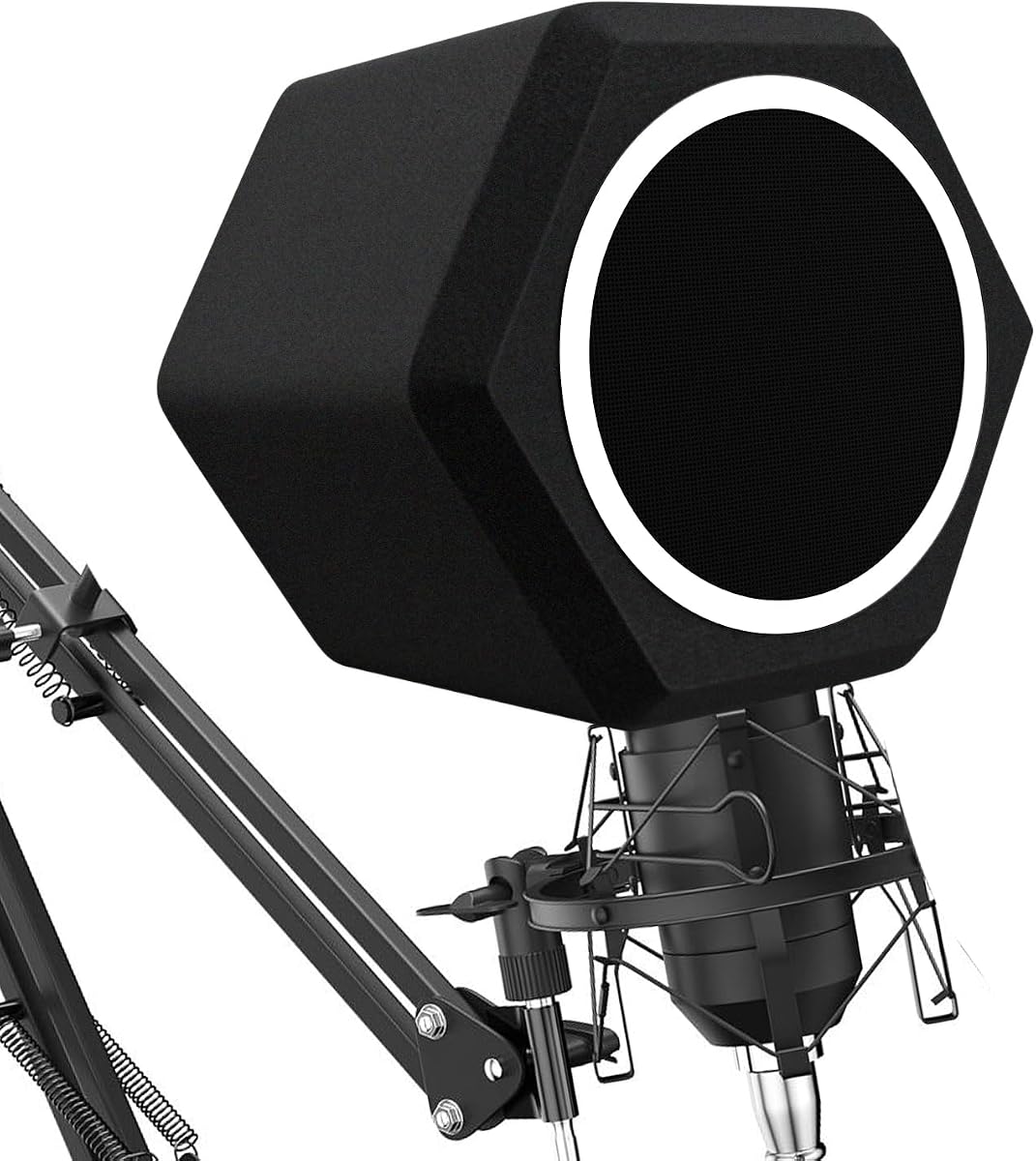
The Penypeal Microphone Isolation Ball combines a conventional pop-filter function with a surrounding acoustic foam enclosure, making it the most versatile overall design in this guide. It carries a 4.5 customer rating, and its strongest distinguishing feature is the five-sided seal that helps limit noise and reflections arriving from several directions rather than only from directly in front of the microphone.
We may earn a commission when you buy through this link, at no additional cost to you.
Its front opening uses a double-layer screen to disrupt divergent airflow before it reaches the microphone. Around that opening, the five-sided foam body is intended to reduce interference, plosives, wind, saliva spray, and ambient reflections while protecting the microphone capsule. A removable jacket accommodates most XLR and USB condenser microphones with a diameter between 50 and 75 millimeters, and an included holder is designed for different microphone sizes.
The trade-off is bulk. A fully enclosing isolation ball takes up more visual and desk space than a slim mesh filter, and the 50–75 millimeter range excludes larger specialty microphones. It also may feel unnecessary for a minimal setup where a flat screen would be easier to position precisely. Even so, the combination of directional screening, broad compatibility, portable weight, and mounting versatility gives it exceptional value for users who want more protection than a single screen provides.
Choose this model if you record vocals in a untreated home studio, stream from the same desk where you work, or want one accessory to handle plosives, reflections, wind, and saliva. It is also suitable for radio studios, live recording, and outdoor performance. For anyone willing to trade a little size for comprehensive acoustic protection, this is the strongest all-around recommendation in the list.
The five-sided foam enclosure expands protection beyond the plosive control offered by a basic flat screen. That makes it especially useful in rooms with noticeable reflections or background sound, while the front double layer focuses on the strongest bursts of vocal airflow.
The detachable jacket and included holder support microphones within the stated 50–75 millimeter range. Confirm the body diameter of your microphone before ordering, particularly if it has a large outer grille or an unusual shock mount.
We may earn a commission when you buy through this link, at no additional cost to you.
The NEEWER Professional Microphone Pop Filter Shield is a straightforward and economical answer to common vocal plosive problems. Its 4.4 customer rating reflects a well-established design centered on two mesh layers, an adjustable steel gooseneck, and a rotating clamp designed for tubular microphone stands or boom arms. It is an easy recommendation for podcasters, singers, streamers, actors, and voice-over artists.
We may earn a commission when you buy through this link, at no additional cost to you.
The first screen blocks the initial air blast, while the spacing between the two layers disperses remaining pressure before it reaches the second mesh. This staged approach is intended to reduce the harsh P and B sounds associated with plosives as well as hissing and lisping around S sounds. The rigid gooseneck holds the screen in place while allowing the user to change its angle and distance relative to the microphone.
Its main limitation is that it handles only the space between the speaker and microphone. It does not surround the microphone in foam, so it cannot provide the broader environmental isolation offered by an isolation ball. The scratch-proof clamp is nevertheless thoughtful, and the swivel mount makes installation and removal straightforward. A microphone is not included, and this is a stand-mounted accessory rather than a model-specific windscreen.
This is the pick for someone who wants effective plosive control, simple adjustment, and dependable metal hardware without paying for a more elaborate enclosed system. It works particularly well with common USB and condenser microphones on desktop stands or boom arms. For focused vocal recording in a reasonably controlled room, the NEEWER offers the most accessible balance of construction, adjustability, and affordability.
Separating the two mesh screens allows some of the initial pressure to dissipate before the air reaches the microphone again. This layered arrangement is the central reason the shield can control abrupt vocal consonants without requiring a large foam enclosure.
The steel gooseneck supports the screen while resisting unwanted sagging. A rotating clamp with a scratch-proof gripper secures the accessory to a tubular stand, and the swivel mechanism makes it easy to move the filter out of the way when it is not needed.
We may earn a commission when you buy through this link, at no additional cost to you.
The PEMOTech Three-Layer Pop Filter takes a different mounting approach from conventional stand-mounted screens. Instead of using a long gooseneck and boom clamp, it attaches directly around a compatible microphone with elastic bands and an inner rubber ring. It has a 4.5 customer rating and a three-part construction comprising foam, metal mesh, and etamine.
We may earn a commission when you buy through this link, at no additional cost to you.
By placing multiple materials between the speaker and microphone, the filter is designed to reduce plosives, crackles, wind interference, and breath sounds. The metal mesh provides structure while the foam and etamine layers add different degrees of airflow diffusion. This compact arrangement is particularly convenient for handheld recording, YouTube production, streaming, and other situations where repositioning a long arm would be inconvenient.
The important limitation is microphone fit. The stated range is 45 to 61 millimeters, and the listing explicitly says it is not for the Blue Yeti. It also omits a gooseneck, so users cannot fine-tune distance and angle as they could with a stand-mounted shield. The elastic-band and rubber-ring system is simple, but it may not be ideal if the microphone's body shape or diameter does not match the stated specification.
This model is a strong choice for a compatible condenser or USB microphone where portability and direct attachment matter most. Its multi-material construction offers useful plosive control without the footprint of an isolation ball. Check the microphone diameter and body shape first, and choose it when quick installation, compact storage, and multi-layer airflow diffusion outweigh the benefits of long-distance positioning.
The foam, metal mesh, and etamine layers each serve a different purpose, combining structural support with airflow diffusion. The result is a relatively compact screen that can be placed close to the microphone for direct vocal work.
Elastic bands and an internal rubber ring hold the filter on the microphone without a separate stand adapter. This makes assembly and disassembly quick, although it also means the screen cannot independently move away from the mic body.
We may earn a commission when you buy through this link, at no additional cost to you.
The YOUSHARES Blue Yeti Pop Filter is designed specifically for the Blue Yeti rather than trying to accommodate every microphone shape. It has a 4.5 customer rating, and its six-layer construction includes outer metal mesh, high-density windproof sponge, and a separate foam windscreen. The package combines both components in one model-specific setup.
We may earn a commission when you buy through this link, at no additional cost to you.
The filter is intended to disperse air pressure before it reaches the Blue Yeti, reducing the plosive effects produced by P and S sounds while protecting the microphone from saliva, dust, and vapor. A carbon-steel gooseneck supports the filter and permits changes to its angle and distance. The L-style swivel clip attaches to a microphone stand or the Blue Yeti itself, providing a more stable option than a conventional adhesive pad.
Its obvious advantage is specialization. A model-specific assembly can produce a more controlled fit and avoid uncertainty about whether a generic filter will remain centered on the microphone. The limitation is equally clear: this is not a universal solution for someone who owns several different microphones or plans to change to another large USB model. The clip and included foam windscreen are also designed around the Blue Yeti form factor.
For a Blue Yeti owner, this is a purpose-built way to combine plosive filtering, foam protection, and stable positioning. It is especially relevant to streamers, podcasters, and remote workers who speak or sing at close range. If your recording setup centers on the Blue Yeti and you value a coordinated fit, it is more compelling than a generic shield. Otherwise, verify compatibility before choosing it.
The 5.5-inch assembly and model-specific clip are intended to sit securely around a Blue Yeti. That focused approach can simplify positioning compared with a universal screen that must be balanced and aligned on an arm.
Two outer metal mesh layers are paired with high-density sponge and a separate foam windscreen. The layered approach is designed to soften both concentrated air bursts and looser airborne interference before they reach the microphone.
We may earn a commission when you buy through this link, at no additional cost to you.
The Professional Double-Layer Pop Filter is a conventional stand-mounted screen with unusually clear dimensional information. It has a 4.1 customer rating, the lowest among the rated products in this guide, but its stated construction includes dual metal mesh, high-density foam, a 360-degree carbon-steel arm, and an L-shaped universal clamp.
We may earn a commission when you buy through this link, at no additional cost to you.
Its six filtering layers are intended to reduce plosives, sibilance, and unwanted noise by breaking up the strongest airflow before it reaches the microphone. The flexible arm measures 13.39 inches and provides a total extended length of 21.06 inches, giving the user room to place the filter precisely between the mouth and a microphone mounted on a boom or desk stand.
The clamp fits tubular boom arms and desk stands up to 1.38 inches in diameter and uses an anti-scratch EVA pad. That maximum may be restrictive for users with thicker arms, so the stand should be measured before buying. The 4.1 rating also suggests that some buyers may have found the overall execution less consistent than the higher-rated alternatives, even though the design includes useful features.
This product makes the most sense for a home-studio or broadcasting setup with a relatively slim stand and a need for long, precise positioning. It can also serve karaoke, singing, streaming, and everyday voice recording. If those applications align with your equipment and you value the clearly specified dimensions, it remains a functional option, but the better-rated universal filters elsewhere in the guide offer a stronger overall balance.
The listing specifies the outer screen diameter, inner screen diameter, arm length, and total reach. These details make it easier to judge whether the filter can fit between the speaker and a particular microphone position before buying.
A carbon-steel arm can be twisted into different shapes and is stated to withstand more than 10,000 bends. Its flexibility allows the filter to be moved closer for stronger plosive control or shifted away when it is not needed.
We may earn a commission when you buy through this link, at no additional cost to you.
The SUNMON Fifine K688 Pop Filter is a specialized accessory for users of the Fifine K688 and K658. Its 4.1 customer rating reflects a less emphatic customer response than the top-rated products, but the design combines a six-layer screen, a 5.5-inch windscreen, and a flexible arm in a package aimed at vocal recording, podcasting, streaming, karaoke, and broadcasting.
We may earn a commission when you buy through this link, at no additional cost to you.
A foam-and-metal construction is intended to break up airflow and reduce the harsh effects of B and P consonants without sacrificing the upper range of the voice. The gooseneck is made from carbon steel and can be twisted into a preferred position while remaining in place. An L-shaped clip includes rubber pads at the bottom, helping it grip compatible equipment without sliding or causing surface damage.
Because the product is optimized around named Fifine models, it does not offer the broad flexibility of a standard clamp-on pop filter. The 4.1 rating may also reflect differences in fit or setup experiences, so buyers should compare the product dimensions with their microphone and stand. Its advantages become clearer when a Fifine user wants a coordinated filter-and-windscreen setup.
Choose this model if you specifically use a Fifine K688 or K658 and want a six-layer screen with an integrated foam windscreen. It may be especially useful for close-range streaming and spoken content. For users who might switch microphones, a universal filter with an adjustable clamp would offer more freedom. Within its intended microphone family, however, it delivers the core protection and positioning features expected from a dedicated accessory.
The L-shaped clip is designed for the dimensions and shape of the Fifine K688 and K658. Rubber pads help the filter remain stable while reducing the chance of scratching the microphone or nearby equipment.
Metal and sponge materials are combined to reduce concentrated consonant bursts and broader background interference. The foam windscreen also adds a final barrier against moisture, saliva, and other particles.
We may earn a commission when you buy through this link, at no additional cost to you.
The Two-Layer Isolation Ball is a portable, foam-covered microphone shield intended to combine plosive reduction with limited environmental isolation. Its 4.2 customer rating places it in the middle of the group, while its detachable jacket supports a broad 1.96–2.75-inch microphone diameter range. The product is listed as suitable for several USB and condenser models, including the Audio-Technica AT2035, AT2020, and Blue Yeti.
We may earn a commission when you buy through this link, at no additional cost to you.
The five-sided foam construction is designed to reduce plosives, wind interference, saliva spray, pops, crackles, breath sounds, and echoes. A dual pop-filter cover is positioned at the front, creating an enclosed but accessible path for the microphone. The high-density sponge is described as fine-textured, resilient, and quick to rebound, and the enclosure can also provide some protection from accidental knocks or drops.
The critical requirement is diameter. The manufacturer explicitly warns that this is not a miniature isolation ball, and a microphone outside the 1.96–2.75-inch range may not be supported. Its enclosed shape also blocks a direct view of the microphone and may be less convenient when precise mouth-to-mic spacing is critical. A flat filter offers more immediate positional control in those situations.
This model is a strong option for mobile recording, outdoor performance, radio work, or a home studio where reflections and nearby environmental sound are concerns. At 120 grams, it is light enough to move between a desk stand, tripod, cantilever arm, or floor stand. It provides the most complete physical protection in the list, provided your microphone falls within the clearly stated size range.
Unlike a flat mesh shield, the isolation ball surrounds much of the microphone with foam. That enclosure is intended to reduce interference from multiple directions, including reflections, airborne wind, loose breath sounds, and nearby room noise.
The detachable jacket accommodates microphones from 1.96 to 2.75 inches in diameter. Measure the body that enters the jacket rather than assuming the widest visible grille is the relevant dimension, and verify compatibility before ordering.
We may earn a commission when you buy through this link, at no additional cost to you.
The Microphone Pop Filter with 360° Flexible Gooseneck and Clamp Mount delivers the basic tools needed for straightforward vocal recording. It has a 4.5 customer rating, a dual-layer mesh screen, a metal gooseneck, and a padded clip designed to work with the Blue Yeti, Rode, Audio-Technica, and other standard microphones.
We may earn a commission when you buy through this link, at no additional cost to you.
The mesh is intended to reduce the plosive effects of P and B sounds, soften sibilance, and lessen breath noise. Its placement can be adjusted in angle and distance, allowing the user to find a useful balance between vocal clarity and a natural sense of proximity. The gooseneck is designed to remain in position without sagging, while the swivel mount allows quick attachment and removal without tools.
As a flat screen, it does not offer the environmental isolation of a foam-covered isolation ball. It also has fewer layers than several competing products that use metal mesh, foam, and etamine combinations. The benefit is that the simpler construction remains easy to position and less likely to interfere with a compact recording space. Its stated universal focus is broad, although users should still check stand and microphone dimensions.
This is a compelling pick for someone who values quick setup, straightforward cleanup, and dependable adjustment more than maximum environmental isolation. It suits podcasting, voice-over work, streaming, and standard home-studio vocals. With a 4.5 rating, a tool-free mount, and a scratch-resistant clip, it is one of the most balanced universal choices for a compact setup.
The swivel mount lets the user attach or remove the filter without reaching for tools. This is convenient for creators who alternate between recording, gaming, streaming, and other activities on the same microphone stand.
The 360-degree metal gooseneck supports changes to both angle and distance. A padded adjustable clip helps prevent slipping and shields the microphone or stand from scratches during repeated adjustments.
We may earn a commission when you buy through this link, at no additional cost to you.
The Stedman PS101 V2 Pop Filter is a dedicated screen for the Stedman PS101 V2 microphone. No customer rating is supplied for this listing, so the strongest basis for evaluating it is its stated compatibility, construction, and intended function. It is designed to reduce plosives and breath noise while integrating with the microphone's own form.
We may earn a commission when you buy through this link, at no additional cost to you.
For a PS101 V2 owner, that focused compatibility can be more useful than a generic accessory. A model-specific screen can be positioned as part of the microphone setup, and the simple attachment mechanism is described as allowing quick installation on a microphone stand. The stated studio-oriented construction is intended to withstand regular use while maintaining consistent vocal performance.
The trade-off is obvious: it is not a universal choice. If you use another microphone, this filter will not offer the same tailored fit, and the limited published information makes detailed comparison difficult. It also lacks the multi-layer specifications provided for many competing products, so prospective buyers should inspect the current listing and confirm attachment and clearance before ordering.
This recommendation is specifically for creators who have chosen the Stedman PS101 V2 and want a coordinated pop-filter solution. It may be particularly relevant to home-studio, podcasting, voice-over, and professional recording users who value a dedicated attachment. If you need broad compatibility or a highly layered wind-control structure, choose one of the universal multi-layer options instead.
The filter is designed specifically for the PS101 V2, removing the uncertainty involved in fitting a generic shield to a different microphone body. Confirm that your microphone is the stated version before making a purchase.
The screen is intended to reduce the two common vocal recording problems of sharp plosives and audible breath noise. Its straightforward attachment also supports quick changes between recording sessions.
We may earn a commission when you buy through this link, at no additional cost to you.
The PROAR Multi-Layer Pop Filter is the premium-style selection in this guide, combining thick filter sponge, a flexible steel gooseneck, and a secure rotating clamp. It has a 4.5 customer rating and is designed for a wide range of popular microphones, including the Blue Yeti, Blue Snowball, HyperX QuadCast, Shure, Rode PodMic, and other models.
We may earn a commission when you buy through this link, at no additional cost to you.
The layered screen is intended to reduce plosives, wind interference, saliva spray, hisses, pops, and thuds, making it useful for singers, podcasters, voice-over artists, vloggers, gamers, and streamers. Thick sponge adds more material through which concentrated bursts of air must travel, while the frame and multi-layer construction are designed to preserve clear vocal output.
A carbon-steel gooseneck provides 360-degree positioning and can be adjusted to change both the angle and distance between the filter and microphone. The clamp includes a scratch-proof gripper and secures tubular boom arms or stands, although its stated capacity extends to surfaces up to 1.96 inches. Users should measure thicker boom arms to ensure the clamp can open far enough.
This filter is an excellent all-purpose choice when a user wants more substantial material and refined positioning than a basic flat screen. The combination of a high rating, broad microphone compatibility, strong mounting hardware, and a multi-layer profile makes it appropriate for serious home recording, streaming, gaming, and podcasting. It is the top pick for buyers who prioritize robust construction and flexible placement.
Thick sponge and a multi-layer screen distribute the force of vocal air bursts more effectively than a very thin single mesh. The result is designed to reduce harsh consonant transients and keep moisture or saliva from reaching the microphone.
The reinforced carbon-steel gooseneck supports the filter while allowing repeated changes to angle and distance. A rotating anti-scratch clamp then secures the assembly to compatible tubular stands and boom arms.
We may earn a commission when you buy through this link, at no additional cost to you.
The most useful pop filter depends on your microphone, recording environment, and willingness to adjust the setup. Material construction, mounting stability, diameter, and positioning range deserve more attention than layer-count claims alone.
Start by determining whether the filter is universal, stand-mounted, or designed for a specific microphone body. Universal clamps work with many common condenser and USB microphones, while model-specific designs may provide a more coordinated fit. Measure the microphone's diameter, inspect its grille, and account for any shock mount that will remain in use. A filter that cannot attach securely or that presses against an unusual body shape may not work properly, even when its filtering materials are appropriate.
Mesh screens are effective against sharp air bursts, while foam and etamine can soften broader airflow, breath, and wind. Multi-layer products combine these materials to broaden the range of unwanted sound they address. More layers do not automatically mean a better recording, however; a balanced, well-spaced filter can control plosives while preserving vocal detail. Consider whether the screen is mainly for consonants, breath, or both, and favor a construction whose materials directly match your speaking or singing style.
A stable mount prevents the filter from moving when a stand is nudged or a performer changes position. Metal goosenecks generally provide firm support, while a padded clamp helps protect the microphone and stand from scratches. Check the maximum stand diameter and whether the clamp can open around a thick boom arm. Swivel or tool-free mechanisms are convenient for frequent use, whereas a model-specific clip may offer the most consistent fit on a matching microphone.
Distance and angle matter because a filter placed too close can alter the perceived sound, while one placed too far may not intercept the strongest consonant bursts before they reach the capsule. A long, flexible gooseneck gives you more control over this spacing. Look for an arm that can hold a curve without sagging and a clamp that lets the entire filter move easily. Direct-fit shields are more compact but offer less independent positioning.
A flat pop filter mainly addresses air traveling directly from the speaker to the microphone. An isolation ball or foam enclosure can also reduce reflections, wind, and environmental sound arriving from other directions. That broader control is useful in untreated rooms, busy offices, or outdoor recording locations, but it takes up more space and can make precise mouth spacing harder to judge. Decide whether your room needs acoustic control or merely direct plosive reduction.
A useful pop filter also creates a physical barrier against saliva, dust, moisture, and accidental knocks. Foam and etamine layers can intercept particles that a thin metal screen would allow to pass. This matters for a microphone used repeatedly in a home office, during long streaming sessions, or in an environment where performers speak closely to the capsule. A removable or cleanable surface is especially useful because accumulated moisture can reduce both hygiene and airflow performance.
A controlled vocal booth changes the role of a pop filter. In such a room, a slim screen may be sufficient for plosive control and easier to position. A home studio, untreated bedroom, shared office, or outdoor location benefits from a more substantial layered design or enclosed isolation system. The product should solve the actual problem in your space rather than add equipment simply because more material is available.
If you move between locations, weight, footprint, and setup time become important. A lightweight screen with a tool-free clamp is easy to carry, while an isolation ball offers more protection but may be awkward beside a compact laptop stand. Consider how the foam or etamine will be cleaned and whether the filter can be removed without disturbing the microphone. A simple design that can be maintained regularly is more useful than a complex one that is rarely handled.
Begin by securing the microphone in its stand and positioning the pop filter directly along the intended speaking or singing line. For a stand-mounted shield, attach the clamp to a compatible tubular section and tighten it without forcing it against a delicate finish. Keep the screen between the mouth and microphone, but leave enough space to speak or sing naturally rather than pressing the face against the foam.
Adjust the gooseneck gradually. Start with the filter a few inches from the microphone and move it closer if P, B, or T sounds remain harsh. Moving the filter can alter the high-frequency response and apparent proximity, so make small changes and listen to the result. For an isolation ball, center the microphone inside the jacket and verify that the front screen is aligned with the sound source while the enclosure is not touching the grille.
For cleanup, follow the manufacturer's material instructions and avoid soaking any metal frame, clamp, or gooseneck. Remove loose dust from foam and etamine gently, and let materials dry fully before reassembly. Periodically check the clamp, rubber pads, elastic bands, and attachment points for looseness. A stable, clean filter maintains consistent airflow and makes every recording setup more predictable.
A pop filter is most useful with directional condenser microphones placed close to a singer or speaker because their sensitivity can expose strong plosive bursts. It can also help other microphones, but the effect varies with pickup pattern, capsule design, distance, and room acoustics. If a recording already sounds clean, a filter may still provide useful protection from saliva and dust.
A standard pop filter is a flat screen positioned between the voice and microphone, mainly slowing concentrated airflow. An isolation ball surrounds the microphone with foam and can reduce plosives plus some reflections, wind, and environmental interference. The ball usually provides broader protection but occupies more space and may not fit every microphone diameter.
It can make the recording sound cleaner by reducing harsh consonant spikes, sibilance, and breath noise. It does not correct room echo, poor microphone placement, weak gain settings, or an unsuitable recording environment. The most noticeable improvement generally comes from using the filter correctly and combining it with sensible gain control and basic acoustic treatment.
There is no single correct distance for every setup, but the filter should sit between the mouth and microphone without touching the grille. Begin a few inches away, listen for plosives, and move it closer if needed. Because distance affects frequency response and vocal presence, compare settings through the microphone's actual monitoring and final recording rather than judging by physical spacing alone.
A model-specific filter can offer a cleaner fit and coordinated attachment when you know your microphone will remain unchanged. A universal filter is often more practical for owners of several microphones or for future upgrades. The most important requirements in either case are secure mounting, adequate diameter clearance, and the ability to position the screen in front of the microphone's pickup axis.
Yes, and outdoor recording can benefit greatly from one because wind and reflections are often more difficult to control. A model with foam layers, a windscreen, or a fully enclosing isolation ball offers broader protection than a bare mesh screen. Even with a filter, use a windshield or sheltered recording position when possible because severe wind can create noise that no pop filter can fully remove.
Remove loose debris carefully and clean the foam or etamine according to the product instructions. Avoid immersing the metal mesh, frame, clamp, or gooseneck, and do not use harsh cleaners that could damage the surface or adhesives. Allow all parts to dry completely before use so moisture does not create a new airflow or hygiene problem.
No. A thicker or more enclosed design can reduce plosives, wind, and reflections, but it may also change the sound or make precise positioning more difficult. Choose based on the problems in your recording. A well-positioned dual-layer screen is often sufficient for speech, while an isolation ball is more useful when untreated room noise and reflections are significant.
The Penypeal Microphone Isolation Ball is the best overall choice because it combines a double-layer front screen with a five-sided foam enclosure and broad support for common XLR and USB condenser microphones. The NEEWER Professional Pop Filter Shield stands out as the best budget option, offering a dependable dual-layer screen, metal gooseneck, and protected swivel clamp in a simpler format.
The PROAR Multi-Layer Pop Filter is the premium-style choice for creators who want substantial sponge protection, precise 360-degree positioning, and a scratch-resistant clamp. If your microphone is a Blue Yeti or Fifine K688 or K658, a specialized model may provide a more coordinated fit than a generic filter, while a universal screen remains safer if your equipment may change.
Before purchasing, verify the microphone diameter, mount type, stand thickness, and the type of noise you need to control. Pay close attention to how the filter must be positioned and whether it can be adjusted as your recording setup changes. Product specifications, customer ratings, and prices can change, so review the current listing before making a final decision.