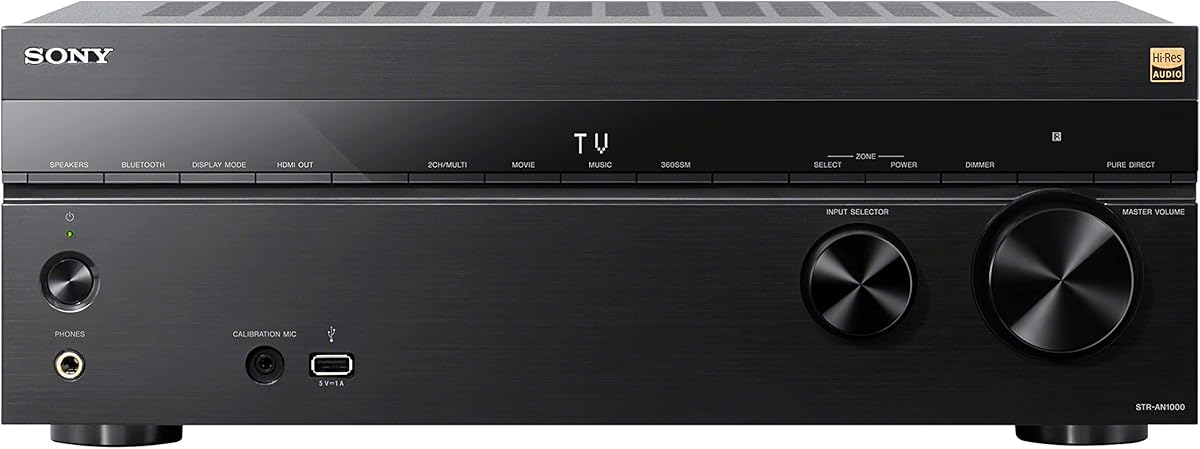
Sony STR-AN1000
4.2Editor score
Zone 2 and Zone 3 support
7.2-channel home theater platform
Six HDMI inputs, two outputs
Dolby Atmos and DTS:X decoding
Our 3 Zone AV Receiver guide compares ten receivers for multi-room audio, surround sound, HDMI performance, streaming, calibration, and easier setup.
A 3 Zone AV Receiver is intended to make home entertainment more flexible by distributing audio to multiple rooms while preserving a powerful main theater setup. The best models combine capable surround processing, modern HDMI connectivity, strong room calibration, and reliable control features for music, movies, television, and gaming.
We compared ten receivers using the specifications and feature descriptions supplied for each model, with particular attention to channel configuration, zone support, immersive audio, HDMI capabilities, wireless streaming, calibration, and setup convenience. The list includes traditional 5.2- and 7.2-channel models, premium receivers, and one stereo-only option.
Each pick reveals a different balance of capabilities, from straightforward surround systems to advanced multi-room equipment. Note that the phrase 3 Zone describes the use case rather than guaranteeing three independently powered zones: confirm the exact zone count, supported sources, video distribution, and amplifier requirements before purchasing. Prices and availability change.
A strong 3 Zone AV Receiver should not only power a main home theater but also make it convenient to share music and other audio elsewhere in the home. The best choice depends heavily on room layout, speaker count, video needs, and how much control you want over independent listening zones.
4.2Editor score

4.4Editor score

4.1Editor score
The table below compares all ten receivers by channel layout, zone capabilities, major HDMI functions, and the features most likely to affect a multi-room installation. A receiver with more zones is not automatically the right choice, so amplifier capacity, video demands, and room calibration should guide the final decision.


The Onkyo TX-NR6100 is a 7.2-channel network AV receiver with a 4.1 rating and one of the strongest balanced feature sets in this guide. Its THX Select certification, 210-watt-per-channel Dynamic Audio Amplification system, and support for 5.2.2-channel Dolby Atmos and DTS:X make it particularly appealing to buyers who want serious home theater performance with secondary-room flexibility.
We may earn a commission when you buy through this link, at no additional cost to you.
Its strongest multi-room feature is the discrete Zone 2 audio and video output, allowing the receiver to serve another area without reducing the receiver to a basic two-channel stereo unit. On the main side, three HDMI 2.1 inputs support 8K at 40Gbps, while object-based audio and certified amplification create a strong foundation for modern movies, concerts, and games.
The important limitation is that the supplied specifications identify only Zone 2, not independent Zone 2 and Zone 3 outputs. It can therefore anchor a two-room system, but buyers searching literally for three independently controlled areas should not assume that a third zone is included. Extras such as additional amplification, speaker impedance matching, and source distribution may need separate equipment.
This is a strong recommendation for a buyer whose primary goal is a powerful 7.2-channel theater with one genuine secondary zone. It suits listeners who value THX certification, modern HDMI performance, and network features more than a fully integrated three-zone system. For literal three-zone control, compare the Sony STR-AN1000 or verify the exact architecture of another Onkyo model.
The discrete Zone 2 audio and video output gives the TX-NR6100 more flexibility than a typical entry-level surround receiver. It can serve a second room while retaining the full 5.2.2-channel experience in the primary theater.
THX Select certification, 210 watts per channel, and Dolby Atmos and DTS:X playback form a compelling package for listeners who want serious output and current immersive-audio support.
We may earn a commission when you buy through this link, at no additional cost to you.
The Yamaha RX300A is a 5.2-channel receiver that brings Dolby Atmos, modern HDMI support, and guided setup to a more approachable category. Its 4.0 rating reflects a practical package centered on straightforward home theater use, flexible 3.1.2 speaker layouts, room correction, and convenient control rather than extensive multi-zone hardware.
We may earn a commission when you buy through this link, at no additional cost to you.
The receiver delivers 70 watts per channel and supports up-firing or in-ceiling height speakers, DTS Virtual:X, Dolby Vision, HDR10+, eARC, ALLM, and VRR. A supplied setup microphone measures room acoustics and speaker characteristics, while the on-screen settings and Quick Guide simplify initial configuration. Bluetooth Multipoint allows two source devices to be connected and switched more easily.
For a literal three-zone installation, this model is not the strongest match because no dedicated multi-zone outputs are listed in its supplied specifications. The lack of an explicit zone count also means it should not be assumed to distribute independent sources across three rooms. A network-based speaker arrangement or separate amplifier may be required for that purpose.
The RX300A is a good recommendation for first-time surround-system buyers, renters, and anyone who values simple setup more than advanced custom-integration features. It is particularly well suited to a living room with a 5.2 or 3.1.2 layout. Buyers with a definite three-zone plan should prioritize a receiver whose documentation explicitly confirms the required zone outputs.
Automatic room measurement and flexible 3.1.2 layouts make the RX300A approachable for users who want height effects without navigating a complicated surround-speaker configuration.
Bluetooth Multipoint, four custom scene presets, and support for ALLM and VRR make the receiver convenient for mixed entertainment and gaming households.
We may earn a commission when you buy through this link, at no additional cost to you.
The JBL MA310 is a compact 5.2-channel receiver built for straightforward home cinema, television, music, and gaming. With a 4.0 rating and 60 watts per channel, it focuses on the fundamentals: four HDMI inputs, one HDMI output, ARC, native 5-channel decoding of Dolby and DTS formats, and wireless music streaming through Bluetooth 5.1 with Low Energy.
We may earn a commission when you buy through this link, at no additional cost to you.
Its appeal lies in reduced complexity. The MA310 is designed to integrate readily with smart televisions, streaming devices, cable boxes, and game consoles without demanding an advanced home-automation setup. JBL presents it as a high-fidelity option for both music and movies, making it a practical option for an apartment, den, or secondary media space.
Multi-zone capability is the main compromise. No zone outputs or zone-count details are included in the supplied specifications, so buyers should not treat it as a confirmed three-zone receiver. A traditional 5.2 layout also offers fewer object-based-audio possibilities than the 7.2-channel models in this guide, although the native Dolby and DTS decoding remains useful.
The MA310 is a sensible recommendation for buyers who want a clean, uncomplicated AV centerpiece and already have a modest 5.2 speaker system. It is less appropriate for a complex whole-home installation, but for a single living room it offers the essential connectivity and decoding in a compact package. Confirm room and source requirements before finalizing a multi-room plan.
Four HDMI inputs, one output, and ARC provide enough connectivity for common entertainment components while keeping the receiver approachable for everyday users.
Native surround decoding and Bluetooth 5.1 Low Energy make the MA310 useful for both disc-based movies and casual wireless music listening.
We may earn a commission when you buy through this link, at no additional cost to you.
The Denon AVR-S570BT is a 5.2-channel receiver with a 4.2 rating and a strong emphasis on modern HDMI, gaming, and accessible setup. Four HDMI 2.1 inputs support 8K, while eARC handling, VRR, Quick Frame Transport, HDR formats, and dynamic HDR features make it a capable center for a current television and game console.
We may earn a commission when you buy through this link, at no additional cost to you.
At 70 watts per channel, it provides a useful upgrade path for conventional 5.1 or 5.2 speaker arrangements. The on-screen Setup Assistant walks through connections and equalization, while the Denon Remote App supports control from iOS and Android devices. Built-in Bluetooth and access to services such as Spotify, TIDAL, and Pandora make it useful for music as well as movies.
This model is not listed with dedicated multi-room or zone outputs, so it should not be presented as a verified three-zone solution. Its 5.2 amplifier section also cannot independently drive seven theater channels and multiple additional rooms. A separate multi-zone amplifier or compatible networked speakers would be needed for a larger distributed audio installation.
The AVR-S570BT is a strong recommendation for budget-conscious buyers who prioritize 8K HDMI, gaming, and streaming in a main room. It offers more current video flexibility than many basic 5.2 receivers, but its lack of stated zone support makes it better suited to a single-room theater plan than a literal three-room system.
Four HDMI 2.1 inputs, 8K support, eARC, VRR, and Quick Frame Transport provide a practical foundation for a modern television, streaming device, and game console.
Bluetooth, HEOS-based streaming access, and support for major music services turn the receiver into a useful central hub for everyday listening.
We may earn a commission when you buy through this link, at no additional cost to you.
The Yamaha RX-A2A is a 7.2-channel AVENTAGE receiver with a 4.3 rating and a refined combination of build quality, room calibration, streaming, and theater processing. It supports Dolby Atmos, DTS:X, HDMI 2.1, 8K60, 4K120, Dolby Vision, HDR10+, HLG, and BT.2020, making it a strong centerpiece for a modern high-performance home theater.
We may earn a commission when you buy through this link, at no additional cost to you.
YPAO R.S.C. with multipoint measurement is one of its standout qualities. The system is designed to optimize the main room using measurements taken at multiple positions, while Surround:AI analyzes content and adjusts sound and effects in real time. A seven-in, one-out HDMI configuration offers generous switching options, with three inputs supporting the highest specified 8K and 4K120 modes.
For whole-home use, Yamaha includes a discrete Zone 2 output, allowing a secondary room to receive sources independently of the main theater. As with the Onkyo TX-NR6100, the listed specifications do not confirm a third independent zone. A three-area project may require a dedicated amplifier, speaker-based distribution, or a different receiver with more zone hardware.
The RX-A2A is an excellent choice for a buyer seeking a refined 7.2-channel theater with one dedicated secondary zone and extensive ecosystem options. MusicCast, AirPlay 2, Spotify Connect, numerous streaming services, voice-control compatibility, and a phono input make it particularly versatile. It is a premium two-room solution, but not a confirmed three-zone receiver.
YPAO R.S.C. multipoint measurement and Surround:AI give the RX-A2A a strong calibration foundation for optimizing sound in the main listening area.
MusicCast, AirPlay 2, Spotify Connect, extensive streaming-service support, voice control, and a phono input make the receiver useful well beyond movies.
We may earn a commission when you buy through this link, at no additional cost to you.
The Sony STRDH190 is a traditional two-channel stereo receiver rather than a surround AV receiver. Its 4.5 rating is the highest among the listed products, and the supplied specifications emphasize strong stereo amplification, flexible speaker switching, phono support, Bluetooth, FM radio, and a compact enclosure designed for conventional AV furniture.
We may earn a commission when you buy through this link, at no additional cost to you.
With 100 watts per channel into 8 ohms, it can support a serious stereo pair. The ability to connect up to four speakers and use A/B switching provides a basic form of room flexibility: one pair can play in one location, another in a separate location, or both pairs can operate together. This is not equivalent to independently sourced, volume-controlled AV zones.
The trade-offs are substantial for anyone seeking object-based surround, HDMI switching, Dolby Atmos, DTS:X, gaming features, or multichannel calibration. It has no listed surround processing and no HDMI connectivity. Its zone-like flexibility comes from speaker switching, so the listening areas generally share the same source and control hierarchy.
The STRDH190 is a strong recommendation for a two-room music system, especially for vinyl listeners who want phono connectivity and a compact, traditional receiver. It can also serve as the central audio component of a two-room setup with an additional amplifier. It is not a suitable solution for a dedicated three-zone home theater.
A/B switching lets a listener move between two speaker pairs or play both at once, offering basic multi-area flexibility without surround decoding or HDMI switching.
The 100-watt-per-channel amplifier, phono input, multiple analog inputs, and FM radio make the STRDH190 a capable traditional music receiver.
We may earn a commission when you buy through this link, at no additional cost to you.
The Yamaha RX-V4A is a 5.2-channel AV receiver combining modern HDMI performance, MusicCast, several streaming platforms, voice-control support, and YPAO room calibration. Its 3.8 rating is the lowest among these ten products, but the supplied specifications still present a capable feature set for a conventional home theater and music system.
We may earn a commission when you buy through this link, at no additional cost to you.
The HDMI section supports HDCP 2.3, eARC, 4K60, 4K120AB, and 8K60B across four inputs and one output. Audio formats include Dolby TrueHD, Dolby Digital, and DTS-HD Master Audio, while Dolby Vision, Hybrid Log Gamma, and BT.2020 cover modern picture requirements. Dual-band Wi-Fi, AirPlay 2, MusicPlay, and Spotify Connect make network listening convenient.
Multi-room performance is less explicit. No dedicated Zone 2 or Zone 3 outputs are listed, so a buyer should not interpret MusicCast compatibility as built-in independent AV zone support. The receiver may work well as the central theater component, with additional wireless speakers or a separate amplifier handling other rooms. That arrangement requires careful synchronization and control planning.
The RX-V4A works best for buyers who value Yamaha calibration and streaming integration in one main room without needing multiple integrated zone outputs. It is a less convincing match for a literal three-zone receiver search because the zone count is unspecified. Its feature set is broad, but prospective buyers should also consider models that explicitly document their multi-room outputs.
MusicCast, AirPlay 2, MusicPlay, Spotify Connect, and support for numerous services create a broad set of options for daily music listening.
YPAO automatic room calibration helps the receiver establish a more appropriate sound field for the main room and connected speaker arrangement.
We may earn a commission when you buy through this link, at no additional cost to you.
The Sony STR-AN1000 is the clearest match in this guide for the literal 3 Zone AV Receiver use case. It combines a 7.2-channel home-theater platform with explicit Zone 2 and Zone 3 support, giving it the strongest documented multi-room foundation among the listed products. Its 4.2 rating reflects a capable, feature-rich receiver designed for modern entertainment and flexible distribution.
We may earn a commission when you buy through this link, at no additional cost to you.
The receiver provides 165 watts at 6 ohms under the specified one-channel test condition and supports Dolby Atmos, DTS:X, Digital Cinema Auto Calibration IX, and 360 Spatial Sound Mapping. Its HDMI 2.1 section includes six inputs and two outputs, with 8K and 4K120 connectivity, Dolby Vision, HDR10, Hybrid Log Gamma, and IMAX Enhanced support. That makes it well matched to a main theater with several source devices and a second display or video zone.
The important planning issue is power allocation. Supporting Zone 2 and Zone 3 does not necessarily mean every zone can simultaneously deliver the same output as the main 7.2-channel theater, and the supplied information does not detail the exact output configuration for every combination. Speaker impedance, room size, and listening levels must be checked in the manual before installation. A professional integrator can also assess whether external amplification is necessary.
This is the top recommendation for a buyer specifically seeking three-zone capability. It combines true multi-room distribution with high-end theater decoding, modern HDMI, extensive streaming options, Sonos integration, and a guided setup interface. It is more complex than a single-room receiver, but it most directly answers the three-zone requirement.
Explicit Zone 2 and Zone 3 support distinguishes the STR-AN1000 from conventional 5.2- and 7.2-channel models that only describe wireless streaming or secondary speaker playback.
Six HDMI 2.1 inputs, two outputs, 8K and 4K120 support, advanced HDR formats, and 7.2-channel amplification create a strong platform for a feature-rich theater.
We may earn a commission when you buy through this link, at no additional cost to you.
The Denon AVR-X1700H is a well-equipped 7.2-channel receiver with a 4.4 rating, advanced 8K-ready HDMI, multi-room streaming, and extensive home-automation support. It offers 80 watts per channel, Dolby Atmos, DTS:X, DTS Virtual:X, and Dolby Atmos Height Virtualization, allowing listeners to add virtual height effects even when physical height speakers are not installed.
We may earn a commission when you buy through this link, at no additional cost to you.
Three of its six HDMI inputs support 8K at 60Hz and 4K at 120Hz, and 8K upscaling is listed for all six inputs. It also supports 4:4:4 color, HDR10, HDR10+, Dolby Vision, and HLG. The Quick Setup Guide and color-coded rear connections make installation approachable, while pre-outs can expand subwoofer or external-amplifier options.
The receiver supports simultaneous music streaming in another zone through HEOS, Wi-Fi, AirPlay 2, or Bluetooth. However, the supplied specifications do not explicitly confirm a count of independently amplified AV zones. Buyers should therefore treat its multi-room functionality as flexible networked distribution rather than automatically assuming three fully independent preamp outputs and speaker feeds.
The AVR-X1700H is an excellent recommendation for a buyer who wants a high-performance 7.2-channel theater, extensive streaming, modern HDMI, and integration with a smart-home system. It is also a flexible candidate for a multi-area installation when paired with the correct external amplification. For an explicitly confirmed Zone 2 and Zone 3 receiver, however, the Sony STR-AN1000 is clearer.
Dolby Atmos Height Virtualization can create height effects in a 5.1.2 or 7.1 theater when a full physical height-speaker layout is not available.
IP control, external control, remote monitoring, major voice-agent compatibility, and multi-source HEOS streaming make the receiver adaptable to a broader smart-home installation.
We may earn a commission when you buy through this link, at no additional cost to you.
The Sony STRAZ3000ES is a premium 9.2-channel AV receiver designed with custom home integration in mind. Its 4.0 rating and substantial specification set emphasize extensive theater channels, advanced spatial processing, dual HDMI outputs, networked streaming, voice-control compatibility, and seamless IP control for professionally managed installations.
We may earn a commission when you buy through this link, at no additional cost to you.
The receiver supports Dolby Atmos, DTS:X, Digital Cinema Auto Calibration IX, and 360 Spatial Sound Mapping. It handles 8K and 4K120 video through six HDMI 2.1 inputs and two outputs, with Dolby Vision, HDR10, Hybrid Log Gamma, and IMAX Enhanced support. Bluetooth, Wi-Fi, Chromecast built-in, Spotify Connect, and Apple AirPlay provide flexible access to online and local content.
Although the 9.2-channel amplifier is impressive, the supplied specifications do not identify Zone 2 or Zone 3 outputs. It should therefore not be selected solely on channel count as a verified three-zone receiver. Its IP control capability is valuable for a custom installer, but sophisticated network control does not automatically provide independent audio zones. The exact configuration and any required external amplifiers must be confirmed.
The STRAZ3000ES is best recommended for high-end home theater owners and custom integrators who value maximum channel flexibility, premium processing, and centralized control. It is less suitable for a straightforward living-room installation or a buyer who simply needs one guaranteed secondary and tertiary zone. For those priorities, the Sony STR-AN1000 offers a more direct answer.
A 9.2-channel amplifier layout offers more powered-channel options than the other receivers listed, making it appealing for ambitious main-room theater designs.
Seamless IP control integration, a graphical interface, and a front-panel display make the STRAZ3000ES well suited to a professionally configured whole-home system.
We may earn a commission when you buy through this link, at no additional cost to you.
A useful three-zone receiver depends on more than its nameplate. Confirm independent zone outputs, amplifier capacity, video routing, calibration, control methods, and the number of connected speakers before making a final choice.
The term 3 Zone can describe different capabilities. A receiver may have two dedicated powered zones plus a third zone supplied by a separate amplifier, or it may provide only preamp outputs for secondary areas. Check whether each zone has independent source selection, volume control, bass management, and speaker outputs. Wireless playback through MusicCast, HEOS, Bluetooth, or A/B switching is not automatically equivalent to three integrated AV zones.
In this guide, the Sony STR-AN1000 is the only model explicitly listing both Zone 2 and Zone 3. The Onkyo TX-NR6100 and Yamaha RX-A2A list a discrete Zone 2, while the Denon AVR-X1700H supports multi-room streaming without an explicit zone count. Choose based on documented outputs, not on marketing terminology alone.
A three-zone receiver still needs to deliver excellent sound in its primary room. A 5.2-channel model is appropriate for a conventional living-room system, while 7.2 channels provide greater flexibility for Dolby Atmos and DTS:X configurations. The 9.2-channel Sony STRAZ3000ES offers the most channels in this group, but that does not automatically translate into three independent rooms.
Choose a main-room channel count based on your actual speaker inventory and room design. Pay close attention to whether the receiver supports 5.2.2, 7.1.2, or 7.1.4 layouts and whether height virtualization is useful for a room that cannot accommodate height speakers.
Rated wattage is only one part of amplifier planning. Consider speaker sensitivity, impedance, room dimensions, listening distance, and the number of channels driven simultaneously. A receiver that can provide substantial power in a five-channel theater may deliver less per channel when all channels and secondary zones are active. Documentation is especially important for a genuine three-zone model.
Match the amplifier to the speakers rather than focusing on a single wattage figure. If long speaker runs, low-impedance speakers, large rooms, or high-volume listening are expected, external power amplifiers may provide a more practical solution than relying entirely on the receiver.
The HDMI section determines how many sources you can connect, which video formats the receiver can pass through, and whether it can support a television and projector. Models with HDMI 2.1, 4K120, and 8K60 support are best suited to current gaming systems. ALLM, VRR, eARC, and Quick Frame Transport can improve convenience and responsiveness.
Count every intended device before selecting a model. Four HDMI inputs may be sufficient for a television, game console, streaming box, and disc player, while a larger installation benefits from six inputs and two outputs. Verify output formats and ensure the television or projector can actually display the desired resolution and refresh rate.
Audio zones and video zones are not automatically the same. If a secondary or tertiary area needs its own television, you need suitable video outputs, switching, and possibly an HDMI matrix or distribution system. Zone 2 video support in one model does not imply that Zone 3 video is available.
The Sony STR-AN1000 and STRAZ3000ES provide two HDMI outputs, while several 5.2-channel models list only one. A two-output receiver still may not offer independent zone-to-zone source routing, so consult the manual and create a source-to-display plan before installation.
Room correction can make a meaningful difference in a dedicated theater. Yamaha YPAO, YPAO R.S.C., Sony Digital Cinema Auto Calibration IX, Denon setup assistance, and the Yamaha RX300A measurement microphone each provide ways to analyze speakers and listening conditions. The quality of the result depends on correct placement, room understanding, and reasonable expectations.
Calibration is especially valuable when a receiver supports many channels or a less-than-ideal room shape. It cannot correct poor speaker placement, eliminate every acoustic issue, or make incompatible speakers sound ideal, but it can help set distance, level, delay, and EQ more consistently.
MusicCast, HEOS, Bluetooth Multipoint, Wi-Fi, AirPlay 2, Spotify Connect, Chromecast built-in, and voice assistants can make a receiver much easier to operate across different rooms. Consider which ecosystem your speakers, television, phone, and other devices already use. Also decide whether you want control from a mobile app, a television remote, a dedicated control system, or a combination.
Sonos compatibility and IP control are useful for integrated installations, while a phono input can serve turntable owners. The best system is the one that is reliable in your household and supports the sources you actually use rather than an expansive collection of features you will rarely open.
Zone speakers need power, appropriate impedance, and a sensible path for audio. A receiver with a dedicated zone output can directly drive some speakers, but in-ceiling, in-wall, outdoor, or long-run installations may need local amplification, impedance-matching devices, or speaker distribution controls. Low-volume background listening also has different power needs from full-volume theater playback.
Map every room, speaker pair, amplifier, and cable run before ordering. If the receiver cannot power the intended combination, an external amplifier is often cleaner than weakening the main theater or removing a zone. This planning step also helps distinguish a genuine multi-room system from a simple speaker-switching arrangement.
Begin by identifying each source and destination before connecting equipment. Write down which devices feed the main theater, which television or display appears in each additional area, and which speakers belong to every zone. Connect the receiver, displays, and network equipment first, then add powered speakers and source devices. Label every cable at both ends so later troubleshooting is faster.
Run the receiver's setup process in the main room, complete the microphone measurements from the intended listening position, and verify speaker assignment, channel levels, subwoofer operation, and HDMI switching. Configure each zone separately if the model permits it. Test volume limits, source independence, bass management, and control permissions rather than assuming every combination behaves as expected.
Keep the ventilation area clear, avoid stacking the receiver beneath equipment that can restrict airflow, and handle the cabinet with care. Firmware and control-app updates can improve compatibility, but the receiver should be stable and properly connected before major updates. For a dedicated installation, surge protection, labeled cabling, periodic connection checks, and professional service can preserve performance and simplify troubleshooting.
A 3 Zone AV Receiver is designed to provide audio to three separate areas, although the zones may not all be identical. A true implementation should allow independent source selection, volume, and speaker control in each area. Some products use separate amplifiers or wireless speakers to create the third zone, so buyers should check the full system design rather than relying on a broad product label.
It may be possible to build a three-area system around a 5.2-channel receiver, but the receiver will not necessarily contain three integrated zone outputs. Additional amplifiers, wireless speakers, audio distribution, and a control system may be required. The 5.2 channels also need to be allocated between the main room and secondary areas without reducing the theater below the desired configuration.
The Sony STR-AN1000 is the only model in this guide whose supplied specifications explicitly list both Zone 2 and Zone 3. The Onkyo TX-NR6100 and Yamaha RX-A2A list a discrete Zone 2, while the Denon AVR-X1700H describes multi-room streaming. Confirm output details in the manual because a zone label does not always reveal maximum power or independent routing.
It depends on the receiver, speaker impedance, cable length, room size, and desired volume. A dedicated zone output may drive ordinary speakers directly, while outdoor, in-wall, in-ceiling, or long-run installations often benefit from local amplification. External amplifiers also reduce the load on the receiver, leaving more capacity for the main theater.
No. The receiver, source device, display, cable, and active features must all support the desired format. Some HDMI 2.1 ports are limited to lower specifications, and a television may not accept 8K. Check the exact input and output limitations, including refresh rate and chroma sampling, before purchasing.
Bluetooth can send audio from a paired phone to the receiver, but it does not automatically provide independent room control or a dedicated speaker feed. A Bluetooth-equipped receiver might be combined with separate speakers, yet that arrangement requires additional hardware and synchronization. A dedicated zone output generally offers more predictable integration within a whole-home system.
Room calibration can help set channel levels, speaker distances, delays, and equalization based on measurements taken in the listening area. It is most useful when the room has reflective surfaces, uneven speaker placement, or several surround channels. It cannot fix incompatible speakers, poor placement, or excessive room noise, so correct placement remains the foundation.
A 7.2-channel model with explicitly supported Zone 2 and Zone 3 outputs may serve a three-room system better than a higher-channel receiver without confirmed zone capability. A 9.2-channel model is advantageous when the main room needs maximum powered channels, but additional amplification may still be necessary for other areas. Prioritize explicit zone routing and power allocation over total channel count.
The Sony STR-AN1000 is the strongest literal match for this guide because it explicitly supports Zone 2 and Zone 3 while providing a capable 7.2-channel theater, modern HDMI, advanced calibration, and extensive streaming options. The Onkyo TX-NR6100 is a balanced two-room choice with discrete Zone 2 support, while the Denon AVR-X1700H is a particularly versatile 7.2-channel receiver for connected homes and multi-room streaming.
Prioritize the architecture of the installation before focusing on the largest channel count. Confirm the number of independent zones, required source selection, video distribution, amplifier loads, room calibration, and control ecosystem. A receiver with fewer channels but clearly documented zone outputs may be a better three-zone solution than a more powerful model that requires substantial additional equipment.
Finally, compare current prices, availability, warranty terms, and the latest manufacturer documentation before ordering. Receiver specifications and promotions can change, and a model that fits your room today may not remain the best value later. The right choice is the one that supports your actual speakers, displays, sources, and everyday listening habits without creating unnecessary installation complexity.
