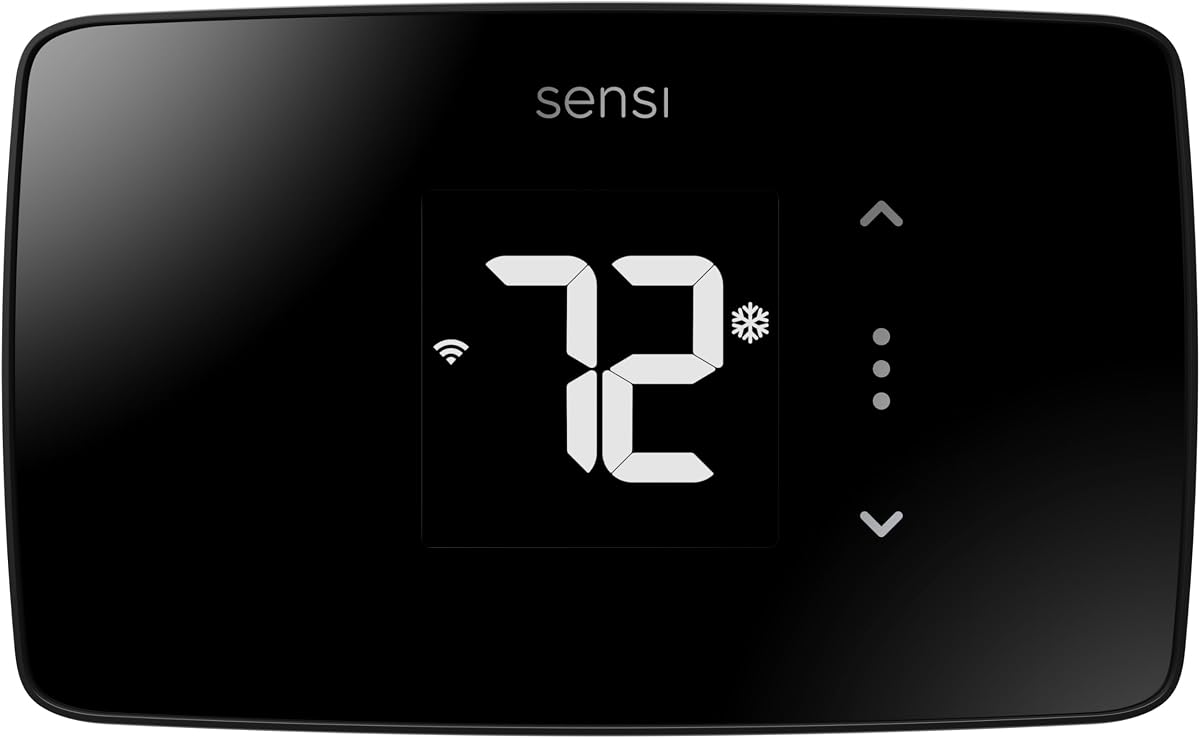
Sensi Lite Smart Thermostat ST25
4.0Editor score
Designed for no-wire homes
Geofencing and remote access
ENERGY STAR certified
Best smart thermostats without C wire: compare 10 leading options for installation, app control, scheduling, energy features, and HVAC compatibility.
Smart thermostats can add remote control, scheduling, usage reports, and voice control without requiring a new cable through the wall. The best models for older homes also work with typical low-voltage HVAC wiring, although a C wire or compatible power accessory may still be necessary for certain equipment.
This guide compares ten thermostats based on their stated no-C-wire support, installation requirements, app features, scheduling options, energy tools, display design, and smart-home compatibility. It also identifies products that require a C wire, so shoppers can avoid discovering an installation obstacle only after ordering.
Each review explains who the thermostat suits, what makes it useful, and where it falls short. The Sensi ST55, Sensi Lite ST25, and ecobee Smart Thermostat Premium stand out for different reasons, while several conventional models appear as compatibility warnings rather than genuine no-wire solutions. Product availability and prices change, so verify current details before purchasing.
4.0Editor score

4.4Editor score

4.3Editor score
The table below compares all ten models by their actual wiring requirements, core controls, and standout functions. Because several products require a C wire despite appearing in this category, compatibility status is shown first and should be checked against your own HVAC system before buying.


The Sensi Smart Thermostat ST55 is the strongest general recommendation for someone replacing a conventional thermostat without running a new C wire. It carries a 4.4 rating and distinguishes itself with uncomplicated installation, Wi-Fi control, flexible scheduling, and HVAC maintenance reporting. Its stated 23% energy-saving potential is based on ENERGY STAR certification and the use of features such as scheduling, remote access, and reports rather than a guarantee for every household.
We may earn a commission when you buy through this link, at no additional cost to you.
The most important advantage is its broad DIY appeal. Sensi includes a built-in level, while the app provides step-by-step instructions designed to help installers identify wires and complete setup. The product is also intended to fit the space occupied by a traditional thermostat, reducing the visual disruption associated with adding connected equipment. Privacy is another strength: the manufacturer states that it will not sell personal information to third parties.
There is no included remote temperature sensor, so comfort decisions depend on the thermostat's location. The product also does not work with every possible HVAC configuration without additional power. Its marketing says a common wire is not required in most applications, which is helpful but not the same as universal compatibility. Homeowners with heating-only, cooling-only, or heat-pump systems should still inspect their wiring and consult compatibility guidance.
Choose the ST55 when you want a familiar physical interface, meaningful app features, and a relatively conservative approach to installation. It is a better all-around choice than a thermostat that only works without a C wire under unusually specific circumstances. Confirm your HVAC type, photograph the existing wiring, and read the manufacturer's instructions before removing the old thermostat.
The built-in level and app-guided instructions reduce uncertainty for first-time installers. Because the faceplate is designed around the footprint of a standard thermostat, most users can also preserve the existing wall opening rather than patching and painting.
Flexible schedules, remote access, and usage reports give owners several ways to reduce unnecessary heating and cooling. The ST55 also sends equipment alerts and maintenance reminders, making it useful beyond basic temperature adjustment.
We may earn a commission when you buy through this link, at no additional cost to you.
The Sensi Lite ST25 is the value-oriented choice for homeowners who want connected temperature control without necessarily having a C wire. Its 4.0 rating reflects a simpler feature set than some premium competitors, but the essentials remain useful: Wi-Fi access, flexible scheduling, geofencing, remote control, and energy-use reports. It is also ENERGY STAR certified and explicitly designed to work without a C wire in most homes.
We may earn a commission when you buy through this link, at no additional cost to you.
Sensi's mobile app is designed for both Android and iOS devices, allowing users to change the temperature and review activity away from home. Geofencing adds a convenient layer of automation by adjusting comfort based on a phone's location, while schedules remain useful for occupants with predictable routines. The manufacturer's privacy statement also says thermostat activity is not leveraged for targeted advertising.
The critical limitation appears in the common-wire requirements. Some heating-only, cooling-only, and heat-pump systems need a C wire or another compatible power accessory. The word 'most' is doing important work in the product description, so a standard gas or central air system may be a straightforward installation while a heat pump is not. Verify wiring requirements before making an order based on compatibility alone.
The ST25 is best for a straightforward first smart-thermostat upgrade. It omits some of the premium model's extras, yet its scheduling, geofencing, and remote access cover the features most households use daily. It is a sensible selection when the priority is economical connected control rather than a large display or integrated speaker.
Geofencing can reduce heating and cooling when nobody is home, while a custom schedule provides more direct control. These functions make the ST25 useful even for users who do not want to manage their thermostat through a voice assistant every day.
A no-C-wire design does not override every electrical requirement. Heat pumps and single-stage heating or cooling setups can have different power needs, making an early compatibility check essential.
We may earn a commission when you buy through this link, at no additional cost to you.
The product listed as Smart Thermostat, No C Wire Required is distinctive because its central selling point is the absence of a C wire rather than compatibility as a secondary feature. It offers a color LCD, mobile app management, Wi-Fi operation, programmable heating, and stable remote temperature adjustment. It is marketed particularly for home offices and hotels where remote oversight may be valuable.
We may earn a commission when you buy through this link, at no additional cost to you.
Its app lets users adjust the environment without physical access, and the scheduling functions support more consistent heating. The product description specifically references floor-heating systems and precise temperature regulation, giving it a somewhat different positioning from conventional residential HVAC thermostats. A durable ABS body is intended to blend into the surrounding space while remaining practical for regular use.
The principal drawback is limited evidence in the supplied listing: there is no numeric customer rating, and the description provides less detail about broad HVAC compatibility, voice-assistant platforms, energy reports, and security integration. Prospective buyers should examine the seller information, documentation, wiring requirements, and return terms before choosing an established platform. It may be especially relevant to a floor-heating setup rather than a conventional forced-air home.
This thermostat is worth considering when the C wire is genuinely unavailable, the installation has a straightforward heating or floor-heating configuration, and mobile remote control is the priority. The hardware claims align with the keyword, but a buyer should not treat the lack of a listed C wire as proof that every system will work. A qualified installer can confirm the terminal arrangement and power source.
The color LCD provides a more visual way to read the current setting and programmed information than a minimal monochrome display. It may appeal to users who want obvious status feedback at a glance.
Mobile app management suits offices, guest properties, and other spaces where checking or changing the temperature remotely is valuable. Scheduling adds a second layer of control for routine operating periods.
We may earn a commission when you buy through this link, at no additional cost to you.
The Google Nest Thermostat in Snow is an attractive option for households already invested in Google Home. It has a 4.1 rating and works without a C wire in most homes, although heating-only, cooling-only, zone-controlled, and heat-pump systems may require a C wire or another compatible power accessory. The distinction between the widely installed Nest and newer Nest models should be kept in mind when comparing feature lists.
We may earn a commission when you buy through this link, at no additional cost to you.
Its strongest everyday behavior is automatic temperature reduction when the home is empty. Users can create an energy-efficient schedule in the Google Home app on Android or iPhone, and family members can make changes remotely from a phone, laptop, or tablet. Savings Finder examines the schedule and suggests possible adjustments, while HVAC monitoring can alert the user when equipment behavior appears abnormal and provide maintenance reminders.
Google Home and Matter-certified voice assistants provide broad smart-home compatibility. Google Assistant and Alexa can be used through compatible smart devices for voice temperature control, although the thermostat itself does not need a built-in speaker like the ecobee Premium. Nest Renew may also prioritize usage during periods when energy is cleaner or less expensive, depending on service availability.
The Nest is a strong recommendation for a Google-centered home with standard equipment and a straightforward wiring setup. It should not be selected for a heat pump or unusual HVAC configuration without checking the online Nest Compatibility Checker first. Buyers who want to see and manage a full-home energy usage history may also appreciate the reporting and suggestion tools.
Control through Google Home, the mobile app, Google Assistant, and compatible Matter assistants makes the Nest easy to incorporate into an established connected home. It works especially naturally for users who already rely on Google's routines and services.
HVAC monitoring, maintenance reminders, and Savings Finder recommendations help users understand how the thermostat affects system operation. These functions make the device more useful after the basic installation is complete.
We may earn a commission when you buy through this link, at no additional cost to you.
The Sensi Lite ST25W offers the same core approach as the ST25: an affordable connected thermostat designed for many homes without a common C wire. Its 4.0 rating, ENERGY STAR certification, and inclusion of app scheduling, geofencing, remote access, and usage reports make it a credible option for budget-conscious buyers.
We may earn a commission when you buy through this link, at no additional cost to you.
The built-in level and step-by-step guidance support DIY installation, and the device is designed to work with the HVAC equipment found in most homes. A mobile app for Android and iOS provides the main control interface. The manufacturer also states that Sensi will not sell personal information to third parties or use thermostat activity for targeted advertising.
As with the ST25, compatibility language needs careful interpretation. Heating-only, cooling-only, and heat-pump systems may require a C wire or a compatible power accessory. Because the ST25W is a closely related model, purchasers should compare the specific model and included accessories rather than assuming the appearance on the listing guarantees a particular installation path.
Choose the ST25W when you prioritize Sensi's app, scheduling, and no-wire approach over a premium display or extra sensors. It may be especially useful in a rental, secondary home, or older house where pulling a new wire would be disruptive. Confirm the system type and compare the model's current package contents before finalizing the purchase.
Remote access, geofencing, flexible schedules, and usage reports cover the core functions expected from a modern smart thermostat. The interface is available on both major mobile operating systems.
A built-in level and app-led instructions help reduce installation uncertainty, particularly for people replacing a standard residential thermostat. Existing openings can generally remain undisturbed.
We may earn a commission when you buy through this link, at no additional cost to you.
The Honeywell Home RTH9585WF1004 is an excellent smart thermostat in many respects, but it does not belong in a strict no-C-wire buying shortlist because the manufacturer explicitly states that a C wire is required. Its 4.3 rating, large color touchscreen, flexible programming, energy reports, and voice-platform support still make it worth understanding as a compatibility comparison.
We may earn a commission when you buy through this link, at no additional cost to you.
The display is bright and easy to read, and programmable scheduling can accommodate different workdays, weekends, utility rate periods, or household routines. Monthly energy reports and personalized reduction tips help users review consumption. Eligible customers may also be able to join a local utility demand-response program that slightly adjusts heating or cooling during periods of high demand.
Compatibility is more restrictive than the headline smart features might suggest. The unit works with forced-air gas, oil, or electric systems, hot-water and steam heating, and heat pumps with electric backup. It does not support 120–240V electric baseboard heat, and heating-only oil furnaces require a C wire. It also works with most heat-and-cool oil furnace systems.
This model makes sense for a homeowner who can run a C wire, wants a large color screen, and values utility participation. It does not solve the central obstacle of this guide. If your wall lacks a common wire but your HVAC equipment can use an approved Honeywell power adapter, that accessory may enable installation, though the buyer should confirm support before buying.
The touchscreen provides an immediately readable control surface and makes schedule adjustments more direct. It is especially suitable for users who prefer visible menus over app-only setup.
Demand-response enrollment and peak-rate-oriented programming can make the thermostat more relevant to homeowners participating in regional energy programs. Availability depends on the local utility and household eligibility.
We may earn a commission when you buy through this link, at no additional cost to you.
The ecobee Smart Thermostat Premium is the most feature-rich choice in this guide and the clearest premium answer for a home without a C wire. It has a 4.3 rating and, importantly, includes a Power Extender Kit for homes without a common wire. It also includes a SmartSensor, a trim kit, and the components needed for a DIY installation, reducing the risk that buyers must immediately purchase missing essentials.
We may earn a commission when you buy through this link, at no additional cost to you.
The included sensor detects which room is actually occupied and uses that information to address hot or cold spots. The thermostat also has radar occupancy detection, allowing it to preheat or precool the home before arrival and automatically adjust when occupants are home or sleeping. Its built-in air quality monitor can issue alerts, offer improvement tips, and remind users to change the furnace filter.
The built-in Alexa speaker expands the device beyond climate control. It can handle voice commands, stream music or podcasts, and listen for smoke-alarm sounds when an ecobee Smart Security subscription is active. Siri use requires an Apple home hub, while the Premium's camera and two-way talk function requires a compatible ecobee Smart Doorbell Camera. These optional services make it important to distinguish standard functions from subscription-dependent extras.
Choose the Premium when a no-C-wire installation must be self-contained, room-level comfort matters, and integrated voice control is worth the premium position. It is also useful for users who want ongoing HVAC, air-quality, and maintenance information in one device. Confirm HVAC compatibility and review any security subscription requirements before installation.
The SmartSensor reduces reliance on a hallway reading by measuring where occupants actually spend time. This is valuable in homes with uneven temperatures, multiple bedrooms, or frequently changing daily routines.
A built-in Alexa speaker turns the thermostat into a useful smart-home hub, while the air-quality monitor adds household alerts that a basic thermostat cannot provide. Subscription-dependent security functions should be evaluated separately from standard features.
We may earn a commission when you buy through this link, at no additional cost to you.
The Honeywell Home T5 Smart Wi-Fi Thermostat combines schedule-based control with geofencing, but it is not a native no-C-wire product. Its 4.2 rating is supported by useful features such as seven-day programming, automatic home and away modes, monthly energy reports, and ENERGY STAR certification. The installation requirement is the main reason it appears in this comparison with a clear caution.
We may earn a commission when you buy through this link, at no additional cost to you.
Geofencing uses a smartphone's location to recognize when occupants leave and return, allowing the system to adjust the home automatically. Users can instead rely on a seven-day schedule, making the thermostat adaptable to workdays, weekends, and changing plans. The stated use of scheduling saved customers between 8% and 16% on heating and cooling bills, although actual results vary with consumption and household behavior.
The product requires a C wire power adapter according to the supplied information. It works with most heat-and-cool oil furnace systems but not heating-only oil furnaces unless a C wire is present. Before buying, Honeywell recommends checking compatibility and determining whether the home needs the adapter. This makes the T5 more appropriate for a planned installation than a quick replacement in an older wiring setup.
Choose the T5 if you want a proven scheduling approach, location-based automation, and energy reports and can provide the required power solution. Do not choose it merely because the word 'smart' appears in its name when the key requirement is avoiding new wiring. Confirm the HVAC type and adapter compatibility before ordering.
The thermostat can follow a recurring weekly program or adjust according to phone location. Offering both approaches helps users balance predictability with changes in daily routine.
The required power adapter means this model is not a direct answer for a home that cannot accommodate a C wire or approved accessory. Compatibility depends on both wiring and the type of furnace or HVAC equipment.
We may earn a commission when you buy through this link, at no additional cost to you.
The ecobee Smart Thermostat Essential is a flexible middle ground for people who want ecobee's app, touchscreen, and automation but may not need the Premium model's speaker and included sensor. It has a 4.2 rating, is ENERGY STAR certified, and supports no-wire homes through the ecobee Power Extender Kit, although that kit and a trim kit are sold separately.
We may earn a commission when you buy through this link, at no additional cost to you.
Users can control the thermostat through its color touchscreen or the ecobee app, and free software upgrades are intended to extend the product's useful life. It works with Apple HomeKit, Google Assistant, and Alexa, making it less dependent on one connected-home ecosystem. Its schedule assistant and time-of-use feature can preheat or precool when energy is less expensive.
The Essential includes indoor humidity detection and can support a SmartSensor in rooms that matter most, but the sensor is also sold separately. Its stated compatibility reaches 85% of systems, and the manufacturer recommends using its online compatibility checker. The device works with most 24 VAC gas, oil, electric, dual-fuel, forced-air, conventional, heat-pump, and boiler equipment, but the total percentage should never replace an individual system check.
Choose the Essential when you want a modern touchscreen and expandable room sensing without paying for the Premium package. If your home lacks a C wire, include the cost and availability of the separately sold Power Extender Kit in your decision. It is also important to distinguish included hardware from optional accessories when comparing the listing with alternatives.
The combination of a physical color display, mobile app, and support for major smart-home platforms gives the Essential flexibility. It works well for households that do not want their climate controls tied to a single ecosystem.
SmartSensor support can improve comfort in occupied rooms, while the separate Power Extender Kit addresses homes without a C wire. Buyers should purchase these accessories only after confirming compatibility with their equipment.
We may earn a commission when you buy through this link, at no additional cost to you.
The Honeywell Home 7 Day Programmable Touchscreen Thermostat is not a Wi-Fi thermostat, so it does not satisfy the smart-connected part of this category. It does, however, offer a useful alternative for a home that lacks a C wire and values automated scheduling over app control. Its 4.4 rating is supported by a bright display, flexible programming, Smart Response Learning, and broad HVAC compatibility.
We may earn a commission when you buy through this link, at no additional cost to you.
Users can program heating and cooling for individual days, the weekend, or the entire week. The thermostat senses when the home needs heating or cooling and learns cycle times to reach the desired temperature when expected. A backlit blue display shows indoor temperature and humidity, while on-screen air-filter reminders add basic maintenance guidance. Settings remain saved through a permanent day-and-time backup during a power outage.
The major advantage is flexible power operation. It can use batteries or a hard-wired source, making it easier to accommodate in homes without a C wire. Compatibility is broad: it supports single-stage and multistage heating and cooling, heating-only and cooling-only systems, furnaces, central air, heat pumps with or without auxiliary heat, hot-water and steam or gravity systems, 750 millivolt systems, and gas fireplaces.
Choose this model if you want a programmable thermostat with learning behavior but do not need remote access, energy reports, or voice control. It should not be called a smart thermostat in the Wi-Fi sense, and that limitation should be central to the purchasing decision. Verify the receiver package and terminal configuration with the installation instructions for the exact model.
Smart Response Learning adjusts to heating and cooling cycle times, while a seven-day program provides consistent control. These features offer automation without a cloud account, app, or voice service.
Battery operation can make replacement easier in a home without a common wire, while hard-wired operation remains available. Check the receiver, equipment type, and manufacturer instructions before removing the existing thermostat.
We may earn a commission when you buy through this link, at no additional cost to you.
Choosing a thermostat for a home without a common C wire requires more than checking the product title. Compare wiring behavior, HVAC type, power requirements, app quality, scheduling, sensor placement, and any accessories that must be purchased separately.
A C wire, also called a common or power wire, supplies continuous electrical power to many thermostats. Some battery-operated smart thermostats can operate without it, but only when the HVAC system and existing wiring provide enough power. The phrase 'works without a C wire in most homes' is promising but not absolute. Heating-only systems, cooling-only systems, zone-controlled equipment, and heat pumps are repeatedly identified as situations that may need a C wire or another compatible power accessory.
Check every product against the exact equipment in your home. Determine whether the system is gas, oil, electric, dual-fuel, forced air, boiler, or a heat pump, and note the number of heating and cooling stages. Use the manufacturer's compatibility checker when available, and read the installation guide rather than relying on a product badge. A thermostat that works in a standard central-air home may still be unsuitable for a heat-pump installation.
In short, no wire in most homes is not the same as no wire in every home. Verify compatibility before ordering.
When a thermostat does not accept a C wire, a manufacturer-approved power adapter may draw power from the heating system or another compatible source. The ecobee Premium includes a Power Extender Kit, while the Essential supports the kit as a separate purchase. Other products, including the Sensi models, may work without a common wire because of their power design, but their listings still warn that some systems require an accessory.
Do not assume any generic adapter is interchangeable. A power accessory should be approved for the thermostat and compatible with the equipment, and installing one may involve additional wiring work. If you are uncomfortable identifying terminals or working inside the HVAC cabinet, ask a qualified HVAC professional to inspect the system.
In short, an included or approved power accessory is a meaningful advantage, but compatibility remains system-specific. Check the full package and equipment requirements.
A good smart thermostat should make automation understandable without requiring constant manual adjustments. Flexible weekly schedules suit households with regular routines, while geofencing can reduce unnecessary conditioning when a phone detects that the user has left. Remote access is valuable for rentals, offices, second homes, and unexpected schedule changes. The Sensi ST25 and ST25W include geofencing, as do the Google Nest and Honeywell T5.
Look for a stable app, clear schedule editing, and a way to override automation temporarily. Energy-use reports and savings suggestions can help identify whether the schedule actually reflects occupancy patterns. Be wary of relying on a manufacturer's claimed savings percentage, which is not guaranteed for every household.
In short, prioritize an app that supports the routines you actually use and makes temporary overrides simple. Test the app before committing to a schedule.
The most capable thermostat is not automatically the best choice for every home. Basic buyers may prioritize easy scheduling, remote access, and low power requirements. Households with uneven temperatures may value a remote room sensor, making the ecobee Premium more relevant. Users interested in voice assistance, audio streaming, air-quality alerts, or door-camera communication will find a broader feature set in that same model.
Some advanced capabilities depend on subscriptions, compatible hardware, or third-party services. The ecobee Premium's security listening and door-camera features require compatible ecobee products and, for security functions, a Smart Security subscription. Siri support requires an Apple home hub. Nest Renew and utility programs depend on location and provider availability.
In short, separate standard features from optional or subscription-based ones. Choose added capabilities only when they solve a problem in your home.
DIY installation is easier when the product includes a physical level, clear terminal labels, and step-by-step app guidance. The Sensi ST55, ST25, and ST25W emphasize these elements, while the ecobee Premium includes a Power Extender Kit and trim kit. Existing thermostat size can also matter: a device that fits the traditional opening reduces painting and wall repair.
Before starting, photograph the existing wires, identify the current thermostat's model, and read both the new product's compatibility guide and the HVAC manufacturer's instructions. Do not assume wire colors will be identical in every installation. If the equipment has unusual terminals, a proprietary controller, or integrated zoning, consult a professional before disconnecting anything.
In short, good instructions help, but they do not replace careful wiring identification. Photograph the setup and verify every terminal before installation.
The best interface is the one household members will use comfortably. The Honeywell RTH9585WF1004 offers a bright color touchscreen, the ecobee models use color touchscreens, and the Sensi ST55 retains a traditional button-based layout in a familiar footprint. The no-C-wire product with an LCD color screen prioritizes visibility and direct status feedback.
Consider glare, viewing angle, button size, and whether family members need access without a phone. A display that looks attractive is less important if schedules are difficult to edit or the device sits in direct sunlight. Voice control and mobile apps can reduce the need for frequent physical interaction, but they should complement rather than replace a clear local display.
In short, prioritize readability and ease of adjustment over decorative screens. A simpler thermostat that everyone understands may work better for a family.
ENERGY STAR certification, usage reports, maintenance reminders, and equipment alerts can make a smart thermostat more useful over time. Sensi models provide usage reports, alerts, and filter reminders, while Honeywell models add monthly energy reports and personalized reduction tips. The ecobee Premium adds indoor air-quality alerts and filter reminders, while the Essential includes humidity detection and time-of-use preheating or precooling.
These tools do not guarantee a specific reduction in household energy use. Results depend on the building, equipment, schedule, occupancy, climate, and user settings. Utility rebates, demand-response programs, and clean-energy programs may also be available, but eligibility and availability vary by provider and location.
In short, energy features are most useful when you review them and act on the recommendations. Treat manufacturer savings claims as potential, not a promise.
A thermostat reads the temperature where it is installed, which may not represent the rooms people occupy. The ecobee Premium includes a SmartSensor, while the Essential supports optional sensors sold separately. If bedrooms, upstairs spaces, or sunlit rooms have different conditions, a remote sensor can improve comfort. It can also help the system make more informed occupancy-based adjustments.
Accessories should be considered as part of the complete purchase. The ecobee Essential lists its Power Extender Kit and trim kit as separate items, whereas the Premium package includes the relevant kit. The ecobee Premium SmartSensor is also listed as having a stated value in the product description, but optional SmartSensor packs for the Essential remain an added expense.
In short, account for every item needed to complete the installation and improve comfort. A lower thermostat price can still lead to a higher total cost once required accessories are included.
Begin by identifying the HVAC system, photographing the current wiring, and checking the new thermostat's compatibility guide. Turn off the HVAC equipment at the appropriate breaker or switch, remove the old faceplate, and label each wire according to the instructions for both devices. Never rely solely on wire color because installations can differ. If the terminal arrangement is unclear, stop and obtain professional assistance.
Install the thermostat according to its manufacturer instructions, including the built-in level where provided. Connect only the approved wires, attach the faceplate, restore power, and follow the app's setup sequence. Set the equipment mode correctly, confirm that the app detects the thermostat, test heating and cooling, and then create a schedule that reflects normal occupancy. Enable geofencing or away behavior only after testing basic heating and cooling.
For care, clean the thermostat gently with a dry or lightly damp cloth and keep the vents around the room open. Review monthly energy reports, equipment alerts, filter reminders, and schedule suggestions. Check app permissions, account security, and connected-service subscriptions periodically. For a traditional thermostat, note the filter-change interval and arrange prompt replacement; for a smart thermostat, acknowledge alerts while still following the HVAC manufacturer's maintenance guidance.
Yes, many smart thermostats can operate without a C wire by using compatible existing wiring or an approved power accessory. The arrangement depends on the thermostat and the HVAC system, not just the home's age. Heating-only, cooling-only, heat-pump, and zone-controlled systems may need a C wire or another supported power solution. Always run the manufacturer's compatibility checker before purchasing.
The C wire is the common power wire found in many low-voltage HVAC systems, and it continuously powers the thermostat. Some smart thermostats can operate from batteries and do not require that continuous power. Others include a power extender or can work with an approved adapter. The requirement depends on both the thermostat model and the equipment it will control.
The ecobee Smart Thermostat Premium includes a Power Extender Kit for homes without a C wire, along with a trim kit. The ecobee Smart Thermostat Essential supports the same type of kit, but the supplied information says it is sold separately. The Sensi ST55, ST25, and ST25W are designed to avoid a C wire in many installations but may still require another compatible accessory for certain systems.
Not always. The Sensi Lite models explicitly warn that some heat-pump systems need a C wire or compatible power accessory, and the Google Nest has the same type of exception. Heat pumps can use different wiring arrangements and equipment configurations, so compatibility must be checked against the exact model. Do not assume a conventional forced-air installation guide applies.
No. A properly programmed conventional thermostat can also reduce unnecessary heating and cooling. Smart controls can make scheduling, away behavior, and remote adjustments easier, but technology alone does not guarantee savings. Occupancy, insulation, equipment condition, climate, and user settings all influence energy consumption.
Many compatible installations can be completed by homeowners because several products include a built-in level and app-led instructions. The essential steps are identifying the system, labeling wires, observing power warnings, and following both installation guides. Stop if the wiring does not match the manual, the equipment has unusual controls, or you are unsure which terminal carries power.
It is most compelling for households that want an included room sensor, a power extender, occupancy-based comfort, air-quality alerts, and a built-in voice speaker. It can reduce the need for separate accessories in a home without a C wire. Users who only need remote scheduling may find the Essential or Sensi options more focused and less expensive.
Generally, no. The Honeywell 7 Day Programmable Touchscreen offers scheduling and learning behavior but does not provide app control, remote access, or voice-assistant integration. It belongs in this roundup as a useful non-Wi-Fi alternative for homeowners whose main requirement is avoiding a C wire. The term 'smart' usually implies connected control in current buying guides.
The Sensi Smart Thermostat ST55 is the best overall option because it combines broad no-C-wire applicability with a familiar interface, clear DIY support, remote access, scheduling, and usage reports. The Sensi Lite ST25 is the best budget choice for shoppers focused on core automation, while the ecobee Smart Thermostat Premium is the best premium option because it includes a Power Extender Kit, a room sensor, occupancy sensing, and a built-in voice speaker.
Prioritize actual equipment compatibility over a broad 'works without a C wire' claim. Determine your HVAC type, inspect the existing wires, and check whether a C wire, manufacturer-approved power accessory, or included extender is required. Then choose based on the functions you will regularly use, such as scheduling, geofencing, remote access, room sensing, energy reports, or voice control.
Product listings, package contents, features, and prices can change, so review the current manufacturer instructions and listing before ordering. Taking a few minutes to verify the thermostat's compatibility with your wiring, equipment, app, and optional services can prevent a difficult installation or an unexpected accessory purchase.
