
4-Pack SG90 Micro Servo
4.2Editor score
Four micro servos
1.6 kg-cm torque
4.2–6V operation
Arduino and Raspberry Pi ready
Discover the best servo motors for robotics, compared for torque, speed, control, durability, compatibility, and project suitability.
Servo motors for robotics must combine controlled movement, useful torque, accurate positioning, and dependable operation. A servo that performs well in a small demonstration may struggle with a heavier arm, gripper, steering assembly, or articulated chassis. The right choice also depends on control voltage, PWM behavior, gear construction, feedback requirements, and whether the project needs one motor or a complete coordinated system.
This guide compares ten products spanning compact SG90 micro servos, heavy-duty digital servos, testing equipment, multi-servo kits, and an open-source robotic arm platform. We compared the supplied specifications, stated applications, torque, speed, electrical requirements, control methods, and included components. The list helps separate lightweight hobby motors from high-output actuators and complete robotics platforms.
Each review identifies the product's strongest use, practical limitations, and ideal buyer. Ratings reflect the supplied customer feedback, while technical details are based on the listed product information. Servo performance can depend heavily on the power supply, linkage load, control signal, and mechanical balance, so real-world results may vary. Product prices and availability can change, so check current listings before purchasing.
4.2Editor score

4.8Editor score
4.3Editor score
The comparison covers compact hobby servos, heavy-duty digital actuators, testing equipment, and complete robotic-arm systems, with emphasis on torque, speed, control, construction, and intended applications.




This 25KG full-metal-gear digital servo is positioned for robotic arms, industrial equipment, humanoid robots, and other mechanisms that need considerably more holding power than an SG90 can provide. It carries a 4.5 rating, with a listed maximum torque of 34.5 kg-cm at 6.8V and a speed of 0.17 seconds per 60 degrees. Those figures make it a strong candidate for medium-to-heavy joint work.
We may earn a commission when you buy through this link, at no additional cost to you.
The construction details are particularly relevant to robotics. The servo uses steel gears, a high-resolution digital chip, potentiometers, and a CNC aluminum center shell. Its listed angle range is 0 to 270 degrees, while the output can be rotated through 360 degrees when powered off. The long power lead and included U-brackets simplify installation around larger joints and steering mechanisms.
There are trade-offs. The stated 34.5 kg-cm figure is a maximum rating, and sustained performance will depend on voltage, linkage geometry, duty cycle, and the controller's power delivery. This unit is also much bulkier than a micro servo, making it less appropriate for tiny mechanisms. Nevertheless, the combination of torque, response speed, and metal gearing makes it a versatile actuator for serious robotic builds.
Choose this servo when your project needs meaningful joint torque without moving to an enclosed industrial actuator. It is well suited to articulated arms, bipedal mechanisms, tracked or wheeled robots, and RC-inspired platforms that can accommodate a standard heavy-duty servo. For compact educational robots, an SG90 model may be easier, but for load-bearing joints, this is the more convincing option.
The listed high-torque output gives robotic arms and jointed platforms more resistance to sagging or stalling than lightweight hobby servos. Aligning the load close to the pivot also reduces the leverage the motor must handle.
Full metal gearing, potentiometers, and digital control support repeatable positioning and durable response. The wide 270-degree operating range offers more freedom for unusual linkages and steering layouts.
We may earn a commission when you buy through this link, at no additional cost to you.
This four-pack of SG90 micro digital servos offers a practical starting point for small robots, pan-and-tilt mechanisms, steering controls, and basic articulated projects. Its 4.2 rating reflects solid utility for lightweight work, although it is not intended to compete with heavy-duty or magnetic-feedback systems. The compact 9G format is particularly useful when space and weight are primary constraints.
We may earn a commission when you buy through this link, at no additional cost to you.
Each servo operates from 4.2 to 6V, which broadens the available power options. At 4.8V, the listed torque is 1.6 kg-cm, with a response speed of 0.3 seconds per 60 degrees. The maximum travel is 180 degrees, making the units familiar to users of Arduino, Raspberry Pi, and standard RC control arrangements.
The main limitation is mechanical capacity. A 1.6 kg-cm output is suitable for small linkages and light duties but can strain under heavy arm sections, large grippers, or poorly balanced joints. The response speed is also slower than that of several other SG90 options in this comparison. Users must provide a stable signal and power arrangement appropriate to the number of connected servos.
This pack is best for learners, classroom exercises, small pan-tilt robots, and projects that need several inexpensive axes. It is less appropriate for a full-size robotic arm or any mechanism carrying a substantial load. For a first robotics build where simplicity, availability, and low power draw matter most, the four-pack provides a sensible starting point.
Four matching servos simplify projects that require several axes and allow a spare to remain available if one unit fails. They are particularly useful for introductory pan, tilt, steering, and small arm experiments.
The 4.2–6V operating range and compact form make these servos approachable for Arduino, Raspberry Pi, and RC-inspired robotics. Adequate supply current remains important when multiple motors move at once.
We may earn a commission when you buy through this link, at no additional cost to you.
The Hosyond ten-pack supplies a substantial fleet of compact SG90 analog servos for micro robots, robotic arms, helicopters, aircraft, and boats. With a 4.5 rating, it is especially attractive to builders who want many matching axes without assembling a mixed collection. The standard 9G format makes it familiar to the broad hobby robotics audience.
We may earn a commission when you buy through this link, at no additional cost to you.
Listed performance includes a no-load speed of 0.12 seconds per 60 degrees at 4.8V and 0.1 seconds per 60 degrees at 6V. Maximum rotation is 180 degrees, while stall torque is listed at 1 kg-cm. The stated 7-microsecond dead band provides a control-resolution reference, and the servos use JR and Futaba-compatible interfaces.
Its most important limitation is torque. At 1 kg-cm, it trails some of the other SG90 choices in this guide and should be reserved for light linkages, small aircraft surfaces, and modest mechanisms. The product information also warns that the analog servo needs a continuously supplied PWM signal and more than 1A of starting current. That makes power and signal reliability central to successful use.
This pack is a good fit for classroom fleets, multiaxis micro robots, and builders who prefer a single bulk purchase. It is not the strongest option for a gripper supporting noticeable weight or an arm with long sections. If your priority is many inexpensive axes rather than maximum small-servo torque, the package is convenient and versatile.
A ten-pack is useful when a robot requires many identical movement channels or when several servos may need replacement. It reduces the need to source each motor separately.
The listed no-load figures show quick travel, which can benefit small aircraft, boats, and micro-robot linkages. Actual speed and positioning stability change as mechanical load increases.
We may earn a commission when you buy through this link, at no additional cost to you.
This two-pack of RDS3225 digital servos stands out as the most balanced conventional servo in the list. Its 4.8 rating is the highest among the individual actuator-focused products, while the listed specifications combine 28 kg-cm of stall torque with a 0.17-second response at 6.8V. That combination suits robot arms, steering systems, crawler platforms, and other articulated projects.
We may earn a commission when you buy through this link, at no additional cost to you.
The dual-shaft design is central to the package's value. It offers a second output location for supported linkages, while the included long and short U-brackets, metal disks, and screws provide several installation options. Copper and aluminum gears, high-precision potentiometers, a CNC aluminum center shell, and waterproof rubber seals support the heavy-duty positioning.
The servo accepts 4.8 to 6.8V and follows a 500–2500-microsecond PWM range for 180-degree control. A 3-microsecond dead band is listed, along with fast heat dissipation and strong interference resistance. As with other high-output servos, real performance depends on a capable power source and a mechanically balanced load. It is also too large for the tiniest mechanisms.
This is the strongest general-purpose choice for a builder needing meaningful torque, precise PWM control, and flexible mounting. It works particularly well for medium robotic arms, crawler steering assemblies, and custom robot joints. Choose it when one compact micro servo would be too weak but a complete robotic platform would be unnecessary.
A dual-shaft output gives a builder more ways to transmit motion than a standard single-output servo. The included disks and brackets make it easier to adapt the servo to steering horns, joints, or custom linkages.
Waterproof rubber seals and a metal-based construction make this pack more appropriate for outdoor robots and crawler vehicles. Electrical protection still depends on correct wiring, voltage, and weather management around the connections.
We may earn a commission when you buy through this link, at no additional cost to you.
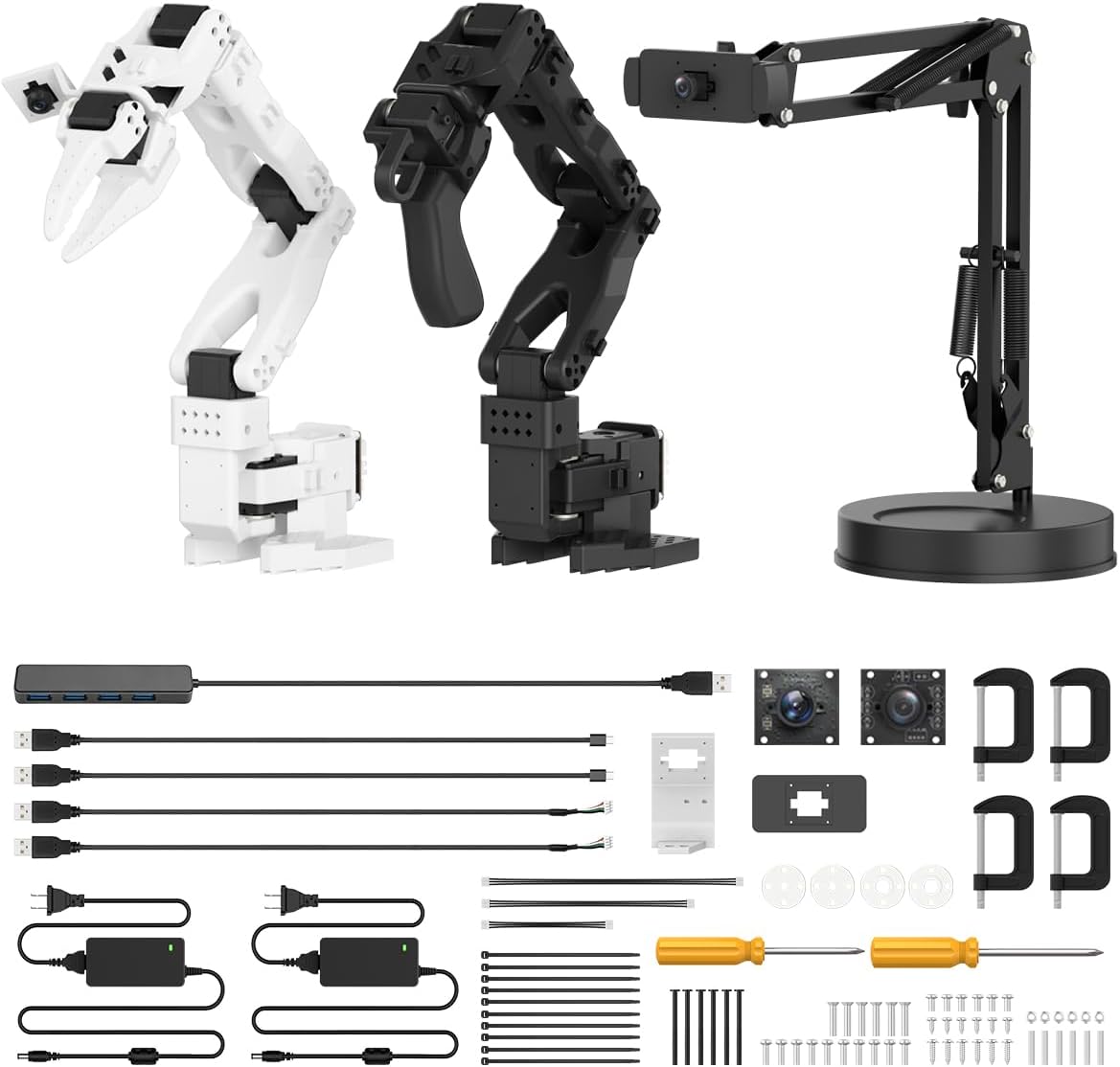
The Hiwonder SO-ARM101 is more than a collection of servos: it is an assembled six-axis robotic-arm platform designed for embodied AI, imitation learning, and advanced manipulation experiments. Its 4.3 rating reflects a feature-rich system rather than a basic actuator. The kit includes twelve high-torque bus servos with magnetic feedback, a 3D-printed part, and vision hardware.
We may earn a commission when you buy through this link, at no additional cost to you.
Two cameras support the development process. A gripper-mounted camera assists with precise manipulation, while an external camera provides environmental awareness. The arm is compatible with the LeRobot open-source framework, giving developers access to shared code, templates, and pre-trained models rather than requiring every software layer to be built from the ground up.
The twelve magnetic-feedback bus servos are intended to deliver smooth, stable movement and avoid power-deficiency and jitter problems associated with less integrated systems. A BusLinker V3.0 debugging board supports servo scanning, real-time status monitoring, trajectory control, calibration, and debugging through the included PC software. This level of integration is the product's defining advantage.
This platform is ideal for researchers, advanced makers, and educators working on imitation learning or vision-guided manipulation. It is not a practical choice for someone seeking one inexpensive servo or a simple pan-and-tilt mechanism. The advanced toolchain, specialized bus control, and larger system design create a steeper setup path, but offer a far more complete robotics platform.
Magnetic-feedback servos give the control system position information that supports smooth movement across the arm. That integration is valuable when precision and repeatability matter more than standalone actuator cost.
The paired camera arrangement supports manipulation and scene awareness within an open-source development workflow. This makes the kit more useful for structured AI experiments than for basic servo demonstrations.
We may earn a commission when you buy through this link, at no additional cost to you.
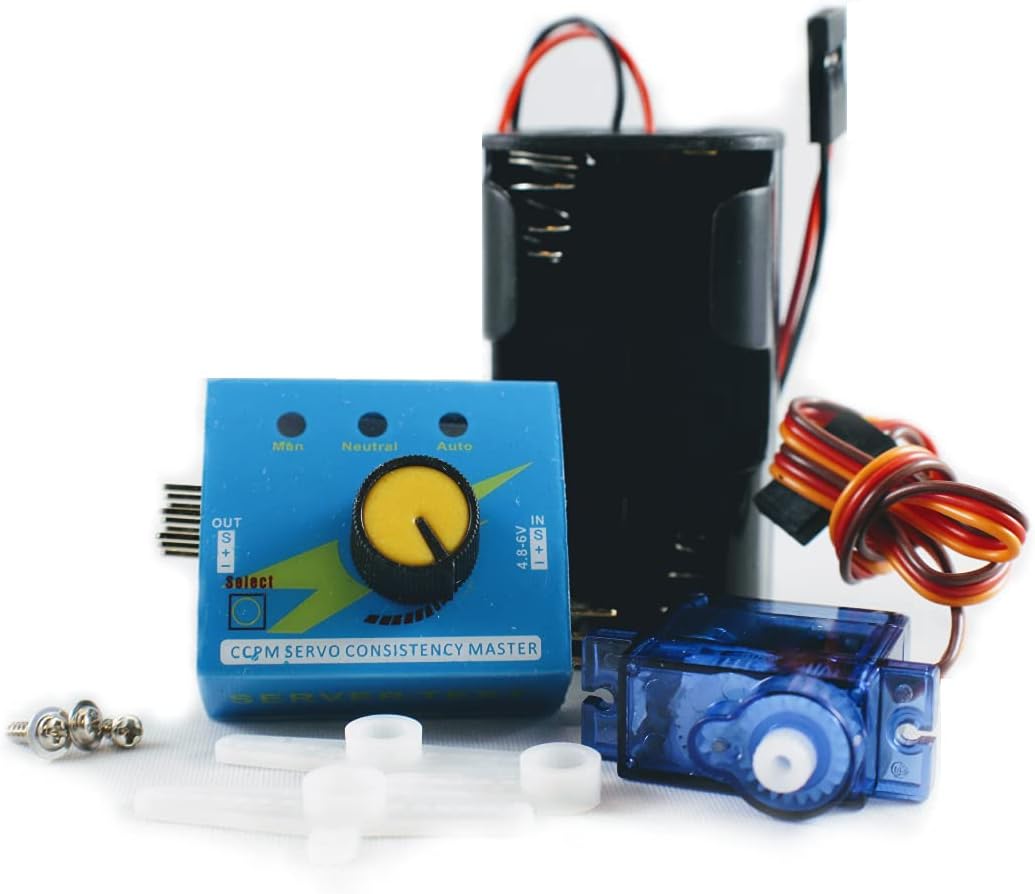
This servo motor tester kit is designed to simplify the first stages of a robotics project. It combines a 180-degree 9G servo, an RC servo tester, a four-cell AA battery holder, and three types of servo horns. Its 4.4 rating indicates a useful and approachable package for experimenting, centering mechanisms, and checking basic servo movement.
We may earn a commission when you buy through this link, at no additional cost to you.
The tester offers manual/dial, neutral, and automatic modes. Its own indicated range of motion is approximately 45–135 degrees, making it a centering and functional-check device rather than a full-range motion controller for the entire build. The battery holder produces 6V for the tester and included servo, reducing the need for additional bench equipment during initial setup.
The included 9G servo itself covers 0–180 degrees, and the servo horns support different attachment arrangements. The product information says each component is individually hand tested, which adds confidence that the kit arrives functional. Nevertheless, the included servo remains a light-duty component, and the tester does not add torque, current capacity, or advanced telemetry to the servo itself.
Choose this kit for students, first-time builders, or anyone who wants a simple way to center a servo horn and verify movement before integrating it into a larger machine. It is particularly helpful when a project uses a mix of servos and ESCs. For developed robotics requiring feedback, higher current, or coordinated control, the tester should be viewed as a starting accessory rather than the final control system.
The neutral mode helps establish a predictable reference position before fitting a horn to a steering or joint mechanism. This reduces the chance of a linkage binding against its own limits.
The AA battery holder allows basic checks away from a permanent workbench. It is useful for quick validation, although a project-grade supply will eventually be needed for repeated or loaded operation.
We may earn a commission when you buy through this link, at no additional cost to you.
The Smraza ten-pack upgrades the familiar SG90 format with metal pinion gears and stronger stated torque than many competing micro servos. Its 4.4 rating makes it a credible middle ground between inexpensive light servos and much larger heavy-duty actuators. It is aimed at compact robots, small robotic arms, RC aircraft, gliders, and boats.
We may earn a commission when you buy through this link, at no additional cost to you.
The listed maximum torque is 1.9 kg-cm, and the stated operating speed reaches 0.08 seconds per 60 degrees. Its 180-degree range and five-microsecond dead band provide useful control references, while the metal pinion and shaft are intended to resist the tooth breakage and heat deformation associated with plastic-gear versions. The package also includes servo arms and 24.5 mm leads.
The product supports straightforward three-wire PWM hookups and is compatible with JR and Futaba receivers, making it approachable for Arduino and Raspberry Pi builds. One caution is significant: it requires a continuous PWM signal, and the power supply must support more than 1A of starting current. Even with a 1.9 kg-cm rating, long arms or large grippers can create excessive leverage.
This kit is an excellent choice for small robots that need more speed and gear durability than a basic SG90 provides. It works particularly well for lightweight aircraft mechanisms, compact arms, and steering systems. Builders should treat it as a micro servo, however, and move to a 25KG or 45KG class unit when the mechanism carries a meaningful load.
The upgraded metal pinion targets a common weak point in small servos: gear tooth wear and heat-related deformation. It is still not equivalent to the full metal gearing used by heavy-duty models.
A listed 0.08-second response is useful for small fast-moving parts. Responsiveness is most apparent on lightly loaded linkages, so balanced mechanisms remain important.
We may earn a commission when you buy through this link, at no additional cost to you.
This two-pack of 45KG digital servos provides the highest stated torque in the comparison. With a 4.9 rating, it is a strong option for demanding robotic arms, large steering mechanisms, crawler vehicles, monster-truck-style platforms, boats, and animatronic joints. The listed maximum stall torque reaches 51 kg-cm at 8.4V, while speed reaches 0.11 seconds per 60 degrees.
We may earn a commission when you buy through this link, at no additional cost to you.
The servo uses a coreless motor, high-resolution digital chip, high-precision potentiometer, and hard-anodized stainless steel and aluminum gears. Its IP67 waterproof rating and CNC aluminum center shell add durability for outdoor or wet installations. At 40 by 20 by 38.5 millimeters, it retains a conventional servo footprint that many robot builders will recognize.
High output comes with requirements. The headline speed and torque figures are tied to an 8.4V operating condition, and the electronics need a supply capable of handling substantial current. As with any high-torque servo, continuous stall loads can generate heat, so the mechanism should be balanced and the servo should not be expected to hold a static overload indefinitely.
This is the appropriate pick for a builder whose joint is too demanding for a 25KG servo. It is especially relevant to outdoor robots, heavy steering assemblies, and articulated mechanisms that need substantial reserve torque. For small pan-tilt units or lightweight arms, however, this servo is unnecessarily large and demanding.
The 51 kg-cm listed stall torque gives heavily loaded joints a substantial margin. Mechanical balance still matters because long arms and offset payloads increase the force required at the shaft.
The IP67 rating makes this servo suitable for wet environments where ordinary hobby units would be more vulnerable. Connectors, exposed wiring, and the rest of the robot still need appropriate protection.
We may earn a commission when you buy through this link, at no additional cost to you.
The Hanaive sixteen-pack is one of the largest matching micro-servo collections in this guide. It is intended for classroom use, extensive multiaxis projects, micro robots, small arms, boats, and RC toys. Its 4.5 rating reflects a useful specification set, particularly the combination of compact size, 16 included motors, and a listed 0.08-second response.
We may earn a commission when you buy through this link, at no additional cost to you.
Each servo measures approximately 32 by 30.9 by 12.4 millimeters and provides 180 degrees of rotation. The listed stall torque is 1.6 kg-cm at 4.8V, with a five-microsecond dead band. No-load speed is stated as 0.1 seconds per 60 degrees at 4.8V and 0.08 seconds per 60 degrees at 6V. The package also includes multiple servo arms and fixing screws.
The manufacturer specifically cautions that the reduced pulling force makes these servos appropriate only for ordinary small electric aircraft, not large fixed-wing models or electric helicopters. That same limitation applies to robotic mechanisms: they are best reserved for light linkages. A common three-wire arrangement—red for power, brown for ground, and yellow for signal—simplifies hookup, while JR and Futaba interface support broadens compatibility.
This multipack is ideal for schools, makerspaces, and students who need many inexpensive servos. It can populate a line-following robot, a multi-joint teaching arm, or a set of small mechanisms without mixing motor specifications. It is not the right choice for high-torque gripping, long arms, or large steering forces; those projects call for a higher-output class.
Sixteen matching motors are useful when many students or many axes need identical parts. The included arms and screws simplify assembly of multiple small mechanisms.
The standard wire colors and interface support reduce setup confusion. Beginners should still use a regulated supply with sufficient current rather than powering several servos directly from a single controller pin.
We may earn a commission when you buy through this link, at no additional cost to you.
The 6DOF mechanical arm kit is aimed at college teaching, creator education, IDY production, and six-axis manipulator demonstrations. Its 2.8 rating is the lowest in the list, so buyers should evaluate the platform carefully rather than assuming it is a finished autonomous robot. The package provides a mechanical arm, claw, six MG996R metal-geared analog servos, and an assortment of hardware.
We may earn a commission when you buy through this link, at no additional cost to you.
Its structural design uses 2 mm aluminum plate for bracket fittings and imported cup bearings at the steering joints. The disc-shaped chassis is intended to support smooth left and right movement, while the six servo axes enable forward, backward, up, down, and gripping motions. The listed arrangement provides a useful mechanical base for learning how axes, linkages, and end-effectors interact.
The main drawback is that this is a kit and teaching platform rather than a polished, fully integrated product. It does not provide the vision, magnetic feedback, debugging board, or open-source AI integration found in the Hiwonder arm. Analog servos also lack some of the precision and stability associated with modern bus systems. The low rating indicates that some buyers may encounter setup or performance concerns.
Choose this kit for a classroom demonstration, an educational six-axis build, or a foundation that you intend to control and refine yourself. It is less suitable for a polished research platform or a finished product requiring sophisticated vision and coordinated feedback. The included servos and metal structure still offer a capable starting point for learning mechanical arm control.
The six-axis frame, metal claw, bearings, and varied brackets give students a substantial manipulator to study. It supports experimentation with forward kinematics, coordinate systems, and actuator placement.
Because the package uses analog MG996R servos, reliable operation depends on suitable control electronics, power, and programming. Buyers seeking a ready-made AI or vision platform should consider a more integrated alternative.
We may earn a commission when you buy through this link, at no additional cost to you.
A useful servo choice depends on the mechanism's load, required travel, available power, control system, and tolerance for size. Compare torque, speed, feedback, construction, and included hardware while keeping the entire robot's mechanical balance in view.
Torque is one of the most important specifications because the servo must move its attached load without stalling. Compact SG90 models commonly provide around 1 to 2 kg-cm, making them appropriate for small linkages, aircraft surfaces, and lightweight arms. The heavier digital options in this guide list substantially greater output, including 28 kg-cm for the RDS3225 dual-shaft pair and up to 51 kg-cm for the 45KG model. Those maximum figures represent stall capability under stated conditions, not continuous lifting capacity.
Account for leverage before comparing numbers. A load located far from the pivot demands much more torque than the same weight near the shaft. Link length, linkage angle, joint friction, and the weight of the servo horn all contribute. A mechanism close to its limit may become noisy, heat up, lose positioning accuracy, or stop moving, so selecting a servo with meaningful reserve is usually wiser than matching the calculated load exactly.
Speed is normally listed as the time required to travel 60 degrees. A quick servo can improve the appearance of a pan-tilt unit, small aircraft, or lightweight robot, but speed alone does not guarantee useful performance. A fast motor moving a poorly balanced mechanism can create vibration, stress the gears, and reduce the precision of the final position. High-torque servos with quick listed response may be better suited to articulated mechanisms that need both authority and prompt movement.
Consider the complete control loop rather than the no-load figure alone. Gear backlash, PWM resolution, signal quality, mechanical rigidity, and the controller's ability to issue rapid corrections all affect the result. The listed dead-band values on the SG90 products provide some indication of control sensitivity, but they should not be treated as a complete measure of positional accuracy.
Servo voltage requirements are not interchangeable across every product. The SG90 options generally operate in the 4.8–6V region, while the 45KG model lists its strongest performance at 8.4V. A supply that is too weak can cause jitter, slow movement, unexpected resets, or failed starts. A supply that is too high can damage a servo not designed for it, so use the specified operating range rather than assuming all robot motors tolerate the same voltage.
Current matters at least as much as voltage. Several product descriptions state that the included micro servos need more than 1A of starting current, and a large robot moving many servos simultaneously can demand far more. Use a supply sized for the combined load, route power appropriately, and avoid powering several high-current servos through a small controller regulator. Grounding and connector quality also affect stability.
Most hobby servos in this category are controlled with PWM, and several of the lighter products require a continuous signal. The RDS3225 uses a listed 500–2500-microsecond range for 180-degree movement, while micro servos commonly use standard JR or Futaba-style interfaces. Make sure the controller can generate the required pulse range and provide a stable common ground.
Feedback type changes what a platform can accomplish. The Hiwonder SO-ARM101 uses twelve magnetic-feedback bus servos, enabling the control system to monitor position and coordinate motion. The other conventional SG90 and MG996R-based products do not claim comparable external position feedback. For simple demonstrations, PWM may be sufficient; for vision-guided manipulation or smooth multi-axis movement, integrated feedback and debugging tools can be decisive.
Gear material matters when a small servo repeatedly starts, stops, or encounters an unexpected load. Several micro servos use plastic gearing, while the Smraza pack upgrades the pinion and shaft to metal. The high-output RDS3225 products use metal gear sets, and the 45KG model combines stainless steel and aluminum gears with a hard-anodized finish. These materials are generally better suited to repeated positioning and higher mechanical stress.
Housing construction also affects thermal management and environmental resistance. CNC aluminum center shells appear in several heavy-duty choices, while the 45KG model lists an IP67 waterproof rating and the RDS3225 uses rubber seals. Water resistance helps in outdoor robots, but exposed connectors and wiring remain vulnerable. For indoor tabletop mechanisms, housing strength and mounting rigidity may matter more than weather sealing.
The SG90 format is compact and lightweight, making it the natural choice for small robots and restricted mounting spaces. Heavy-duty servos deliver more torque but occupy considerably more volume and mass. That additional mass can matter in a small pan-tilt unit, while it is often insignificant on a large crawler or articulated arm. Measure the available space and consider the full horn and bracket dimensions, not only the servo body.
Mounting quality is just as important as motor output. Several products include U-brackets, metal disks, screws, and multiple horn options. The RDS3225 dual-shaft model in particular provides several bracket lengths for different linkages. A servo that cannot be mounted rigidly may vibrate or shift under load, reducing the benefit of its internal specifications.
Decide whether you need an actuator, a development tool, a mechanical kit, or a complete robotic platform. A single heavy-duty servo may fit an existing joint, while a six-axis arm kit provides a mechanical structure but still needs control integration. The Hiwonder SO-ARM101 goes further by adding bus servos, magnetic feedback, dual cameras, debugging hardware, and open-source compatibility. These are fundamentally different purchases even though all involve servos.
Match the product to the project's sophistication. Use micro servos for introductory controls and lightweight mechanisms, heavy-duty digital servos for loaded joints, and integrated platforms for AI or vision research. A tester kit can be valuable before those decisions are finalized because it helps validate basic movement and horn positioning with little setup.
Mounting hardware, horns, leads, and extension cables can determine whether a servo is immediately usable. The RDS3225 dual-shaft pack includes long and short U-brackets, metal disks, and screws. The Smraza and Hanaive packs include servo arms, while the 6DOF arm provides a broad collection of mechanical fittings. These accessories reduce adaptation work and help maintain more rigid linkages.
Documentation and control tools are equally valuable on advanced platforms. The Hiwonder system includes a BusLinker debugging board and PC software for scanning, monitoring, calibration, and trajectory control. The 6DOF kit, by contrast, is more mechanical and educational, so buyers should expect to arrange the control electronics and programming themselves. Compare what is included against what your workspace already contains.
Begin by confirming the servo's operating voltage, signal method, and required current. Connect the controller's ground to the servo supply ground, then connect the PWM or bus signal according to the product instructions. Test the servo without a load at a conservative angle, because many units can continue rotating when powered off and may move to an unexpected position when the signal begins. Fit the appropriate horn before operating the mechanism.
Power and mechanical setup determine reliability. Use a supply capable of handling the combined starting current of all connected servos, and secure the servo with a rigid bracket. Keep linkages within the usable travel range, avoid forcing a servo against a mechanical stop, and balance arms as close to the pivot as practical. For outdoor robots, protect connectors and wiring even when the servo housing has a waterproof rating.
Regular care should focus on heat, noise, backlash, and loose hardware. If a servo becomes unusually warm, clicks, or struggles to hold a position, reduce the load or improve the power supply and balance. Inspect horns, screws, brackets, and linkages for wear, and keep gears and the output shaft free of debris. Before using a stored servo again, verify that it still reaches its commanded positions without binding.
An SG90 micro servo is usually suitable for small pan-tilt mechanisms, light steering joints, and introductory robot arms. The listed options range from about 1 to 1.9 kg-cm of stall torque, so the mechanism must stay lightly loaded. For heavier grippers, longer arms, or crawler steering, move to a digital high-torque servo.
Required torque depends on payload, arm length, joint angle, linkage design, and friction. The load's distance from the pivot is especially important because longer leverage multiplies the turning force. Calculate the worst-case static load, add a reasonable margin, and verify that the motor can move the mechanism without continuously operating near stall.
Yes, provided the controller can generate the appropriate PWM signal and the power supply can handle the servo's current draw. These compact servos are widely used with three-wire control arrangements. Use a separate regulated supply when necessary and establish a common ground between the controller and servo power.
Digital servos can provide faster response, improved holding behavior, and better control resolution than basic analog units, but they are not automatically the right choice for every project. A high-torque digital servo is valuable for loaded joints, while an inexpensive analog SG90 may be enough for a small demonstration. Mechanical load and control requirements should drive the decision.
Stall torque is the maximum turning force the motor can produce when its output is stopped or cannot continue moving. It is a useful comparison figure, but it is not the same as safe continuous lifting capacity. Heat, duty cycle, gearbox condition, power voltage, and how the load is applied all affect what a servo can sustain.
Some servos retain their last position briefly when the signal stops, and others can move or drift because of the mechanical design and internal control behavior. Several products in this guide specifically require continuous PWM for normal operation. A dedicated tester or controller is useful for confirming behavior before integrating the servo into a robot.
Usually, yes. High torque requires more electrical current, particularly during acceleration, starts, and sudden load changes. A supply with adequate peak-current capability helps prevent brownouts, resets, and jitter. The voltage must still remain inside the servo's specified range, and the controller should not be asked to power every motor through a small onboard regulator.
Choose a complete platform when you need coordinated movement, feedback, vision, or an established software workflow. The Hiwonder SO-ARM101 provides those integrated features. Choose individual servos when extending an existing robot, experimenting with mechanisms, or building a custom design where a fixed kit architecture would be limiting.
The RDS3225 dual-shaft digital servo is the strongest all-around conventional actuator in the list because it combines a 4.8 rating, substantial torque, fast response, rigid mounting options, and weather-resistant construction. The four-pack SG90 offers an accessible entry for small projects, while the Hiwonder SO-ARM101 represents the most complete platform for AI, vision, and imitation-learning work.
Prioritize the requirement your robot cannot easily accommodate. Light mechanisms need compact micro servos, loaded joints need high-torque digital units, and coordinated research platforms benefit from feedback-rich bus servos. Match the actuator to the arm geometry, supply adequate current, use rigid mounting, and test each axis before attaching the full mechanism.
Finally, check the current listing and technical details before ordering. Voltage ranges, torque figures, package contents, and included accessories can vary, while prices and availability change over time. Comparing the latest product information against the intended load and control system will help prevent an impulse purchase from becoming an electrical or mechanical mismatch.