
ECOHU Round Corner Punch
4.5Editor score
Three 4mm, 7mm, 10mm radii
Sharp stainless steel blade
Compact burr-free housing
A paper corner rounder turns sharp card edges into smooth curves, giving invitations, business cards, scrapbook pages, and handmade projects a more polished appearance. A useful model should deliver clean cuts, accommodate different corner radii, resist jamming, and fit comfortably into a repeatable craft or office workflow.
We compared all ten options by examining their cutting styles, material capacities, blade or die systems, handling features, project versatility, and intended level of use. The list includes compact handheld punches for everyday card making, Japanese stationery tools, multipurpose designs, and heavy-duty machines for larger production runs.
Each review identifies the strongest use case, practical limitations, and best-suited materials for its selected corner rounder. Ratings and specifications reflect the available product information, while availability and prices can change, so readers should confirm current listing details before making a purchase.
4.5Editor score

4.7Editor score
4.7Editor score
As an Amazon Associate we earn from qualifying purchases.
This side-by-side comparison covers compact craft punches, multipurpose handheld tools, Japanese stationery designs, and heavy-duty floor or bench machines, with attention to radii, paper capacity, construction, and ideal applications.


The QIQQIKIN Paper Corner Rounder 3 in 1 is a compact multipurpose punch designed for card making, scrapbooking, journaling, photographs, envelopes, gift cards, and other paper projects. It carries a 4.3 rating, and its defining feature is the selection of 4mm, 7mm, and 10mm corner radii. That range allows users to create subtle business-card curves or visibly rounded invitation corners without buying separate punches.
We may earn a commission when you buy through this link, at no additional cost to you.
The cutting system combines a ZBS and zinc alloy construction with a sharp stainless steel blade. The manufacturer recommends regular paper, craft paper, foil, and EVA foam below 2mm, with 70–230gsm stock identified as the preferred range. Operation is straightforward: select the appropriate guide, insert the corner, align it against the guides, and press the handle. The alignment system makes the tool approachable for beginners while retaining enough structure for repeated work.
The main limitation is that very thin paper can misfeed. The instructions advise stacking two or three sheets when the material is too light, and they specifically warn against sticky or adhesive-backed paper because it may cause the punch to stick. It is therefore less convenient for stickers and extremely flimsy single sheets than a heavier stationary cutter, although it remains effective when thin material is layered.
This punch is best for home crafters, students, and office users who want several corner styles in a single compact accessory. It also works well for photo corners, business cards, gift cards, and laminated pieces within the stated limits. For users seeking affordable variety and compact storage, it is a strong choice, provided they follow the paper-weight and adhesion guidance.
Having 4mm, 7mm, and 10mm options in one housing reduces tool clutter and makes it easier to coordinate different finishes within the same project. The smaller curve suits professional-looking cards, while the broader radii create a more decorative scrapbook or journal effect.
The cleanest results come from flat, unstuck paper in the recommended 70–230gsm range. Lightweight sheets should be stacked, while adhesive-backed material is best cut with a different tool to reduce the chance of a jam.
We may earn a commission when you buy through this link, at no additional cost to you.
The Sunstar Stationery Kadomaru Pro Corner Cutter is a compact manual cutter with a 4.7 rating. It is positioned for both personal and professional paper-crafting, particularly where clean, consistent corners matter. Its stated capacity extends to three sheets of 20lb bond paper, allowing several layers to be finished together, while laminated film up to 3.9 mils can also be cut.
We may earn a commission when you buy through this link, at no additional cost to you.
The design is deliberately simple. Material enters from the back of the body, and the user presses the handle to make the cut. This direct workflow makes the tool easy to learn without requiring alignment marks or a complex guide system. Because it is produced by an established Japanese stationery brand and emphasizes even edges, it is especially attractive for business cards, invitations, photographs, and other presentation-oriented paper work.
A trade-off is that the supplied information does not describe interchangeable dies or multiple radius settings. Buyers seeking a different curve for each project may find this less flexible than three-way punches, but for a consistent standard corner, that limitation may be inconsequential. The stated film capability also gives it broader utility than tools designed only for ordinary cardstock.
The Kadomaru Pro is best for office users, card makers, and crafters who prioritize a refined result and modest batch cutting over die-changing versatility. It is a particularly strong choice when projects involve multiple sheets of standard bond paper or thin laminated pieces, and its high rating adds confidence for shoppers comparing it with larger, more complex machines.
The ability to cut up to three sheets of 20lb bond paper reduces repetitive handling for invitation sets, business-card batches, and coordinated stationery. Evenly stacked sheets are important because misalignment can affect the final corner.
Inserting material from the rear and pressing the handle keeps the technique uncomplicated. This makes the tool approachable for occasional users while remaining useful in a professional office or crafting setup.
We may earn a commission when you buy through this link, at no additional cost to you.
The ECOHU Round Corner Punch is a three-way corner punch built for general paper crafts, card making, and scrapbooking. Its 4.5 rating is among the stronger figures in this comparison. It offers 4mm, 7mm, and 10mm radii, providing enough variation for both subtle professional cards and more visibly decorative paper layouts without the bulk of a bench-mounted cutter.
We may earn a commission when you buy through this link, at no additional cost to you.
The housing is described as sturdy, smooth, and burr-free, while the stainless steel blade is intended to deliver precision cuts. It works with cardstock, scrapbook paper, vellum, photographs, business cards, and gift cards. The maker recommends 180g craft paper and explains that the paper edge should be flat and smooth, with the corner inserted at a 90-degree angle for dependable alignment.
As with other lightweight three-way punches, extremely thin or adhesive-backed material requires care. The instructions suggest using two or three layers when the paper is too thin and warn that sticky material may jam the blade. These are meaningful limitations for projects involving individual flimsy sheets or adhesive elements, but they do not affect the tool's suitability for properly prepared cardstock and standard craft paper.
This is a compelling option for beginners, scrapbookers, teachers, and home offices that need one dependable punch for several common corner styles. It is easier to store than a heavy machine and more versatile than a single-radius cutter. Users who value clear ratings, multiple options, and straightforward handling will find it particularly well balanced.
The three available radii cover professional, intermediate, and decorative looks. Users can coordinate a project without constantly changing tools, while the compact format remains suitable for a craft bag, classroom, or office drawer.
Flat paper edges and a 90-degree insertion are essential for a consistent curve. Taking a moment to square the sheet before pressing the lever helps prevent uneven or partial cuts.
We may earn a commission when you buy through this link, at no additional cost to you.
This 2PCS Paper Corner Rounder set includes one standard three-way punch with 4mm, 7mm, and 10mm options and a second punch designed for irregular angles. Both products have a 4.3 rating in the supplied listing information. The added tool is a meaningful distinction for scrapbookers and mixed-media makers who want to vary the character of a finished edge rather than create only uniform curves.
We may earn a commission when you buy through this link, at no additional cost to you.
The standard punch uses alignment marks that remain visible when the tool is flipped upside down. Users insert the paper until the corner sits snugly against the alignment points, then press the handle. A sturdy metal blade is said to produce smooth, precise cuts with light pressure. The entire set is lightweight and compact, making it convenient for workshops, craft fairs, school activities, and trips away from a permanent workspace.
The listed material range covers standard paper and cardstock up to 2mm thick, with specific applications including photographs, business cards, gift tags, and envelopes. This gives the set broader usefulness than a novelty mini punch. Its trade-offs are practical rather than functional: two units take more room than one, and the irregular-angle punch cannot provide the same consistency as the standardized 4mm, 7mm, and 10mm radii.
The set is best for crafters who regularly switch between rounded and irregular edges or who appreciate having a backup tool available. Schools, club leaders, and family craft sessions may also benefit from the two-piece format. For someone who only needs one polished rounded corner, a single three-way punch is more space-efficient, but this bundle offers broader stylistic range.
The standard punch produces three measured radii, while the second creates irregular angles. Together they support both coordinated and deliberately eclectic layouts, making the set more versatile than a single-shape tool.
Visible alignment points make it easier to position each corner accurately. Flipping the punch for a clear view and pressing only after the paper is snug against the guides supports repeatable results.
We may earn a commission when you buy through this link, at no additional cost to you.
The QIQQIKIN Pink Corner Rounder combines a practical three-radius cutting system with a cheerful appearance suited to a visible craft station. It has a 4.3 rating and provides 4mm, 7mm, and 10mm corner options. Suitable uses include scrapbooking, birthday cards, laminated paper, cardstock, photographs, business cards, planner decoration, journaling, and wedding invitations.
We may earn a commission when you buy through this link, at no additional cost to you.
Its ABS housing is paired with a sharp metal cutter intended to leave smooth edges without burrs or scraping. The maker specifies a working range of 70–230gsm and a maximum material thickness of 2mm, while also listing EVA foam and foil among compatible inputs. An anti-slip mat on the bottom helps prevent the punch from shifting as pressure is applied, a useful detail when working on a desk or craft table.
The tool remains subject to the common limitations of compact paper punches. Very thin material may require two or three stacked sheets, and adhesive-backed paper is specifically discouraged because it can stick to the cutting mechanism. It is also not positioned as a heavy-production machine, so users making large batches may find a lever-operated bench tool more efficient.
This pink punch is a good fit for home crafters, students, scrapbookers, and anyone who wants an approachable tool that coordinates with a colorful workspace. The anti-slip base and compact shape improve convenience, while the three sizes handle most common card and paper-craft needs. It is especially appealing when visual appeal matters alongside functionality.
The anti-slip mat helps keep the punch from sliding while the handle is pressed. That stability supports more accurate blade engagement and is useful on desks where a larger machine would be inconvenient.
Three radii make the tool useful across both subtle and decorative applications. The same punch can finish business cards, journal pages, invitations, photo corners, and celebratory card projects.
We may earn a commission when you buy through this link, at no additional cost to you.
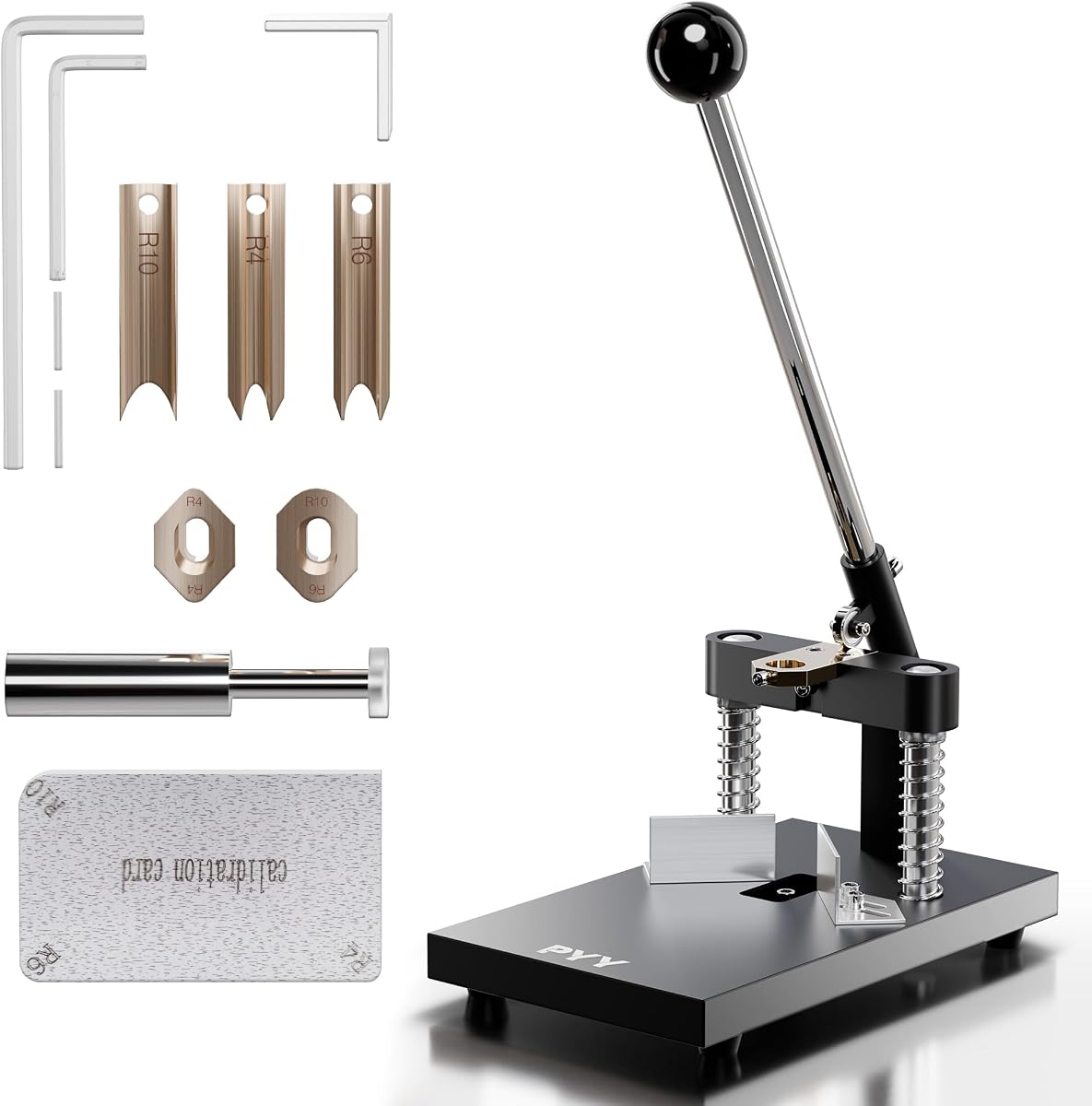
The PYY Corner Rounder Punch Cutter is the premium production choice in this roundup, combining a 4.7 rating with a heavy-duty metal construction. Its adjustable cutting height reaches 30mm, or 1.2 inches, and the manufacturer states that it can process approximately 300 sheets at once. That scale distinguishes it from handheld craft punches intended for individual cards and small project batches.
We may earn a commission when you buy through this link, at no additional cost to you.
Three dies are included for 4mm, 6mm, and 10mm radii. Adjustable positioning plates help control the cutting angle, while the thickened A3 tool steel body is designed for durability and rust resistance. The tool also has a 35cm extended handle that provides leverage for thick stacks, and anti-slip silicone pads help stabilize the base during forceful operation.
The stated material capabilities extend beyond ordinary stationery to aluminum sheet, booklet material, PVC plastic paper, leather, magnet sheets, and foam core. Installation, disassembly, and cleaning are described as straightforward, and the package includes dies, plates, carriers, calibration cards, tools, and a manual. A one-year warranty and professional technical support add confidence for buyers making a substantial equipment investment.
This cutter is best for studios, print-oriented businesses, schools, and experienced crafters who regularly process larger stacks. Its size, weight, and specialized setup are unnecessary for someone rounding four card corners, but the trade-off is justified when throughput and thick-material capability matter. Among the premium options, it offers the most clearly documented high-volume feature set.
An adjustable 30mm cutting height and an approximately 300-sheet capacity make this model substantially more productive than a desktop craft punch. It is a better fit for repeated batches than for isolated projects.
The extended 35cm handle gives the user greater mechanical advantage over thick stacks. Together with the weighted body and silicone base, it supports stable, controlled cuts in demanding workflows.
We may earn a commission when you buy through this link, at no additional cost to you.
The Sunstar Stationery Kadomaru Pro NEO earns the Editor's Choice position for its strong combination of 4.7 rating, compact proportions, and professional-looking results. It offers three radii—3mm, 5mm, and 8mm—which are thoughtfully differentiated for business cards, playing cards, photographs, posters, and menu lists. The black housing also gives it a restrained appearance that suits a formal office or design workspace.
We may earn a commission when you buy through this link, at no additional cost to you.
This cutter can handle material up to 0.4mm and thick laminated pieces up to 200µ. That makes it more versatile than a punch restricted to conventional paper. The operating method remains intuitive: material is inserted at the back of the body and the handle is pressed. At approximately 10.2 by 7.7 by 4.8cm, the tool is small enough to store in a drawer while remaining substantial enough for regular use.
Its main limitation is capacity. The listed 0.4mm material capability does not extend to the thick stacks handled by a bench press, and the product information does not claim multi-sheet production. Users processing hundreds of cards may need a heavy-duty machine, but a craft studio making small batches can benefit from quick setup and easy storage.
The Kadomaru Pro NEO is best for card makers, photographers, office professionals, and designers who want a reliable, consistent corner without a large machine. Its three well-chosen radii, laminate capability, and high rating make it the most balanced recommendation for typical premium-adjacent paper-crafting needs.
The 3mm curve offers a subtle professional edge, the 5mm size suits cards and photos, and the 8mm option creates a more visible decorative curve. These choices cover many common paper formats without adding unnecessary sizes.
The small black body is easy to store and gives the tool a professional appearance. It is particularly attractive for offices, photography studios, and craft spaces where equipment presentation matters.
We may earn a commission when you buy through this link, at no additional cost to you.
The QIQQIKIN 3-in-1 Corner Cutter is intended for crafters who want more than a standard set of rounded corners. It combines a 5mm radius, a straight 10mm cut, and a scalloped edge in one compact punch. The product carries a 4.3 rating and is aimed at scrapbook pages, photographs, laminated paper, business cards, greeting cards, planners, and junk journals.
We may earn a commission when you buy through this link, at no additional cost to you.
The ABS housing and metal cutter are designed to produce neat, smooth results without burring or scraping. It handles cardstock in the 70–230gsm range, and the easy-grip housing is intended to make the lever comfortable to squeeze. Most importantly, the three designs let a crafter create a rounded edge on one part of a project and a decorative border or tab treatment on another.
The trade-off is that the straight 10mm and scalloped options do not deliver the uniformity of three measured rounded radii. This is a creative tool rather than a precision production cutter, and it is not designed for large stacks. Projects that require exact corners on many identical pieces may be better served by a dedicated three-way or heavy-duty rounder.
This punch is best for scrapbookers, junk-journal enthusiasts, card makers, and anyone adding mixed edge treatments to paper projects. The scallop option gives it a distinctive creative advantage over conventional three-way punches, while the rounded and straight alternatives keep it versatile for more structured layouts.
A straight cut and scalloped edge add visual options that ordinary corner punches do not provide. This makes the tool useful for borders, tabs, photo framing, and coordinated paper embellishments.
The stated 70–230gsm cardstock range suits scrapbook and journal materials. It is best for individual decorative pieces rather than thick commercial stacks.
We may earn a commission when you buy through this link, at no additional cost to you.
The QIQQIKIN Corner Hole Punch combines two separate paper-making functions in one compact device. It creates a 4mm circular punch alongside 5mm and 10mm rounded corners, giving users three cutting choices rather than three versions of the same curve. Its 4.3 rating reflects a practical tool aimed at borders, photos, scrapbook pages, business cards, gift cards, and general DIY crafts.
We may earn a commission when you buy through this link, at no additional cost to you.
The construction combines ZBS, zinc alloy, steel, and plastic to form a sturdy housing and cutting mechanism. The listing says it clips cleanly and recommends regular paper, craft paper, foil, and EVA foam below 2mm, with 70–230gsm paper identified as the preferred range. This broad material list makes it potentially useful for mixed craft sessions in which a single circle punch and dedicated corner rounder would otherwise take up two slots.
The trade-off is reduced specialization. A user who needs three measured rounded radii, such as 4mm, 7mm, and 10mm, will have fewer options here, while the circular punch is not needed for every project. Light sheets may still need to be stacked, and adhesive-backed material is not recommended because it can stick during the cut.
This punch is best for crafters who frequently add small circular details alongside rounded corners. Journalers, scrapbookers, and card makers can use it for photo borders, decorative dots, and coordinated edge treatments. It is less suitable for a production specialist seeking a dedicated high-capacity corner cutter.
The 4mm circle punch complements the two corner radii, enabling quick border and embellishment cuts without a second tool. It adds flexibility for journals, scrapbook layouts, and decorated cards.
Combining functions reduces the number of accessories carried to a craft session. It is especially convenient for mobile crafting, school work, or small workspaces with limited storage.
We may earn a commission when you buy through this link, at no additional cost to you.
The BEAMNOVA Heavy Duty Corner Rounder is an industrial-style machine designed for sustained workshop use and larger material variety. It has a 4.3 rating and supports a maximum cutting height of 30mm. Two cutting dies are included, producing 6mm and 10mm rounded edges, while the construction uses heavy-duty A3 steel intended to resist rust and wear.
We may earn a commission when you buy through this link, at no additional cost to you.
Both the top and bottom cutting blades are described as hardened carbides with sharp edges, supporting fast cutting and clean curves. The iron-casting base improves stability on a tabletop, while a paper-pressing device helps keep sheets from slipping. An adjustable metal baffle holds cards in position and allows the operator to establish the desired angle, reducing the chance of paper movement during the cut.
The ergonomic extended handle and smooth bearing mechanics are intended to reduce the effort required for repeated work. Calibration settings assist with accurate blade installation. Materials listed as compatible include foam core, PVC and ABS plastic sheets, paper, cardboard, pads, booklets, magnet sheets, and aluminum sheets. That range goes well beyond ordinary scrapbooking, although users should still select settings appropriate to each material.
This machine is best for print shops, fabrication environments, educational workshops, and serious crafters who regularly round thick or varied materials. It is unnecessarily large for occasional card making, and the included 6mm and 10mm dies are fewer than those offered by the PYY premium model. Even so, its stable base, carbide blades, and long-handle design make it a capable production option.
The iron-casting base and paper-pressing mechanism help keep the material steady as force is applied. This is especially valuable when cutting cardboard, plastic sheets, magnets, or other workshop materials.
Blade calibration settings and an adjustable baffle support accurate setup. The baffle also fixes the card at the intended angle, helping operators repeat cuts across different pieces.
We may earn a commission when you buy through this link, at no additional cost to you.
The right corner rounder depends on the kinds of materials you cut, the volume of work, the precision required, and how much space you can devote to the tool.
Corner radius determines the size and visual character of the curve. A 3mm or 4mm radius creates a restrained professional edge suited to business cards, message cards, and formal stationery. Medium radii around 5mm to 7mm work well for photographs, invitations, and general card making, while 8mm to 10mm options look more decorative and suit scrapbooks, journals, and bold presentations. A three-way punch gives you enough choice to coordinate several pieces without replacing the tool, while a single-radius cutter can produce excellent results when every project uses the same shape.
Capacity is more than the maximum thickness stated by a manufacturer; it also includes how many sheets can be stacked and whether the blade can cut layered material cleanly. Compact punches commonly handle a few sheets of ordinary paper, while heavy-duty machines can process tall stacks and thicker cardstock. Look closely at recommended paper weights because some punches perform best only above a minimum weight. Very thin sheets can misfeed or tear, while laminated pieces, plastic sheets, and heavy board require a more robust mechanism.
The three broad styles are handheld craft punches, compact manual corner cutters, and heavy-duty bench machines. Handheld punches are convenient and inexpensive but may need multiple layers and careful alignment. Manual corner cutters generally provide smoother, more consistent pressure and sometimes support lamination. Heavy-duty machines use guided plates, weighted bodies, and long handles to cut larger stacks and varied materials. A tool with selectable or replaceable dies is more adaptable, but it may also require more involved setup and maintenance.
A sharp blade and stable housing help produce smooth curves without burrs, tears, or partial cuts. Steel cutting components are common in quality manual tools, while heavy-duty machines often use hardened carbide blades. The housing should be comfortable to hold and resistant to flexing, particularly if the punch is used frequently. For a compact punch, an anti-slip base reduces movement. For a bench machine, a weighted metal base and paper clamp provide greater stability, though they require more permanent workspace.
Even the best blade cannot create a consistent curve if the paper shifts. Look for visible alignment marks, corner guides, adjustable positioning plates, or a paper-stopping baffle. These features matter when reproducing multiple identical cards or processing a batch of invitations. A straightforward insertion path can also be valuable for beginners, since it reduces guesswork. Whatever the mechanism, the paper should sit flat against the tool with a square edge and the corner fully seated before pressure is applied.
The smallest punches can be carried in a craft bag, classroom, or office drawer, making them ideal for occasional projects. Compact Japanese-style corner cutters take up little space but should stay on a flat work surface during use. Heavy-duty machines are substantially larger and heavier, so buyers should measure the intended workspace and consider whether storage or permanent placement is acceptable. Portability is valuable if you craft away from home, while bench stability is usually more important for professional production.
Paper corner rounders are not automatically suitable for every material sold as paper. Standard craft paper, cardstock, photographs, envelopes, and laminated sheets are common targets, but the number of sheets, lamination thickness, and adhesive backing can affect performance. Stickers and adhesive-backed sheets may stick to the cutting edge and should generally be avoided unless the manufacturer explicitly approves them. EVA foam, foil, PVC, leather, magnet sheets, and aluminum require a more powerful tool. Verify every planned material against the listed specifications rather than assuming all craft media will behave the same.
Multi-die tools offer greater design flexibility, while machines with multiple calibration components require correct assembly and periodic cleaning. Lightweight punches are easier to maintain because they have fewer moving parts, but they demand careful preparation of thin or uneven paper. Industrial-style machines may include replaceable components, adjustment tools, and instructions, yet they need a stable operating area and attention to blade alignment. The best purchase is not always the one with the most features; it is the tool whose operation matches your skill level and the amount of maintenance you realistically want to perform.
Begin on a flat, stable surface and inspect the paper before inserting it. The edge should be smooth and square, the sheet should lie flat, and the corner should be free of folds, creases, adhesive, and debris. For very thin paper, use two or three aligned layers as recommended by the manufacturer. Heavy-duty machines should be checked for stable placement, proper blade seating, and correctly positioned guides before force is applied.
Select the desired radius or edge design, then feed the corner into the tool according to its instructions. Handheld punches often work best with the tool turned so alignment marks remain visible. Slide the paper until the corner sits fully against the guide, confirm that the edge is square, and apply steady pressure to the handle. Avoid twisting the paper while the blade is engaged, and do not pull a partially cut corner sideways because that may damage the blade or leave an uneven edge.
After cutting, open the tool and remove any paper fragments from the blade area. Use a soft brush or gently wipe away loose debris, but avoid pushing residue deeper into the mechanism. Store compact punches with the handle relaxed and the cutting edge protected. For heavier machines, follow the manual's cleaning and disassembly guidance, confirm that dies remain sharp and aligned, and keep the base dry to reduce the risk of corrosion. Retire or replace a blade if it repeatedly tears paper or produces rough, incomplete curves.
The best option depends on whether you prioritize flexibility or capacity. A three-way handheld punch offers several radii for mixed card designs, while a compact professional cutter can provide cleaner results across multiple sheets. For large batches, a heavy-duty bench machine is more suitable. Start by matching the tool's stated paper-weight limits to the stock you actually use.
Some models can, but the lamination thickness must remain within the manufacturer's stated limit. The Sunstar Kadomaru Pro is listed for laminated film up to 3.9 mils, while the Kadomaru Pro NEO supports thick laminated material up to 200µ. Always verify the exact specification and avoid cutting adhesive sheets that may stick to the blade.
A smaller radius, such as 3mm or 4mm, usually creates the most restrained and professional appearance. It suits business cards, formal invitations, and message cards. Larger radii between 8mm and 10mm appear more decorative and work well for scrapbook pages, journals, and playful projects.
The paper may be too thin, misaligned, or carrying adhesive that is pulling against the blade. Use two or three aligned layers for lightweight stock, keep the edge flat and square, and push the corner fully against the guide before pressing. Adhesive-backed paper should generally be cut with a tool that explicitly supports it.
A heavy-duty model is rarely necessary for occasional greeting cards or scrapbook pages. Compact punches and manual corner cutters are more convenient, portable, and easier to store. Heavy-duty equipment becomes worthwhile when processing large stacks, thick cardstock, laminated materials, or workshop products such as PVC, foam core, magnet sheets, and aluminum.
A three-way punch is better when you want to match different corner styles across multiple projects. It reduces the need for separate tools and allows the same cutter to produce subtle or prominent curves. A single-radius cutter can be simpler and may suit standardized production where every item needs exactly the same finish.
Cut against a flat surface, align the paper with the tool's guides or positioning plates, and confirm that the edge is square before applying pressure. For multi-sheet cutting, stack the sheets precisely and keep the pile from shifting. A paper clamp or baffle on heavier machines helps prevent the workpiece from moving during the cut.
A craft punch is intended for lightweight individual pieces and usually uses a short lever with one or more small cutting dies. An industrial-style corner rounder has a weighted metal body, stable base, extended handle, and larger adjustment system for thicker materials and repeated batches. The heavier design offers greater throughput but takes more space and setup.
The ECOHU 3-in-1 Corner Punch is the best budget-oriented all-rounder, offering 4mm, 7mm, and 10mm radii in a compact housing. The Sunstar Kadomaru Pro NEO is the Editor's Choice for crafters and professionals who value polished results, three well-chosen sizes, laminate capability, and a compact footprint. For heavy production, the PYY Corner Rounder Punch Cutter stands out with a weighted steel body, three dies, an extended handle, and a substantial cutting-height capacity.
For most home and studio projects, prioritize the corner styles you need, the recommended paper-weight range, and a secure alignment system. Compact three-way punches are ideal for cards and scrapbooks, Japanese-style manual cutters suit professional finishing, and heavy-duty machines are appropriate when throughput and thick materials justify the additional size. A decorative multi-design punch can be valuable when mixed edges are central to your work.
Before purchasing, confirm the current listing details, included accessories, dimensions, and material limitations, and compare them with the stock and volume you expect to process. Product availability and prices can change over time, so checking the latest listing ensures that the selected corner rounder remains suitable for your specific paper-crafting workflow.